Let’s open a dedicated thread for Tikkurila in honor of this positive profit warning.
9 Likes
I think +8% is a pretty moderate reaction to this pop. Tikkurila was forgotten among the companies that can withstand the corona.
2 Likes
{“content”:“Alright, come rain or shine, us owners are happy again. Already the second (Tokmanni) portfolio company that gave a positive surprise for Q2, I’ll need a reality check soon  . \n\nAs expected, weakness in professional and industrial customers, but consumer customers got excited about heavy brush use in all main market areas, meaning apparently also in Russia, which I was most worried about beforehand. The main interest now is whether the weakness in professionals and industry will continue in future quarters; consumer demand might not support the result indefinitely, even though Q3 is still a good time for outdoor painting. \n\nIn my opinion, Tikkurila was already making a turn for the better before the corona crisis, which only brought uncertainty. It’s good that operational efficiency and savings measures are also starting to show results. There was no mention of declining raw material prices, but probably due to the quiet period, they didn’t want to go into details. \n\nIt was kind of funny for me that for portfolio management reasons, I made a small “cheese grater” selling order in the morning at a price of 13.20, and it quickly went through with the positive earnings warning, but it doesn’t really affect the overall picture much, because I got on board already at prices a little over 10 euros.”,“target_locale”:“en”}
1 Like
IIRC, Heikkilä & Vilén pondered Tikkurila as a turnaround company precisely at the turn of the year, and in the same context, it was speculated that an acquisition might be possible for it, i.e., that it could be bought. We’ll see. At least paint dealers know a lot about paints when buying them, meaning Tikkurila has apparently invested in sales training. That’s good.
1 Like
Agreed. If you look at the forecasts/recommendations from the beginning of the year and how much adjusted operating profit has been accumulated now. And considering that perhaps a better painting season (Q3) is ahead, the reaction seems quite tame.
Well, analysts will surely calculate this out in the coming days.
Edit. The biggest question here is probably what investors are wondering: is this on a sustainable foundation. My view is that the efficiency measures that have been in the pipeline for a long time are finally starting to come through. However, it should be noted that revenue grew very moderately but profitability significantly.
Yeah, I guess so. Heikkilä & co has already bought Mikro Markka to be the 9th largest owner. Interesting to see if the purchases continue in July.
3 Likes
@Petri_Kajaani new update and add €15
I have to say that when you look at Tikkurila’s ROE/ROI development, it is indeed remarkable.
From under 10% to 20% in a few years, but the turnaround has been made.
I bought a little more yesterday even after the positive earnings surprise. What’s interesting about turnaround companies is that views and multiples gradually improve. Of course, the results must speak for themselves. Now the result was double the consensus forecasts and the share price reacted with a +7% increase. This tells us something, that there is still some work to be done to gain trust.
The company commented in its release that demand improved especially towards the end of the review period. I interpreted this to mean that they are certainly talking about June. Q3 includes July and August, so at first glance, demand continues to be good in those months as well. We will certainly get comments on this in connection with the H1 earnings release when there is good visibility into July. In other words, if the company gives indications that this will happen, there may be more upward pressure on forecasts.
4 Likes
{“content”:“Strong buy and a 16.5 target ”,“target_locale”:“en”}
3 Likes
Yeah, I was calculating something similar myself yesterday. Of course, the H1 report is coming, so some analysts will surely want to see/hear more detailed comments.
Good that SEB has enough confidence already at this stage 
1 Like
Hey @Petri_Kajaani, you didn’t mention anything about raw material costs in your morning comment. I assume they are still in a favorable position for Tikkurila, right!? What kind of delay do they usually have in procurement, and can you shed any light on Tikkurila’s raw material inventory levels?
2 Likes
Hi. It’s difficult to comment on raw material price levels, as the company didn’t mention anything about them in its release, and due to the ongoing quiet period, it won’t comment on company-related matters to analysts or investors until the Q2 report.
In Tikkurila’s case, raw material price development plays a big role because about 50% of revenue goes to raw materials and packaging materials, and these have seen significant price increases in past years. Now, over the last year, the situation has started to ease, and the prices of raw materials important to Tikkurila have shown a downward trend.
Here’s one slide from our extensive report, which discusses Tikkurila’s raw materials:
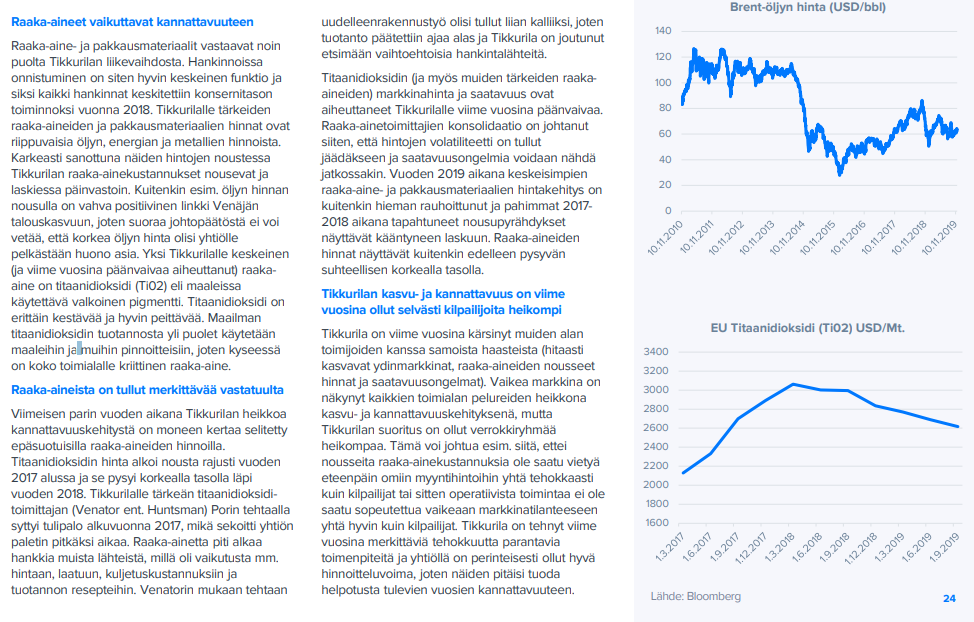
Oil and titanium dioxide prices are the most important cost-affecting factors for Tikkurila, and the company reports on these to investors. In Tikkurila’s Q1 presentation, the company itself also commented that their prices have shown a downward trend, which is, of course, a positive thing for raw material costs.
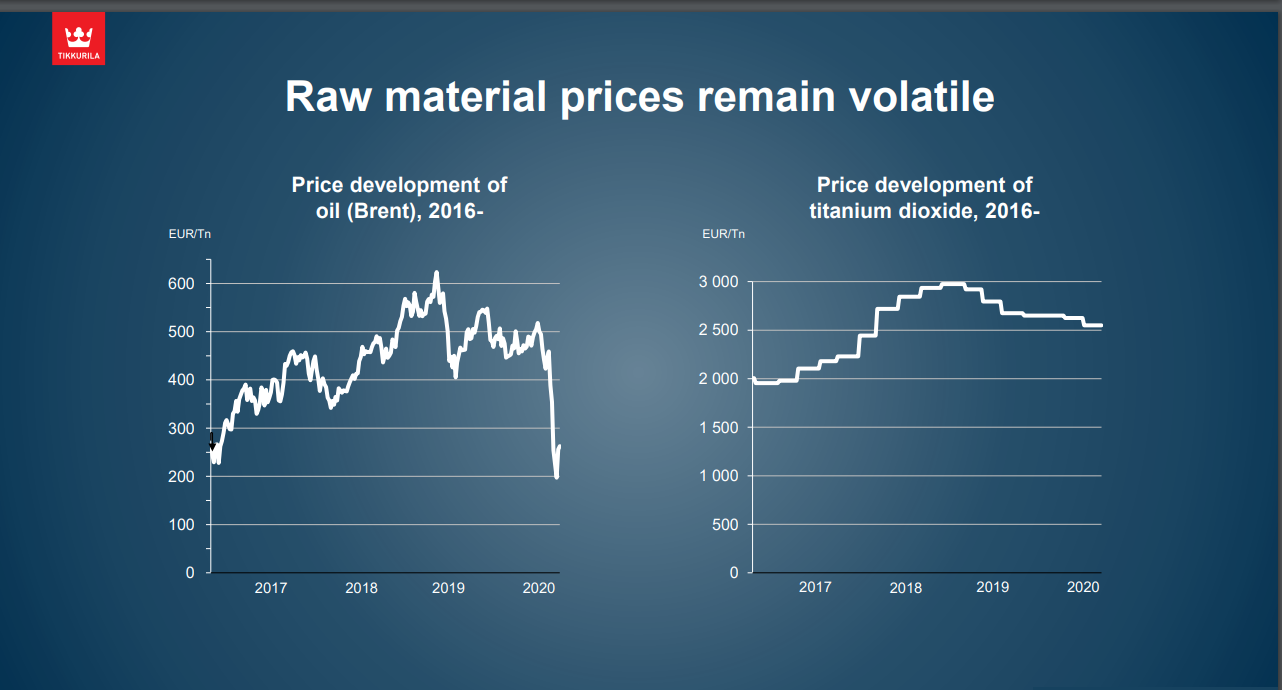
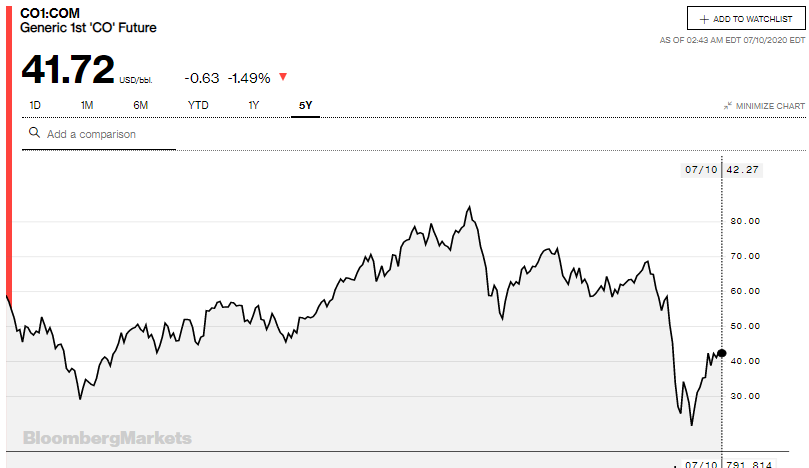
The price of oil has remained relatively low throughout this year when looking at the longer Brent curve:
As for titanium dioxide, I personally don’t have access to the prevailing price level, and Tikkurila often presents its own data sources for these in connection with interim reports. However, all signs indicate that Tikkurila has seen a tailwind from the price development of raw materials and packaging materials, and this has also contributed to the observed improvement in profitability. Depending on the specific raw materials, prices will likely be incorporated into new contracts with a cycle of approximately 3-6 months, so the raw material price reductions seen in the images have probably already supported the results.
A couple of years ago, Elisa Markula hired a consultant from PWC (Mika Uusitalo), who, in his previous life, I believe, worked on a project for Tikkurila to streamline procurement. Mika has good experience in these matters and has helped many large manufacturing companies improve procurement efficiency. Mika then stayed at Tikkurila after the project and received the title (VP, Sourcing). At Tikkurila’s 2019 CMD last summer, Mika enthusiastically stated in his presentation that Tikkurila has PLENTY of room to improve in procurement (direct and indirect) and that there are PLENTY of cost savings to be had. Streamlining procurement was also one of the steps in Tikkurila’s strategy to achieve that 12% EBIT target. Mika was just leaving the following week to meet several of Tikkurila’s largest suppliers and had apparently received good mandates to renegotiate purchases and centralize procurement. This is probably one indication that Mika’s actions have yielded savings. In our recent meetings, Elisa has repeatedly emphasized that Mika’s role is significant in Tikkurila’s future profitability improvement.
I wrote this in my update report on the Q2 figures:
"Tikkurila may have in its own
cost structure prepared for a significantly
worse spring than what actually materialized, which is why
profitability developed with a very strong leverage upwards
due to the small sales growth now."
The company was quite pessimistic about the sales outlook for the spring, as visibility was so poor, and in connection with the withdrawal of guidance in March, management predicted that volumes for both consumer and industrial paints would decline in the coming months. I believe that for safety, they have completely reined in layoffs and their own cost structure this spring, and nothing extra has been done to keep profitability and cash flow strong. We can say that the world looked a lot scarier a few months ago than it does now, and this was certainly the right move on the company’s part. The danger partially passed, and people apparently bought more paint than even management expected, and with their own cost structure pared down to the bare bones (so-called “lean and mean”), profitability was now really good. I don’t want to take anything away from the efficiency measures the company has taken in recent years and the strategy of focusing on premium brands (which clearly also supported profitability improvement even before corona), but these extra temporary savings measures this spring certainly deserve credit for this really strong Q2 result as well. However, it’s probably difficult to maintain such an ascetic cost structure for an extended period.
7 Likes
Many thanks for this summary @Petri_Kajaani! I must dig up that company report again and reread it. Decreased raw material costs were an important driver for me when making the investment decision in Tikkurila. I also had a very positive contact with Tikkurila’s IR in the spring regarding the remote general meeting, so these also matter from an investor’s point of view.
2 Likes
The matter is certainly exactly as you wrote. For this reason, the share price reaction was probably a bit lackluster despite the result. It is probably thought that Tikkurila was just lucky and was in the right place at the right time. This was certainly partly the case, and Tikkurila still has something to prove for this reason. For this reason, I am especially looking forward to the H1 report, to see if the company can convince investors at this point.
The main thing for the company, of course, is that demand is strong and that it can also be converted into a good margin: +1:
2 Likes
Did OP give a new target price, by the way?
The one dated June was probably “Add” and €14.
No access to OP’s database, but based on Market Screener, for example, I would assume they haven’t updated yet.
2 Likes
The news about Tikkurila’s “posari” (positive profit warning) left me a bit puzzled. Isn’t a profit warning only possible if a company has valid guidance in effect? Tikkurila doesn’t. In a way, this is a minor detail; the most important thing, of course, is Tikkurila’s clearly better performance compared to the reference period and expectations. But if we’re calling things by their proper names, Tikkurila exceeded (consensus) expectations but didn’t issue a positive profit warning?
1 Like
Yeah, you’re absolutely right. Tikkurila hasn’t even given guidance for 2020 yet. So there’s a real possibility of a positive earnings surprise here. Operating profit improves significantly from 2019, or something similar.
(The original guidance was that operating profit would improve from 2019.)
The market might still be completely surprised by this. 
I remember last year with Honkarakenne, it was easy to calculate after H1 that the verbal guidance would be raised during H2. And when that happened, the stock price went through the roof. Well, maybe not quite the same thing, but the point is that even a small uncertainty can be seen as a “weakness”.
This could very well be the case with Tikkurila as well. Will profitability continue through the rest of the year? Will the painting enthusiasm continue in Q3, etc.?
I personally think this situation is not just a temporary craze. I’ve been thinking that, for example, postponing foreign trips will lead to an increase in home and cottage renovations next year as well.
1 Like
I had to switch to Tikkurila Tokmanni for a moment. For my taste, there was a very insignificant price increase from really good figures. That level was already reached at the beginning of June without any positive news. Someone, I wonder if it was a CSV broker, was passionately selling shares yesterday. I expect a good increase next week or the week after. When OP also gives a new target price for this, I guess it will slowly start heading towards those targets. This actually seems like a damn good company for even longer ownership 
Yeah, I don’t know who CVS operates under, but it has been selling larger quantities for a longer time, for example, on Ilta Huutari.
In Tikkurila’s case, Varma has significantly reduced its ownership during spring/summer. They recently sold 700k units in a block trade. This actually piqued my interest. I had Tikkurila before, of course, but finding a buyer for such a large quantity is usually a good sign. Another point about trading is that when OP raised its outlook a month ago, buying also started, and it was the largest net buyer for a long time.
It’s also worth noting about Tikkurila that the stock normally has very low trading volume. Less than 10k units might change hands in a day. Now that we’ve gained some liquidity and someone is selling a larger pot, the shares are getting traded. On Friday, there was also a hint that many (Nordnet) were cashing in profits before the weekend, as the stock didn’t quite take off as one might have initially thought.
1 Like
I too was one of those rookies who sold on Friday, but I think I only sold in the 14.10-14.24 range. Some of it remained in the game portfolio waiting.