I am not intimately familiar with the production timelines of the graphite processing chain (how realistic are they?), but I also see the new high-energy-density silicon anode technologies, which are currently being intensively researched and developed, as a threat to this. There are several unicorn startups in the market (Sila Nanotechnologies, Amprius, Group14, etc.) working on silicon anodes, and it is simply a matter of how pure the silicon for the anode can be produced while keeping the expansion of the silicon under control.
Most recently, Korean researchers used a polymer binder in a pure silicon anode and achieved ten times the energy density compared to a graphite anode. Production technology for silicon anodes already exists, and factories are being established. All major battery suppliers use at least some silicon in their latest battery anodes.
Thanks for your contribution! Especially the link you sent with the interview about possibilities to stop the mine in the municipal government is interesting, I hadn’t seen it before.
In general, I think that Talga has been very straightforward in their communication, and I’d assume that they’ll communicate as required by rules and regulations even in the future.
In Finland we have mostly good skills in English and many of us also know Swedish well enough (including me). So if you need any help, we can try to assist. Of course, the Swedish participants in your forum are probably more knowledgeable than us in matters regarding Sweden, but we can google as well.
There are indeed high expectations for many battery technologies, including pure silicon anodes. Technologies may shine in some areas, but they won’t achieve widespread adoption unless they are good enough in all key areas, such as price, availability of raw materials, charging speed, longevity, resistance to cold and heat, safety, etc. It’s very difficult to predict which technologies will ultimately break through. There have been countless battery startups and all sorts of revolutionary inventions featured even in the Finnish media, but very few (if any) have progressed commercially.
In my opinion, it is fairly safe to expect that the demand for graphite for car batteries will still be very high ten years from now. I could, of course, be wrong, so draw your own conclusions. If you are more concerned, it’s probably best not to invest in, for example, Talga.
In any case, Talga itself is developing technology where significant amounts of silicon are added to the graphite mix; as much as half can be silicon. This can lower production costs and produce a better end result, at least in some respects.
That’s correct @finito you probably are aware of Talnode si. Like you I think Graphite will still be in demand in 10 years. I guess the amount of silicon used will slowly increase over the years but personally I think Solid State will likely be more successful than 100% silicone.
And Solid State has for many many many years been… only a few years away LOL
At least there is one competing solution, and Mercedes has already announced that they will implement it in the first G-Wagen EV, the EQG, which will be introduced in 2024, with the first cars delivered to customers in early 2025. The battery technology originates from there → Titan Silicon.
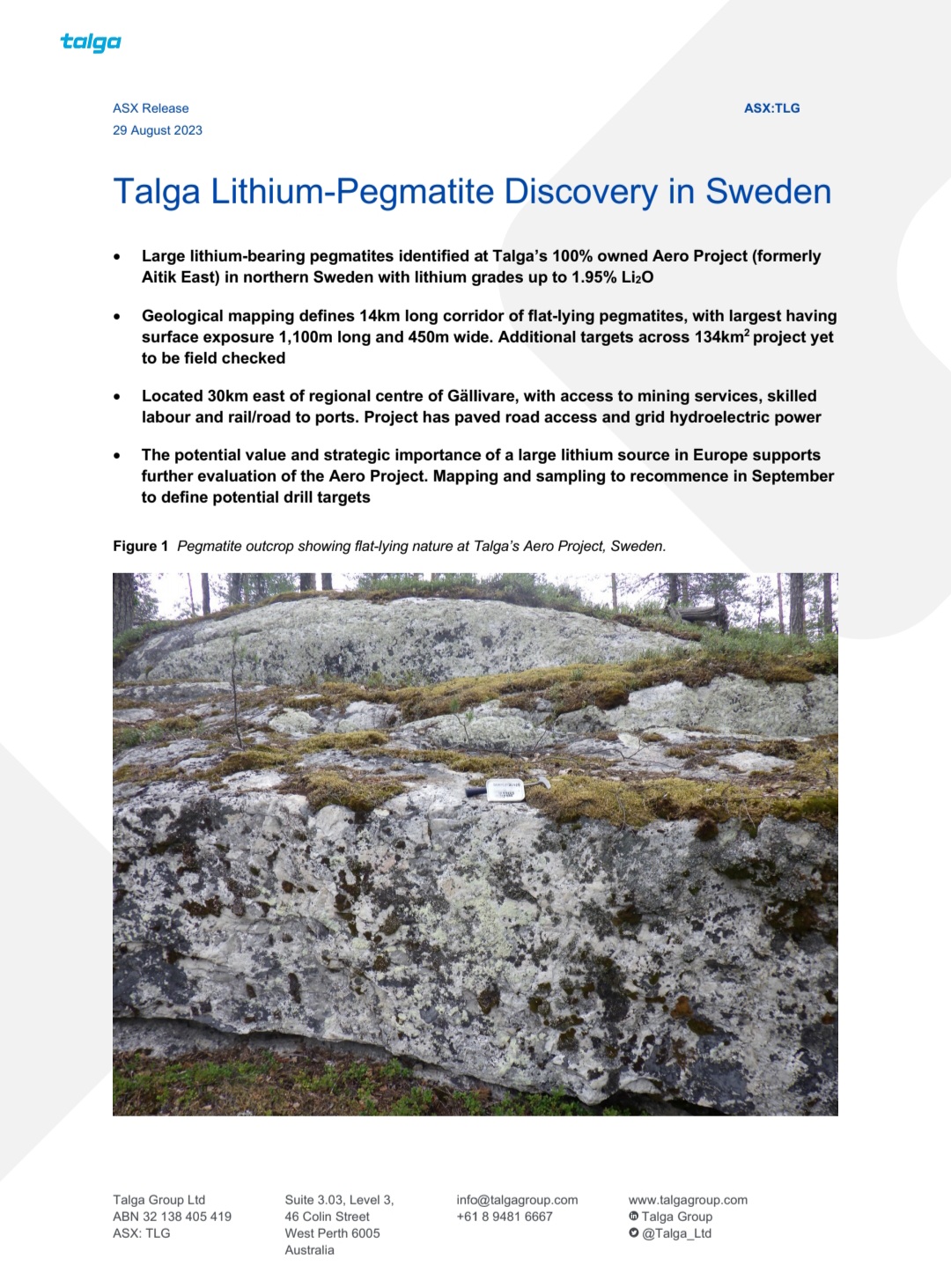
That lithium deposit is an interesting wild card for Talga. The probability of it becoming a mine is likely still very small, but if it does, you would think there’d at least be enough demand.
The appeal period for Nunasvaara’s environmental permit ends on Thursday. If no appeals are filed, the environmental permit remains valid, and an appeal can only be made if it is considered that errors were made in the process itself.
I personally expected that if the permits were approved, the share price would be at completely different levels than before the permit approval. How wrong I was. The share price is now near multi-year lows, even though risks have decreased significantly along the way. I wonder what investors have been expecting?
There is still a possibility that the city board will not approve the zoning plan that enables the mine. However, even then, as previously stated, the Swedish government can intervene and rule otherwise, as the area has already been designated as an area of national interest. Connections to the Swedish government are already in good shape, as Talga had a ministerial-level guest celebrating the start of construction work: https://talgagroup.eu-central-1.linodeobjects.com/app/uploads/2023/09/12160714/20230912ProjectUpdate_ASX.pdf
Sila’s Titan Silicon solution is certainly good, as it’s even entering the market. At least for now, the company operates only in North America, while Talga’s focus is on Europe. Talga has also praised its own solutions, stating that they are significantly better not only in terms of production costs and environmental impact but also in performance compared to current materials. There is a lot of development happening in this field, and I believe there is room for many players in the market. Even if Talga were to expand its own mine significantly, the company would still only be able to produce a small fraction of Europe’s projected graphite demand.