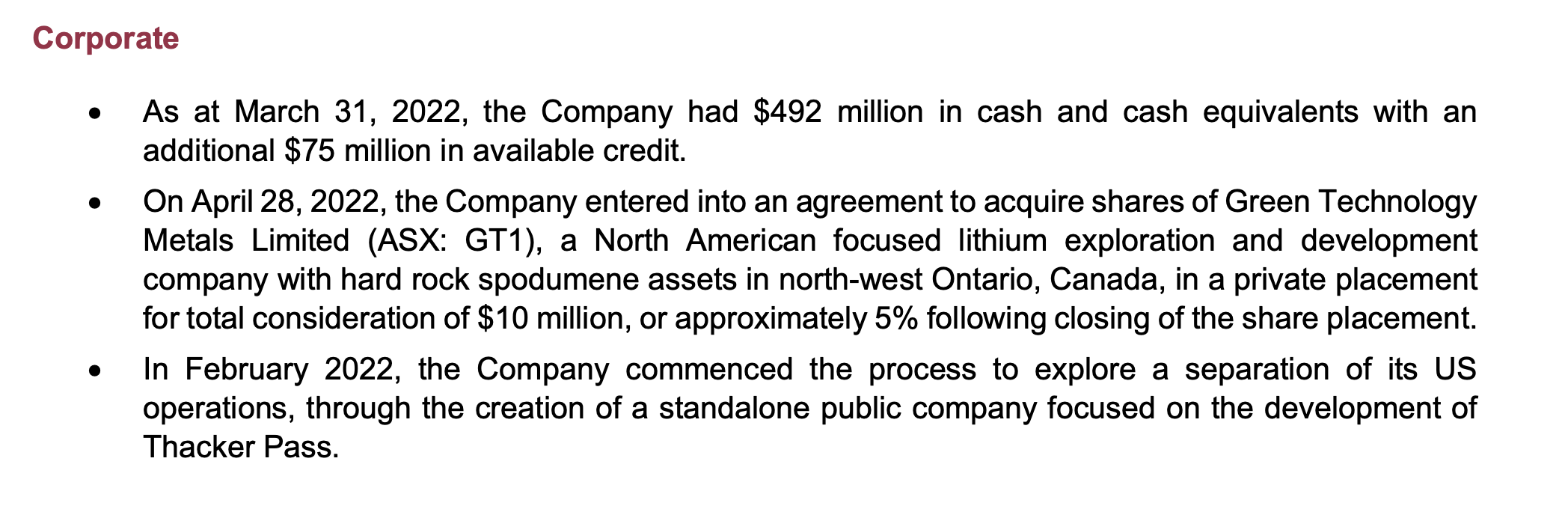
Lithium Americas - Battery Minerals from America

Lithium Americas is an early-stage US mining company with several globally significant lithium mining projects in the United States and Argentina. In the US, they have the enormous Thacker Pass mining project, the final appeal of whose construction permit is currently being heard in US courts. If the appeal fails, construction on this significant mine, relatively close to Tesla’s Gigafactory, can begin later this year.

In Argentina, Lithium Americas has the Cauchari-Olaroz mine, which is just starting production and will generate significant cash flow next year, as well as the Pastos Grandes mining project, acquired this year, which is slowly progressing.

Additionally, there are a few smaller stakes in early-stage mining companies and a cash reserve that enables the company to advance current projects effectively and negotiate sensible financing solutions to increase production. The firm is currently investigating whether Thacker Pass should be spun off into its own company, as the stock has significant Chinese ownership, and they collaborate with Chinese partners on Argentinian mining projects, which might prevent the company from receiving substantial federal support. It also appears that most US investors are more interested in Thacker Pass, so spinning it off might enable the company to create shareholder value.

39 Likes

There hasn’t been much discussion here, but let’s not let that deter us. I’ve accumulated a small batch of this myself without much follow-up. Can you, @Pohjolan_Eka, provide an analysis of the company, regarding whether things have progressed in a good direction or not?

2 Likes

Yeah, this hasn’t really sparked much interest in the end, so I haven’t bothered writing much more about it myself either. Mining companies are the kind of niche that only appeals to a few :slight_smile:

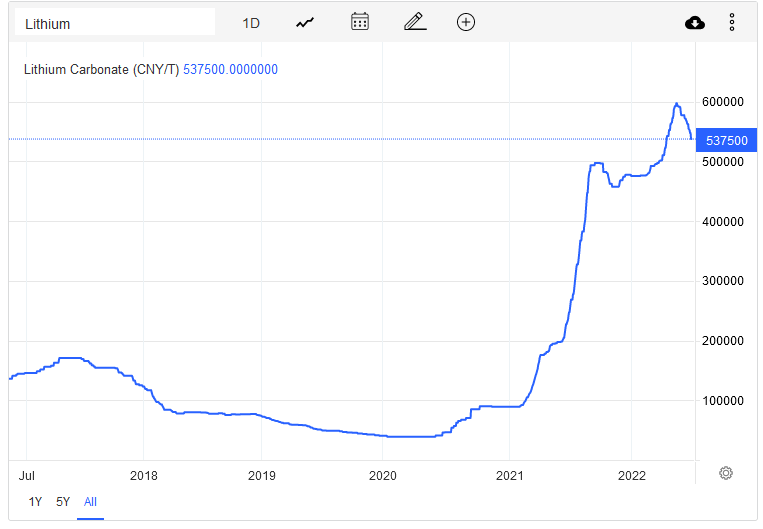
Everything seems to be moving forward excellently. The M&A market for lithium mines is still running very hot, and China in particular is trying to capture the lion’s share of the world’s lithium reserves. Decent investment targets are exceptionally rare, and quite hefty prices are being paid for them. The price of lithium has remained at a high level:

The company’s separation into a North American company and a South American company is progressing. This split is, of course, being done because the Chinese have such a large influence in the company that the massive Thacker Pass investment in the US cannot be carried out otherwise, and US investors aren’t that interested in those otherwise quite good South American mines.

https://www.lithiumamericas.com/news/lithium-americas-announces-intention-to-separate-into-two-leading-lithium-companies

In America, the permitting for Thacker Pass has been delayed, and legal battles with Native American groups are still ongoing. I expect a positive decision during 23H1, after which they’ll be able to move forward with the mine at full speed.

In Argentina’s Caucharí-Olaroz, lithium production should start in the coming months, and useful output will likely start coming from there in 23H2.

Construction of Pastos Grandes will begin sometime during 2024.

Just before Christmas, there was some significant news that Lithium Americas acquired Arena Minerals, thus owning an even larger stake in Pastos Grandes going forward:

https://www.lithiumamericas.com/news/lithium-americas-to-acquire-arena-minerals-to-consolidate-the-highly-prospective-pastos-grandes-basin

You really have to get used to waiting when it comes to mining companies, as opening mines is such a slow process :sunglasses:

14 Likes

Thanks for the great opening. I got excited to look into the company and made an initial investment.

I have previously been unsuccessful with one junior miner. From that, I learned that competent and experienced management is absolutely essential in these mining companies – so many things can go wrong (and usually do) before a mining company gets even its first mine operational. In Western countries, there are lawsuits, appeals, environmental permit issues, etc. In less developed countries, governance is unpredictable and corruption or outright criminality complicates matters. Mines flood, grades aren’t what they should be, etc. etc. In this case, management seems to meet this criterion. That’s the first :white_check_mark:. The second :white_check_mark: is that the firm is already quite close to generating significant cash flow. The third :white_check_mark: is a good financial situation – setting up mines is shockingly expensive, and there are almost always some unexpected problems. The capital of early-stage investors can be diluted to nothing. In this case, even this risk is small. And of course, it doesn’t hurt that we are riding the lithium megatrend :white_check_mark:.

The next catalyst for the stock is likely the lawsuit related to the Thacker Pass permits, the closing arguments for which are currently being held. There are likely three options for the outcome: scrapping the project, passing as is, or being conditional in some way. Based on my own superficial research, I’d guess the latter. In all cases, there is likely also the possibility of appeals and further delays. The judge’s decision is expected within a couple of weeks (edit: according to the judge’s closing remarks, apparently not until a couple of months).

In the meantime, Lithium Americas has signed a project agreement for the Thacker Pass construction works with an engineering company that, as I understand it, has a very good reputation and expertise, which in some way reflects management’s confidence in the project’s progress.

https://elkodaily.com/mining/lithium-americas-awards-thacker-pass-contract-to-bechtel/article_9f40f4e2-8bf5-11ed-9dd9-afb2c54fd776.html

11 Likes

Great that the opening didn’t “go to waste” :smiley:

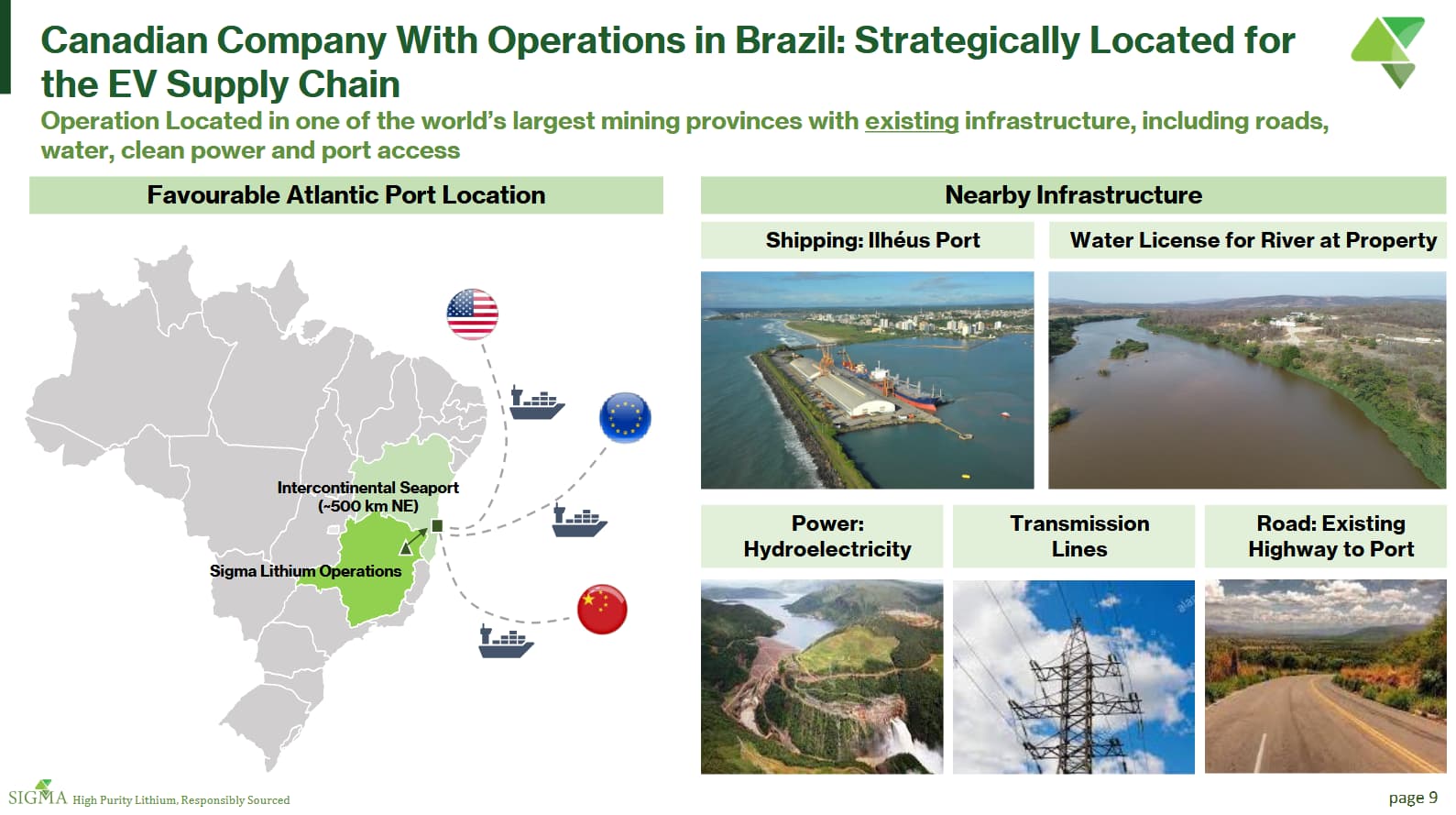
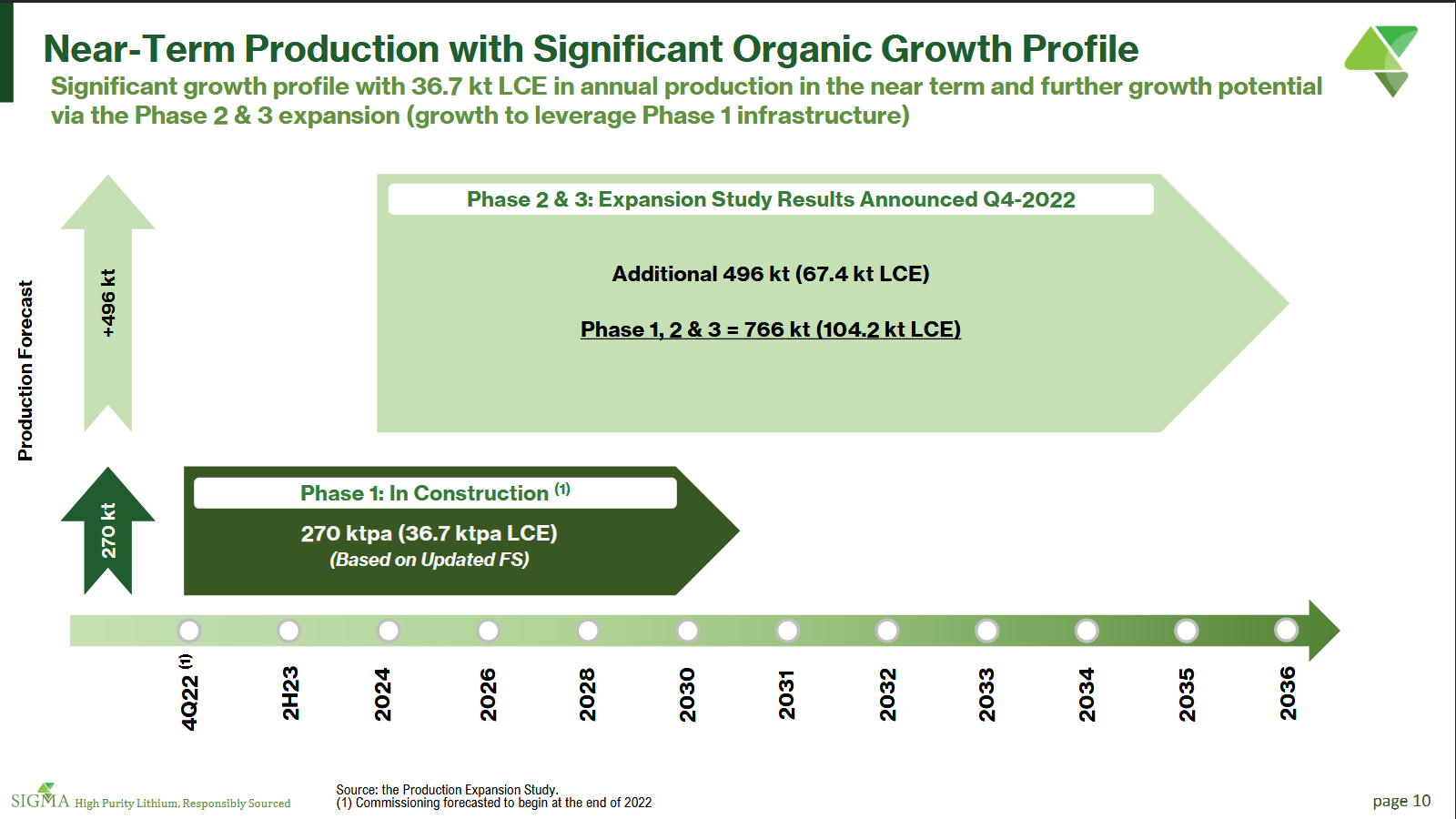
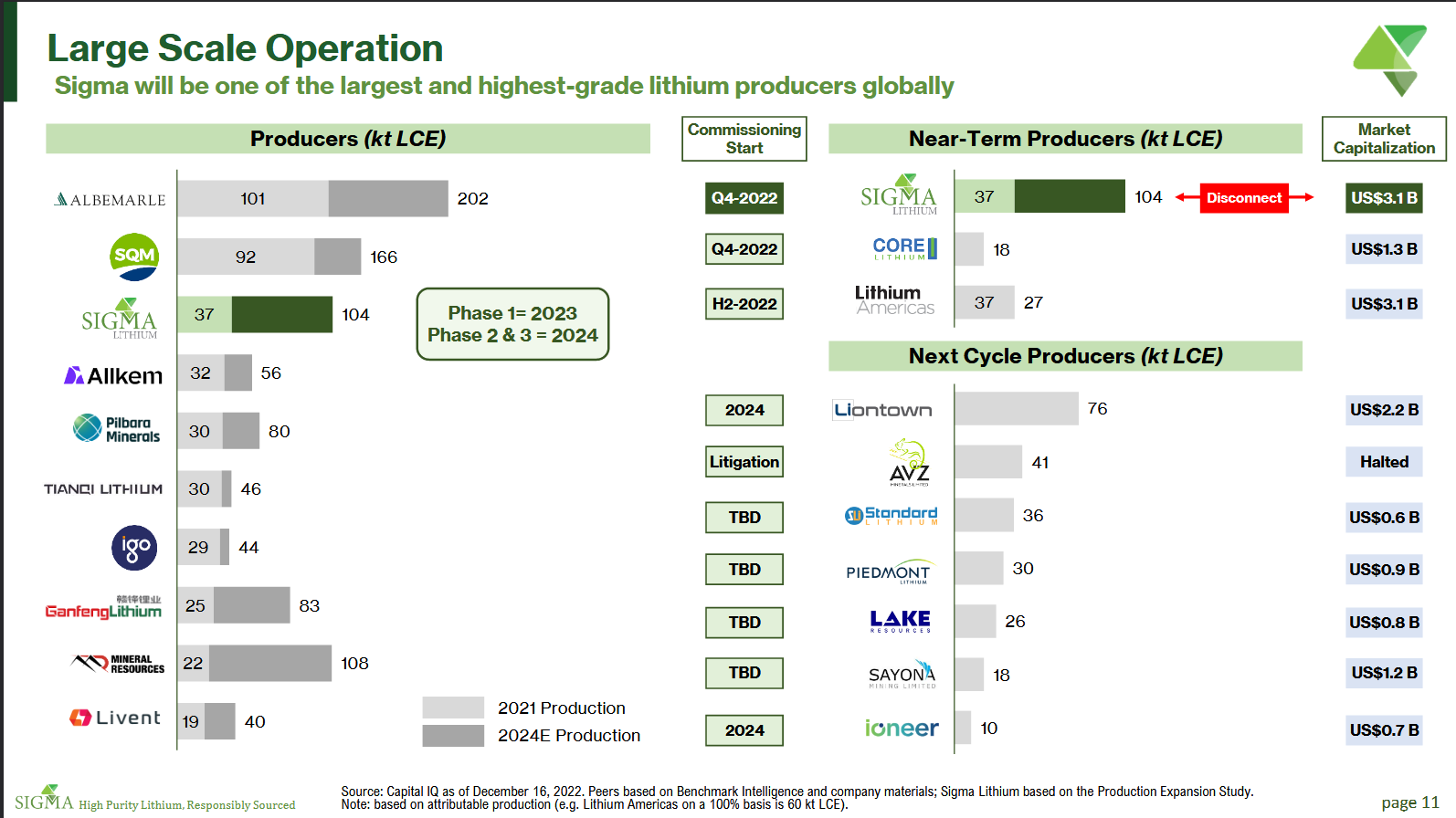
If you’re interested in large lithium mining companies building internationally significant production, Sigma Lithium (SGML) is also worth taking a look at as a peer to Lithium Americas:


Presentation:
https://ir.sigmalithiumresources.com/static-files/5d34a766-0bfe-4a16-805b-aa652440a22f

9 Likes

Argentina is becoming slightly less favorable for lithium mining companies.

https://www.boletinoficial.gob.ar/detalleAviso/primera/279728/20230116. This has a small (1.5-4%) impact on LAC’s operations in Argentina. So, no significant financial impact, but an interesting little news item with its justifications.

The key parts as a Google translation:

MINISTRY OF ECONOMY

Resolution 15/2023

That currently, the litiferous sector has registered an exponential growth, both in terms of mineral prices -driven by a great global demand- and in advances of the numerous projects that are based in the ARGENTINE REPUBLIC.

That lithium mining, from its development, has seen significant improvements in terms of competitiveness, technology and infrastructure.

That in effect, taking into account the electro-mobility that caused a change in the market and that the international scenario had an abrupt growth in the demand for lithium that produced an exponential increase in the price and thus also in the profitability of the projects, it is understood that a stimulus such as reimbursement has fulfilled the objectives for which it was duly established.

Thus,

THE MINISTER OF ECONOMY RESOLVES:

ARTICLE 1.- Proceed, through the competent areas of the MINISTRY OF ECONOMY, to annul the refund for the export of the goods described as lithium, lithium oxide and hydroxide, lithium chloride and lithium carbonate, included in tariff items 2805.19.90; 2825.20.10; 2825.20.20; 2827.39.60 and 2836.91.

Allkem briefly commented on the matter in its quarterly report: The government of Argentina has communicated its intention to remove the export benefits that currently apply to lithium chemical production. Whilst the timing of implementing such change and its full effect are not yet known, it is anticipated it would result in the loss of incentives in the range of 1.5% to 4% of revenue.

https://yourir.info/resources/f93690ed400d26d6/announcements/ake.asx/2A1426036/AKE_December_2022_Quarterly_Activities_Report.pdf

Well, it looks like GM has jumped into this in a big way. Some conditions have apparently been set for receiving the funds, though.

"DETROIT AND VANCOUVER, BC, Jan. 31, 2023 /PRNewswire/ – General Motors Co. (NYSE: GM) and Lithium Americas Corp. (TSX: LAC and NYSE: LAC) announced today they will jointly invest to develop the Thacker Pass mine in Nevada, which is the largest known source of lithium in the United States and the third largest in the world.

Under the agreement, GM will make a $650 million equity investment in Lithium Americas, which represents the largest-ever investment by an automaker to produce battery raw materials. Lithium Americas estimates the lithium extracted and processed from the project can support production of up to 1 million EVs per year."

https://finance.yahoo.com/news/gm-lithium-americas-develop-u-113000811.html

4 Likes

Great news! Thacker Pass has been rumored to be a partner for Tesla’s Gigafactory, but there is clearly interest from others as well.

The first of the conditions naturally relates to the outcome of the lawsuit regarding the permits for Thacker Pass. The condition for the second tranche of funding includes, among other things, the successful separation of U.S. and Argentine operations and the success of financing arrangements.

GM’s investment will be split between two tranches. The funds for the first tranche will be held in escrow until certain conditions are met, including the outcome of the Record of Decision ruling currently pending in U.S. District Court. If those conditions are met, the funds will be released and GM will become a shareholder in Lithium Americas. The escrow release is expected to occur no later than the end of 2023. The second tranche investment is expected to be made into Lithium Americas’ U.S.-focused lithium business following the separation of its U.S. and Argentina businesses and is contingent on similar conditions, including Lithium Americas securing sufficient capital to fund the development expenditures to support Thacker Pass.

Edit: After a closer look, the news might be “good” rather than “great.” In my opinion, the good part is that a credible domestic financier has been found for Thacker Pass’s astronomical construction costs, which could well help in securing the remaining funding (partially) with government assistance. Although this has no direct impact on the lawsuit, one could think that the judge’s threshold for scrapping the project increases even further when, instead of just a Canadian-Chinese mining company, the project is (also) backed by one of the USA’s most iconic automakers. However, one cannot escape the thought that GM has done quite well in the negotiations: GM is paying the current market price of $21.34 for the first-phase shares, which prices in the risk of the lawsuit failing, even though GM does not bear this risk due to the terms. The share price will be something else entirely if the outcome of the trial is favorable for LAC. Be that as it may, the market saw the news as quite positive.

https://www.marketscreener.com/quote/stock/GENERAL-MOTORS-COMPANY-6873535/news/Lithium-Americas-Provides-General-Motors-Transaction-Details-and-Update-on-Construction-Plan-for-Tha-42857270/

4 Likes

And this might cause a slight rise today
Judge largely affirms federal permit for Thacker Pass lithium mine near Winnemucca - The Nevada Independent

3 Likes

And this might potentially cause a slight increase today
Judge largely affirms federal permit for Thacker Pass lithium mine near Winnemucca – The Nevada Independent

In some news headlines, this was titled much more cautiously. However, the only point where the plaintiff won is mainly technical. The best explanation I found is the following:

*“Remand without vacatur” is an administrative law remedy that allows courts reviewing agency actions with minor legal defects to leave the action in place while the agency fixes the defect. *
So, the mine moves forward as of today and BLM and LAC will clarify details for the tailings site.

There is still a possibility of an appeal to the court of appeals, but this certainly looks very good for LAC and now also for GM. As I understand it, the start of construction work can no longer be prevented.

Seeking Alpha’s oddly titled article also breaks down the content of that court decision for those less familiar with legal terminology.

https://seekingalpha.com/article/4575900-lithium-americas-trump-and-biden-just-won

3 Likes

Interesting times in the lithium space. Things have been a bit quieter around LAC lately, but the annual report and especially the update on the ramp-up of Argentinian operations are eagerly awaited. @Pohjolan_Eka probably won’t mind if I write a few words in this thread about Sigma Lithium, which is more interesting right now?

I looked into Sigma based on Eka’s tip, and based on the company’s own presentations, the firm looked so good it almost seemed like a scam at first. I researched further and concluded it’s not a scam, but rather some US/Canadian-style slight exaggeration. I ended up investing in Sigma myself, even though I don’t fully believe in that NPV calculation.

According to the company itself, its NPV is about 15 billion USD. Its enterprise value and market cap are currently hovering around a quarter of that, so even the market doesn’t quite agree with that net present value, or the stock is incredibly undervalued. Sigma is essentially a mining company run by businesspeople with great assets in Brazil, intending to kickstart a globally significant amount of lithium-spodumene production in a few years. The mine has been in preparation for years, but the planned ramp-up would likely be a world record if realized. Sigma aims to benefit from the lithium shortage by producing raw material for battery chemicals on a fast schedule. The company does not produce the lithium chemical itself. The investment company behind Sigma has put its share of the firm up for sale before the start of commercial production.

A few days ago, news was published stating that several Chinese companies are interested in buying Sigma. According to the report, the offer would be 4-5 billion USD. This pushed Sigma’s share price up by about 10%.

Tianqi expects to bid USD 4bn-USD 5bn, said one of the sources familiar. Sigma had a market cap of USD 3.5bn based on yesterday’s (16 March) closing price.

Before this, there were rumors of Tesla being interested in the company, but there’s likely little fact behind it. Elon Musk has said that the biggest bottleneck in lithium production right now is the insufficient and concentrated refining capacity for lithium chemicals. Buying Sigma wouldn’t help with this.

Today, on the other hand, a short report was published, dismissing the whole of Sigma as a scam. Sigma’s share price dipped because of this but already seems to be recovering. After 30 minutes of reading, a large part of the report is nonsense, and the report is internally contradictory. However, it does have a few valid points that I believe specifically explain the differences between Sigma’s own calculations and the enterprise value seen by the market. The biggest of these is likely the speed of the planned ramp-up. Sigma has few of its own employees and no prior experience in mining operations, though individual executives certainly do. Nevertheless, Sigma advertises that it will kickstart globally significant spodumene production faster than anyone to date, as I understand it. One can say with reasonable certainty that there will be problems here that don’t show up in Sigma’s own materials. Tesla’s ramp-up issues might be a point of comparison, and in domestic mining, the infamous Talvivaara comes to mind. This is likely realized at Sigma too, and I believe it’s one reason the company is for sale. A capable buyer might be better able to drive the production ramp-up and resolve the problems that are sure to arise. Additionally, a buyer could gain synergies if they know how to build the actual chemical plant needed for battery-grade lithium production alongside the production site. This requires a completely different set of skills that the current Sigma lacks. On the other hand, Sigma can advertise being the world’s greenest lithium mining company because it only deals with hard rock and leaves the chemical processing to others.

Another relevant point in the short report relates to costs. The costs presented by Sigma itself (both capital and operating costs) look very low compared to anything else. It’s likely these will rise as ramp-up issues are sorted and production is actually tested. On the other hand, the short report calculates returns based on Goldman Sachs’ completely absurd price forecast. Based on my own research, the prices used by Sigma itself (which are presented quite vaguely in the company’s reports) might be quite justified. Analysts are currently very divided on the price development of lithium, but I personally consider it likely that the lithium shortage will continue into the 2030s, and there’s therefore no return to the cost curve. Sigma likely has some fixed-price agreement with LG for the selling price of lithium concentrate, but the details of this haven’t been made public.

Most of the short report is either exaggeration or complete nonsense, and the market seems to have concluded the same based on the price reaction. For example, the mentioned insider sales are largely explained by the CEO couple’s divorce, and co-CEO Calvyn Gardner, who left Sigma’s operations, sold his shares. Claims of child labor and underpayment are ridiculous when you read the basis for them in the report. They looked at the wrong company on LinkedIn when claiming Sigma has no employees there :rofl: If there’s any truth to the buyout rumors, the shorter might have been in a hurry with their position?

Summa summarum: I believe Sigma will be sold within the coming year, and possibly on a fast schedule. Determining its true value would require expertise I don’t have. Most likely, that 4-5 billion is a reasonable range, representing a 7-33% upside at the current share price. Without any risk adjustments and using the values presented by the company, the upside would be 300%. For now, I’m staying in. The fast-paced and risky situations will likely continue.

https://community.ionanalytics.com/leveraged-capital-markets-news-analysis/chinas-tianqi-lithium-ganfeng-lithium

https://grizzlyreports.com/sigma-lithium-corp-nasdaq-sgml-bogus-feasibility-studies-production-delays-will-leave-investors-praying-for-a-buyout/

8 Likes

https://twitter.com/LionHirth/status/1638170844437291009?t=Lz5nAc8nvwY57ywHmIhqlQ&s=19

There’s been a lot of talk lately about the drop in lithium prices (in China). Do you think this is a relevant development for this case in any way?

2 Likes

That is indeed the million-dollar question. It is certainly relevant. I am not an expert in the field, so if there are any, additions are welcome.

There are many different prices for lithium. Lithium carbonate and lithium hydroxide are “finished” battery-grade chemical compounds. The former has been the most important raw material for lithium batteries, but hydroxide is gaining ground. Spodumene 6% (or 5.5%) is a concentrate filtered from ore mined from the ground, which serves as the raw material for the lithium chemical. Piedmont’s website has this information in a concise form. When comparing different mining companies or lithium firms, one must first understand how they produce lithium (mining vs. brine, i.e., saltwater pools) and whether they ultimately sell finished lithium chemicals or spodumene used as a raw material. This is the short version. In addition to the spot price, it should be noted that, especially outside of China, lithium is hardly sold in large quantities at spot prices but rather through longer contracts. Therefore, tracking only the spot price can lead to incorrect analyses.

When tracking the development of lithium prices, people typically talk about the spot price of Chinese lithium carbonate. It has dropped like a stone. According to my understanding, this is because during last year’s lithium shortage, everyone hoarded lithium to full capacity, creating a self-reinforcing price spiral. Now, as demand decreases (Q1 is always bad in China), there is a situation where manufacturers are depleting their inventories and waiting for the price to drop further. At some point, inventories will reach a stage where they have to buy again, and a rapid price spike upwards might occur IF we assume there is an actual shortage of lithium, i.e., demand exceeds supply, and for example, Chinese demand picks up again according to normal seasonal variation. My working hypothesis is that this will happen during Q2-Q3. Of course, macro factors might change the big picture. If, on the other hand, there were an oversupply of lithium, the price would return to the level at which the producer with the highest costs can still sell. This might be $10-20/kg, or roughly 70,000-140,000 yuan/ton. I don’t believe in this.

Goldman Sachs says that the lithium market is moving from a deficit to a surplus. Goldman Sachs’ most bearish price forecast for the market is as follows (prices are per ton):

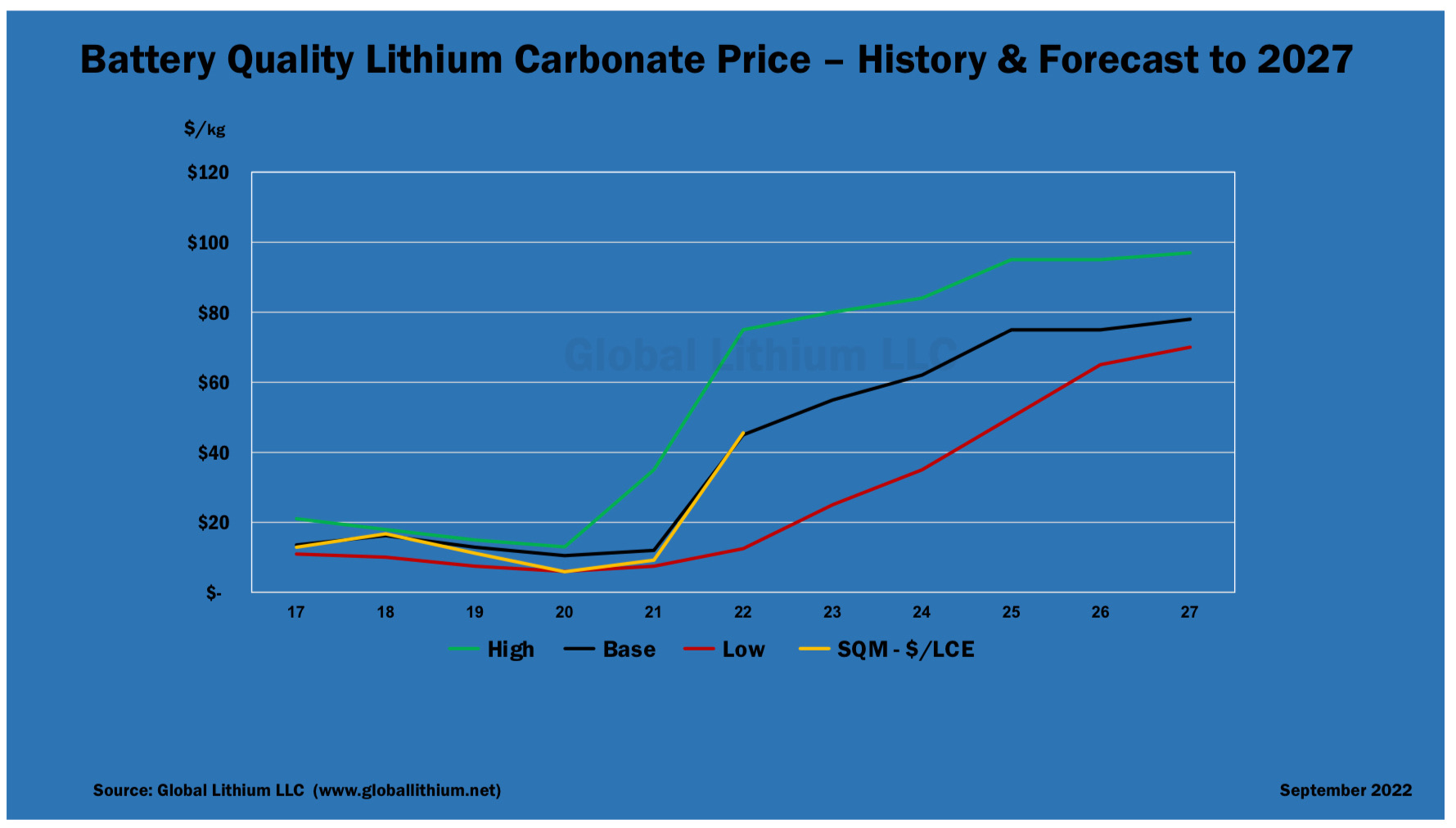
This practically assumes that all known lithium projects succeed at least as planned and on schedule, demand growth slows down significantly, and in a lithium surplus, prices return close to the left side of the cost curve. Quite credible criticism of this analysis can be found online. In real life, opening lithium mines is slow, and increasing the production capacity of battery-grade lithium is possibly even more difficult. And a large part of this chemical side is in China. Goldman Sachs’ bearish analysis is countered by, for example, Joe Lowry, who has immense experience in the field. His price forecast is roughly as follows:

At the moment, with a quick Google search, you can find a suitable analysis to support just about any price development. Generally, many bearish analysts seem to be of the opinion that there is plenty of lithium on Earth, and demand will grow slowly once the initial excitement for electric vehicles has subsided. Another viewpoint is that while there is indeed plenty of lithium, the number of places where it can be obtained in commercial quantities at reasonable costs is much smaller. And developing these takes a very long time, and hurdles and problems are always encountered. Additionally, refining lithium is not easy, and the processes depend on the characteristics of the raw material, which in turn vary by mine. If, in addition to this, demand is assumed to grow at current rates, we will be in a lithium deficit at least until well into the 2030s. In this case, the price of lithium deviates from the costs and could basically be anything until a price that is too high actually starts to cut demand.

I have leaned toward the latter view. I try to play the game by being involved in projects that are either already producing lithium or are at least close to commercial production, are at the low-cost end of the cost curve, and/or produce lithium in North America or Europe (rather than China). This provides a margin of safety even if the highest price forecasts do not materialize and/or if lithium can be partially replaced by other materials in the 2030s.

Regarding Sigma: it produces spodumene, which it concentrates into 5.5% grains that are then shipped to LG, etc. Only Sigma’s customer turns this material into battery-grade lithium. That’s why those invested in Sigma are interested in the price of spodumene. Elon Musk’s view seems to be that there won’t necessarily be a shortage of spodumene comparable to battery-grade lithium, so their price developments may diverge. This also depends on how projects currently underway can be brought to completion.

7 Likes

I’m returning to Sigma and that short report, even though this is the LAC thread. By the way, I’ll throw out an idea: would it make sense to start a separate lithium thread (or change this one into one)? There hasn’t been a huge amount of discussion about just LAC yet.

In any case, Sigma’s CEO Ana Gardner addressed, among other things, the ramp-up schedule in yesterday’s webinar. From the 31:30 mark onwards, she asserts quite emphatically that Sigma is on the promised schedule. Loose quotes:

31:30

The mine has been running since October

32:00

We started commissioning (of DMS plant) on January, we’re completing commissioning by the end of March as planned. Everything in accordance with plan, we’re gonna have first material in April. … We are planning to ship first week of May. Most likely will be 15 000 tons. Then we’re going to ramp all the way until June, when we will probably going to be hitting steady state by July.

34:30

I have a thousand people on my team now

36:30

We are experiencing a risk free ramp up… She said that there is a one-month buffer in the ramp-up schedule.

37:00 Addressed permitting issues. It was a bit unclear whether this related to the permit mentioned in the short report, but it seemed very positive.

42:00 Addresses offtake agreements. They haven’t made overly long or binding agreements.

43:50

My job is always to exit, as I’m a private equity investor

From the presentation and certain emphases, I personally conclude that this is partly a response to that short report, even if it wasn’t stated directly. A short statement about her family situation and the criticism of it also points to this. Ana’s performance was more tense than usual this time, but quite convincing.

It must still be stated that if the ramp-up really succeeds as promised and Sigma is at the full promised production rate already in July, then I think the stock is cheap right now. The current price already factors in significant risk adjustments, for instance, regarding the possibility of the ramp-up being delayed. Despite this, bad news can of course affect the share price. If you have the patience to watch the full hour, you’ll get a pretty comprehensive picture of the company.

2 Likes

A small Lithium update.

Lithium Price and Costs

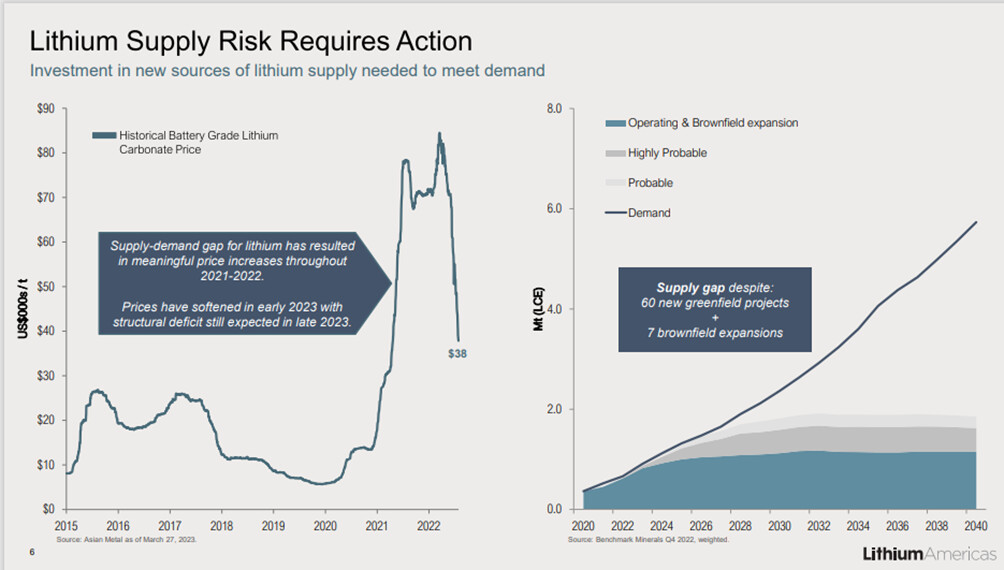
The market price of lithium has plummeted during 2023. The most followed price is the China spot price for lithium carbonate (on the left in the attached LAC slide). The same slide shows Benchmark Minerals’ presentation on the supply and demand imbalance.

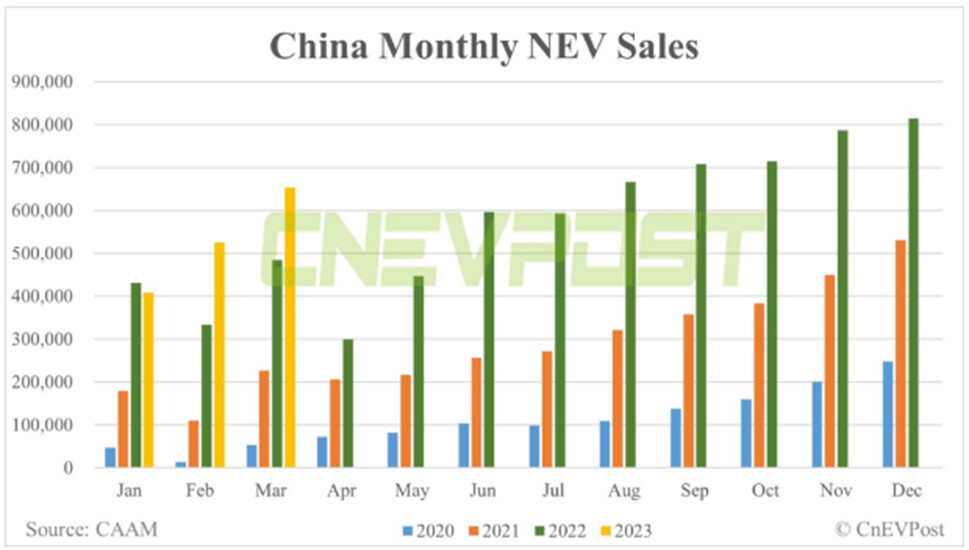
In China, Q1 is always weak. This year, in addition to normal seasonal variation, H1 is seeing internal combustion engine (ICE) vehicle inventories being cleared with massive discounts due to upcoming Chinese emission regulations, which is temporarily reducing EV demand in H1. Even so, China’s EV sales don’t look completely catastrophic after a poor January:

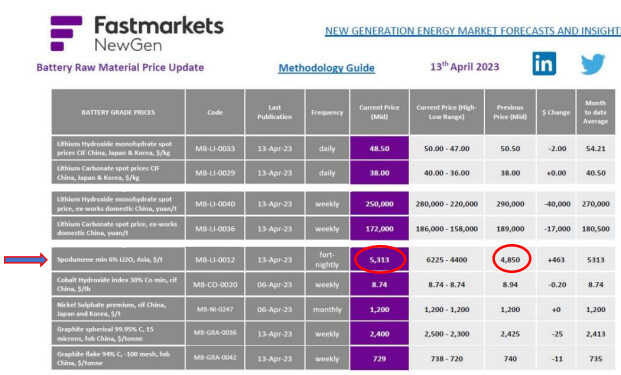
Now might be an interesting moment in the spot market. The spot price of spodumene, used as a raw material for lithium carbonate and hydroxide (which never fell as sharply as the end-product price), has turned upward. (This is a good thing for Sigma, for example, which specifically produces and sells that spodumene, partly at spot prices. Sigma’s own estimates are calculated with a spodumene price of $3,956, which would result in a free cash flow of $1.8B in late 2024. Market cap is currently $4.1B. Sigma’s spodumene is 5.5% grade; the spot price is for 6% spodumene.)

According to quite credible estimates, the current spot price of raw material spodumene means that the end product, lithium carbonate, is being sold below cost, which has already led to production cuts in China while demand shows slight signs of recovery. Lithium can no longer be produced cheaply in large quantities; instead, Chinese producers in particular have to extract lithium raw material expensively from lepidolite. Therefore, costs at the right end of the cost curve are something quite different from the low-cost producers at the left end. This creates a new floor for the price of lithium.

“Daniel Jimenez highlights the current disconnect between spot spodumene prices and spot lithium carbonate (LC) prices in China. He points out that the spodumene concentrate price has increased to $5,313 per tonne, which translates to a lithium carbonate cost of $52 per kilogram, without any margin for the refiner. However, current spot prices for lithium carbonate in China are between $25 and $35 per kilogram, creating an apparent discrepancy.”

Personally, I interpret this to mean that if the price of spodumene does not turn downward again (which I don’t believe it will), we will see the bottom for carbonate within a few months. If this holds true, the bottom for lithium stocks may have been in March for now. If so, March might have been the best buying opportunity since '21, and we are still not very far from it. Naturally, a macro-level analysis must be done separately, and a larger recession could disrupt the picture. However, a lot of spodumene is sold to China, so geography must be included in the macro analysis.

Edit: I won’t change the previous paragraph afterward, but after further research, it is quite possible that the price of spodumene will decrease during Q2-Q4. Although demand is growing, in addition to Sigma’s significant production, several producers will enter the market in the coming months, which could momentarily saturate the market.

Lithium Americas

LAC updated its situation earlier this year. The separation of North American (Thacker Pass) and South American operations is still expected, though there is no precise information yet. However, this enables, among other things, obtaining US government-guaranteed loans for up to 75% of Thacker Pass’s massive capex. Otherwise, the project might be difficult to finance. There is potential in LAC, but the capex for Phase 1 of Thacker Pass alone is $2.3B. The result here is an end product, so this cannot be directly compared to the raw material producer Sigma, but Sigma’s capex in Brazil is approx. $300M including phases 1-3, resulting in 104 kt (LCE) production and $2.5B revenue. LAC’s Thacker Pass Phase 1 production is 40 kt (LCE) in 2026 and the revenue forecast is $1.1B with a selling price of $36k/tLCE. These are not directly comparable, and LAC’s assets are much larger than Sigma’s, but the figures provide some indication. LAC still faces the risk that lithium at Thacker Pass must be extracted from clay. So far, no one has done this successfully on a commercial scale, but they have a quite credible plan for it.

In South America, LAC’s Caucharí-Olaroz is expected to start commercial production at the end of H1. After the ramp-up, it should produce 40kt of the end product, lithium carbonate. The capex here is also quite high, about $650M, but this is already financed. Revenue could be $1.4B when Phase 1 is running at full capacity.

M&A

Consolidation continues. Some car manufacturers (e.g., GM) are entering the mining business. Tesla (Musk) says mining lithium is easy but refining is difficult, and is building its own refinery. Some experts disagree completely: a refinery can be built in a few years, but opening a mine takes a decade. Large lithium mining companies want more assets and are buying smaller ones. Lithium giant Albemarle’s hostile bid for Australian Liontown instantly nearly doubled Liontown’s share price. Yet, the bid did not go through. Sigma has been pushed up by several sale rumors, and Sigma is owned by investment bankers and is certainly for sale. On the other hand, Sigma is now hitting a developing resource shortage with massive production and will need more assets in the 2030s. There are a couple of interesting small projects near Sigma that could be bought at a reasonable price. Additionally, there are rumors of interest from large non-lithium mining companies in smaller lithium juniors. In my opinion, the market is still in an interesting phase.
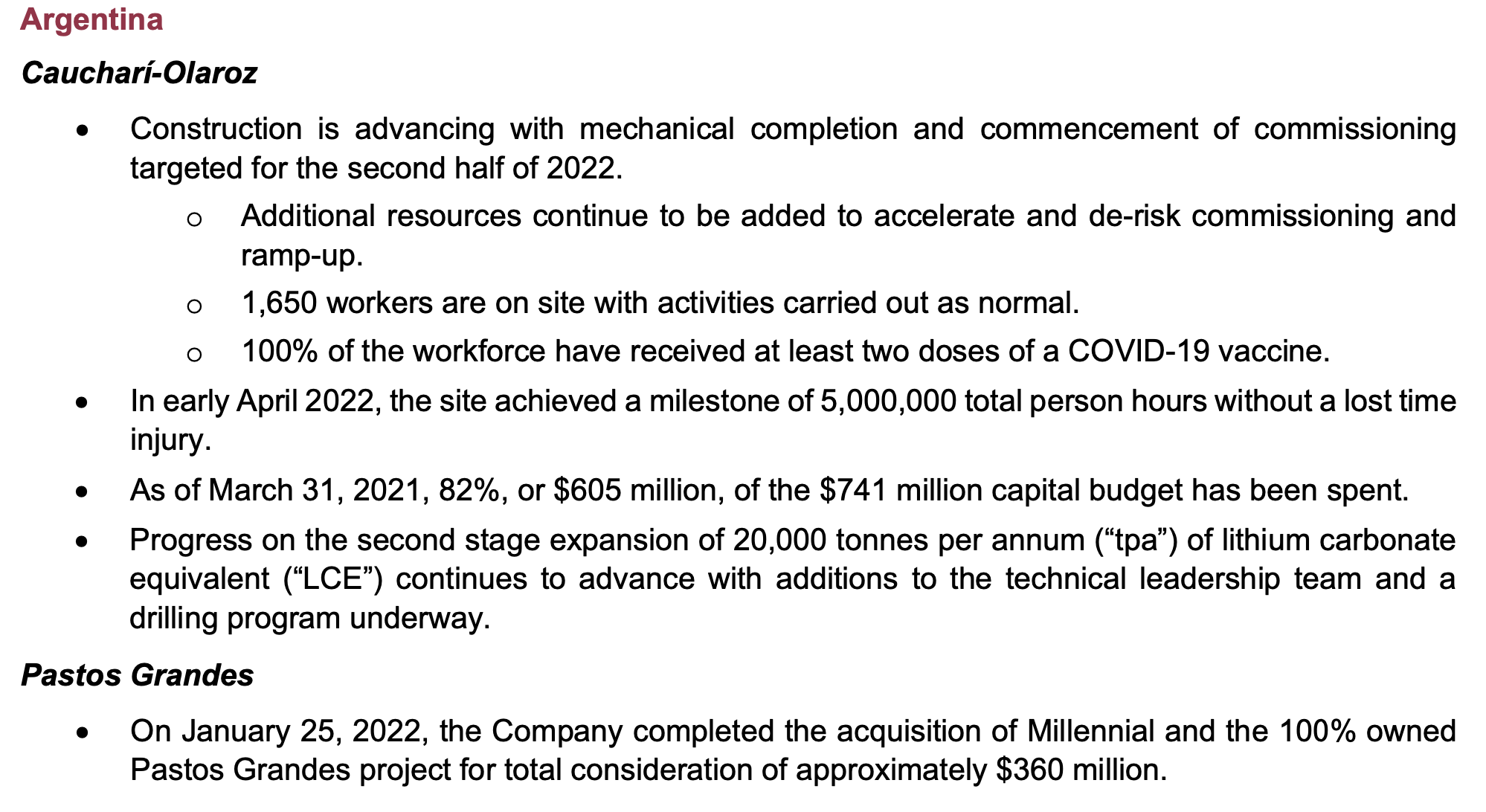
11 Likes

It is estimated that 60% of the world’s lithium reserves are located in the South American Triangle, namely Chile, Argentina, and Bolivia. Lithium mines have caused massive environmental damage in these countries (you can find plenty of articles on Google). The problem is likely the method used, where lithium is extracted using water. Judging by the pictures at least, the landscape becomes surreal and there is no water left anywhere. In Chile, 2.2 million liters of water are consumed to produce one ton of lithium. In Bolivia, the San Cristóbal lithium mine uses 50,000 liters of water a day. Chile is practically facing a water shortage. There is no longer any groundwater in the country. One Chilean minister remarked bitterly: “we have fancy electric cars, but no water.”

In the USA, one small mine operates in Nevada (Albemarle), and Nevada holds the US lithium reserves. Opening new mines is a double-edged sword. The lithium area belongs partly to indigenous people, and there are also large (and I mean large) cattle ranches in the area. In practice, the mine would shut down the ranches and the indigenous people would have to be relocated. However, the Biden administration has provided hundreds of thousands of dollars under the IRA program (Inflation Reduction Act) to get the mines opened. Currently, this is not happening because legal processes from appeals are still pending. The presidential elections are also coming up. If Trump wins, the mines will not be opened; instead, the construction of Alaska’s second oil pipeline, which Biden halted, will continue. Trump cannot afford to lose the support of ranchers and the agricultural sector.

2 Likes

That is true. Lithium is currently mined using two different methods: extracting it from hard rock and dissolving it in brine pools. A third, upcoming method is separating lithium from clay. Sigma mines lithium from rock and separates the lithium from other rock material using a method that uses very little water, and they even claim to recycle all the water. In contrast, LAC’s Argentina mine is a brine operation, which consumes much more water. LAC’s Thacker Pass would separate lithium from clay, and if I recall correctly, they advertised being able to recycle 80% of the water, but I have no clue about the actual water consumption of this method. Instead of brine pools, the DLE (direct lithium extraction) method is under development for lithium separation, but it won’t be commercially ready for at least the next few years. It would reduce water consumption.

Lately, the share prices of these hard rock mining companies have risen much more than those of brine mining companies, even though brine is in principle the cheapest way to separate lithium. Perhaps these environmental issues have something to do with it. Such excessive water consumption is not sustainable in the future.

3 Likes

The mine planned for Nevada would use that third method, the clay method. However, it still consumes 1.9 million liters per 1 ton of lithium. Construction work for the Nevada mine began this month. All appeals have been dismissed, and the permits were already applied for last year. The area covers 1.160 ha and is expected to yield 3.7 million tons of lithium. General Motors invested 650 million dollars in the project in March and secured priority rights to the lithium.

1 Like

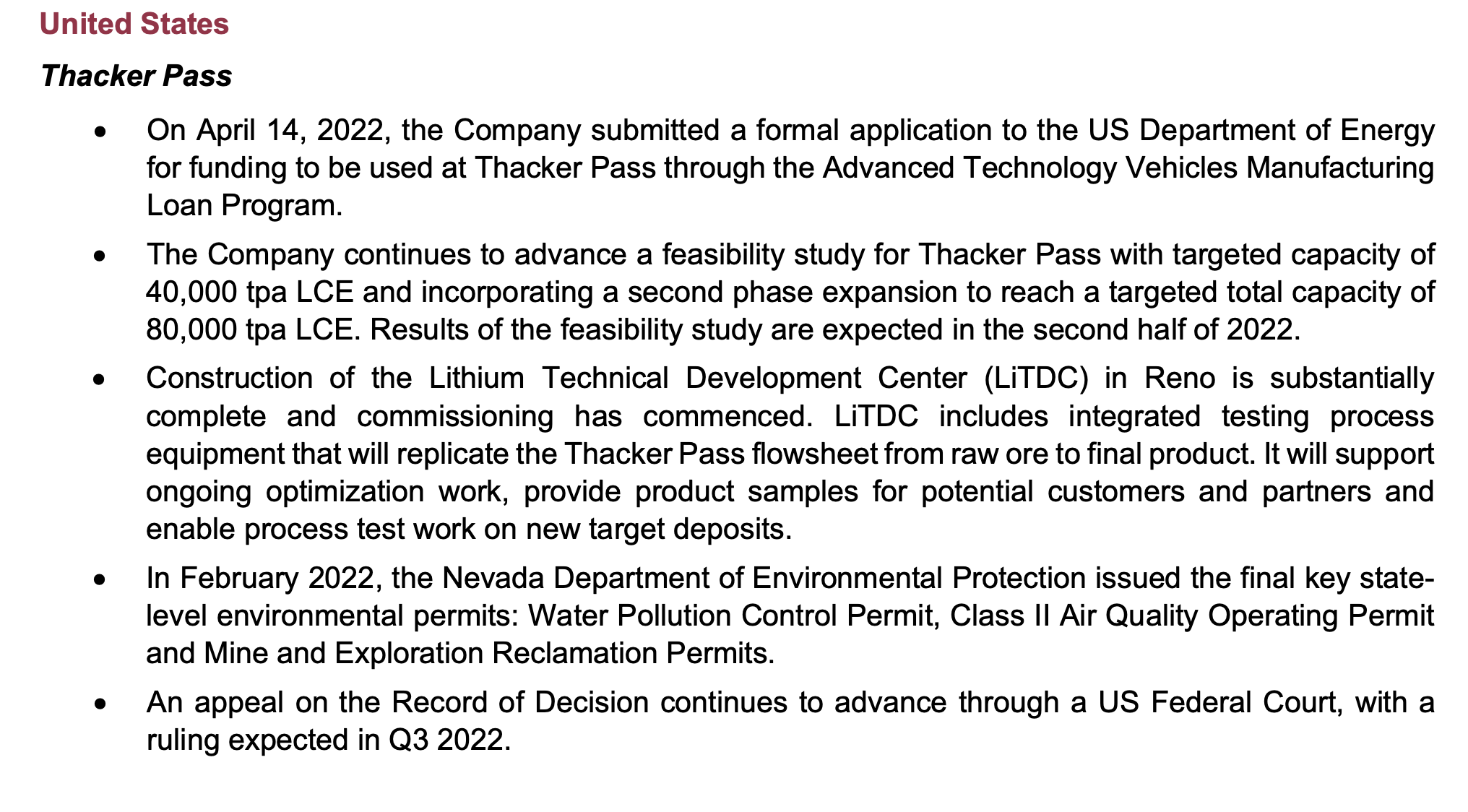
Yeah, so we’re talking about the same mine. This is exactly LAC’s (Lithium Americas) Thacker Pass:

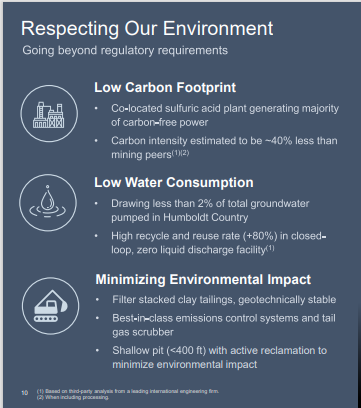
LAC themselves advertise the following regarding water consumption:

1 Like

The water consumption figures for Thacker Pass are estimates. The truth will only become clear once the mine has started operations. If water recycling succeeds, it would be a major plus and also important for cleaning up the public image. Lithium is also being mined in Chinese Tibet, and an environmental catastrophe is a reality there, at least according to available information and images. Interestingly, the Chinese automaker BYD (which also entered the Finnish market) comes up in many stories. BYD has received exclusive rights from authorities to own mines, and the impact has been devastating for the environment and people. An extraction method is used in BYD’s mines. BYD is supported by the military, which can effectively prevent protests. No outsiders are allowed into the mines, but toxins leak from the basins over a wide area, and groundwater has either disappeared from the regions or is contaminated with chemicals. A miserable situation.

4 Likes