Talenom - Automated processes for greater efficiency

Juha Kinnunen’s comments on Talenom’s software launch under its own brand. :slight_smile:

“In the big picture, the competitiveness outside Talenom’s service business will only become clear through a wider user group, but we see a place for Easor in the Finnish market and significant potential abroad. We did not receive any truly new information from the event, and in the big picture, Talenom seems to be progressing largely on the path we expected.”

22 Likes

Apparently, a typo had slipped into the very end of the intro, as there was no review on Ascension Day. I corrected it, and you get the rest as a bonus :smiley:

14 Likes

Hi @Juha_Kinnunen

What kind of expectations / assumptions do you have regarding Easor’s sales volumes to accounting firms outside Talenom, for example, this year?
And what kind of expectations / assumptions do you have regarding the pricing in euros?

Thanks!

3 Likes

Hello,

both good questions, unfortunately, the answers are less clear for now.

I still have an official forecast model in country-specific forecasts, which is why official forecasts cannot be provided. In other words, the forecasts have not yet differentiated between software and services, or these have not been released. In general, it’s a bit difficult to decide for now how these will be categorized in the future either, and it depends on how data comes in going forward.

But if one generally considers the forecasts, in my opinion, they do not require significant growth from Easor outside of Talenom’s services. So, if it were to pick up strongly now, I would see this as a positive factor for the forecasts. But on the other hand, they do require good traction for services, and customers should not leak from services to other software, which could now be possible. If this were to happen, the forecasts would be too demanding. It will be interesting to see how services will grow in the future as the market is expected to normalize at some point.

In principle, Easor will grow strongly in the coming years if existing service customers actually start using it and paying for its use in Sweden and Spain. So, in Sweden, a large portion of customers were moved to their own software last year, but as far as I know, invoices for it have not really been sent yet. So, first, long free trials are offered to get used to the software and reduce resistance to change (transitioning from Fortnox). And then there’s Spain, where there’s different software, but a transition will certainly be attempted at some point. The timing for Spain is a bit unclear for now, as there are also two proprietary software solutions.

The intention is to open up this whole picture more broadly with the next major update, but forecasting with current information will be challenging in any case.

Customer invoicing depends so much on the customer and its volumes that it is unlikely to be the basis of the forecast model in the future either. Of course, an average price can be outlined in the future, and even now, knowing the number of customers (over 12k SMEs) and revenue (over 20 MEUR). But that doesn’t necessarily tell much. There are many different pricing models, and as far as I know, they also vary by competitor on a customer-by-customer basis. Then so-called kickbacks are paid to accounting firms when their customers adopt the systems. So, one cannot look at gross figures, as the “sale” of the software also practically generates revenue. Furthermore, Easor has two types of customers - the end-customer and the accounting firm providing the service. Prices are also different when talking about Rantalainen and Paten Kirja, due to negotiating power. So, prices are ultimately difficult to compare, even if the price components were known from a list (fixed, transaction, etc.).

Ultimately, the relevant price for an accounting firm is likely the software’s (external vendor) invoicing in relation to the total invoicing. However, the customer will put all financial administration costs into a budget. These can sometimes be steep, especially for smaller customers and accounting firms that lack negotiating power with the vendor. Then, for example, Netvisor (Visma) can be very expensive for the end-customer relative to service invoicing, but then a more sensible choice would probably be Fennoa (and vice versa in another client relationship). My own feeling is that Easor could be strong among small businesses, as I understood that pricing can also be viewed in relation to total invoicing. This is mainly the point when considering why an accounting firm might include Easor in its offering and grow its user base. But the large cash flows would still be elsewhere.

In the big picture, I estimate that Easor aims to position itself significantly below the Visma / Procountor duo, but a general guideline is ultimately difficult to establish. However, the affordability of the overall package also depends on the net cost and the support services accompanying it. This is such a significant expense for an accounting firm that, for example, a potential saving of 10% should already entice them to the negotiating table to consider solutions. Then, when talking about, say, 10-20%, one would expect them to put in the effort to include the package in their offering.

I apologize for the complex answers; not all matters are clear to me yet, and in the initial phase, various experiments may be seen - possibly also reactions from competitors. I would also prefer to write in a few lines that this is how it goes :slight_smile:

39 Likes

I was wondering, while I had some free time,

How has Talenom calculated, in its spreadsheets, the changes in customer behavior caused by the software’s differentiation? If I were an entrepreneur interested in switching to the Easor software, I would probably try to find a so-called partner office. I would get the software but at the same time a local, personal accountant from a small accounting firm instead of a large firm. If several people think this way, could this be seen as eating into Talenom’s accounting firm business?

On the other hand, Talenom might acquire good acquisition targets in Finland in the future, as the target would already have customers using the Easor software. One would think this would benefit Talenom?

All in all, an interesting change to follow in Finland’s otherwise so serene accounting market.

9 Likes

There has been some discussion about Talenom’s valuation. Revenue multiples are rarely used for clearly profitable companies, but sometimes they can provide certain boundaries for valuation. So, a simple and very simplified exercise:

Software business (Finland) revenue according to recent information 20 million euros → X revenue multiple 5x = 100 million euro value

Other revenue (simplifying, accounting firm service revenue) 105 million euros (total revenue in 2024 was 126 million) → X multiple 1x = 105 million euro value

Total value 205 million with the above back-of-the-envelope calculation, enterprise value (EV) is around 250 million or more. The multiples are in the same class as, for example, Admicom’s and Lemonsoft’s EV/Sales for software and for services, in the same class as Aallon Group. Of course, Talenom’s profitability potential should be in a different class even in services. A 5x multiple for software revenue is not a particularly “bumtsibum” figure, but perhaps more of a “fair” multiple, much like 1x would be for a basic service business. In any case, there are some expectations of growth or future improvement loaded into the stock. From this, an investor can then make their own decisions, relative to, for example, the risk brought by the capital structure.

16 Likes

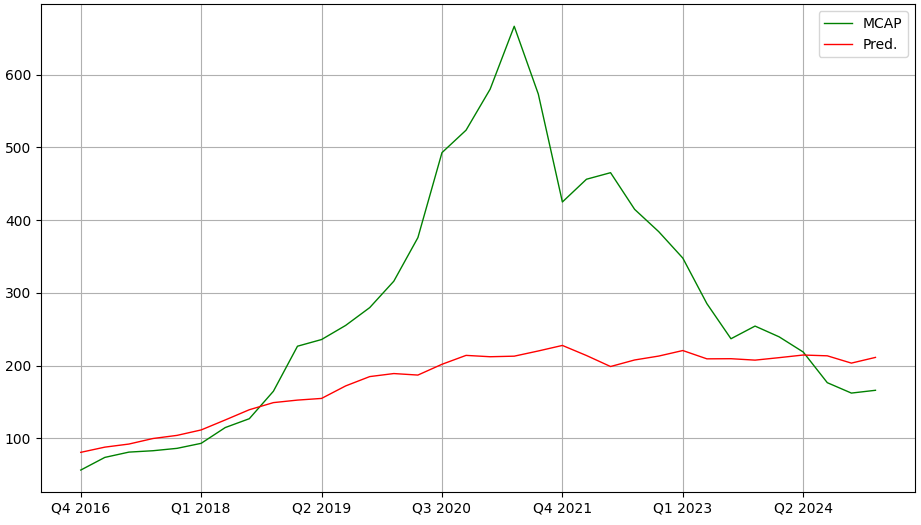
Our AI model, based on its own figures and short-term forecast, gives Talenom a fair market value of 210 MEur. Historically, now could be a good opportunity to pick up some shares from the bargain bin.

image

13 Likes

You are apparently using market cap in your calculations, do you take the constantly growing debt burden into account in your model in any way?

11 Likes

This model considers revenue, operating profit, profit before taxes, net profit, total assets, equity, operating cash flow, investing cash flow, cash assets, and net debt.
The model is based on neural networks and attempts to predict market value. The impact of debts is somewhat challenging to evaluate in these models. The training data for Finnish stocks behind it is from approximately 3000 quarters.

20 Likes

Juha has written his preliminary comments as Talenom publishes its Q2 report on Friday. :slight_smile:

We expect slight revenue growth from the company, supported by Finland and Spain, but the decline in Sweden continues clearly. From the Finnish business, we expect strong results and an improvement in earnings compared to the reference period, but the trend in Sweden is negative and relatively stable in Spain. We expect the guidance for 2025 to remain unchanged, but Finland’s economic development is still anemic, and growth is therefore tight. Without larger-than-anticipated acquisitions, 2025 revenue is likely to remain at the lower end of the guidance range, so a decrease in the upper end would not be a surprise. The greatest interest is focused on the profitability development in different countries, Sweden, and the software business Easor. Related to this, we are also interested in how the business will be reported in the future.

18 Likes

https://www.inderes.fi/releases/talenom-oyj-puolivuosikatsaus-2025-konsernin-liikevaihto-kasvoi-ja-ohjelmistoliiketoiminnalle-julkaistiin-oma-easor-brandi

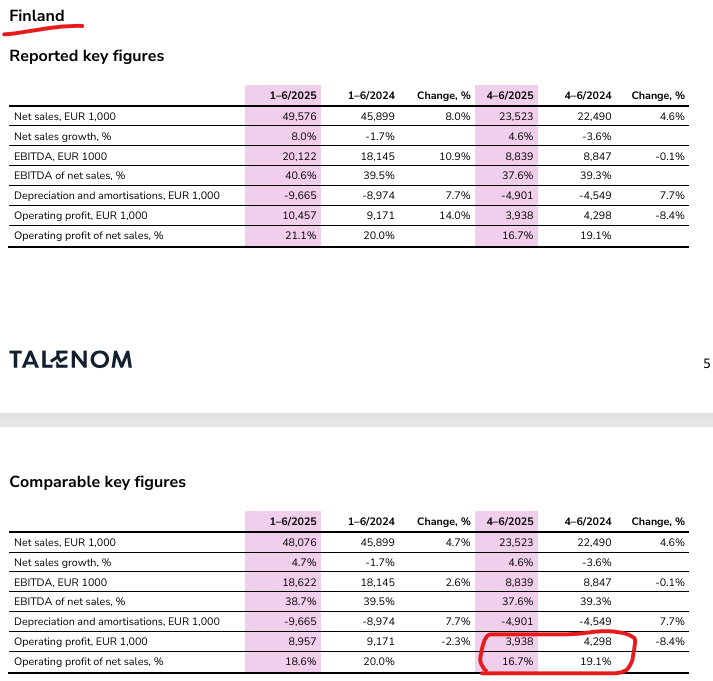
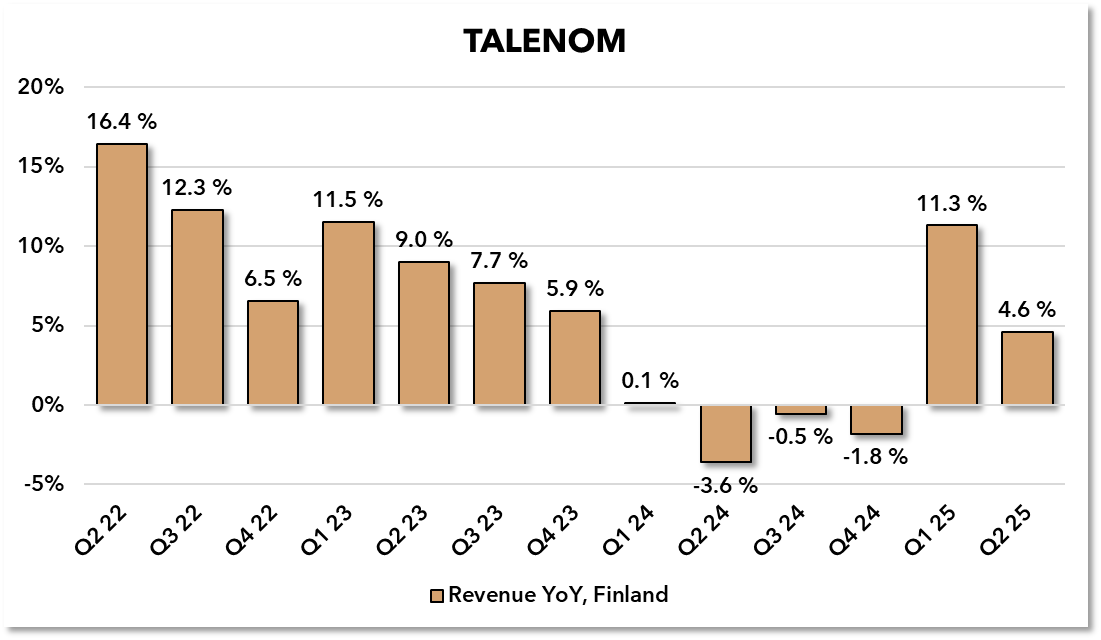
If Finland’s business figures were a positive surprise in Q1 regarding both revenue and profitability, then Q2, on the other hand, was a disappointment, especially regarding profitability. The operating profit margin in Finland decreased from 19.1% to 16.7%.

image

image

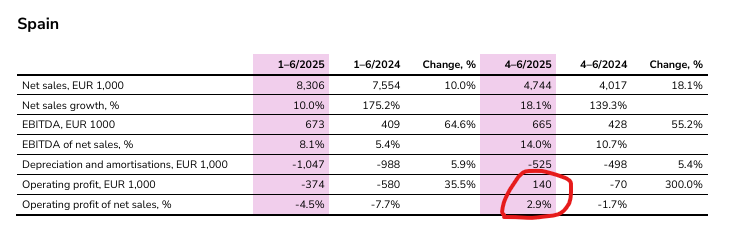
In Spain, in the black :+1:

image

32 Likes

Spain looks promising, and so does Finland, although increased depreciations are pulling Finland’s result down. Why did you leave out Sweden’s figures, by the way? Italy’s direction doesn’t look good.

The earnings report needs to be read carefully to better understand what is not being said. I’m afraid that Sweden will drag the group badly underwater.

15 Likes

Screenshot_2025-07-18-09-27-58-80_40deb401b9ffe8e1df2f1cc5ba480b12

Kinnunen’s forecasts for Sweden:
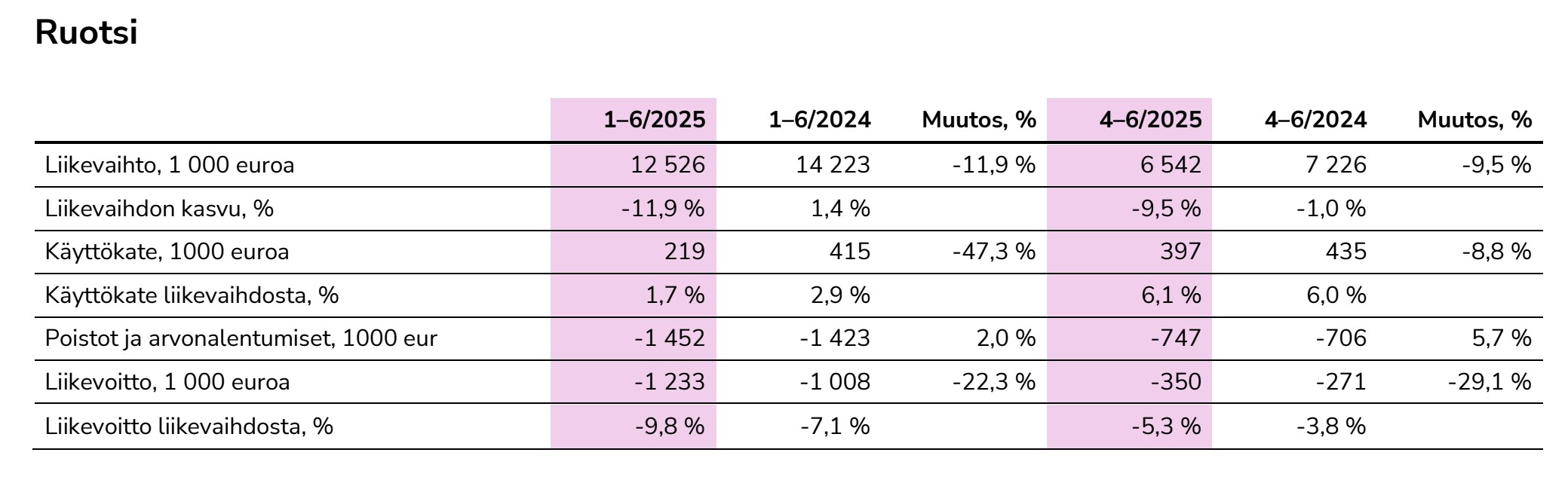
In Sweden, we expect revenue to have decreased by approximately 13% due to previous customer churn, which would mean revenue of approximately EUR 6.3 million.

Instead, a significant operating loss is expected from Sweden, which is in a transitional phase (forecast -EUR 0.6 million).

16 Likes

Sweden and Spain performed well now relative to expectations. In Finland, operating profit fell short by about a million, which was mainly explained by marketing costs. A million is quite a lot for marketing. Granted, depreciation also apparently was slightly larger than expected.

13 Likes

In the webcast, it was stated that “a few hundred thousand” had been invested in marketing. There was no concern about Finland’s profitability.

In Sweden, revenue is expected to decrease further by the end of the year, but profitability is expected to improve.

9 Likes

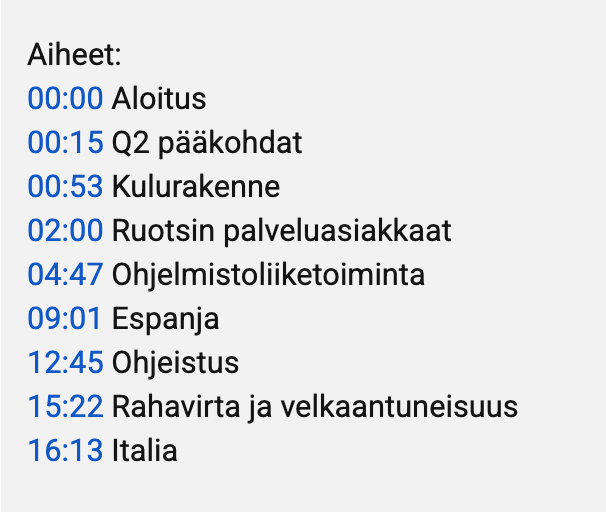
Talenom CEO Otto-Pekka Huhtala in an interview with Juha Kinnunen after the earnings report.

Individual highlights:

-Profitability in Finland and Sweden expected to grow in Q3 and Q4.

-Customer base in Sweden stabilized between quarters, still declining year-on-year. Expected to turn to growth by year-end.

-Acquisitions continue in Spain. Company acquisitions expected by year-end. First deals hoped for already after the holidays.

-The company’s various markets are showing nascent growth. This will ease the situation by year-end.

-Regarding the autumn dividend vs. acquisitions in Spain (with the balance sheet in mind):
a) Emphasis on growth through acquisitions.
b) The board will decide on the autumn dividend payment based on the situation.

-Juha Kinnunen commented on the poor figures from Italy and asked about the situation in the country:
a) No further acquisitions of accounting firms in the country.
b) Software is being developed. The market potential is the largest among operating countries because current software on the market is underdeveloped.
c) Software coming in the first half of 2026.
d) Near-term expectations for Italy are low.

image

https://www.youtube.com/watch?v=royuWiEUzqY

31 Likes
14 Likes

Kinnunen was exceptionally cautious. Perhaps Inderes now has earnings warning anticipation as a theme, given similar comments from several companies.

Juha didn’t give much value to Spain’s genuinely started e-invoicing software mandate, didn’t believe the Q3 profitability improvement in Sweden promised by OP, nor the acquisition in Spain promised after the holidays.

Finland’s profitability was criticized. Well, it’s clear that the launch of Easor weighed on the result - not everything can be activated. In my opinion, the core business is booming as before.

11 Likes

It seems Danske has a more positive stance than Kinnunen.

Danske sees:

  • A clear earnings beat in Spain
  • Spanish acquisitions as certain, and the CEO has stated in the last two earnings calls that there will be at least 4-5 acquisitions this year in Spain. Based on this, I wouldn’t be too worried about negative guidance if the lower end of the guidance fails. Rather, we’ll reach the midpoint of the guidance, and Spanish acquisitions will still have an impact this year.
  • A turnaround for the better has occurred in Sweden

Here is a link to Danske’s analysis:

14 Likes

A broken clock is right twice a day

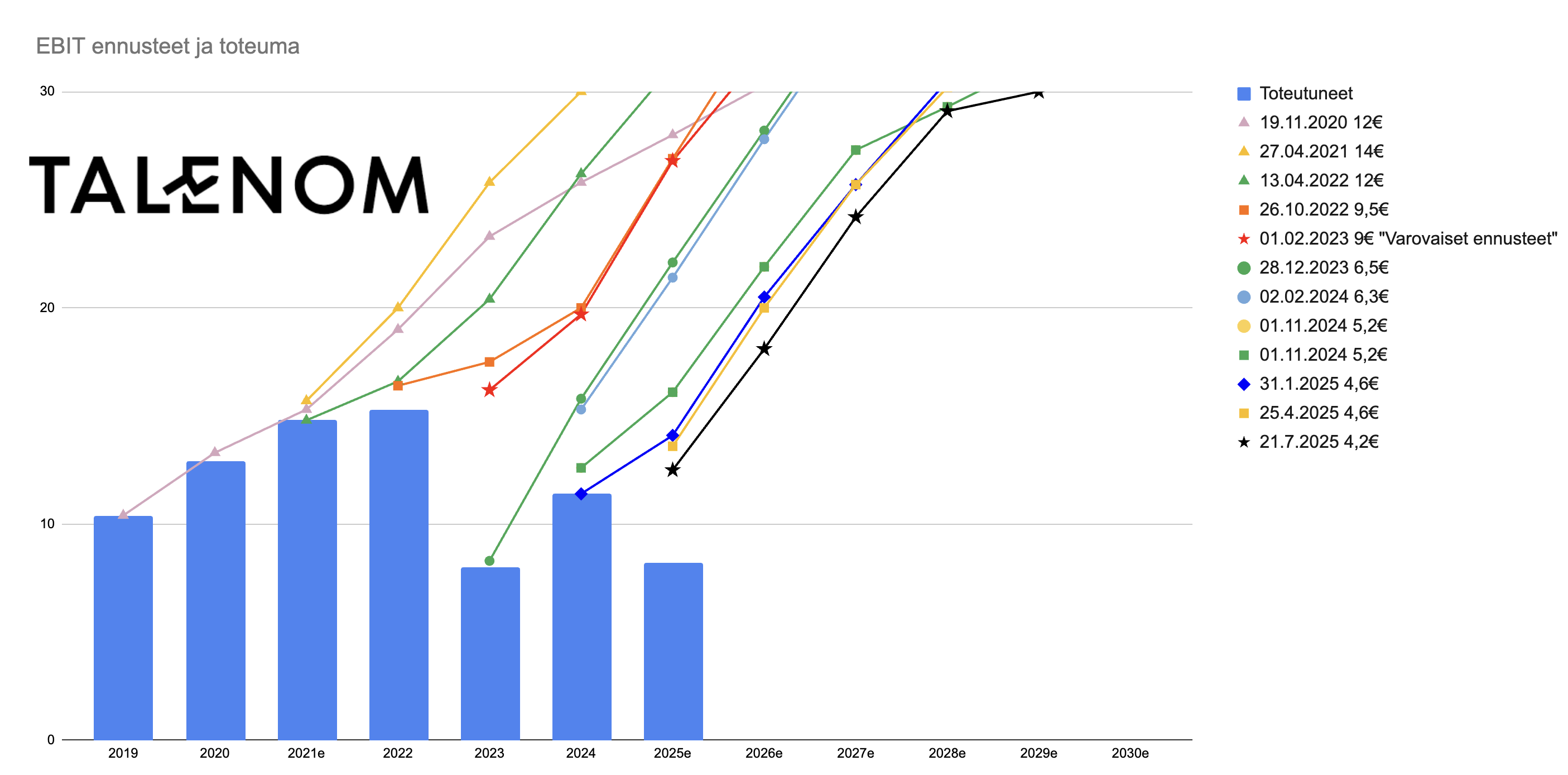
Nothing new in Talenom’s forecasts. Forecast cuts continue. The slope coefficient for “potential” has remained the same for years, but the timing has now been moved forward four years, quarter by quarter and year by year.

image

46 Likes