Talenom - Automated processes for greater efficiency

Quite a news day, and I was a bit surprised since I assumed Talenom’s business was on a fairly stable foundation, and now they are restructuring. Initially, it seemed like Talenom was being restructured quite harshly, with business operations being divested and the workforce being reduced significantly. On second thought, my mind is starting to change; it seems more like smart action from the management, especially from a shareholder’s perspective.

What’s particularly positive is that Talenom perhaps realized the need for a large-scale restructuring in time and didn’t wait for bigger losses or other major negatives. Now, an optimist is already looking for the numbers to show margins returning to the same level they were before today’s profit warning.

It remains to be seen how many euros Talenom will get from selling non-core parts to other players, but I suppose one can expect some cash flow from that, which improves the chances of investing in the core.

I wonder if the root cause is that companies with better sales captured the market, and a good product isn’t enough on its own.

Maybe it’s over-optimism, but once the company gets these arrangements sorted—and I wonder how far along they already are—the company’s operations will be easier to analyze, focusing on core activities without the extras.

Cut the extras, focus on the core, and drive shareholder value up.

It could be quite a task to sell Talenom’s software outside the company, as Visma and Accountor software are already present in almost all accounting firms.

22 Likes

The accounting market has digitized, but so has construction and, for example, ice cream production.

1 Like

While Procountor and Netvisor, which you mentioned, are market leaders, they are by no means in use in “almost all firms.” At least not in the sense that those firms wouldn’t have any other software in use besides them. This study shows those market shares and, for example, how Fennoa has increased its share from 2% in 2019 to the current 13%. So, it will certainly be a task to grab market shares, but if the product is in good shape, it’s not an impossibility.

8 Likes

Of course, the software company also has a solid existing customer base in Talenom’s own accounting firms, with more to come once the software is made available to accountants abroad. Everything sold externally in addition to that is just extra to cover development costs and generate operating profit compared to the current situation. Assuming, of course, that sales costs and the like are covered first.

But why do they need a separate company? Why not just start selling the software to others?

2 Likes

What if the entire software company is sold to others? Some kind of corporate restructuring might be brewing, that’s what it looks like to me.

7 Likes

An unusual move. Just recently, the CEO stated that in Sweden, the software adoption rate is high and profitability will improve as soon as volumes per employee increase. Now they are getting rid of them. Communication towards investors hasn’t been very transparent.

One must also remember that the management, and with it the culture, will surely remain relatively the same despite this turnaround.

12 Likes

Kauppalehti had apparently received comments from the CEO regarding today’s press releases.

“The software has been developed for about twenty years and has been distributed exclusively to Talenom’s service customers. Now we are starting to distribute the software to others besides Talenom’s accounting firm customers.”

“The essential point is that until now we have refused to sell the software to others. We constantly receive feedback when corporate restructurings occur where larger companies buy smaller ones. Often (smaller) companies would have wanted to continue using our software. Now we are making it possible.”

and additionally, Kauppalehti reports:

“The intention is not to spin off the business into its own listed company, for example, but to make it a second pillar for Talenom.”

It is difficult to draw any major conclusions one way or the other from this yet. We almost have to wait for more information about the new strategy in connection with the Q3 results. It is clear that the narrative is changing significantly because of this. Before today’s news, the expectation was that profitability in Sweden would start to rise from next year onwards, which would prove the viability of the software and actually the whole concept internationally.

Now we also have to start considering how opening up their own software to everyone affects the company’s future. It is quite difficult to assess this with the current information. The software business will likely grow as it starts being sold to others, but what effects will this have on Talenom in the long run?

29 Likes

First, a few facts:

There is currently not a single person with a purely software background in Talenom’s executive management team or board of directors.

In Talenom’s executive management team, there is not a single person with clear international business experience.
On the board, there is one person who has previously worked in multinational companies.

Talenom’s software development has been a separate subsidiary, Talenom Software, for 11 years. Revenue in 2023 was 32.7 million euros. It had 135 employees and an operating profit margin of 35.1%.

Now, Talenom’s communication stated that “the revenue of Talenom’s software business in Finland is estimated to be approximately 15–20 million euros.”

It was also reported that the statutory negotiations (YT negotiations) concern 180 people, with a reduction requirement of 35 people. This means, in practice, every fifth person will have to leave if the target is met.

Looking at the figures above, one notices that over 10 million euros is missing from the currently reported revenue compared to the 2023 figure, and at the same time, it seems that the statutory negotiations concern activities other than just software development. Apparently, this refers to other automation, support, and similar functions.

Some reflection: looking at Talenom Software’s 2023 figures, one can’t help but wonder how the situation could have deteriorated so significantly in a year that statutory negotiations are necessary. It seems like they are selling off some of their “non-core competencies” to an external party while simultaneously reducing their own staff.

If and when Talenom becomes a significant owner of the new company, it would also be advisable to recruit software industry professionals for the parent company’s executive management team and board. Similarly, with international growth in mind, the recruits should have significant experience in international business.

41 Likes

I personally got the impression from the announcement that it is possible to sell software other than Talenom’s to larger customers (which might suit them better), while their own software is sold to small and medium-sized customers.

Where did you get the idea that the reductions are related to Talenom software? Is this just a case of processes being automated and the need for labor in the acquired companies being lower?

A profit warning is a profit warning; the above points don’t mean that Talenom is doing well—instead, there is clearly sand in the gears, and as a result, it’s been concluded that things need to be done differently.

10 Likes

As I understand it, the software business is practically the same thing as the software development, maintenance, and sales of the Talenom software unit. Consequently, the change negotiations concern the entire unit unless some parts are excluded from the negotiations.

1 Like

Today was a great day to load up on more Talenom. I think the company is still high quality. Sure, there have been a huge number of mistakes, but business isn’t always easy. Fortunately, you can always learn from mistakes. The most important thing is that the company is high quality and the product being sold is strong. Fortunately, with Talenom’s regular cash cow, international mistakes can be offset without the company getting into trouble. I think it’s important that management actively looks for new ways and boldly tries things out! Personally, I’m in no rush with an investment story like this. My only fear is whether it’s headed in Rapala’s direction… Although a story like Rapala’s (an extremely strong brand with high margins managing to mess up the entire investment story for 20 years) is rare. At least for now, I don’t want to believe that Talenom will become the next Rapala.

9 Likes

Amidst the bad news, perhaps something good too.

Questions have been asked here about why there’s a desire to separate business operations. Separating a business into its own entity is a common practice when a product/service, etc., begins to be sold to competitors. Such a move supports sales.

And as the company has frequently mentioned, electronic invoicing is rapidly becoming mandatory in Europe. If they intend to take a significant slice of this cake, it seems clear that it must be done by selling the software separately, as it is a fast way to advance/grow and ties up only a fraction of the capital compared to acquiring companies (which can be continued in parallel). Otherwise, where would one find the army to perform due diligence and the funds to acquire companies at such a pace? That is, of course, impossible, so this is undoubtedly a sensible move. Some might call it erratic, while others might say it’s good that management is reacting.

It is no wonder that this sparks speculation about a merger with Aallon Group, as the separation would also facilitate a merger. These two companies should definitely sit down and consider whether it is worth competing tooth and nail for acquisition targets, or perhaps join forces and thus manage acquisitions at more sensible levels; therefore, such a possibility has likely been considered at least at the conceptual level. Other synergies would also be found.

19 Likes

Analyst comments following yesterday’s news. :point_down:

24 Likes

If I recall correctly, I’ve wondered in this thread as well that if Talenom really has the best software, why isn’t it sold to others too, since in the software business, gross margin is easily 95%, meaning it scales like crazy.

Now we’ll see just how good this software actually is.

54 Likes

My guess is that Talenom has been forced to start accepting third-party software and also selling just the software itself to outsiders, because customers don’t want to be locked into a small Finnish company’s closed IT system.

Imagine when a salesman tells a potential Swedish customer: “Forget about Fortnox already, we have this Talenom One (or something like that). It’s built by Finnish engineers, you can’t get it unless you transfer your accounting to us—but its usability is top-notch. Just move your accounting to us, we’ll gladly take it and transfer everything for free. No need to worry about how easy it will be to switch accounting firms in the future and move the material back to, say, Fortnox; we have top-tier usability.”

11 Likes

Amazon Web Services was originally developed for the company’s internal use but ended up becoming the company’s most profitable product. :smiley:

13 Likes

My interpretation, based on a fair understanding of systems in my field, is that developing a financial management system is extremely efficient, cost-effective, and easy as long as the dev team and process are kept lean and features are limited to effectively serve a specific service process and customer base. Commercial systems have to offer a bit of everything to everyone, which makes sprawl in software development unavoidable. At the same time, if a system must succeed in serving various differing service production processes, both the work and software development easily become inefficient. Few accounting firms (i.e., the potential customers in this context) are in a position to quickly change their entire service process to operate on the terms of the acquired application. Developing the best system for the mass market is very different from developing one for a tight-knit group under one’s own command. It is not impossible, but it requires different expertise and a different mindset.

29 Likes

image

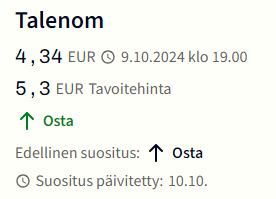
Interestingly, the “Buy” recommendation has been reiterated.

Proprietary software and the potential scalability and profitability benefits it brings were the only justification for high multiples. Now, Talenom is essentially turning into an Aallon trying to compete with Fortnox. In other words, a software house that doesn’t have enough muscle to compete with the big players and an accounting firm burning cash on developing its own software. Even with a potential merger option with Aallon, the case looks poor from a Talenom owner’s perspective when Talenom’s valuation is currently almost triple.

11 Likes

I was thinking years ago whether a merger with a competitor might be a good idea if Talenom’s systems could then make the new entity more efficient, but things were going so well back then that I suppose such things weren’t really considered… Maybe the other party wouldn’t have seen it as such a good move, though I don’t know if those kinds of things were even on the table.