At this stage, it can probably already be stated that the short attack has fizzled out; the stock price has returned above $80, where it has been trading for the past month.
Supermicro seems to be trending right now, at least on Seeking Alpha, with six articles related to the company published in less than a week. The news section also mentions the short report and the reiterated recommendation from analysis firm Northland:
Northland reiterated Super Micro’s Top Pick status along with its outperform rating and $165 price target.
Supermicro has also been included in Seeking Alpha’s Steven Cress’s (SA Head of Quantitative Strategies) Top 10 Stocks for 2023 list as the tech sector representative, taking the top spot on the Top 10 Tech Stocks 2023 list, and named as Steven’s personal #1 pick for next year:
There is no information on Steven’s track record, but with 20k followers, one could guess he’s at least a more interesting writer than the average “SA analyst.”
That’s right. It came and went pretty quickly. It’s possible that the shorters will still find themselves in a bind with their positions. Since there is no upper limit to losses in shorting, if the prices turn upward, the shorter is forced to buy the shares from the market or otherwise close their position.
I skimmed through the thread: I have thought about building a computer as a hobby a few times, and Supermicro’s boards have been under consideration. If the price on the exchange were reasonable, buying the stock might also be of interest.
I don’t like the following: 2022 is on the left and 2019 on the right:
Gearing ratio (%) 124.8 104.49 80.04 78.78
But then again, if the accounting is sketchy, what can be trusted in this company and its reporting? The company apparently hasn’t paid dividends in a long time (if ever, I didn’t check). If the figures are “roughly approximate” and there is no dividend history, what on earth is the share price based on?
This is exactly the point where you have to form your own view of the company. Personally, it will take me a couple of quarters before this company and its financial statement patterns and their significance start to make sense. But these discussions of ours illustrate very well exactly why there doesn’t seem to be a “quality premium” in the company’s price.
Q2 pre-announcement figures from Supermicro, they look set to beat their already high estimates
Due to Supermicro’s expanding markets and diversified customer base adopting our rack-scale Total IT Solutions, Supermicro anticipates the following results:
This is a positive profit warning! And Supermicro is getting hammered by shorters today as well. Normal volume is 1.9M shares and now 4M have been traded. January options expire tomorrow/the day after tomorrow, Jan 21. It’s quite interesting, someone is selling the stock frantically against the positive news. This Supermicro is being churned just like meme stocks.
Whether shorting was involved or not, for a popular growth stock that has issued a positive profit warning, I think the recent share price performance is a major warning sign. This has dropped significantly more in recent days than other companies in the sector. I’m also going to “spam” this thread by suggesting you check out other smaller firms in this sector that shorters haven’t targeted yet. For example, Aehr Test Systems, Amkor, Impinj, Jabil, and Rambus. (I couldn’t find a dedicated thread for these smaller semiconductor companies.)
Volatility is certainly nerve-wracking, but can it be considered a warning sign at the company level, especially when it’s a target of short activism? Uncertainty has surely arisen in the market, causing the share price to fluctuate, but if no actual misconduct is found in the company, then the value of the business naturally doesn’t decrease.
Having followed the discussion on the observations in the short report, I am also starting to be convinced by the counter-argument that any potential accounting irregularities would likely be more easily flagged during an audit due to the company’s past history. Similarly, it is somewhat normal for a fast-growing company’s capital to be tied up in inventory and investments; for the same reason, borrowing is likely justifiable. Unfortunately, my own research hasn’t been sufficient to validate these claims, but on a general level, they are quite logical counter-arguments.
That’s an interesting list of semiconductor companies, by the way; someone could even start a dedicated thread for them. I should mention, however, that the companies you highlighted don’t seem to operate in the same part of the supply chain as Supermicro; instead, they apparently manufacture semiconductors themselves, package them into components, or provide products to the semiconductor industry itself. Supermicro seems to have a history and current business in building components, but currently, their business is at least at the rack level, from where they are moving further toward the Total IT Solutions level.
Interesting companies, they seem quite iconic since they have stayed alive for e.g. 57 years, some are from the 60s and 70s. Thanks for the tips, they require a deeper dive…
Guidance for the current quarter was indeed lowered, but the FY2023 guidance remains. Reaching the lower end of the full-year guidance (revenue $6.5bn) with the revised Q3 guidance looks quite realistic; it would require Q4 revenue of about $1.43bn (in the same ballpark as Q3). The lower end of the FY2023 EPS guidance will practically be reached already with the guided Q3 EPS.
To my taste, positive cash flow almost the size of the net income looks particularly good, and of course, a TTM EPS of $10.85 doesn’t feel bad at the current share price (~$74). Even the market seems to be turning towards a green reaction after a small after-hours dip.
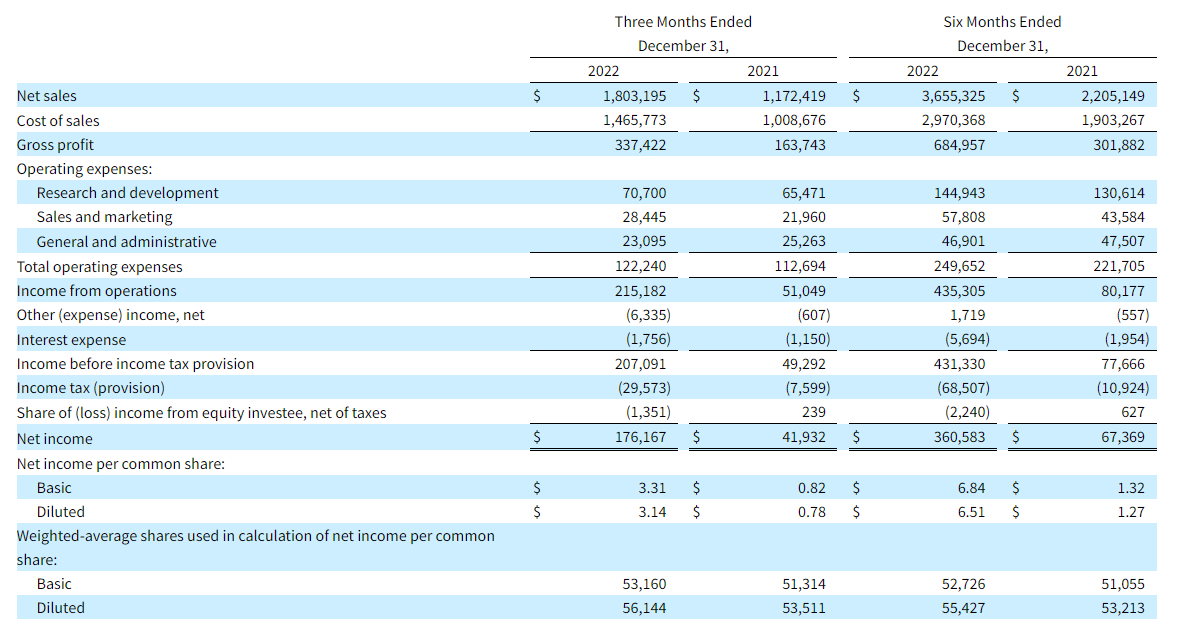
Here are the numbers in an easy-to-read format for others to look at:
Perhaps the most interesting highlight is “no single customer is more than 10% of their revenue”; this debunks what was perhaps the strongest argument in the short report. Also, the $200 million buybacks—the amount corresponds to nearly 5% of the company’s shares outstanding, which is a quite significant operation.
Alright, I waded through the call transcripts. It certainly clarified many things. The company has set expectations for the coming quarters low because they are cautious about the macro situation. And it became clear that they don’t want to keep updating the 2023 guidance all the time. They also have seasonality even within a single year. They said that the end of 2023 will be better than the beginning. So with Supermicro, revenue, margins, etc., fluctuate all the time; in other words, they don’t experience that kind of steady growth. That’s why it’s better to focus on the product portfolio. It’s in good shape; AMD, Nvidia’s H100, etc., use Supermicro’s solutions. Now that AMD and Meta seem to be avoiding a business slump after all, I’d say Supermicro is setting its own forecasts quite low. That’s the company’s style, and that’s just how it is. And finally, they emphasized the energy efficiency of their solutions again. That is also a very important factor for customers.
What are your thoughts on how Supermicro fits into these heaviest AI solutions? At the company, they have certainly talked a lot about energy saving and AI. It could be that the company’s certain lack of standardization is an advantage at this moment… there could be disruption among chip manufacturers again; Intel is already out of the game, what is the ability of NVIDIA and AMD to react… as AI software development takes big leaps… interesting times are underway and ahead.



 .
.