Steady Energy - Domestic Nuclear District Heating

This thread follows the story and progress of the domestic nuclear power startup Steady Energy towards commercial production and a possible stock market listing.

In 2020, VTT researchers began working on a simplified reactor designed specifically for low-temperature heat production. As the work progressed, it became clear that the targeted design concept of LDR-50 had enormous commercial and environmental potential.

By May 2023, supported by visionary investors, Steady Energy was launched. Founded by Tommi Nyman, Hannes Haapalahti, and Petteri Tenhunen, the company is now dedicated to transforming the potential of LDR-50 into real commercial success and environmental development.

The LDR reactor unit consists of two concentric pressure vessels. Water heats up as it passes through the reactor core and rises upwards due to buoyancy. In the upper part of the reactor vessel, the flow is directed to heat exchangers placed around the riser channel, through which heat is transferred to a separate intermediate circuit. The cooled water descends back to the bottom of the reactor vessel, from where the flow is directed back to the core.

The most important safety functions of nuclear reactors are related to fuel cooling, especially in situations where normal cooling circulation has been lost due to, for example, a pipe leak or a power supply disturbance. In traditional nuclear power plants, such situations are prepared for with multiply redundant active emergency cooling systems. A high level of safety requires strict fault tolerance criteria.

In many small reactors, similar safety functions rely on passive technology and natural water circulation. In LDR, too, cooling is based on passive systems. The reactor vessel is entirely enclosed within a larger containment vessel, and the reactor units are submerged in water pools that act as heat sinks. In the normal operating state of the reactor, heat is transferred from inside the reactor vessel through the heat exchangers to the intermediate circuit, so losses to the pool remain correspondingly small.

In a disturbance situation, the heat exchangers stop functioning, causing the temperature inside the reactor vessel to rise. The changed flow conditions initiate passive heat transfer through the space between the pressure vessels to the pool water. The system does not include any electrically operated pumps, valves, or other mechanical moving parts. The volume of water in the pool is sufficient to absorb heat for at least several weeks without the need for operating personnel to intervene.

https://www.ldr-reactor.fi/perinteista-teknologiaa-ja-innovatiivista-turvallisuussuunnittelua/

Steady Energy, a Finnish pioneer in small modular reactor (SMR) solutions, has secured €22 million in funding and will commence constructing a full-scale pilot plant in the second half of this year. The €22 million funding milestone brings the company very close to completing its B-round and solidifies its lead in the race for the world’s first commercial SMR in operation.

Forbes recognizes Steady Energy’s unique market position and early commercial success, noting that the company “is pioneering heat-only nuclear reactors, designed to replace fossil fuels used to generate heat in homes, for clean water supply by (i.e. desalination plants), and in industries." The article emphasizes the cost-effectiveness of the solution compared to alternatives.

The publication specifically highlights Steady Energy’s impressive commercial traction, mentioning that the company “has already secured its first two contracts and reportedly has a sales pipeline valued at $1.5 billion.” This recognition comes in the context of Forbes’ analysis of nuclear power’s resurgence as a clean energy solution, alongside a growing global commitment to triple nuclear capacity by 2050.
57 Likes

In July, Steady Energy raised an additional 32 million euros in funding. Investors in the round included 92 Capital, Lifeline Ventures, LähiTapiola, Valo Ventures, and Move Energy. Tesi also participated in the round with its initial investment. In addition, they have started a pilot at the former Salmisaari coal power plant, although without nuclear fuel. They have also signed a preliminary agreement for the construction of 15 small modular reactors (SMRs) in Finland.

Finnish nuclear technology company Steady Energy announces the successful completion of its €32 million funding round and will now begin constructing a full-scale pilot plant. With preliminary agreements secured for 15 reactors in Finland and a potential to deliver dozens of reactors in the European Union, Steady Energy is on track to deploy the world’s first commercial nuclear heating plants in the early 2030s.

In December, the first international agreement was signed with the South Korean company Korea District Heating Corp.

Things seem to be going quite well, but it’s still in the early stages and many hurdles may lie ahead. For example, the reform of Finland’s Nuclear Energy Act is only expected to reach Parliament in the spring of 2026; if it doesn’t pass, we are unlikely to see small modular reactors in Finland.

Steady Energy’s CEO appeared on Martin Paasi’s “paasipodi” podcast in the fall to talk about small modular reactors for an hour.

8 Likes

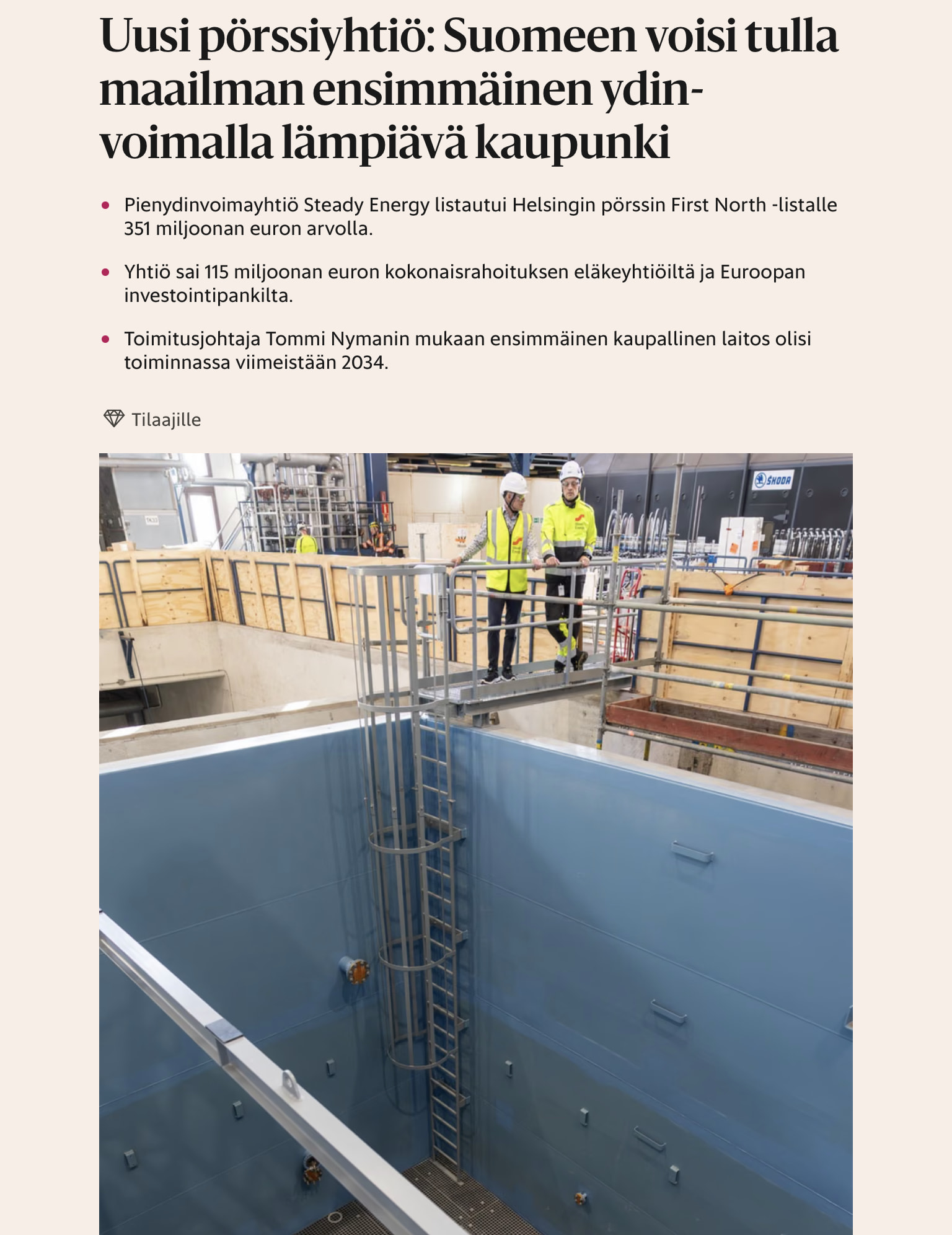
Steady Energy, a developer of small nuclear power plants for district heating production, and investment company 3North Partners (3NP) are merging. The new company is seeking a listing on the Nasdaq First North marketplace in Helsinki. The financing arrangement related to the listing amounts to approximately 115 million euros.

9 Likes

Press conference coming up today at 11:00 AM:

9 Likes

Long-term financial targets and operational targets

Steady Energy has set the following long-term financial targets, which the Combined Company will apply starting from the implementation of the Combination (“Implementation”) (“Long-Term Financial Targets”).

  • Revenue of over EUR 500 million by 2035 and EUR 1,000 million by 2040; and
  • Operating profit margin (adjusted for goodwill amortization under FAS standards) of 25–30 percent by 2035 and 35–40 percent by 2040, with the positive development of the operating profit margin expected to continue after 2040 supported by growing HaaS revenues.

Key assumptions of the Long-Term Financial Targets include: (i) the project portfolio of 70 reactors according to the Steady Energy management scenario, with deliveries possible in 2033–2045, develops essentially in accordance with the targets, (ii) approximately two-thirds of the 70 reactors included in the Steady Energy management scenario will be delivered under the EPC model and approximately one-third under the HaaS model, and (iii) the targeted revenue consists primarily of EPC reactor deliveries, and the share of HaaS revenue will grow from a minor share to approximately 50 percent of revenue by 2045.

Steady Energy has set the following operational targets, which the Combined Company will apply starting from the Implementation (“Operational Targets”):

i) Signing of the following key milestone agreements under which it is appointed as the exclusive or primary supplier of the reactor or HaaS, provided that such agreement is conditional only on the final investment decision or final heat purchase agreement before it becomes fully effective (technology delivery agreement):

  • The first technology delivery agreement will be signed in 2027–2028;
  • Technology delivery agreements for 4–8 reactors will be signed in 2027–2030; and
  • Technology delivery agreements for 8–18 reactors will be signed in 2031–2035.

ii) Other Operational Targets include:

  • Initiation of the pilot plant testing program in 2027;
  • Receiving a decision-in-principle for the first commercial plant from the Ministry of Economic Affairs and Employment in 2027–2028;
  • Submission of the construction license application in 2028–2029; and
  • Commencement of construction of the first commercial plant by 2029–2030.

Steady Energy Oy on allekirjoittanut osakevaihtosopimuksen yhdistyäkseen 3North Partners Oyj:n kanssa; suunnitelmissa listautumisanti ja listautuminen Nasdaq First North Growth Market Finland -markkinapaikalle

9 Likes

Moving on a tight schedule since trading is supposed to start already in two weeks, if the approvals come through, and why wouldn’t they.

Provided that 3NP’s listing application is approved, trading in 3NP’s series A shares is expected to commence on the First North marketplace on approximately October 2, 2026, with the ticker STEADY.

9 Likes

Great to see new companies listing.

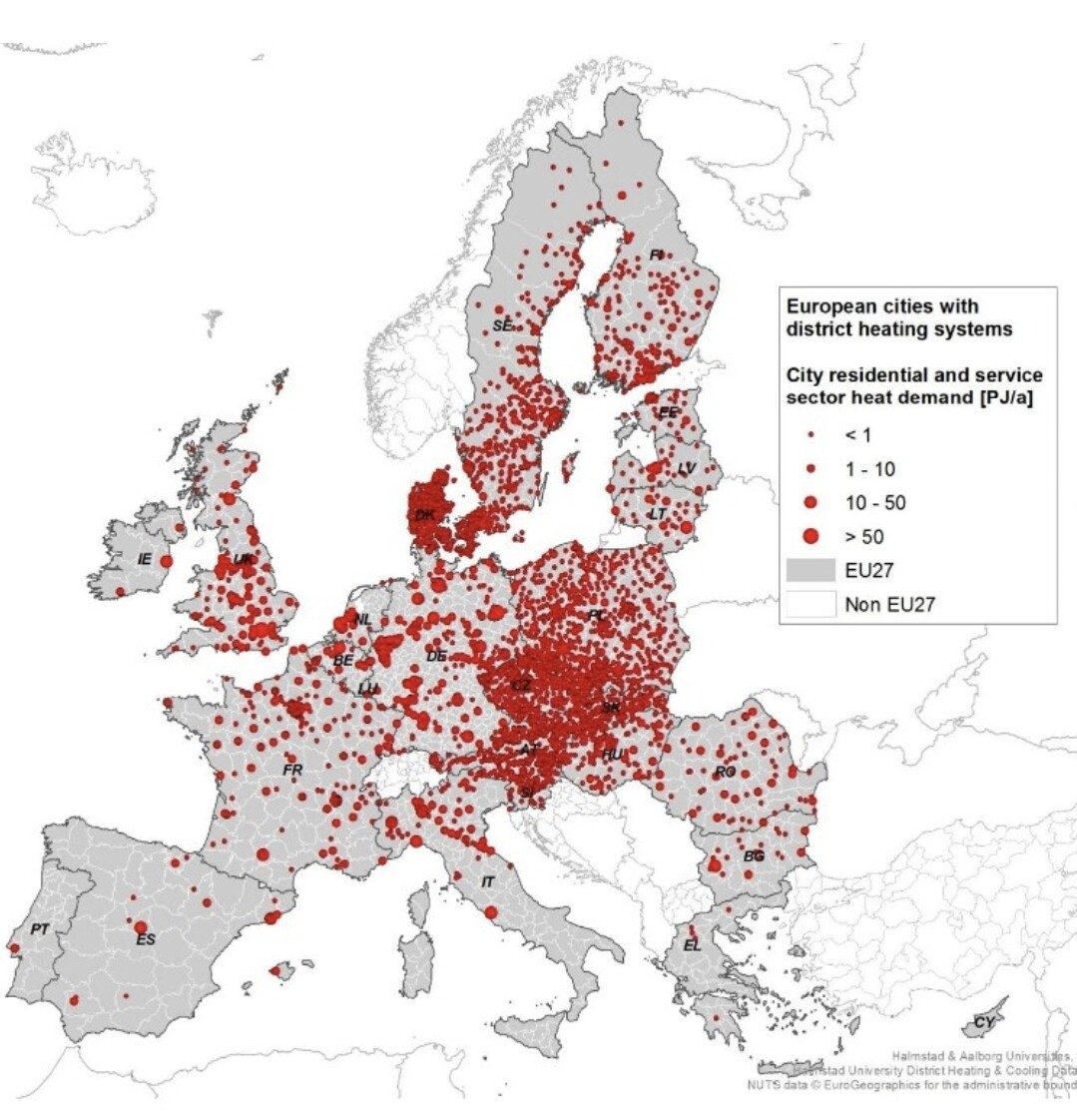
However, regarding Steady Energy, I wonder about the evolution of the target market. The scope is logically focused on district heating companies in areas with existing, sufficiently large district heating networks.

The press release does mention some sources of competitive advantage compared to competing baseload technologies, but the competitive landscape is not elaborated further. Areas with functioning district heating networks also attract other players that have an indirect, but potentially quite significant, impact on the market. For example, data centers, process industry, metal industry, etc., which generate a lot of waste heat in their processes, also look closely at these matters in connection with investments. In other words, Steady Energy will also compete with these players, and I see it as a potential risk that the quantitative growth of these other indirect district heat producers might shrink the potential market.

10 Likes

[quote="Rauta, post:7, topic:61497"]\nAreas with functioning district heating networks also attract other operators that have an indirect, but potentially quite significant, impact on the market. For example, data centers, process industry, metal industry, etc., whose processes generate a lot of waste heat.\n\n[/quote]\n\nNo one is going to produce 100% of district heating using nuclear power or waste heat alone. The waste heat from data centers and other power-hungry industries must of course be utilized as efficiently as possible, but it is not enough on its own. They are somewhat similar to wind and solar energy in electricity production. District heating is also needed when factories experience faults or maintenance shutdowns.\n\nFor example, Tommi Nyman, the CEO of Steady Energy, estimates that “Helsinki’s district heating network would need 20 small modular reactors if we wanted to handle everything with them alone, including all winter peaks. But a reasonable amount would be around 10-15 reactors.” Naturally, there’s probably a bit of salesmanship and optimism in that. So they probably wouldn’t even install 10 units with these population numbers.\n\nStill, it’s a solid product; since there are no moving parts, it’s maintenance-free and safe.

4 Likes

Well, the reactor isn’t completely free of moving parts, at least the control rods, I believe, move. Instead, the heat transfer of the reactor in all cases (=safety) is ensured without moving parts, i.e., passively.

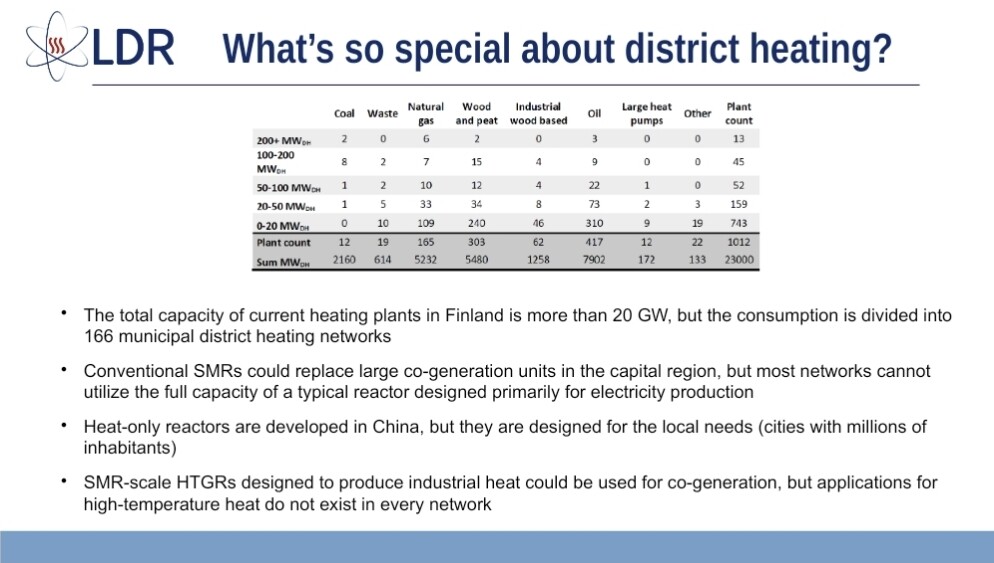
For example, the principle is presented in this slideshow: https://rmseura.aalto.fi/docs/2023/Jaakko_Leppanen_RMS_2023.pdf

In the same set, there is also an interesting image of the target market.

One of the slides also explains why low power is a good thing in the district heating market. A large number of plants are low-power because they serve small networks.

2 Likes

[quote="kimsku, post:8, topic:61497"]\nNo one is going to produce district heating 100% with nuclear power or waste heat alone. The waste heat from data centers and other power-guzzling industries naturally needs to be utilized as efficiently as possible, but it is not enough on its own.\n\n[/quote]\n\nI agree with this, and decentralized heat production also limits risks. My point was that these waste heat producers will eat into a share of Steady’s market. In addition to the market, regulation also acts as a driver here. Furthermore, Steady must, of course, compete against electric boilers, various CHP plants, thermal storage, etc.\n\nIf small reactors are allowed close enough to population centers, in other words, district heating networks, other SMRs suitable for CHP will also enter the competitive landscape. Simpler technology, low thermal output, low pressure, the absence of a turbine, etc., lower the investment in Steady’s favor. However, the growing demand for electricity makes the CHP option interesting, because at the same time, the proportion of the investment allocable to electricity production for this competing concept decreases.\n\nI have met representatives of Steady and Calogena, which operates with a similar focus, and the topic has not been the most encouraging in discussions. I wish both success, but my fear is that the potential market is being chipped away from a bit of every direction.

15 Likes

Is this share issue roughly the same as a SPAC, but the target is known? How has that valuation been assessed, and by whom? Hopefully, it won’t be the same investors as in the Lifeline SPAC scenario, where a story was sold first, an overpriced deal was pushed through at the very last minute, and which now seems to have disappointed—at least from the SPAC shareholder’s perspective. Of course, the future for Canatu still looks quite promising.

2 Likes

Is the share price in that private placement the same 10 euros as in the retail (“tuulipuvut”) IPO?

1 Like

The background here involves the same people as in Lifeline SPAC, and a shell company is being brought to the stock exchange, but this time the target company is already known. According to AI, the valuation is nearly €350M, and it is highly likely that the can will be kicked down the road even more than in Canatu’s case. Therefore, anyone investing in this should be prepared for the share price to drop by at least 70% when the revenue growth targets are missed. If you want to make a deep tech investment on the Helsinki Stock Exchange (Hesuli), Canatu is likely the better horse this decade at the current valuation.

24 Likes

Steady Energy seems to make the most of Finland’s forestry debate in its company brochure, naturally taking a stance that supports its own business by staking out that “The share of biomass in Finland’s district heat production is about 50 percent, and it is generally considered a transitional fuel.” Currently, commercial district heat production methods include fossil fuels, biomass, waste, electricity, and heat pumps. Could it be that once Steady Energy’s technology is commercialized sometime next decade, no one will remember that ten years earlier the forestry debate went into a full-scale frenzy? In that case, e.g., carbon sequestration will return to being a significantly more prominent issue in forest management than it is today.

2 Likes

Here you also get that wonderful political risk. For example, Germans are allergic to the mere mention of nuclear waste. There was just an article in Tekniikka&Talous about how the logistics of nuclear waste from many different sources to, say, Onkalo would be a bit more complicated, so could it be stored in the same place in the bedrock?

Then again, the French probably won’t agree to buy any foreign infrastructure, even if nuclear energy wasn’t an issue, so do we really have to start selling this to the Eastern Bloc right after the Nordic countries?

1 Like

the subscription price is the same, but the option right allocated in it is much, much more valuable than the free share allocations in the retail offering, so the private placement is a much more attractive target if one could participate in it.

1 Like

An interesting company and technology. I truly hope they reach their goals and that we get another success story. There are certainly plenty of risks in the technology, execution, and permitting. Too early-stage for my taste, and if the first reactor is ready perhaps in the early 2030s, it’s still a long road ahead. If there were even one actual reactor already under construction, I might be more interested. Furthermore, the convoluted share exchanges, earn-outs (lisäkauppahinnat), and various options do not make the situation any easier.

9 Likes

Analysis of the Steady Energy IPO (listautumisanti) written by Esa Juntunen above

16 Likes

The merger of Steady Energy Oy with 3North Partners Plc and the listing of the combined company will proceed as planned; the initial public offering was oversubscribed, and trading in Series A shares is expected to begin on approximately October 2, 2026.

Great to see that there was interest in the stock. I wish Steady Energy success on the stock exchange, even though I didn’t jump on board this time.

10 Likes

Helsingin Sanomat is writing about Steady Energy (for subscribers).

Highlights:

The company is only three and a half years old.

Isn’t it too early to go public?

“When making investments that span decades, we want to send a signal that we are here for the long haul. We are not a startup whose ownership base might change completely after a short while,” Nyman justifies.

A startup’s ownership base can sometimes be quite broad, and previously nearly half of Steady Energy’s shares were also owned by foreign venture capitalists. Now, domestic ownership is being strengthened.

According to Nyman, it is also important that a company building nuclear power is publicly listed and therefore subject to tighter scrutiny and regulation. Nuclear energy comes with exceptionally high safety and social acceptance requirements.

If a small modular reactor is built in your local municipality, there is undeniably a different tone depending on whether the plant is built by a private startup or a listed company backed by pension funds.

Prominent investors are involved in 3NP, such as Supercell CEO Ilkka Paananen, Lifeline Ventures partner Timo Ahopelto, and former CEO of Nokia and Fortum Pekka Lundmark. Lundmark will become the company’s Chairman of the Board.

At the same time, nine pension funds and other institutional investors are investing nearly 70 million euros into the company, acquiring nearly 20 percent of the company in a targeted offering. Domestic anchor investors include Finnish Industry Investment (Tesi), Ilmarinen, Varma, and Elo.

Only a 1.5 percent slice of shares was offered to the general public, worth five million euros.

The IPO structure also involves exceptionally complex arrangements, share classes, and incentives aimed at various shareholders. For example, these could dilute shareholders’ ownership stakes as the share price rises.

At the same time, the European Investment Bank (EIB) is financing Steady Energy with a total of 40 million euros in convertible bonds. It has the right to convert the loan into shares later.

The loan is the first the EIB has ever granted to a small modular reactor project, and is part of the EU’s new small modular nuclear power development strategy.

Although there are around a hundred different small modular reactor development projects underway worldwide, in Europe’s district heating sector there is currently only one direct competitor, the French company Calogena.

Steady Energy’s order book currently includes preliminary letters of intent for several reactors. The furthest along is the project with Kuopion Energia, where the city is currently working on zoning and an environmental impact assessment for up to three of Steady Energy’s district heating reactors.

In Helsinki, Helen has a nuclear program to replace combustion-based energy production. Kerava and Jyväskylä are also interested in small modular reactors.

The European Investment Bank announced that investment on September 15:
EIB backs Finnish nuclear technology company Steady Energy with €40 million financing

6 Likes