Canatu - Specialist in Carbon Nanotube Films

Canatu listed on the First North Finland list through Lifeline SPAC 1 on September 17, 2024.
logo_canatu

Canatu’s carbon nanotube production is based on Canatu’s patented Dry Deposition™ method, which, in Canatu’s view, is superior to the traditional wet dispersion method because it simplifies the process, produces longer and cleaner carbon nanotubes as well as uniform carbon nanotube networks, and enables better performance in end applications.

Screenshot_20240917_095901

Canatu has two business models. The first way is to sell finished carbon nanotube products. Canatu’s factory is located in Vantaa. The second business model is the sale of manufacturing equipment for carbon nanotube products, i.e., carbon nanotube reactors, and the licensing of related technology.

Additionally, Canatu has three focus areas: the semiconductor industry, the automotive industry, and diagnostics.

Screenshot_20240917_114631

https://canatu.com/fi/sijoittajat/

https://www.inderes.fi/companies/Canatu

Listing Prospectus PDF

Canatu’s Key Strengths

  1. Canatu is a fast-growing deep tech company with attractive margins
  2. Current focus growth markets are estimated to grow to 2–4 billion euros by 2030
  3. Customer relationships with leading global companies
  4. Differentiated IP-protected technology supporting a strong competitive position
  5. Proven and efficient capability for mass production
  6. A business model that enables asset-light scalable growth with high margin potential
  7. Technological expertise and an experienced management team that attracts international talent

Screenshot_20240917-134751_Chrome

Canatu’s Outlook for 2024

Canatu’s full-year 2024 revenue is forecast to be 20-25 million euros.

Canatu expects the Semiconductor industry to contribute significantly to the guided revenue, the Automotive industry to contribute limitedly, and Diagnostics to contribute insignificantly.

Investments for 2024 are expected to be 5-6 million euros, excluding potential impacts from Canatu’s possible change in policy regarding the capitalization of R&D-related personnel costs.

Long-term Financial Targets

Canatu’s long-term financial targets are annual revenue of over 100 million euros and an adjusted1) operating profit margin of over 30 percent in 2027.

Canatu’s Sustainability Work

Key Competitors:

ac1bcf560b4a1e6e935a5a50cffb5e4f4e5bab4b_2_1380x692

Canatu’s Capital Markets Day Interview:

https://youtu.be/WmFs6H0gWd8?si=vYwmmjfllaxUD5O3

Here is also the recording of the CMD:
https://canatu.videosync.fi/canatu-cmd-2024

Canatu's History:

Canatu was founded in 2004 by four senior researchers specialized in materials, characterization, and aerosol technologies, who worked in the esteemed nanomaterial group at Aalto University.

The unique process that led to the development of Canatu CNT was invented in the late 1990s and developed in the early 2000s. Until the early 2010s, focus was placed on researching the material and its potential, as well as fine-tuning the manufacturing processes. The first mass production award was granted in 2015.

Since then, Canatu has grown and matured, and today the company and its skilled personnel play a key role in innovating products with nanocarbon for a better tomorrow – in collaboration with forerunners.


Here is a message from Pohjolan Eka from the Lifeline SPAC thread:
https://keskustelut.inderes.fi/t/lifeline-spac-i-yhdistyi-canatuun/23318/294?u=vanerihands

Pandakarhu’s message contains semiconductor terminology:
https://keskustelut.inderes.fi/t/lifeline-spac-i-yhdistyi-canatuun/23318/387?u=vanerihands

This link leads to the message where Lifeline SPAC revealed that the target company is Canatu

51 Likes

Alright, the initiation of coverage report has now been published! It is going to be very interesting to follow Canatu’s journey in the coming years, as it feels like this process has only scratched the surface of the company and its industries.

The company’s markets and business model are still at such an early stage that, naturally, they don’t want to disclose all information yet, especially since negotiations for the next reactor deals are presumably ongoing. This, of course, created challenges for drafting forecasts, as it was difficult to gain precise certainty on virtually any single variable in the reactor business assumptions found in the report. They should be taken with a grain of salt; it’s perhaps better to focus on the big picture—that our forecasts outline a scenario where the company achieves its financial targets in 2028 (one year behind the target pace).

In light of our current forecasts, the share’s current valuation can be justified, but further upside would require either faster growth or the acceptance of a lower required rate of return. In my opinion, the base scenario already has enough growth baked into the forecasts that the risk/reward ratio is not sufficient at the moment. But if we put on some very bullish glasses and the real options related to Canatu’s technology materialize, then this could certainly be one of the great success stories of the Helsinki Stock Exchange for the next 10+ years. We have attempted to outline the valuation through various scenarios in the report. All in all, it’s a very interesting company, and as a growth-hungry investor, I would love to own this myself, but at the current valuation, I have to wait for a better risk/reward ratio (or potentially miss the boat).

I already said at the office when starting the project that Canatu seems like a case where an analyst has a high potential to be spectacularly wrong, whether the view is positive or negative. High expectations combined with a high valuation can mean that both continue to rise, or the air gets knocked out of both if significant cracks appear in the story along the way. At least at Canatu’s CMD, one could sense that many investors were very excited about getting this type of growth rocket onto the stock exchange. After all, we don’t currently find many companies achieving double-digit growth in the Helsinki market. Thus, one could expect interest in the company to remain and the valuation to stay elevated, provided the growth story stays on track.

Let’s continue the good discussions and information gathering that were already seen in the Lifeline SPAC I thread. Thanks to everyone who has participated so far!

70 Likes

Thanks for the report, it was an insightful and enlightening reading experience! I understand the caution in outlining the future, and the report cannot delve deep into, for example, evaluating potential CNT use cases. For instance, solar cells could be one such application beyond just the automotive sector.

It feels like the possibilities highlighted by popular science articles about carbon nanotubes in the 90s have started to materialize. It’s exciting to see what kind of growth Canatu will experience in the coming years.

6 Likes

Even three years is quite a long time, so you have to be quite a visionary to see what’s coming. The solar cell you mentioned reminded me of 3M, which mentioned at the end of July that they need to review their entire product portfolio and start investing in growth areas—namely solutions related to the electrification of the automotive industry and climate technologies, where Canatu’s CNT could provide an offering. 3M has been one of Canatu’s investors, and it’s very possible that cooperation will increase (a takeover bid is even possible, as 3M has the resources to get more out of the technology/patents).

11 Likes

In Finland, Valoe’s patents/resources could be available to Canatu now or soon at a low or nominal price. Valoe has expertise specifically in solar panels for cars/commercial vehicles. Canatu would bring its CNT technology to the mix.

Thanks to Atte for the report.

I have to ask a bit about those particle filters. Does Atte have more information or could he give an example of exactly what is done with that filter? Working in the industry, I can’t quite grasp the description in the report; I’m trying to understand the filter’s function and, through that, the market potential. Is it the case then that before the lithography cycle, the mask is inspected with, for example, a KLA or similar device, but what function does Canatu’s membrane have in this regard?

I also paid attention to the following paragraph in the report, quoted from the report:
Research projects are underway in the semiconductor industry looking for a future replacement for silicon as a raw material for silicon wafers. Currently, it appears that at some point in the 2030s, technological development will require the replacement of silicon. Thanks to their properties, carbon nanotubes are considered one potential material for replacing silicon. If this scenario were to materialize, it would offer Canatu the opportunity to take an even larger share of the semiconductor industry value chain. Consequently, in a very favorable scenario, the company has the potential to continue strong growth into the coming decades.

It is very likely that carbon nanotubes will take some kind of role in wafer manufacturing in the future as well, but hopefully no investor is including this in their own calculations, but rather seeing it as a sort of option far on the horizon. The transition from silicon wafers to the next stage will happen gradually, but the next step will not be carbon nanotubes, but silicon carbide (SiC) and gallium nitride (GaN), which power electronics will utilize.

16 Likes

Regarding mask inspection, my understanding is that there are several stages where these various filters are required for particle filtering and detection. First, a blank mask is produced, and it must be inspected. After this, a pattern is created on the mask, which also needs to be inspected. Then a pellicle is applied, and the entire assembly must be inspected. Apparently, there is also one more inspection stage before it is placed into the lithography machine. Additionally, the silicon wafers themselves undergo some form of inspection during the process. Currently, Canatu’s filters are used in patterned mask inspection, and the goal is to expand into the inspection of masks equipped with pellicles. In the longer term, the company also aims to target these other stages.

Furthermore, EUV mask inspection requires filtering certain light rays, necessitating the optical filters currently under development at Canatu.

13 Likes

A video on Canatu is now out, where we discuss the company’s potential with @Atte_Riikola based on the initiation of coverage report :smile:

Topics:
00:00 Introduction
00:22 Canatu as a company
04:12 Business model
08:42 Canatu’s technology versus competitors
11:11 Potential in the semiconductor industry
19:34 Strategy and financial targets
25:48 Risk profile
32:01 Dilution
33:47 Valuation and recommendation

22 Likes

@Atte_Riikola You mentioned in the video that around 2017-2018 it was already evident that “old-fashioned” pellicles could no longer be manufactured using old technology due to poor heat resistance. Since then, it seems research and experimentation have focused on these carbon nanotubes, which have been developed for years to meet the needs of the semiconductor industry.

Where is the upper limit for the potential of carbon nanotubes? Do you see any new competing, superior technology on the horizon that might displace Canatu’s technology and its entire business, perhaps in the 2030s? Specifically, what kind of early-stage technological innovations exist that are aiming to replace carbon nanotubes? And I am talking particularly about the semiconductor industry here; of course, Canatu could find a significant market elsewhere if the semiconductor sector were to fall through.

3 Likes

Semiconductor research institute IMEC works closely with ASML, and this pellicle issue indeed emerged as early as the 2010s when roadmaps for EUV lithography equipment were being outlined.

In relation to this, research projects were launched to consider future materials for pellicles. Looking through my notes from analyst meetings, graphene was investigated as another material option alongside carbon nanotubes in these development projects (here is one article in Finnish somewhat related to the topic). Apparently, however, it is harder to manufacture consistently, and the manufacturing process involves significantly more stages (making it more expensive). Graphene also does not transmit light as well and does not withstand high mechanical stress in the same way as carbon nanotubes. Research related to graphene is estimated to be roughly at least 10 years behind carbon nanotubes.

Based on this research project, IMEC contacted Canatu, and then Canatu, Lintec, and two major semiconductor industry companies began developing these carbon nanotube-based solutions. Canatu’s first reactor deliveries now stem from the cooperation that started back then.

Another material, produced at least by Mitsui Chemicals, is metal-silicide. Apparently, manufacturing this material involves over 100 process steps, so it does not seem like a very viable alternative. Mitsui also appears to have clearly turned towards carbon nanotubes for pellicles, so it is unlikely that this will emerge as a competing material either.

So, at the moment, it looks like carbon nanotubes are the future material that can withstand the rising requirements of EUV equipment technology development into the 2030s. Of course, I am not a PhD in chemistry/physics and I am largely reliant on information received from the company and what can be found (and understood) in the depths of the internet. But I would imagine that if a competitive alternative were found, we would hear about it well before it is in mass production, as the development cycles in this technology seem to span decades.

I cannot give an answer regarding that upper limit, and it certainly also depends on technological development. In its own materials, the company has stated that carbon nanotube-based pellicle films have the potential to withstand even the 1000+ Watt machines that will be a reality in the more distant future.

image

18 Likes

Has Inderes provided any outlook or valuation multiple for Medical Diagnostics, or is the entire valuation based on pellicles and those heaters?

If they truly enter the IVD market, e.g., early cancer detection, there is some serious money involved there.

4 Likes

The report states, among other things: “Point-of-care testing as an industry is still in its early stages, and generally, due to long product development cycles and regulatory requirements in medicine, development may be slower than expected. Thus, at this point, we see this business area as an option for the stock until there is proper evidence of a concrete breakthrough in the business. The first step is to find a significant healthcare company to co-develop this solution with.”

In other words, current forecasts and valuation rely almost entirely on the semiconductor and automotive industries. In the forecast section, I examine this matter from a slightly different angle:

“In light of Canatu’s market potential estimates, the company also has the potential for stronger performance than our forecasts in each of its business segments, both in terms of growth and profitability. Specifically, a breakthrough in diagnostics already in this decade would bring upward pressure to the forecasts. There also appear to be several possible application areas for Canatu’s carbon nanotube technology, which, if realized, could strengthen long-term growth prospects. This optionality can also be thought of as providing a slight safety net for uncertain long-term growth forecasts, for example, in a situation where one of the current product areas does not ultimately achieve the expected growth. Changes in the competitive landscape could also cause significant changes in the dynamics of Canatu’s industries, so it is advisable to maintain a degree of moderation in long-term assumptions at this point.”

13 Likes

Thank you for your comprehensive answer! The current valuation determination makes sense :+1:t2:

Options were detached from Canatu today, and their value at the current price is quite nice.

1 Like

By the way, let’s save Canatu’s disclosure policy here at this stage, as presumably at some point during its journey as a listed company, various announcements will start trickling in from the sales front:

image

20 Likes

On a general level regarding the power of scanner lasers. The power levels used in exposure are already extremely high, and electricity consumption is at a point where you practically need your own power plant to run a single scanner. Thus, power cannot keep increasing forever, and new laser technology is needed to achieve the desired results in exposure.

Feature sizes shrink when the wavelength of the light source is lowered or, alternatively, the optics’ NA (Numerical Aperture) is increased. In the coming years, ASML will focus specifically on increasing the NA; many have surely heard the monster of a term “High NA.” The next step is then to raise the NA from 0.55 all the way to 0.75, which is the so-called Hyper NA tool. Every time the NA is increased, more power is required from the light source because the mirrors used to direct the light onto the wafer surface must grow in proportion to the NA.

However, as I mentioned at the start, something must eventually be done about those power levels, and new technology is required in that regard. In itself, this doesn’t affect Canatu in any way, whether the power is lower or higher, but if ASML finds a way to lower the light’s wavelength close to X-rays, it’s possible that Canatu’s solution may no longer work, though that will certainly take time.

6 Likes

Particles on the photomask cause the pattern to be incorrectly drawn on the silicon wafer and force production to be suspended while the mask is cleaned. Because of this, in the worst-case scenario, the entire wafer ends up in the trash. A pellicle protects the mask from particles and thereby prevents damage to the silicon wafer.

kuva

The challenge, of course, is to find a suitable 10-15 nanometer thick material that allows as much ultraviolet light as possible to pass through and withstands temperatures of 500 degrees in a vacuum. The problem only worsens as the output power of ASML’s machines increases in the near future, which in turn increases the requirements for the pellicle film.

4 Likes

So, the report mentions pellicles and particle filters separately. I do know what a pellicle is, as I happen to be holding one in my hand right now :slight_smile:

I was mainly just wondering about that pre- and post-inspection performed on the pellicle, and what Canatu’s market niche in that is.

5 Likes

Here is Lasertec’s product range related to the topic:

image

So currently, at least Canatu’s particle filters are used in Patterned Mask Inspection.

3 Likes

Oh, this part?

kuva

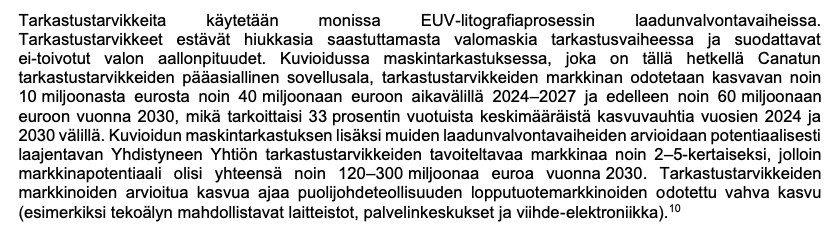
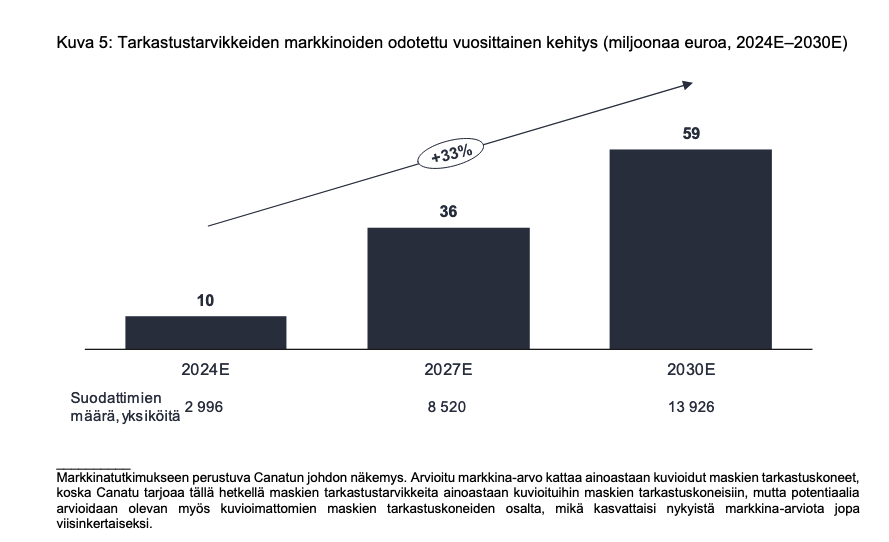
The following was mentioned in the listing prospectus:

kuva
(10 Canatu management estimate)

kuva

2 Likes