SRV as an Investment

One can also examine this matter with the P/E ratio in mind, in which case, in a normal year with normal earnings (which have been achieved before), the P/E would be 2 or 3. Forecast: Inderes net profit of 31 million in 2025, which, with a market value of 60 million, means a P/E of 2. Operating profit would then be 3-4% (this is not necessarily an upper limit either, if one looks at the Sweden/US axis). In recent years, debts and financing costs of approximately 30 million have weighed down the result, but now, with the share issue, and with debts behind them, Inderes, among others, forecasts financing costs of around 5 million for the coming years.

There aren’t many companies on the stock exchange that have a P/E of 2 based on the results of a normal good year.
Martela came to mind as one, even below 2. If you go back far enough, its operating profit has been 10%, and competitor Framery, with its pods, has done even better in recent years. But did Martela already make a quieter pod?

2 Likes

Is SRV cheap or expensive?
If one looks at the P/E metric, the P=Price side is unusually clear, i.e., the stock price.
The E=Earnings side, on the other hand, has been severely flawed, and the company has repeatedly discovered large write-downs and made a couple of share issues in recent years, perhaps even to keep itself afloat.

Well, history is history, but one can certainly ask if the industry is so impossible that one cannot make money from it?
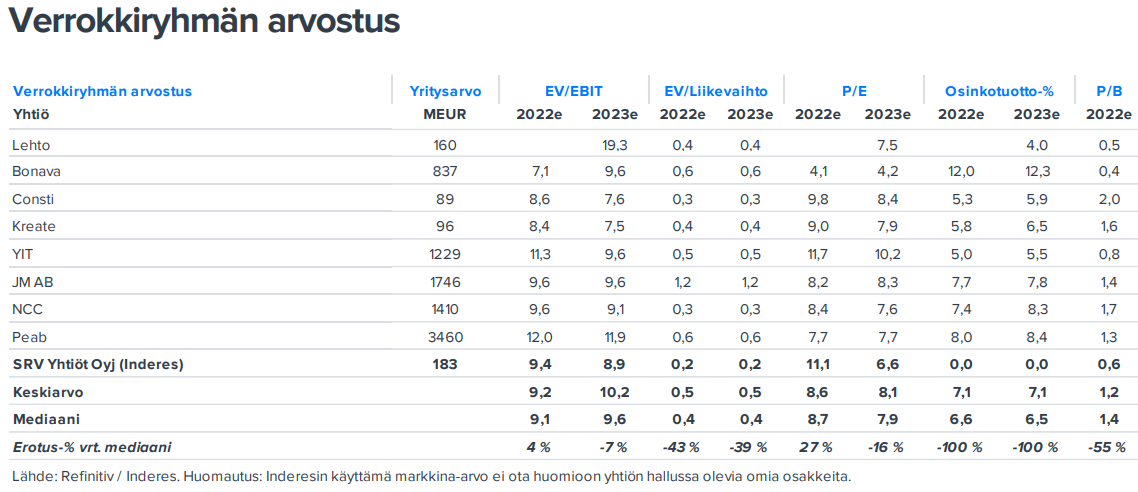
The report on July 22, 2022, refers to competitors. If one looks at them a bit, the EV/EBIT or P/E ratios are not bad at all.

I also looked at what kind of results (operating income) the companies have made. I took 12 months rolling if readily available, otherwise just H1 2022.
Although I’m not trying to make any comparable analysis here, SRV and Lehto certainly stand out, but not in a good way.
Secondly, it seems that a 3-6% operating margin would be achievable in the industry when looking at the references.
Thirdly, even with an estimated 2.4% operating profit for 2023, SRV’s P/E was <5.

Of course, if companies in the industry are capable of performing, what about the board, management, and other personnel of a single company? This is the problem.
SRV’s 15-year stock market journey has been, if not a continuous decline, then at least almost, including the most recent 6 years.
Have the board, management, and board learned something? Other than that, rights issues bring in money?
Are pricing models for projects able to incorporate some kind of risk margin?
Can project costs be kept under control?
SRV’s good result is yet to be completed?

Examples:
-Skanska (12 mths rolling): revenue 160442 mSEK, operating income 9417 → 5.9%
-NCC (12 mths rolling): net sales 56462 mSEK, operating profit/loss 1786 → 3.3%
-PEAB (H1 2022): net sales 29402 mSEK, operating profit 895 → 3.0% (12 mths rolling 5.1%)
-Bonava (12 mths rolling): net sales 16886 mSEK, operating profit 1433 → 8.5%
-JM (H1 2022): revenue 7644 mSEK, operating profit 898 → 11.8%
-YIT (H1 2022): revenue 1063 mEUR, operating profit 44 → 4.2%
-Consti (H1 2022): revenue 132.9 mEUR, operating result 3.3 → 2.9%
-Kreate (H1 2022) revenue 117.4 mEUR, EBITA 3.5 → 3.0%
-Lehto (H1 2022): net sales 163.9 mEUR, operating result -21.5 → -13.1%
-SRV (H1 2022): revenue 402.1 mEUR, operating profit -75.6 → -18.8%

  • and SRV (H1 2022): Operative operating profit 14.7 → 3.7%
    -and SRV (Inderes 2023): 898 mEUR, operating profit 22.8 → 2.4%, EPS=0.73. P/E=5 at current price 3.50
    -and SRV (Inderes 2024): 931 mEUR, operating profit 33.2 → 3.6%, EPS=1.22. P/E=3 -“-
    -and SRV (Inderes 2025): 953 mEUR, operating profit 42.8 → 4.5%, EPS=1.70 - P/E=2 -”-

https://www.inderes.fi/fi/system/files/company-reports/yhtiopaivitys_srv_q222.pdf
8 Likes

This looks good on paper, but the company has had the same prerequisites for making a profit for the past few years, yet the end result has been the destruction of shareholder money.

The real question is, what has changed in the company to suggest that the future won’t be a repeat of the past? If nothing has changed, it’s not worth investing in the company just to participate in another share issue two years from now.

4 Likes

Exactly. The performance in recent years has simply been so dismal that it’s not worth predicting positive earnings growth based on it. It will only start looking more promising when there is visibility that the order book doesn’t contain any loss-making mega-projects like the Redi or Tampere Deck and Arena projects.

SRV probably builds basic residential buildings and other standard construction projects profitably, but in recent years, they have simply tended to find large-scale problem projects.

SRV has published the following announcement during Midsummer:

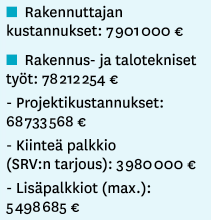
There’s an article about this tender in the new Tekniikka&Talous (e-magazine, no link to share).

In addition to SRV, two other companies participated in the tender. NCC was rejected because the site manager’s years of experience were insufficient. Jatke Toimitilat’s company references were not sufficient.

“Since only SRV Rakennus submitted a bid, there was no need to perform a price-quality comparison between bids” :rofl: :money_mouth_face:

Hopefully, the bid is priced in a way that generates a healthy profit.

5 Likes

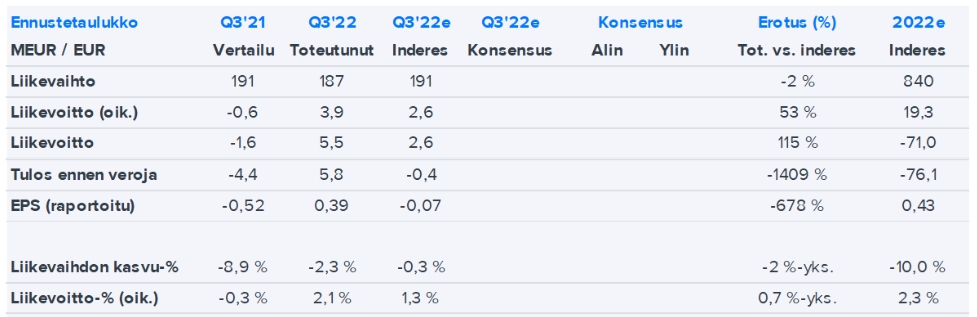
Here are Olli’s comments for the upcoming Q3 results.

We expect revenue to have remained at the comparison period’s level, but for profit to improve significantly from the weak comparison period. We slightly revised our forecasts downwards for Q3 based on confirmed housing completions. Market challenges maintain uncertainty for growth and a turnaround in results in the coming years. The order backlog should therefore signal growth in order to reach our forecasts for the coming years.

2 Likes

In SRV’s case, isn’t it a positive profit warning if there’s no negative one? Or is this a negative one?

SRV Group Plc lowers its revenue estimate for 2022 and refines its operational operating profit guidance for 2022. The new revenue outlook for 2022 is 770-820 million euros (previously 800-860 million euros). According to the refined estimate, the operational operating profit for 2022 is 17-23 million euros (previously 15-25 million euros).

The weakened revenue outlook is due to market conditions, which have caused the start of projects already expected to begin to be postponed later than anticipated. The refined operational operating profit is based on an improved view of the year-end result towards the end of the year.

3 Likes

Analyst’s comments, indeed, it’s more crucial to get confirmation that the result would stay within the given range than to worry about the project’s start date shifting to next year - which it actually reinforces
 Unless it gets canceled


It will be interesting to see if the turnaround company is actually turning around (for the better)?
Let’s see.
SRV wouldn’t need to do much at these prices to be considered “cheap”.

However, the company’s profitability outlook remained in line with our expectations or even strengthens the anticipated earnings improvement for the current year.

The postponement of projects also often means that they support next year’s project portfolio, so in our opinion, there shouldn’t be an overreaction unless the conditions for implementing the projects have significantly deteriorated.

4 Likes

Significant cost-saving targets for 2023 relative to market cap.
Anticipation is a good thing, though the reasons are not uplifting, if unsurprising.

SRV initiates change negotiations under the Co-operation Act

SRV is initiating change negotiations under the Co-operation Act. The aim of the negotiations is to adjust the company’s cost structure and headcount to meet demand in the current market situation. The negotiations are part of adjustment measures through which the company, along with other measures, aims for total cost savings of 6-8 million euros for 2023.

"The market outlook for the construction sector has weakened significantly as consumer confidence has declined and interest rates and investors’ return requirements have risen," says Saku Sipola, CEO of SRV. “We are striving to find permanent measures to improve the cost structure and flexible solutions that achieve both sufficient cost efficiency and the ability to operate agilely when the market recovers.”

Approximately 500 people are within the scope of the negotiations. SRV employs a total of about 870 people. The estimated permanent reduction need for personnel is a maximum of 45 person-years. In addition, the negotiations will assess temporary layoffs as a means of adjustment to ensure sufficient flexibility in changes in market conditions.
SRV kÀynnistÀÀ yhteistoimintalain mukaiset muutosneuvottelut - SRV Yhtiöt Oyj

2 Likes

3Q2022:

July–September 2022 in brief:

  • Revenue was EUR 186.8 (191.1 7–9/2021) million.
  • Operating profit was EUR 3.9 (-0.6) million.
  • Operating result was EUR 5.5 (-1.6) million.
  • Cash flow from operations and investments totalled EUR 4.5 (10.2) million.
  • New contracts worth EUR 135.0 (166.6) million were recorded in the order book.
2 Likes

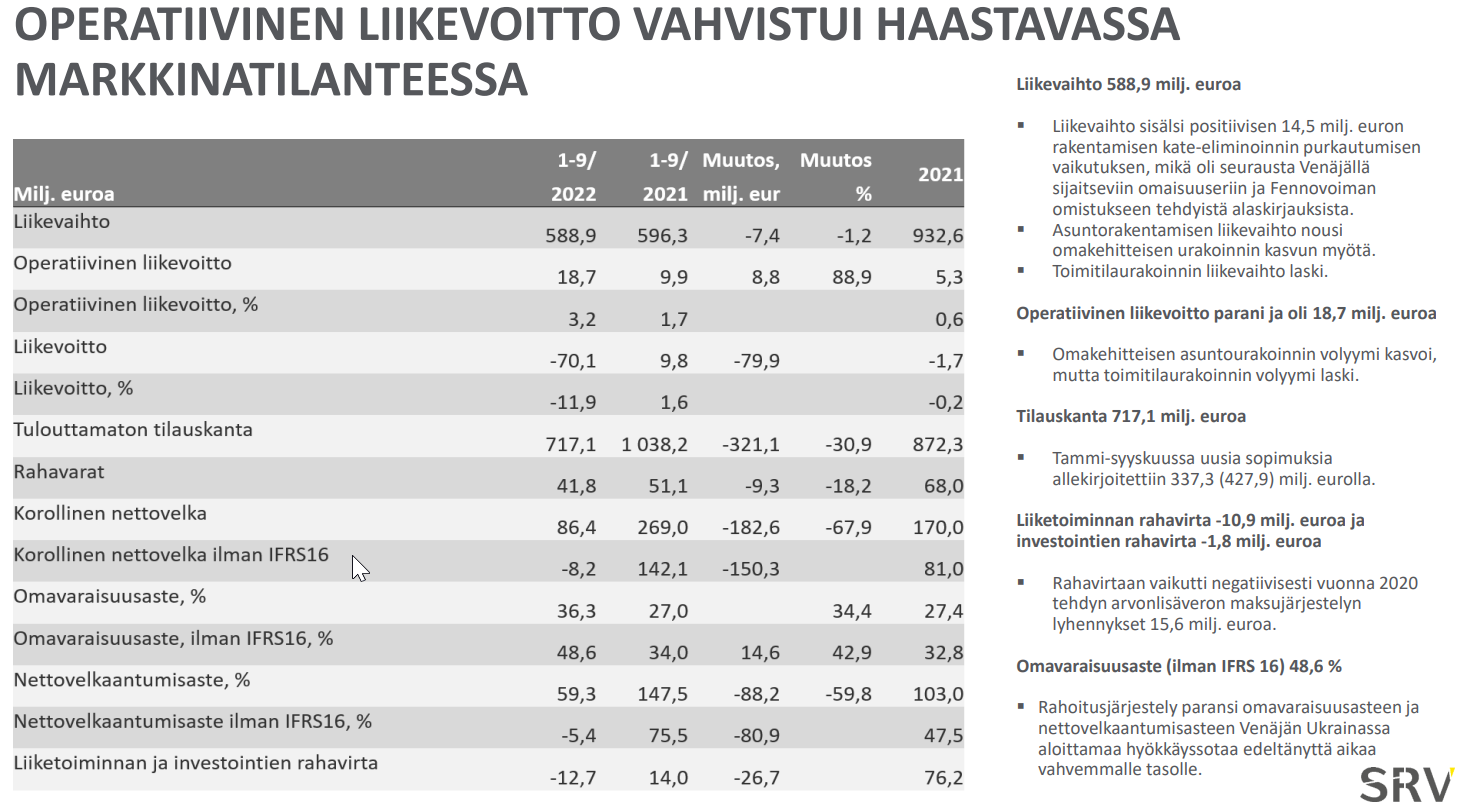
Earnings Presentation,

Cash and cash equivalents €41.8 million,
Interest-bearing net debt excluding IFRS16 -€8.2 million, meaning interest-bearing debt of €41.8-€8.2 = €33.6 million

@Olli_Koponen, do you know why interest-bearing net debt including IFRS16 is €86.4 million?
What kind of premises could a construction company have leased for such a large amount, or is it related to construction site plots or something similar?

https://files.srv.fi/uploads/2022/10/2022_Q3_SRV_osavuosikatsausesitys.pdf

1 Like

It’s not just about renting premises; it also relates to work in progress and inventory.

1 Like

Our optional leasehold plots are listed below. For example, plots for housing projects.

2 Likes

Doesn’t that include ground leases during construction?

1 Like

It is precisely these two above that this relates to!

Analyst’s morning comments:

1 Like

Question for @Olli_Koponen regarding SRV’s equity-like loan. Or rather, a confirmation that I have understood its structure somewhat correctly. :smiley:

  • The company can redeem it before June 30, 2026, by paying the nominal value of 57.1 million euros to the bondholders.
  • The company does not pay interest on this loan, nor does it have any specific repayment date.
  • If the company does not redeem the loan before the given date, a convertible bond-like condition comes into effect, giving the bondholders the right to convert their receivables into shares at a subscription price of €4.00/share → is there any maturity date for this “call option”, or in a situation where SRV’s share price would be significantly below that subscription price from 2026 onwards, would that loan remain “forever” on SRV’s balance sheet without ever being paid off or having interest paid on it?
  • At what prices should SRV’s share trade for it to be worthwhile to pay off that loan before the “due date” of June 30, 2026? So that the company could avoid significant dilution of the share capital if the share price were significantly higher than the conversion price of €4.00/share? If we theoretically consider that the company could, for example, implement a directed at-the-market share issue to raise the nominal capital of 57.1 million euros for repayment.
3 Likes

You’ve understood the main points correctly.

If the share price is below that, it’s not worth converting to shares, but in principle, as I understand it, you won’t get your money back otherwise, because “the loan has no repayment date, and it does not oblige the issuer to pay interest.” If the share price is above that and the business proceeds in the right direction, SRV should be able to clear the loan easily before that.

1 Like

Inderes lowers the target price, apparently with low confidence that SRV will achieve a moderate earnings target
 Those 2023/4 earnings figures would already come in with 1.3% & 2.0% net profit margins. But, we have seen that they might not materialize.

Inderes: 5.30 (add) → 4.60 & add

Valuation is not expensive
SRV’s share valuation is not expensive considering the current and next year’s earnings level. In 2022, the share valuation (22e EV/EBIT (adj.): 8x, P/E: 6x) is moderate and does not change significantly in 2023 (EV/EBIT: 8x, P/E: 7x).
At the lower end of our accepted valuation range (EV/EBIT: 10x, P/E: 8x) and leaning on next year, there would be upside potential in the stock. The earnings-neutral EV/Revenue is starting to be at the level of a crisis company (2022e: 0.2x), which in our opinion also limits the biggest downside in the company. Compared to peers (median 23e EV/EBIT: 10x), there would also be a small upside in the valuation. Our DCF calculation value (6.0 euros) is also higher, although there is still uncertainty regarding sustainable profitability. In our opinion, with the decrease in balance sheet risks, the removal of Russian risks (Russia option), and an operationally better earnings level found, one can get into the turnaround of the stock cheaply now.

Evli has also assessed SRV. It looks cheap, but it needs to provide proof of results so that the valuation can rise to the level of its peers
 This is how it is when you have performed poorly for years.
For 2022, Evli apparently does not adjust for Russian shopping centers (write-downs), whereas Inderes does.
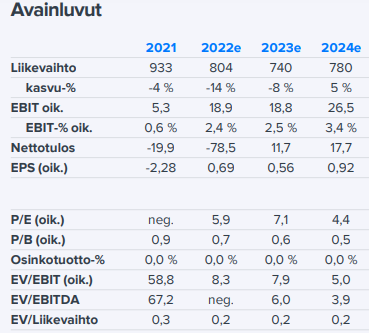
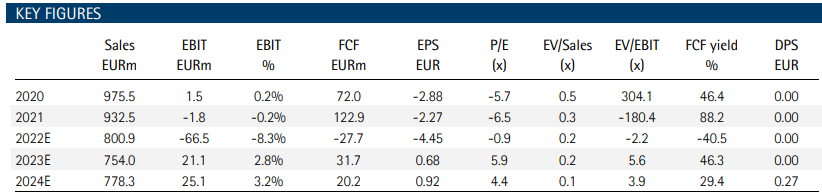
2023 EPS 0.68 EUR vs Inderes 0.56
2024 EPS same 0.92 EUR as Inderes

Evli: 5.0 → 4.3 EUR & Hold

Although valuation looks cheap, with the market challenges we see little potential for materialization of valuation upside compared with peers in the near-term. In the mid-term, improved margins and initiation of dividend payments could act as a catalyst, again however limited by current uncertainties. We retain our HOLD-rating with a TP of EUR 4.3 (5.0).

Key figures in the table when the share price is 4.03 EUR:

https://www.evli.com/equity-research/companies/srv
https://www.evli.com/hubfs/ERP/Raportit/SRV/SRV%20221028%20Q3%20Company%20update.pdf