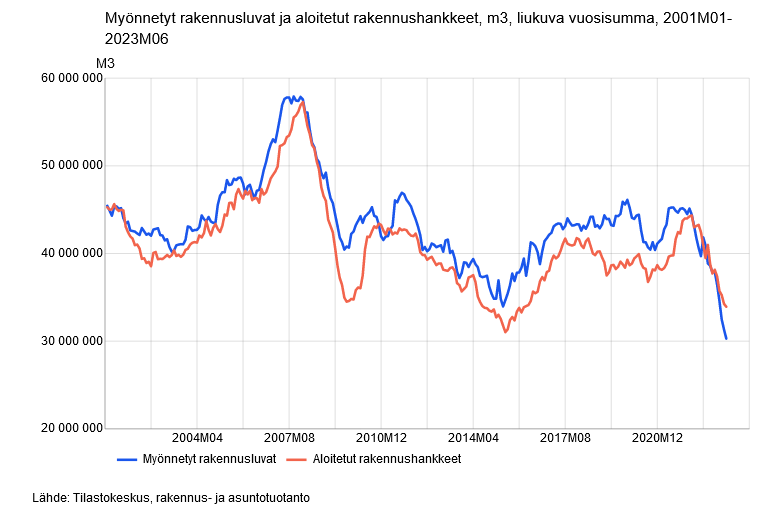
The construction industry is in turmoil. Let’s create a dedicated thread for it, where general discussion can be centralized and doesn’t have to be scattered across company threads and the coffee room.
Let’s start with a small poll: The construction market will change so that the thread’s name can be changed to something more positive…
It looks pretty bleak in Eastern Finland, for example; it feels like even designers could use more work.
Housing permits were down 58%, I think? In the public sector, I guess they’re building schools etc.?
A crystal ball would be handy right about now. How long will this slog last? According to the construction industry, there will already be a housing shortage in growth centers by 2024. This would suggest not for much longer. Variable-rate loans won’t necessarily stall construction indefinitely. With fixed-rate loans, renewing the collateral when moving to a new property pushes the interest rate through the roof. With variable rates, moving house doesn’t increase interest costs in itself; only a more expensive pad does. The poor financial situation of construction companies is due to rising building material costs and previously agreed delivery terms. Once these issues are resolved and buyers adjust to the interest rate environment, the situation could improve surprisingly quickly.
I don’t think a crystal ball is really needed here. Just let the knife fall and wait patiently for the bottom to eventually be found. Instead of being spooked by the sector’s wave of bankruptcies and visible corporate crises, you have to think that yet another competitor is out of the game and more cheap labor is being released into the market.
Finland is full of apartments in the wrong locations, so housing production will inevitably recover at some point. As long as you get in on the coming upturn at a reasonable price and the investment target doesn’t have to do a rights issue at bottom prices, things should turn out quite well for the investor.
I wonder if it’s the case that YIT and others aren’t lowering apartment sales prices but instead offering other benefits (paying 2 years of living expenses) so that they don’t have to write down inventory and worsen the cash crisis?
Oh, those were the days when YIT’s share price multiplied under the leadership of Reino Hanhinen from 2002 onwards.
It seems that times really are tough in the construction industry right now.
I was told at the firm that the starts scheduled for February are being postponed until around summer. A certain larger main contractor has shockingly bad news for the upcoming year. Our company is a subcontractor.
The situation is certainly interesting, to say the least. Considering rental levels, it doesn’t really make sense to buy new right now, especially in the capital region, with current interest rates. At the same time, rental levels are so low that you have to wonder if it’s even possible to stay above water.
Indeed. If price increases don’t pass through the entire food chain, there will be a sufferer at some point, and activity will decrease. In my opinion, apartments being completed nowadays are generally outrageously expensive, but the wild thought is that if everyone had been able to pass on the costs to prices, they would be even more expensive.
Currently, we are living in a “world of preliminary requests for quotes.” Fewer projects are being started than usual, and correspondingly, a disproportionately high amount of investigation is being done into project costs to aid decision-making. At some point, when the prices of raw materials, construction products, and materials have fallen so that construction companies’ quotes fit within developers’ budgets, projects will be started. Now, everyone at different stages of the food chain has a different situation and order backlog, and those who are running out of work will lower prices, even by compromising on margins. It will take time before raw material and material prices come down naturally to the point where construction costs match the current interest rate and yield expectation environment.
According to the construction industry, there will already be a shortage of housing in growth centers in 2024.
When discussing housing volumes and needs, it’s always worth considering who has what interests. Naturally, the construction industry wants to see it that way, but at the same time, one must ask what demand levels that view is based on? Of course, if you assume that the housing sales of the golden years will be repeated, you get certain figures. At the same time, a calculation has been presented that, relative to current demand, there are, for example, enough completed apartments in Espoo for 3 years’ worth of needs.
What would the situation look like if the Eye of Mordor known as housing allowance were to be addressed? Would living in smaller quarters, living outside the city center, or shared housing slowly start to become palatable, or what would happen?
Once, a construction company executive remarked at an event that he would not invest his own money in two sectors: 1) the construction industry 2) the sawmill industry. Supposedly, the construction industry is the first to drift into a recession and the last to get out, and the sawmill industry simply lives in a cycle where one good year is followed by a large number of bad years.
That statement stuck with me; the guy presented it quite convincingly. Of course, I haven’t exactly followed that wisdom, as Kreate is the largest company in my portfolio.
SRV and Lehto have destroyed shareholder value almost completely, and YIT isn’t much better. One can only imagine how many retail investors have burned their fingers on these and caught a falling knife just because they can get in “cheap.” You must have nerves of steel to endure watching a years-long dive and keep adding more to your portfolio on the way down, provided you believed in a turnaround. Mind you, it hasn’t always been this way, as YIT was once the “star company” of Helsinki.
A wave of bankruptcies can create conditions for the growth of the best companies. However, in 2024-2025, the slowdown in the construction sector will only truly begin to show, as almost no new developments will be completed. This year and part of next year, old projects are being finished.
It remains to be seen whether unsold new developments will soon have to be sold at actual fire-sale prices.
It’s hard to imagine an asset class that wouldn’t have some leaner years every now and then. Real estate investors haven’t experienced this in 30 years, so it’s causing a bit of the jitters.
It could certainly be that at some point there will be a clear step-up in rents, or interest rates will bottom out again. Until then, this looks more like charity work, providing housing at cost to those who need it.
Rents are not the problem. If rent levels are proportional to people’s ability to pay, etc., they are at a reasonable level. The problem is the thousands of apartments built over the last few years at far too high a cost, which do not fit into this equation. Construction has that fundamental flaw of being slow to pivot. If it’s decided now that Finland needs more studio apartments, then by the time those studios have been built in every nook and cranny a few years later, they won’t be needed so much anymore. The same applies to price levels. The fact that one year everything sells at any price doesn’t mean that situation will continue. Think about it: the year before last, 47,000 apartments were built. In Finland. Last year too, 38,000. And they have high price tags.
Hard to see a massive rush in new construction
Yeah, at least it’s not expected in the coming months.
Quite a discrepancy in rents in the capital region. Even in Helsinki, you can find small apartments for rent quite affordably in older buildings and so-called less desirable residential areas. The prices of new builds are just so staggering that significant rent increases would be needed for the rental operations to be considered a viable business.
I suppose the market situation will level out over time.
I second Eka on this. Exactly when it feels like there is no hope in the industry, that is the time to invest in it. Not when hope is already in sight and construction starts up again. Or you can still invest then, but you’ll miss out on the best returns. The situation in the sector is miserable, but construction in Finland isn’t going to end; right now, we’re taking a breather and then we’ll get going again.
Lots of bankruptcies already at this point, and in my opinion, we are still just at the beginning of the crisis. Looking at Etuovi, there are so many unsold apartments with these mid-sized players, and many seem to have heavy debt loads. New ones will continue to be completed for a good while yet. Even YIT is so indebted that almost anything is possible. There are certainly stronger players in the mix, like Skanska, and they will probably scavenge the best bits.
At some point, there will likely be pressure for the state to come to the rescue in Finland as well. Will it be direct support for companies, or something else? The state’s finances are so tight that I would guess it’ll be some kind of tax incentives instead. For example, the transfer tax (varainsiirtovero) might be abolished. My own guess is that by the time the state starts providing support and interest rates drop, there will still be plenty of time to get into these stocks.