Space Exploration Technologies Corp. - SpaceX

I invested in SpaceX ahead of a potential IPO (indirectly):

An IPO has not yet been announced, but SpaceX’s recent acquisition of Starlink and Musk’s xAI company suggests that an IPO may be in the works.

Although the company still feels relatively new, SpaceX successfully launched its first rocket 18 years ago. Since then, it is reported to have earned about $20 billion in government contracts, and Morningstar recently reported that it made a profit of about $8 billion on $15 billion in revenue in 2025. One significant caveat: Morningstar’s estimates reflect the recently combined SpaceX-Starlink-xAI entity, which is reportedly taking on significant debt as part of the restructuring. Since financial data for private companies is not disclosed, it is unknown how much of this estimated profit remains after interest expenses—or how much of the IPO proceeds might be earmarked for paying down that debt. The company’s success with Starlink is likely to help keep its margins high.

Personally, I chose the ARK Venture Fund from the various options—i.e., SpaceX owners—in which SpaceX is the largest holding with a 17.96% share. Of course, there would have been other options, e.g., DXYZ, XOVR ETF, and Baron’s funds, and on the equity side, e.g., EchoStar. With this ARK fund, I got some other interesting things as well: they also own shares in Anthropic, which is the fastest-growing company in history, with revenue having increased 10-fold for three consecutive years, which is unprecedented, and Anthropic is also expected to IPO this year. They also own, among others, OpenAI and Groq, in which NVIDIA just made its largest investment ($20 billion). Private companies make up 85% of this ARK’s portfolio.
https://www.reuters.com/business/finance/spacex-generated-about-8-billion-profit-last-year-ahead-ipo-sources-say-2026-01-30/

15 Likes

Which platform did you buy it through? I don’t think that fund is available for purchase here in the EU?

3 Likes

Baillie Gifford also has it. Available from Nordnet, for example. The costs are significant, of course, as it is listed in the UK (stamp duty, etc.). Holdings | Scottish Mortgage Investment Trust

5 Likes

Patrick Boyle has timely released a video today about SpaceX’s IPO. I recommend watching it. If you aren’t familiar with Patrick Boyle, he’s a former trader and portfolio manager from London and NYC. He currently teaches at King’s College and is a private investor.

Edit: Strong recommendation to watch, and apologies that I can’t summarize the video while preserving the dry British humor. At the end of the video, there’s also an interesting section regarding low-float IPOs and their inclusion in indices, even if you’re not directly interested in SpaceX.

10 Likes

In the EU, the ARK Venture Fund is not listed, nor are those couple of other funds I mentioned, but I have a broker in the US through whom everything listed there can be purchased.

2 Likes

Related to this, I came across a good post on X regarding IPOs: Nasdaq's Shame - Keubiko’s Musings

Nasdaq’s proposed rule change reeks of the index being harnessed to serve mega-IPOs. If a giant like SpaceX gets in through an exception route despite a small free float, index funds could be forced to buy the stock in a tight market. This could artificially inflate the price immediately after listing. And when the lock-up later expires, passive money could be left propping up the price while insiders sell. It’s an ugly setup from the perspective of an ordinary index investor.

19 Likes

Summary of Patrick Boyle’s video produced by ChatGPT 5.4:

Here is a concise summary. I wasn’t able to open YouTube’s own transcript in this environment, so this is based on the video title/metadata and an external content summary. This refers to the video “SpaceX IPO Scandal” published by Patrick Boyle on March 14, 2026. (YouTube)

The video’s core claim is that a potential IPO for SpaceX would be structured in a way that primarily favors current owners and insiders. Boyle suggests that a target valuation of approximately $1.75 trillion, a small public float, and rapid entry into indices could drive up the price without proper price discovery. (Podwise)

Another major theme is the shift in SpaceX’s narrative. Boyle describes that the discourse no longer relies solely on the vision of Mars, but more on the Moon, AI infrastructure, and shorter-term funding needs. In this framework, the merger of SpaceX and xAI is also presented as a way to support the massive valuation, even though according to him, xAI’s business quality, market position, and cash burn raise many questions. (Podwise)

Boyle is particularly skeptical of the idea of space-based data centers. He treats it more as a science fiction sales pitch than a realistic business for the coming years, emphasizing the problems with technology, energy, launch costs, and practical implementation compared to terrestrial data centers. (Podwise)

In his financial analysis, Boyle questions how sustainably SpaceX’s earnings potential and total addressable market can be justified. According to the summary, he highlights, among other things, EV/Sales valuation, Starlink’s true market potential, the quality of EBITDA, and the impact of depreciation and investments, i.e., whether the numbers look better than the business’s actual cash economics. (Podwise)

In the end, Boyle’s conclusion is quite grim: in his view, the risk in such an IPO is that public investors will eventually end up as “bag holders”, while early owners, founders, and other privileged parties reap the greatest benefits. The tone of the video is thus clearly cautionary, not neutral. (Podwise)

My own one-sentence summary of the video: Boyle isn’t necessarily claiming that SpaceX is a bad company, but rather that a potential IPO structure and the associated AI/index narrative could make it a bad deal for public investors. (Podwise)

10 Likes

Now it seems Alphabet also has an ownership stake in SpaceX.

A routine regulatory filing in Alaska has pulled back the curtain on one of Alphabet Inc‘s most valuable hidden assets: a stake in SpaceX that could soon be worth roughly $122 billion.

4 Likes

If you’re into rocket porn, then here you go:

Good summary. This reeks of an absolute cash grab from a mile away. Exceptionally brazen behavior, and index investors are the ones footing the bill.

6 Likes

Damodaran valued SpaceX a moment ago as well as it can be valued given the current limited information.

I also shared some thoughts regarding SpaceX in the Coffee Room based on Damodaran’s video.

10 Likes

SpaceX’s listing report was published, just as Verneri advertised in his “Vartti” segment. The first sentence of the Mission Statement: “Our mission is to build the systems and technologies necessary to make life multiplanetary, …” Human physiology cannot withstand the conditions of space for long. Even less understood is that the human psyche cannot withstand space conditions. Evolutionary biologists can explain this if anyone bothers to listen and wants to understand. — There may be many useful and valuable technologies in the company, but the core idea (at least what is being fed to the public) is pure nonsense.

16 Likes

@Alex_af_Heurlin1 and @Elina_Lappalainen discussed SpaceX :slight_smile:

SpaceX is preparing for the largest IPO in history. The company is aiming for a valuation of $1.75 trillion, which would make it one of the largest public companies, positioned between Nvidia and Meta.

The HS Vision podcast reviews SpaceX’s IPO financials, rockets, and AI businesses, as well as why even Finnish index investors will end up as owners of SpaceX whether they want to or not.

In practice, Elon Musk cannot be fired from the company he takes public. His massive compensation package is tied to a Mars colony of one million people.

In the studio, journalists Alex af Heurlin and Elina Lappalainen. The episode was edited by Jonne Piltonen.

8 Likes

Starlink is surely actually a good business and is raking in money.

There is also plenty of demand for launching cargo into orbit, ranging from the private sector all the way to government actors. Of course, in the rocket business, R&D and other costs are staggering, but the potential is there.

What I don’t understand is why the AI money pit had to be baked into SpaceX. Isn’t that mostly a dead weight?
Grok is by no means at the forefront of AI models, and xAI has apparently been selling compute from its data centers to Anthropic so that the data center doesn’t just sit there idling.

7 Likes

I made a summary of that Damodaran video. At a price of $1.2 trillion, he would be a buyer.

Summary

Aswath Damodaran analyzes SpaceX’s potential upcoming initial public offering (IPO) and performs a valuation of the company through three different business units in his video “To Trillion(s) and Beyond: The SpaceX IPO Odyssey” [00:10].

1. SpaceX’s Three Businesses and Damodaran’s Scenarios

Since an official IPO prospectus is not yet available for SpaceX, Damodaran divides the company into three parts and builds a specific “narrative” for each, which he then translates into numbers [01:33, 09:43]:

  • Space Launch: SpaceX currently dominates an estimated 80%+ of the market thanks to its superior cost advantage (reusable rockets) [10:46, 10:52]. Damodaran predicts the market will grow from $30 billion (2026) to $100 billion by 2036 [11:31]. He estimates SpaceX will maintain a 70% market share, as some nations prefer their own operators for national security reasons [11:48, 11:56].
  • Satellite Internet (Starlink): This is the company’s “hyper-growth” engine, contributing approximately 65% of 2025 revenue [05:56, 06:01]. While satellite internet lags behind traditional fiber and cable in quality in urban areas, the global internet market is massive ($1.0–1.6 trillion) [12:30, 12:58]. Starlink has a head start (over 10,000 satellites), and it is difficult for competitors (like Amazon’s Project Kuiper) to catch up—and even they must use SpaceX to launch their satellites [13:13, 13:31].
  • Artificial Intelligence (xAI / Grok): In February 2026, SpaceX acquired Elon Musk’s xAI company [04:47]. Damodaran sees Grok currently lagging behind OpenAI, Claude, and Gemini in enterprise clients [15:42, 15:55]. In Damodaran’s scenario, xAI leaves the expensive and competitive enterprise market to others and focuses on consumer subscriptions and a coding niche (following the Cursor acquisition), implying a smaller market ($80 billion in 2036) but higher margins [16:41, 17:19].
  • Expansion options: Additionally, Damodaran includes $50 billion in extra revenue from potential future markets, such as space tourism or space-based data centers [12:02, 19:39].

2. Financial Figures and Valuation

Damodaran uses leaked/estimated figures from 2025 as a base, according to which SpaceX generated approximately $15.5 billion in revenue (Starlink $11 billion, launches $4 billion) and $8 billion in EBITDA [06:24, 06:34].

Based on these, his 10-year forecast model (to 2036) for the consolidated businesses looks as follows [20:01]:

  • Revenue: Grows from approximately $16 billion to nearly $320–333 billion [20:17].
  • Operating Margin: Rises significantly due to economies of scale, reaching near 48% [20:33].
  • Cost of Capital: Damodaran uses a moderate discount rate of about 8%, as company-specific risk is diversified in an investor’s portfolio and the uncertainty also contains significant upside potential (upside uncertainty) [22:54, 23:13].

With these assumptions, Damodaran arrives at an Enterprise Value of $1.2 trillion for SpaceX [21:12].

He also conducted a Monte Carlo simulation (with revenues and margins as variables), which gave a median value of $1.28 trillion, though the value could vary widely between $660 billion and $2.8 trillion depending on how uncertainties unfold [23:32, 23:54, 24:10].

3. Challenges of Market Pricing and Peer Group

Damodaran points out that in IPOs, bankers and investors often price a company using multiples instead of calculating its intrinsic value [24:54, 25:06]. In SpaceX’s case, this is exceptionally difficult [25:42]:

  • No true peer group: In the launch business, Boeing or Northrop Grumman are too conservative and low-margin companies [27:09, 27:16]. In the data space, Palantir is a completely different type of software company [27:29]. Telecommunications companies, meanwhile, do not match Starlink’s growth [27:36].
  • Multiples: If current revenue is compared to private market prices, the multiples are astronomical [26:20]. Bullish analysts will therefore use pricing based on revenue forecasts 5 or 10 years into the future to justify high prices [26:42, 28:37].

4. Conclusion: Would Damodaran Buy?

Damodaran considers SpaceX to be Elon Musk’s most impressive achievement and a “genuine company of the future” [29:30, 30:47]. However, he reminds investors that they must accept the “Musk package” in its entirety—a genius and visionary, but at the same time an unpredictable and flawed leader [31:07, 31:21].

  • At the rumored IPO price of $1.7–2.0 trillion, Damodaran would NOT buy the stock, as he believes it is too expensive and the upside remains limited [22:04, 24:19, 30:55].
  • At a price of $1.2 trillion, he would be a buyer [31:02].
  • He strongly warns against betting against the company (shorting), as the narrative can change quickly, as seen with Tesla [29:51, 30:34].
8 Likes

Elon Musk likes messy companies. The electric car company Tesla turned into an energy company with its solar panel and battery businesses, until they started investing in self-driving software and robotaxis, and most recently, the dancing robot-guy Optimus, which produces nothing but a loss. For Musk, this also provides an opportunity to dangle some new investment story “pot of gold” in front of the markets whenever the fulfillment of previous goals slows down or is blocked entirely. The markets certainly forgive investors for previously stated scams, as long as something completely revolutionary is promised to come out again within the next couple of years.

It is very easy to predict that SpaceX’s dependence on space will also be diluted in the near future, and many other new businesses will be crammed in alongside AI. This combination of independent businesses has worked excellently for Amazon and has also made Musk the world’s richest man, so perhaps in Finland we just don’t understand the value of business conglomerates :man_shrugging:

22 Likes

Esa Juntunen, also known as @Omavaraisuushaaste, has also written about SpaceX :slight_smile:

SpaceX’s listing on the US stock exchange is either the beginning of a new era or the end of a specific era. There is really no middle ground.

Today, I will exceptionally go through the listing of a US company, as it is so significant to me, to equity investors, and also to fund investors in general (and I will address all these aspects in this text).

This IPO analysis partly resembles my traditional analysis structure, but because this is such an exceptional offering, part of the analysis structure is slightly different. I hope you enjoy it – the SpaceX IPO is a true gold mine for an investment nerd like me, and the research and writing done for this text was exceptionally fun.

16 Likes

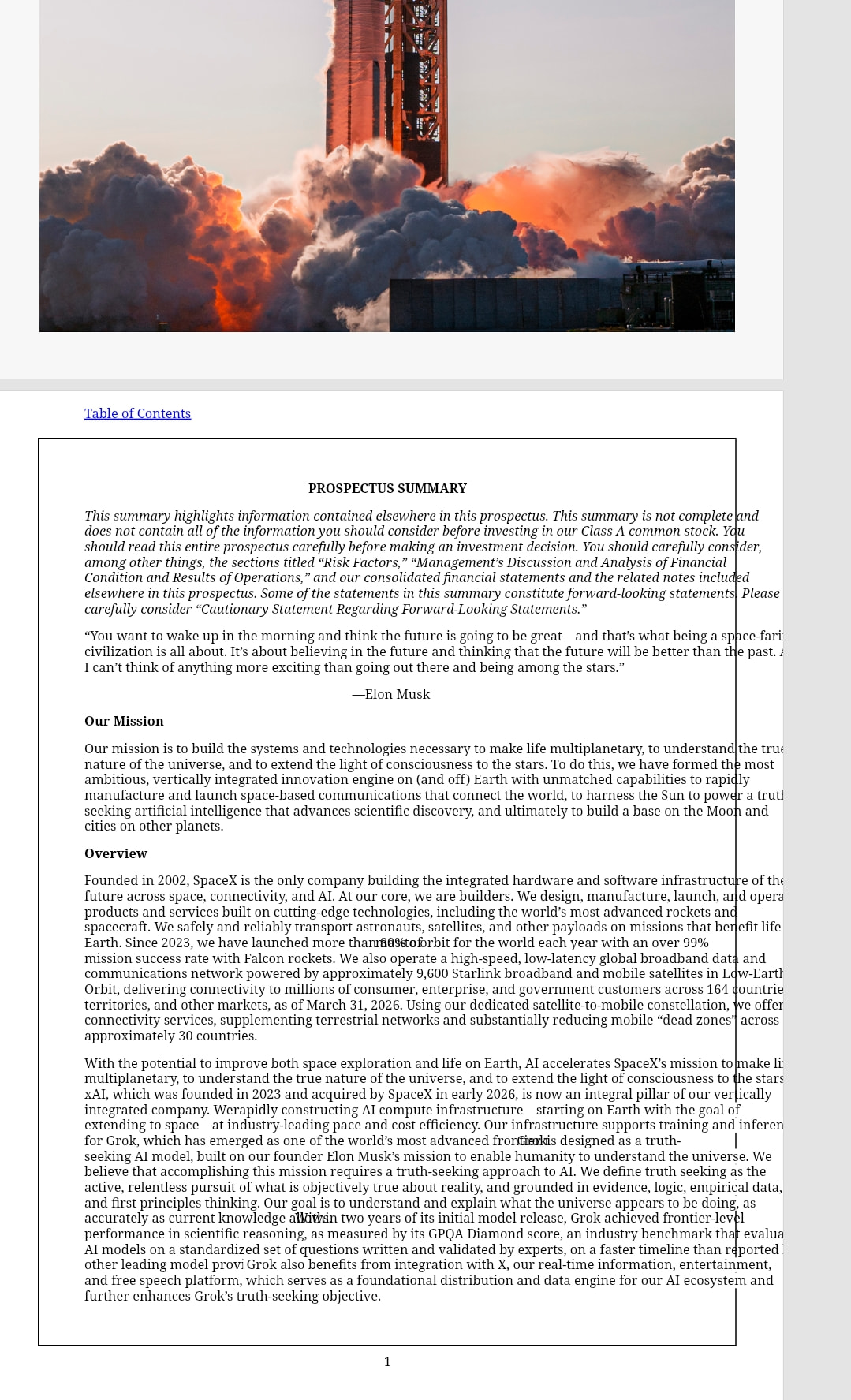
Before SpaceX starts building a colony on Mars, they need to solve the problem of how to keep text within the margins.

Or is the fault on this side of the screen?

https://www.sec.gov/Archives/edgar/data/1181412/000162828026036936/spaceexplorationtechnologi.htm

24 Likes

By popular demand, the SpaceX Quarter (SpaceX-Vartti) is ready!

The space conglomerate SpaceX is planning the biggest IPO of all time. The only certain thing is that this is not a boring investment!

While SpaceX is known for its rockets, the real money is made by the Starlink satellite business. In addition, just before the IPO, xAI was merged under SpaceX, which also makes it an AI company.

00:00 The IPO of all time

01:27 Special terminology

03:50 Mission

04:58 SpaceX development

05:45 Dividend policy

06:06 The recipe

07:46 Asteroid mining

08:05 SpaceX

09:08 Starlink

10:00 xAI

12:35 TAM

14:35 The numbers

16:25 Risks

21:20 Valuation

23 Likes

Earlier in this thread, there were questions about how an investor could gain indirect exposure to SpaceX. I personally hold Stack Capital Group, Inc. (Toronto: STCK) in my portfolio, which has ownership in SpaceX among others. I am seriously considering whether I should exit this position now that the company’s valuation has surged nearly 200% in six months due to the SpaceX IPO hype. Riding along with Elon Musk’s visions with my own money doesn’t feel particularly attractive for several reasons. However, STCK’s share in my portfolio is quite marginal, so in 그 respect, I can still afford to follow the stages of this drama for a while longer.

8 Likes