I will try to summarize briefly and concisely:
GENERAL INFORMATION ABOUT THE COMPANY
-Founded in 1999, focusing on eye-tracking technology/software. The technology recognizes, understands, and predicts human actions and intentions by studying eye movements. Eye tracking can thus lead to conclusions about an individual’s alertness, consciousness, attention, etc. The technology uses infrared light to create reflections, which are then captured by cameras and analyzed by algorithms and software. More about the technology can be found here:
 smarteye.se
-Target market: automotive industry
-Listed in 2016. Current CEO Martin Krantz founded the company together with his father Mats Krantz. Mats is still on the board. Both have a large position in the company.
-Main product is software. This means a gross margin of 100%, not a capital-intensive business where factories are built with concrete and gross margins are max 30%, 40% or 50%. This enables a high operating profit margin in the future.
BUSINESS MODEL
-In the automotive industry value chain, there are OEMs (manufacturers e.g., BMW), Tier 1, and Tier 2 suppliers. Smart Eye belongs to Tier 2. Cameras and other hardware components are produced at the Tier 1 level (Bosch, Delphi, etc.) or by their other Tier 2 partners.
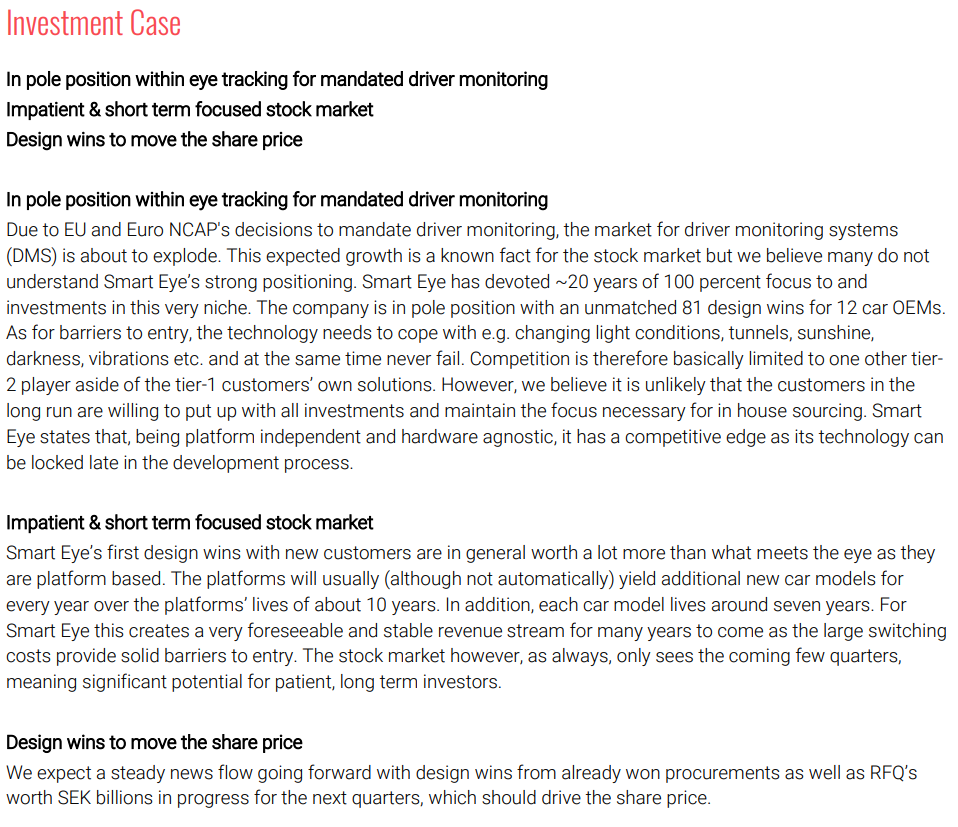
-Tier 1 does not focus on Smart’s technology area. This is demonstrated by Smart’s and a few other Tier 2 suppliers’ Design Wins.
-Car manufacturers generally produce several car models on the same platform, which means that a win for one car model (DW = design win) usually leads to other design wins. This creates barriers to market entry once you have secured several wins from the same car manufacturer.
MARKET POTENTIAL
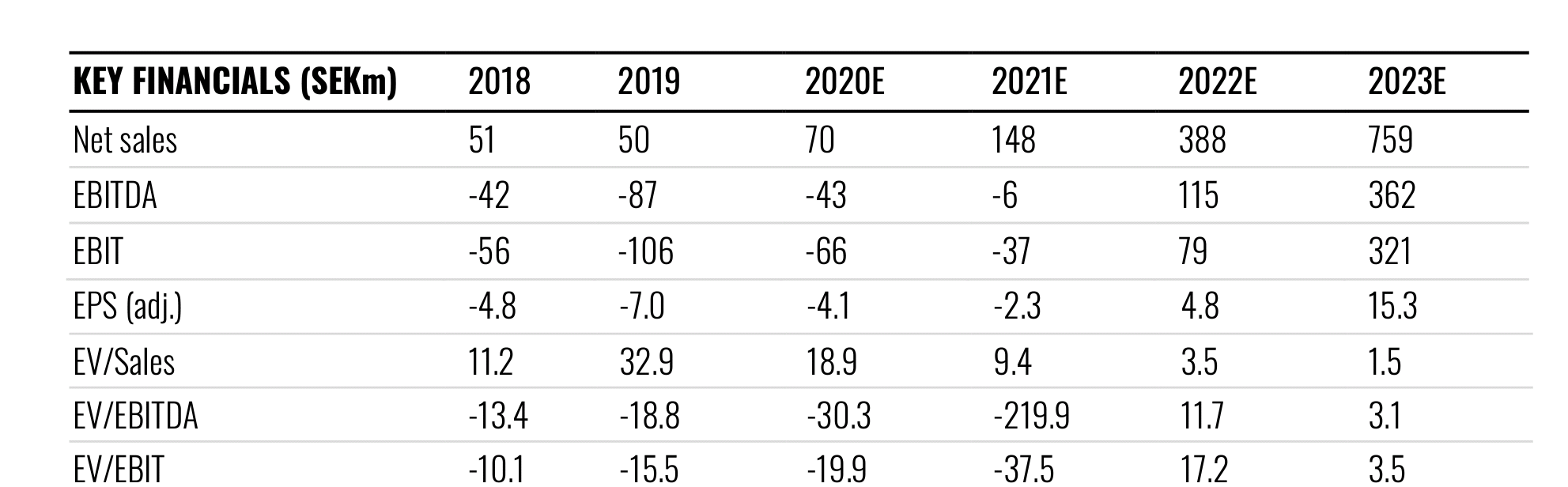
-The DMS (Driver Monitoring Systems) market is expected to grow strongly, with approximately 30-50 million DMS devices in cars by 2026, meaning about 30-50% overall penetration (around 100 million new cars sold annually).
-Euro NCAP plays its part in Europe:
Euro NCAP agrees camera-based DMS crucial to prevent driver distraction | Safestocks
-More on regulation related to China and the US here:
smarteye.se
-Regulation is progressing because 1.35 million people die in traffic annually:
Road traffic injuries (who.int)
-Smart Eye sees the total market potential at over 1.5 billion euros. This includes current DWs, potential additional DWs in the car platforms where Smart is present, and expected nominations within the next 24 months. In addition to this, there will be subsequent rounds. This 1.5 billion refers to the revenue over the entire lifecycle (approximately 14 years per platform).
-Smart earns revenue primarily through royalties, i.e., per car sold. As a rule of thumb, 5-10 euros per car sold.
COMPETITIVE LANDSCAPE
-Practically four players. Smart Eye, Seeing Machines, Fotonation, and Cipia. So far, Smart has about 65% market share of all Design Wins.
-The competitive situation looks very good for Smart, at least in the next tenders. The main competitor, Seeing Machines, is still looking for its own strategy, and as I understand it, they have not been visible in the RfQ phase recently. Here is @Aston_Livingstone’s writing on RfQ etc.:
- RfQ → Design Win obtained → X months for Design Win to be published.
- After that, 1-3 years of development phase, during which the car model is designed.
- After design, the car model goes to production (1-3 years after DW).
- Car model on production line + X months, after which Smart publishes the model.
-Why Smart has won so many DWs compared to others:
- Over 20 years in the business.
- German car manufacturers as clients. This is a sign of quality.
- No problems with the reliability of the technology.
- Has demonstrated to clients that it can continuously improve its technology.
- Hardware agnostic. The software works with all hardware.
REVENUE POTENTIAL
-Calculation to the end of 2025
-Revenue potential depends on the following assumptions:
- DMS penetration (management/market assumption).
- Smart’s market share (so far 65% and the next 2 years look very good. Competition will likely intensify later).
- ASP = price per car. Currently at the high end (5-10 euros) but may drop in the future.
- Other revenue. A small role vs. royalties. Upside if, for example, AIS succeeds. I will leave this untouched.
- Opex. Operating expenses, i.e., selling expenses, etc. My understanding is that it should not rise much from the current level of approximately EUR 20m per year.
- Valuation. In my opinion, a very reasonable assumption for a software business. I am playing it a bit safe because the EBIT margin rises so high in the calculations. On the other hand, I believe Redeye is conservative when it comes to margin forecasts.
A FEW KEY IMAGES
About the technology
About Design Wins and potential
About the Automotive Value Chain
From Design Wins to production
Platform lifecycle
Competitive landscape
Market potential
Investor Presentation from September 2020
[/quote]02_Smart Eye.pdf (3.0 MB)