Good comment, thank you for it. However, I wouldn’t let Redeye’s analyst off the hook quite that easily for such a glaring forecast bias, which is well illustrated by this:
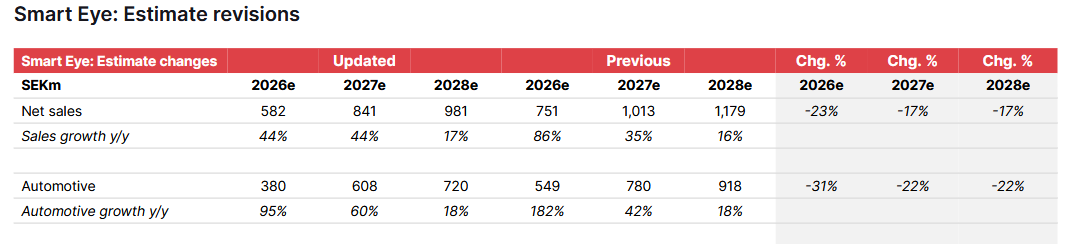
RE cut its Automotive revenue forecast by 169 MSEK after the Q2 earnings report. In my opinion, we have good reason to assume that this cut applied to European license revenue, as that has been the biggest growth driver for Automotive this current year. When that 169 MSEK is divided by an ASP of 42 SEK, the result is roughly four million cars.
Smart Eye’s Automotive revenue is still well on track to at least nearly double this year; RE is forecasting 185 MSEK in growth:
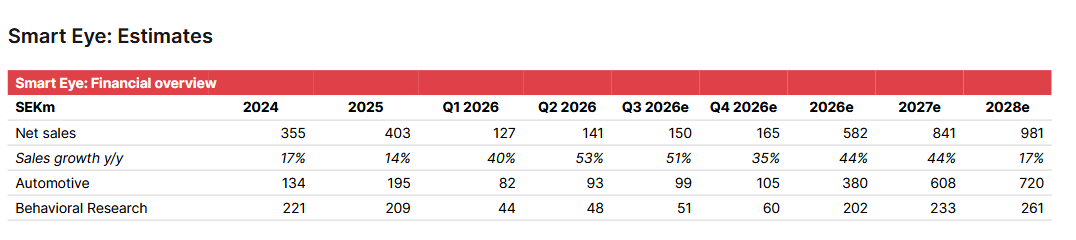
The revenue growth is largely based on EU regulation, and as a rough estimate, Smart Eye has received/is receiving license revenue from cars sold in the EU area for at least 4 million vehicles. Fewer than 11 million cars were sold in the EU area in 2025 [Note: likely referring to annual sales context], and to reach Redeye’s previous forecast, Smart Eye would have had to get license revenue from 8 million cars. This would have meant a ~75% market share of the market; the actualized market share is somewhere between 35-50%.
In my opinion, this well illustrates the unrealistic expectations Redeye had regarding revenue development. This kind of miss in forecasts cannot, in my view, be justified solely by a lower-than-expected ASP or wrong expectations about market share. Smart Eye’s ASP has certainly likely declined this year as sales have shifted away from premium models toward the mandatory EU cars sold out of necessity.
In my view, the expected hockey-stick effect did and does materialize this year in Smart Eye’s Automotive sector and its license revenue. However, license revenue in the EU area was previously only a small part of Smart Eye’s total revenue, and despite the explosive growth, it wasn’t enough to drive the company’s overall figures to even stronger growth than what we’ve now seen.
The company’s management certainly has a lot of room for improvement in how they communicate their future outlook to the market. With Smart Eye, however, I think it highlights very well what the end result is when junior analysts do some light extrapolating and the company lacks comprehensive coverage from multiple houses. Retail investors (“tuulipuvut”) then chase these analyses, since the big investment houses won’t touch these small-cap kiosks.