I started stock investing about a month ago and at the same time I’ve been trying to learn as much as possible about the subject so I can at least understand a little bit of what I’m doing.
So far I’ve read the following books:
Sijoita kuin Guru (Invest Like a Guru), Laatuguru (Quality Guru), Sattuman kauppaa Wall Streetillä (A Random Walk Down Wall Street), Flash Boys Kapina wall streetillä (Flash Boys: A Wall Street Revolt), Suosioharha (The Popularity Illusion), Vaurastu kuin Warren Buffet (Get Rich Like Warren Buffett) and Onnistu osakemarkkinoilla (Succeed in the Stock Market).
I have two eternal projects ongoing: Pääoma 2000-luvulla (Capital in the Twenty-First Century) and Talous ja utopia (Economy and Utopia).
What would the forum recommend for a beginner like me next? I was thinking of buying Arvoguru (Value Guru) soon, but what after that? As for my investing style, I’m slowly but surely building a long-term “dividend portfolio” with a twenty-something student’s budget, and alongside that, some interesting short-term tips. At least for now, unless I come up with something smarter 
@Tyhjatasku, if I may share some of my own thoughts.
A bit about my own history: I’ve been following the markets and investing for just under 4 years (that’s a short time, not many downturns fit into it). I’m 26 this year, and my portfolio size is 5 figures. My highest education: vocational school.
You’ve read quite a few books. In my opinion, in investing (or learning almost anything), books aren’t the shortcut to happiness, but you can get vital lessons from them. You don’t become a professional poker player nowadays just by playing. You have to study it. But also play at the same time. Experience teaches.
I’ve read a few books. I’m still in the middle of the “value guru” book that’s on your shopping list. It’s “unique” in that the content is so fresh and contains so much about companies on the Helsinki Stock Exchange, so I can only recommend it. If you get even something out of that book, it’ll pay for itself pretty quickly (was the price 20e?).
You probably already have a good foundation. If I had to sum up my thoughts, sometimes read other things besides books (like blogs). Read company announcements, earnings reports, get to know companies, dig into their balance sheets and figures. Continuously analyze your actions. Did you lose 50% on some case? Analyze why it happened. Stay informed about macroeconomics. Time and experience teach. In my own case, I’d bet that I’ve learned perhaps 5-10% of investing or related matters from books. Over time, your portfolio’s “composition” might also change as your know-how increases and, for example, a certain industry becomes more familiar to you.
I don’t want to advertise or hype it up, but the Inderes website has been a good place for me to study and follow the companies I own. You might find your own channels in the future to follow companies/markets/economy.
Remember that the stock market and the world in general have changed drastically even in recent decades (and will continue to change). No book is the Bible, and it shouldn’t be taken as such, no matter the author or publication year. Don’t blindly trust anything, and dare to criticize things (even this text  ).
).
Finally, good luck on your chosen path. Starting investing is rarely regretted, as long as you act rationally, long-term, and diversify. And welcome to the forum, there are often good discussions here.
@anon38833097 Thanks a lot for the tips!
I’m a few years younger than you, but I’ve been passively investing for just under ten years (with a buy & hold strategy). However, now I have a desire to start more actively researching and understanding stocks.
I’ve been following Inderes and the forum daily for several months now and have picked up a lot of information from here, though I haven’t dared to open my mouth before. Excellent site and community!
In addition, I’ve bookmarked a few Finnish blogs, a few sites based on technical analysis, etc. I’ve researched some earnings reports, but they feel quite heavy so far, even though I’ve completed a few accounting courses. I still lack the understanding of the essential information. That is, what to look for there. For this long, I’ve mostly tried to gauge the general feel of the company and checked the most important figures.
I think I originally picked up the idea here to start keeping an “investment diary” where one can record ideas and analyze one’s own actions.
Of the books I’ve read, Flash Boys, A Wall Street Revolt was excellent. It made me stop and question what I thought I understood about stock exchanges. A Random Walk Down Wall Street was, of course, also very comprehensive and educational.
But with these, I’ll move forward, I’ll try to gain more experience next, and I’ll add “Arvoguru” to my reading list. It costs 20e, but I think it’s a very sensible investment.
Remember that you can deduct all investment literature, including Inderes Premium, in your taxation  so it’s worth keeping the receipts.
I’ve had a little over 1 year of an investment “career” , I’m 23 years old.
I’ve read Arvo&Laatuguru’s (Value&Quality Guru’s) writings.
You can also find good reading from the following, in addition to Inderes:
- Seeking Alpha (a lot of articles about US stocks)
- Sijoitustieto (Investment Knowledge)
- Shareville
- Salkunrakentaja (Portfolio Builder)
- Various blogs
Welcome to the Inderes forums from me too! 

Yeah. Books can/should be read until the end of the world, if you like. It’s a good way to pass the time, and certainly more sensible than binge-watching TV series. But there are other ways to study investing than just books. And yes, it’s worth reading quarterly reports.
Uncle Masse reiterates his investment philosophy, mentioned above, to Tyhjätasku (Empty-pocket) as well. There is no sensible life outside Inderes. In German: “Hier ist alles”. Verpuk has already acknowledged this to some extent:
Uncle Masse, FA
Juha hasn’t written a book yet, but this latest article is a must-read for every investor
A slight home-field advantage, perhaps that’s allowed.
Great post! If all investors and business leaders understood this, we would all be playing by the same rules, which would help everyone in the long run. 5/5.
I have been thinking a lot about the fluctuation of equity risk premiums (how much greater return is required than from a risk-free investment). It is clear that it is much higher during an economic crisis than during a good economic climate when the risks are “smaller.” We can argue whether this is truly the case, but that is another discussion. I personally believe that risks are smaller in a good economic climate, but one of the market’s inefficiencies comes from excessive pessimism and optimism. Anyway, I haven’t found a good way to measure the required equity risk premium. Perhaps I haven’t researched enough, so maybe someone here has.
Does anyone have any method in mind that I haven’t looked at? I’ve looked at CAPM (doesn’t work because CAPM gives a constant value). I’ve looked at dividend growth models (doesn’t work because in an economic crisis, the assumed return on stocks would be negative, which cannot be true). I’ve looked through the stochastic discount factor (updates with national accounts only once a quarter, so it doesn’t work).
That was a good read. Thank you.
It reinforced my own decision-making
Great writing from Juha. These are always a pleasure to read. Probably not many investors think of it from the perspective that their 1000 euro investment in a company is a 211 euro share of equity, which has generated 54 euros in the last 12 months, and from which 46 euros has now been distributed (Verkkokauppa).
To Kimmo, I respond that the risk premium can vary according to the company’s riskiness. Factors increasing risk can include:
- The company’s indebtedness
- The company’s heavy cost structure (many fixed costs)
- The company’s large investment needs
- Fluctuating demand for the company’s products (if the products are luxury, expensive, or demand is cyclical)
- The company’s young age
- The company’s small size
- The company’s growth status
Giving an exact answer is probably not possible. Setting weighting factors would require research.
I was still pondering the deepest nature of return on equity. Typically, companies in industries that are not very capital-intensive generate a high return on equity. They have some special competitive factor, regulatory protection, high barriers to entry, a patent, or they operate in such a specialized field that it provides a moat. The million-dollar question is whether such a company can grow within its moat.
Let’s take as an example everyone’s beloved health technology company, Revenio Group, whose return on equity is over 40%. The company’s equity has been stuck at around 16 million for ten years. Half of the balance sheet consists of cash and receivables, which makes the result even more impressive. A company owner wouldn’t mind receiving dividends from Revenio but would gladly see all available wealth reinvested at this over 40% return. However, the profit is paid out, and the stock is challengingly priced.
So, how do we justify that Revenio generates shareholder value:
- When bought at this price.
- At all, if the balance sheet does not scale.
Perhaps I’m too fixated on the idea that invested capital is a causal factor of production. If companies don’t need capital, investors are merely observers of the work of skilled professionals. You can be the most skilled carpenter in the world, but your day only has 24 hours, so your high productivity cannot scale. I fear the same applies to companies. Only the financial world is abstract enough for the compound interest phenomenon.
Earnings season is approaching its end, so let’s nudge @Juha_Kinnunen in hopes of a response.
Good read, opening up noteworthy perspectives for investors. I also really started to think about the matter. Calculating return on capital inevitably requires also calculating and reviewing indebtedness; a high return on equity alone is not enough. Juippi did mention indebtedness in the risk premium review. For example, Verkkokauppa (Finnish online retailer) has a large portion of debt on its balance sheet but it is interest-free (correction to the text…).
Investors are good at picking stocks, but not at selling them, according to a recent academic study. Most of the energy goes into finding new purchases for the portfolio, when one should also consider what’s happening with existing holdings and whether the best expected and actual return is already behind them. On the other hand, many investors also fall into the trap of selling stocks just because they have risen.
Worth a look:
https://papers.ssrn.com/sol3/papers.cfm?abstract_id=3301277

For your information. The link showed an “oops” message.
I admit what you said.
Buying stocks is much easier than selling.
But… a holder forgives even small dips.
Thanks, it should work now!
Hi Juippi,
Great thoughts, which bring up many essential aspects of investment dynamics. Scalability and (carpenter’s) reproducibility are, of course, critical issues, and the problem you mentioned affects many companies. However, many product and even some service companies can find scalability, not to mention software or platforms. I will examine many related issues in more detail in my later articles, but I am writing some thoughts now because a good question deserves an answer.
You are absolutely right about the critical importance of the industry, and especially competitive advantage, in choosing a long-term investment. The return on capital will eventually gravitate towards the cost of capital if the company does not have a “moat” to prevent this. If the moat holds, the return on equity has the potential to remain at a very high level. This is, of course, very good for investors, but it does not automatically make the investment excellent. As you noted, that capital does not necessarily accumulate if the company cannot reinvest capital with even approximately the same return expectation. However, if the company can do this and understands how to do it, it is difficult for an investor to lose in the long run. Usually, the biggest mistakes in these investments are made when the depth of the moat is misjudged, too much is paid, and soon the return on capital (profit) is under pressure. The world is changing rapidly these days.
But to the question itself: how do you justify that Revenio creates shareholder value when purchased at the current price, or at all, if the balance sheet does not scale?
Revenio does create shareholder value continuously with those returns on capital according to my definition (and that is not the only correct one). Merely paying dividends sustainably would be creating shareholder value because equity always yields more than can reasonably be demanded from it. But this, of course, does not mean that the stock would be a good investment at any price. These are different concepts, and I will write a more extensive article on that valuation perspective later. For now, I will content myself with stating that I would consider Revenio’s return expectation weak if your assumptions held true. In a caricatured way, I assume they are, in short, that growth is not invested in, but profit is distributed as dividends, and thus profit would not grow. In that case, the return expectation would be limited solely to dividends, and a dividend yield of a few percent would certainly not put me on the buying side.
However, there are a few caveats here. The growth of the balance sheet or equity itself is not the goal but rather a by-product if we assume a constant return on capital and that profit growth requires investments. These are not, in my opinion, normally justified assumptions, but in an ideal situation, profit would, of course, grow without investments. In our Revenio forecasts, this happens, i.e., the return on equity % increases and profit grows. I myself do not know Revenio particularly well, so if you have questions about the forecasts, you should read the latest report or inquire about it with Mikael.
However, I can state that in a product business like Revenio’s, investments often appear as expenses (such as sales & marketing and R&D expenses, if not capitalized) and are thus included in the profit and return on equity. With high product margins, profitability scales strongly with growth, and thus growth does not require “actual investments.” In addition, it is generally good to note that investments are primarily made from cash flow, which can differ significantly from profit. Furthermore, for example, the commitment of working capital or possible negative working capital greatly affects how much a company can actually invest in relation to profit.
I believe Revenio was not the essence of the matter, so I will give another example that I knew well at least during my time as a mechanical engineering analyst. It is probably familiar to everyone: Kone, and it had the challenge you mentioned. The company’s capital yielded excellently by any measure (ROE was around 40%), but the company did not have significant investment opportunities at similar return levels - or perhaps risks were to be avoided. That is why the company has distributed most of its profit as dividends for a long time, and last year the dividend payout ratio rose to over 100%. The company also has negative working capital, so there would still have been money for investments, but let’s ignore that for now. Dividend investors might be happy, but I would have been much more enthusiastic if capital could have been invested in growth. Kone’s profit growth has now officially stopped, and the stock’s return has not been dizzying recently either. In three years, dividends have accumulated reasonably, but the capital appreciation has been less than 10%. As I wrote in the original text, strong shareholder value creation does not mean that top companies should be bought at any price.
The figures below are not for Kone or Revenio, but the purpose of the calculation is only to illustrate the significance of those investment opportunities and capital allocation in the long run. Assume that the company’s return on equity is 30% and the level is sustainable in the future (requires a very deep moat and strong walls in addition). Let’s distinguish three companies, one of which cannot invest anything in growth (dividend payout ratio 100%), the second can invest 50% with the same return expectation (50% in dividends), and the third boldly invests 100% in growth with the same return on capital. Below is a graphical representation of a 20-year time series for these different companies, with the only differentiating factor being the dividend payout ratio. The differences are cruel, with that 30% accumulating wildly, especially towards the end.
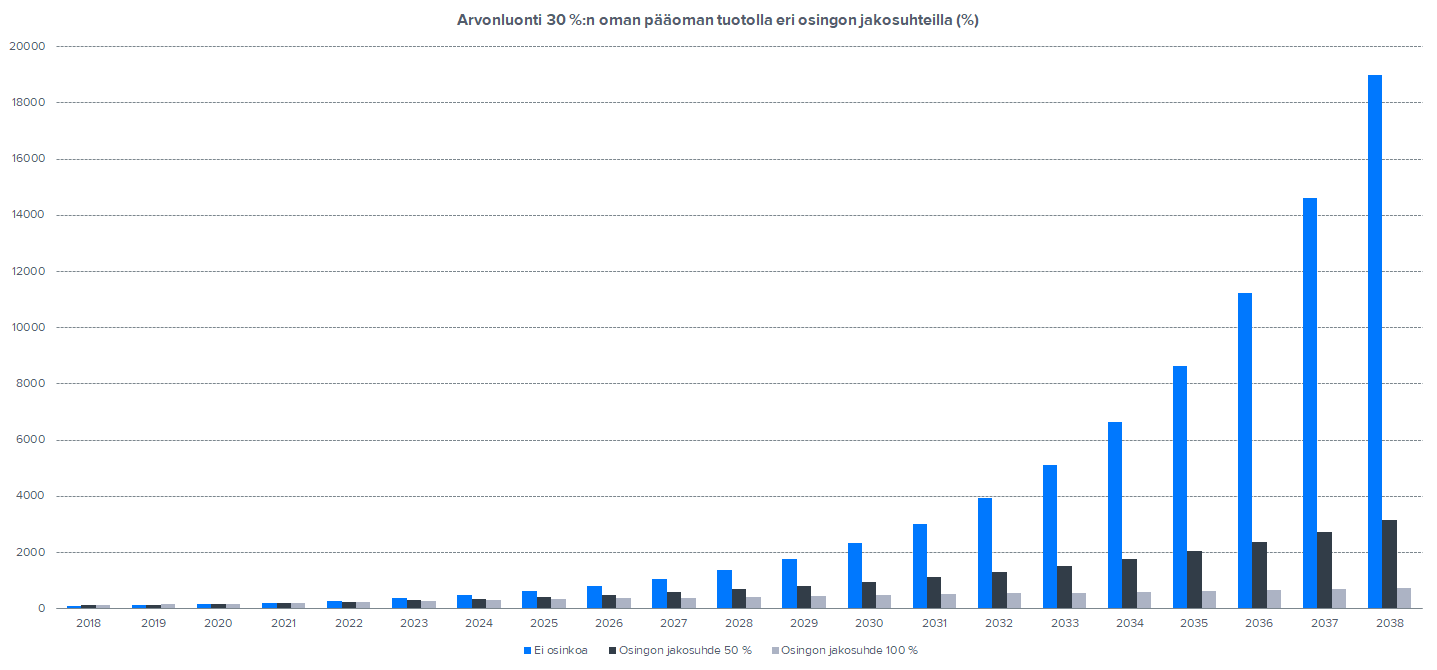
Again, I want to state that my examples contain simplifications. This end went a bit off-topic, but since I have tried to preach about capital allocation whenever possible, I will demonstrate that now as well. More on this is also coming when other obligations ease.
One thing was forgotten, namely invested capital vs. equity. Without ignoring invested capital, I would point out that the return on equity is, however, the most significant for shareholders and is partly related to the business model and its quality. For example, in my view, Talenom can leverage its return on equity with cheap debt capital with very limited risks because its cash flows are defensive and continuous in nature. The same cannot be said for companies engaged in project business, for example, which significantly changes the investment profile.
That was a lot of talk. I hope it made some sense.
Thanks, Juha, for an interesting article.
A couple of comments, moving from theory to practice and the investor’s perspective:
- The last impressive curve showing value creation by different companies apparently doesn’t take into account that if and when these dividends (with a 100% distribution ratio) are reinvested (even if taxes are paid in between) into growing businesses. In other words, value creation continues elsewhere. Or does it?
- Your reflections, in my opinion, emphasize that especially during such low interest rates, companies should not sit on profits and grow their equity unnecessarily but rather invest in organic or inorganic growth or pay out dividends.
There are many factors in business that prevent finding a theoretically straightforward investment target. Let’s take the Kone example. Kone has invested its retained earnings in acquisitions for decades and thus grown, in addition to paying dividends. As an investor, I would not look at a couple of years’ horizon but rather decades. Quarterly economics just sometimes makes us so short-sighted.
Hi Elina,
Thanks for your comments. The chart does not take into account the reinvestment of dividends received by investors. It wouldn’t really be value creation for the example company then; investors would get the credit for subsequent investments I wasn’t really trying to suggest that companies shouldn’t let cash sit idle in accounts, but that’s a good observation. Capital needs to be put to work.
More so, I was just trying to show how significant the difference is over a longer period. Originally, this discussed how important capital reinvestment opportunities are for the long-term development of companies and investments. So, if you find a company with a deep moat and opportunities to invest far into the future, you should generally hold onto it. In my opinion, these things are rarely analyzed over the longer term, and it’s not just theoretical.
I tried to illustrate the same point with my Kone example. Kone has indeed invested in its business for decades, both organically and inorganically. It has grown and succeeded exceptionally well, and in my opinion, it is one of the best companies on the Helsinki Stock Exchange. At the same time, its scale has grown such that it is increasingly difficult for the company to make significant investments without compromising on the return requirement. Of course, there has been talk of major arrangements for the company, and who knows, maybe the next spurt of profitable growth is coming, but as an example, the company served my purpose well. An excellent company, but it has been difficult to find significant investments at its scale with an attractive expected return – I believe that (in my opinion) competent management would have made them otherwise. Perhaps it’s good to note now that Kone continuously invests more than most companies on the Helsinki Stock Exchange. In large numbers, these simply don’t show up in the same way. Of course, this is not straightforward; that was not the intention.
In my work, I naturally focus on quarters like everyone else, and it’s good to remember to take perspective. That’s what I’m trying to bring with these 20-year charts, and Kone’s story was already quite long at this point. So, I wasn’t talking about the previous quarter, except for the recent dividend proposal. After a couple of years of decline, Kone’s earnings are forecast to return to growth in the coming years, albeit quite subdued growth. But otherwise, I now leave the more detailed assessment of Kone’s future to the analyst following the company.
Not exactly literature, but this thread has had a very broad approach to links anyway. Berkshire Hathaway’s latest investor letter was published yesterday; it’s worth reading, even though the content of the letters may have decreased somewhat in recent years.
Again, I’ve devoured books and information. I don’t know how much has stuck in my head, but I personally find reading to be a developing hobby.
I’ve read over a dozen investment books in the last six months, so I quickly realized they repeat themselves. For this reason, I also intend to focus on literature from other fields that can help with investment decisions… for example, leadership and psychology.
A couple of takeaways:
Warren Buffett’s Management Secrets: Proven Tools for Personal and Business Success was a short and concise book. It outlined the main features of Buffett’s management style, which are also evident in his investment style. An educational book, at least for a young person like me.
Nassim Nicholas Taleb’s The Black Swan. I must say, it’s hyped for a reason. It opens your eyes to risk-taking in investing. Also applicable to other areas of life. Very interesting, but at least 1/3 of the content went over my head. A heavy and theoretical book in my opinion, but definitely worth reading.
The aforementioned book inspired me so much that I immediately borrowed the same author’s book Antifragile. This dealt with fragility, vitality, and antifragility of things. Again, at least 1/3 of the book went over my head, but I feel that the 2/3 that stuck was worth reading, and I can apply it to my investment strategy. The author’s attitude towards, for example, the pharmaceutical industry, was very interesting.
Sijoittamalla miljonääriksi (Becoming a Millionaire by Investing) is a fairly traditional investment guide. It went through different forms of investing. I haven’t become a millionaire yet. The nice thing about this book was that several top Finnish investors were interviewed and asked about their investment strategies and styles. This was valuable information in my opinion.
Currently, I’m reading Graham’s Security Analysis, and Kahneman’s Thinking, Fast and Slow is on my shelf. Moving forward with these 