Scanfil organized an investor meeting at its Sievi factory on May 22nd, which was arranged for local retail investors. I had the pleasure of attending this event, and here’s my two cents  On site, it was possible to chat with the management at length. Additionally, we got to know the Sievi factory through a factory tour. The company’s management gave a presentation on its history, present, and future.
Special thanks to @Pasi_Hiedanpaa for the company and for the good answers to all the questions that were asked. In addition to Pasi, the event was attended by, among others, the company’s Chairman of the Board, CEO Sut, and CFO. Regarding Pasi, it’s clear that the company has been studied thoroughly. Therefore, Pasi can correct all my mistakes in this message; these numbers are just thrown out from memory 
1. The Chairman of the Board’s (and largest shareholder’s) historical recollection. Harri was the right man for this, as the company was founded by his father, and Harri has been involved in its operations more or less since he was little:
- Scanfil will turn 50 next year! To celebrate this, a book about the past years is coming out. This is truly a “must-have” item for all shareholders!
- The 1990s was a period of rapid growth for Scanfil. Did you know that Scanfil’s revenue grew from 5 million in 1990 to 100 million in 2000 as a working figure?
- Scanfil has not had A SINGLE loss-making year during its entire (almost) 50-year stock market history! (ok, there was a story that apparently during the 90s recession, there was one year where the numbers were a bit ‘on the fence’ )
Essential and critical events for historical development:
- 1980s: Jorma’s reaction and investment in the electronics industry; this was seen as a clear growth area with plenty to do, allowing them to “catch the megatrends”. They dared to invest in the right things.
- 1990s: aggressive growth, which led to becoming a major supplier for Nokia (they had to be large enough for this to succeed), and naturally, through that, they also got a share of Nokia’s growth.
- 2002: Acquisition of Wecan Electronics. Competitors around them were merging, so Scanfil had to react to avoid becoming a “hot dog stand”. A very important strategic move that ensured they could respond to the competition. There were also some business synergies in the background.
- 2015: Acquisition of PartnerTech; the acquired company was probably slightly larger than Scanfil, so it was a big purchase.
- Miscellaneous figures and facts about the company:
- The company produces 10,000 different products for various customers!
- I asked about the company’s position in the value chain and its changes over the decades – typically, the position of electronics contract manufacturers is perceived as difficult. Harri didn’t quite buy into the idea that they have been or ever were under significant pressure. The company’s strategy has always essentially included the desire to produce large entities and critical stages for customers’ products. That is, products where the switching costs for the customer are higher.
- Referring to the above, both Harri and CEO Sut repeatedly stated that the company’s “stickiness” has always been very good. And if you look at the company’s major customers
- The year 2024 definitely proceeded with a “destocking” theme for Scanfil’s customers and the entire industry. This was clearly reflected in the company’s revenue. Nothing unusual, this is how economic cycles have gone, especially recently.
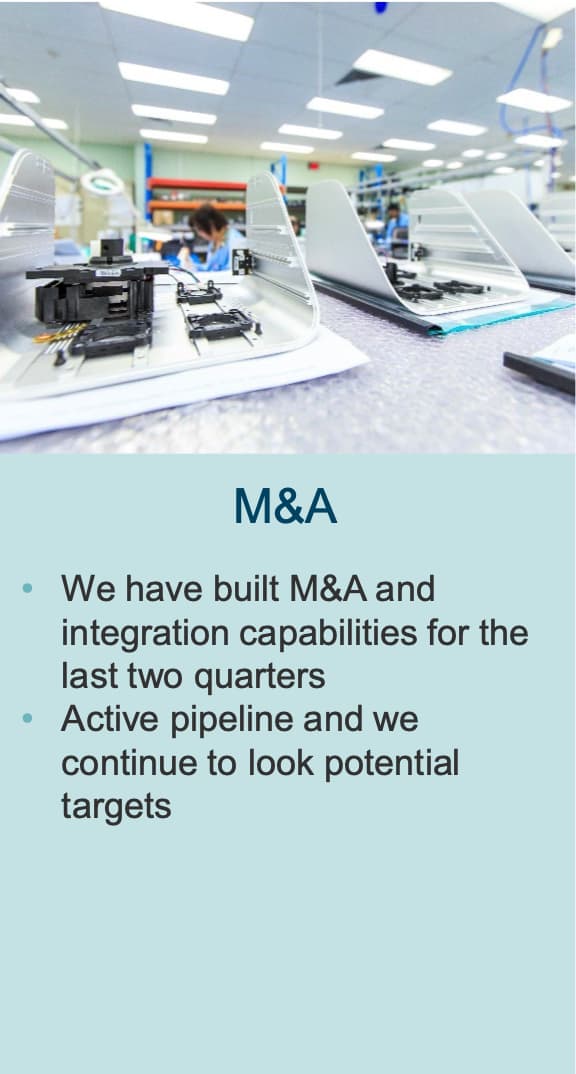
- The company sees very good growth opportunities, both organically and inorganically. And this story was somehow easy to buy. It felt like the CEO was enthusiastically able to describe several different geographical areas and genuinely demonstrate that opportunities abound. And it’s no wonder there are opportunities even organically: if I look at the company’s major customers, they are, damn it, such defensive and high-quality organic growers themselves, so it’s no wonder Scanfil grows too: KONE, ABB, Tomra, Danfoss, Valmet, Vaisala, ThermoFisher, Planmeca, Sandvik.
- The company also emphasized its defensiveness by stating that even though the largest customer accounts for 13% of revenue and the top 10 for 55%, these customers buy numerous different products from Scanfil across various product areas, which also have completely different market cycles. This highlighted and gave the impression that Scanfil’s revenue is much more diversified and “safer” than one might superficially imagine.
One of Scanfil’s biggest “problems” for external investors has been its highly concentrated and loyal ownership base. The owners are perhaps a bit too satisfied, which is reflected in the trading volumes. I calculated that the founders of Scanfil and their close circles still own 68% of the entire share capital And there are no eager sellers, because all long-term owners who know the company recognize that such good long-term investment targets are hard to find in Finland. The company’s DNA has always included a strong balance sheet, nurturing profitability, and a desire for growth. The company does not grow at any cost, and it would rather leave a new, poorly profitable customer relationship on the table than engage solely for the sake of growth. The company also emphasizes this in its fresh, new strategy.
Harri made a good quip related to this topic, which I don’t remember verbatim (how did that go, Pasi?) but the idea was: “no one forces you to buy from us if our price doesn’t please you”
P.S. Pasi, try to advocate for small investors so that next spring’s annual general meeting can be held physically due to the 50th-anniversary celebrations
Other listed companies should also organize such events for investors!