Six-figure portfolios - Where's the money from?

It’s absolutely true that it’s important for an entrepreneur to believe in what they do. An entrepreneur concretely puts their own assets and effort on the line. However, I think this is a different matter. You can believe in your investment thesis unwaveringly, but that has no bearing on the return of the investment. Your investment thesis either succeeds or fails, completely regardless of your wishes. Of course, if you believe strongly, it’s easy to take a high risk, which amplifies the impact of a good or bad outcome.

An entrepreneur’s belief, on the other hand, is channeled into hard work, which inevitably helps the company move forward. It is a positive force, without which entrepreneurship cannot succeed.

To the original author, I wish all the best, it’s great that you succeeded. As your investments grow, you should consider realizing profits into less risky investments. You are now a wealthy investor and reasonably close to your goal; you no longer need to take the highest risk.

30 Likes

I think you are now confusing the idea of making one investment with investing, which involves multiple actions and considerations over time. It’s not a single lottery ticket where you either succeed or fail. Building a thesis requires just as much work as being an entrepreneur. Hard work doesn’t automatically guarantee success in either case, but if you don’t believe in yourself at all, failure is quite easy even if you put in a lot of effort.

5 Likes

I would think that a skilled investor is in a fortunate position compared to an entrepreneur, because they can choose the most glaringly mispriced winning horses from a universe of tens of thousands of companies. An entrepreneur’s lot is to try to be a winning horse, which is laborious and usually thankless work. An investor can also easily diversify their risk by betting on several horses. High concentration can be sensible, but then one must be brutally honest with oneself about the risk factors of the investment thesis and one’s own probable cognitive biases. For me, my two largest stocks constitute 85% of my portfolio, and I could in principle be all-in on either and still sleep well at night. However, I hardly use any debt.

13 Likes

I read the messages above. To others, I want to say that a portfolio worth hundreds of thousands of euros doesn’t require speculation, strong conviction/view, or significant risk-taking. Most of the time, these are only detrimental.

52 Likes

I agree and have found for myself that in life in general, and also in investing, it’s best to go where the fence is just right, not where it’s lowest or highest. By “just right spot to cross the fence,” I mean that for me, it has only required a decision, a plan, sticking to the plan, and time.

I don’t speculate, I don’t guess winners, I don’t bet on stocks, I don’t blindly follow others, I don’t panic, I don’t rub crystal balls, I don’t overthink my portfolio, or ever exceed my own risk level. I don’t make investing too difficult or too easy for myself; instead, I enjoy it through a balanced approach, still achieving a portfolio worth hundreds of thousands, perhaps even a million later on, by investing long-term. I don’t try to invest; I succeed at investing. Intent, repetition, and results—that’s about it.

To keep the answer on topic, my €150,000 investment portfolio is rapidly approaching, and not even Trump’s gaffes or crises will stop it; rather, these factors might even accelerate it. One step back, two forward, and towards the finish line.

35 Likes

For an extremely brilliant market success, the first comment is to talk about speed blindness :smiley: Congratulations would also be in order for @Sijottelija93’s performance.

Not everyone has to be conservative and miss opportunities.

16 Likes

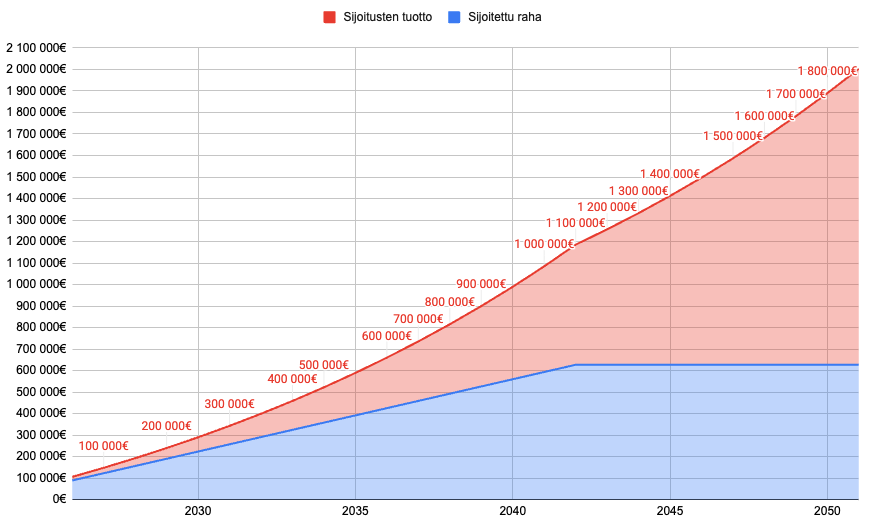
It has apparently been almost 2 years since this already. Currently, the value of my own investments is 47,000 euros. Last year, there was a 10,000 euro setback in the form of an electric car, but otherwise, more money has ended up in savings than planned.

This year, 7,173 euros have gone into investments over four months, meaning an average of nearly 1,800 euros per month. Still, it feels like money is accumulating in the account.

Since the last update, my partner and I formalized our relationship, so from here on out, the calculations include the investments of two people.

Together, we have about 80,000 euros in investments, roughly 95,000 euros in mortgage debt, and 17,000 euros in car loans. There is no hurry to pay those off, at least not yet.

In my opinion, our financial situation is good. I still aim to put 1,500 euros a month into investments, while my wife puts 800 euros into investments and 500 euros into a savings account, from which they are occasionally moved into investments. My wife wants to keep a 5,000–8,000 euro buffer in a separate account.

Out of the family’s net salary of about 6,000 euros, roughly 2,800 euros go into investments.

Here is a similar graph as before. The differences are indeed the inclusion of both of our investments, as well as raising the expected return from 5% → 6%.

We will likely move to a more desirable apartment or a detached house within the next 5–10 years, which will consume savings in the amount of a down payment and affect the savings rate. At the moment, it would not be sensible, as it would eat up such a large portion of the savings and kill the compound interest effect too effectively.

24 Likes

Wouldn’t it make sense to do those calculations using real returns instead of nominal ones? Otherwise, it’s hard to estimate what the portfolio’s purchasing power will be in, say, 20 years.

2 Likes

We’re in pretty much the same boat. Just a couple of days ago I checked my portfolio value and it was just a few tens of euros short of 50,000 euros. My share of the mortgage is 21k€ and other debt related to the apartment is 14k€. There’s 13k€ in car debt, so the total debt is 48,000 euros. About 500 euros a month goes into investments and I pay down 250 euros of the mortgage.

6 Likes

If I may ask as a representative of another field, what exactly is meant by “portfolio” in these discussions?

Securities, of course, and presumably investment properties, forest land, and cash, right? Borderline cases might include something like a luxury car bought for investment purposes—though one more likely won’t break even—and maybe art? Or does it refer strictly to securities only?

1 Like

I, for one, only count securities and cash. I don’t count the money I’ve invested in a certain apartment or, for example, the debt-free portion of my own home.

6 Likes

I’ve only calculated securities and cash. I’ve only taken into account the debt-free portion of my owner-occupied home in my net worth. It’s nice to follow the development of both separately, and both have their own goals for each year.

4 Likes

I definitely don’t count cash. Not to mention my apartment and car. Only stock market holdings. That’s how freedom is achieved.

9 Likes

Stock portfolios (brokerage account and investment savings account). Can, of course, contain cash.

3 Likes

Portfolio today 104,500.

To the original question.
I originally started saving and investing sometime back in 2005. I had landed a permanent job where I still work. The salary was reasonable for a young man, mainly due to shift work. Since then, the job description has changed several times. However, the employer is still the same.
At that time, using an inheritance I received (I think it was around €8,000), I opened a savings insurance policy (säästövakuutus). I saved something like €100/month into it. The portfolio contained completely idiotic funds. Some expensive proprietary OP funds like Prospering Middle Class, America, Super Note blah-blah-blah—whatever they were. And then Russia. I didn’t understand anything about investing. I put all sorts of things in there as long as it had a fancy name. Money did accumulate, and there were some returns. I don’t have any records from that time. Occasionally, I withdrew money for larger purchases. Mainly when cars were swapped. I also got to live for several years in an estate-owned apartment almost for free, which allowed for more savings. Man, if only I had had some understanding of where it’s worth putting that money. Sometimes a year would pass without me checking my investments; at other times, I was more interested. But it never occurred to me that one could actually learn about investing from somewhere! :sweat_smile:

Life situations changed. I found a wife, we had kids, we got a puppy. We bought a terraced house, the down payment for which was taken from the savings insurance again. We swapped the car for a bigger one again. Down payment from the savings insurance. We sold the house. We got almost the purchase price back (:grimacing: this was the first lesson in real estate investing) and we made a contract to have a detached house built. We took on a semi-insane amount of debt. Again, we dipped into the savings insurance.
We paid off the mortgage for the detached house in a way that life wasn’t otherwise very lavish. We flew abroad once a year, plus quite a bit of domestic travel by car driven by hobbies. Swapped cars again and dipped into the savings insurance. The house was lovely. Just what we wanted. Everything in life was pretty great, except the dog died :frowning:.
The savings lived their life in the insurance wrapper, where they had accumulated to about €20,000. One cannot, of course, speak of compound interest effects when the savings insurance was used as a cash fund. Nor had much else been invested there, as the money went into the foundations. The rest belonged to the bank.

Then a bomb dropped :collision:. On Ukraine. At that time, I had been following my investments in some way (I still didn’t understand anything), and the Russia fund had performed well. I had increased it to a clear overweight in my portfolio. Then the fund was closed. No one knew what was happening. I waited and watched. The fund, which I recall was worth about €3,400 in my ~€20,000 portfolio, started showing a value of €2.2. (Or something. This is just an illustrative example.) Other rates probably plummeted drastically at the same time, I don’t remember that well. So the blow was quite significant! OP announced that the Russia fund (:face_vomiting:) would be closed and all activities regarding it would end. I felt that 17% of my savings were practically stolen. That was the investor’s risk and the worst possible scenario that can come true. It taught me a lot of caution, and I guarantee and underline that I will never have anything to do with Russia (sic) again. And this isn’t just because of my own financial losses.
My biggest mistake as an investor is that I didn’t study the matter at all when I started. The second biggest, and partly due to the first, is that I trusted Russia.

Then another bomb dropped :collision:. The second one. Divorce. That lovely detached house and the kids went up for sale (wait, what the hell?! No, I didn’t have to sell the kids. :sweat_smile:) Despite the difficult situation, this real estate deal went surprisingly fast, and we even got our own back from it. Maybe a few thousand on top.

I moved into a rental and continued working at the same firm. I paid an equalization payment to my ex-wife. I paid off the rest of the car loans and started with a bit of a clean slate. I was left with €62,000. I terminated that eternal and expensive savings insurance. I started studying investing. I opened an equity savings account (OST) and a book-entry account (AOT) at the bank. I opened a new savings insurance because I value the ability to modify the content as I please, depending on the situation.
I invested my assets into these three.

My investment strategy:
Keep the size of the savings insurance at about 70% of total investment assets. This is the fundamental part of my investments.
OST 10%: This is the part formed by domestic companies, hopefully resistant to market volatility.
AOT 20%: This is where quick moves and profits are made (if they are). This is where world politics and trends are followed. The turnover rate of this portfolio is definitely the fastest part of my entire portfolio. It contains ETFs and stocks by theme. Commodities, small caps, etc. This is where the highest volatility and fastest turns happen.

Nowadays, I aim to save about €800 a month for investments. My goal would be to grow the pot by about €10,000 a year. However, the last few years have been good for returns, so €62,000 grew to €77,700 in a year, and that again to €95,000 the following year.
Now the market has been favorable again, and I was finally able to write my own story in this thread.
Albeit in the singular. For now.
:+1::victory_hand:

107 Likes

I don’t count cash myself. Nor my home, nor my car or any other consumer goods. Only so-called investment assets, whatever that might include for each individual. For me, it’s equity ETFs, forest, and land for lease. Someone else might also include fixed-income investments, gold, investment properties, you name it.

4 Likes

I count stocks, funds, and cash as part of my investment assets. I don’t include my home, car, or the forest plot I inherited, as I intend to keep it for my entire life in accordance with family traditions. A home and car in personal use are consumer goods, not investments. It’s a good thing that the flawed mindset from the zero-interest-rate era—the idea that the value of one’s own home would supposedly keep rising indefinitely—is finally crumbling.

7 Likes

To each their own, of course, but that forest estate can be a valuable source of cash flow throughout your life. It is valuable in that sense, even if you hold onto it until the grave. Of course, if you don’t intend to do any logging, then it’s a different matter if you focus on preserving natural values. Which is also a fine thing.

8 Likes

Personally, I draw the line at whether it is an asset whose primary objective is to generate a return (or at least preserve capital). If I own the item in question for any reason other than those mentioned, I don’t count it as part of my portfolio. For example, it would be quite inconsistent to include a residential fund or Kojamo shares in the portfolio, while leaving out direct ownership of an investment property.

A cash position held in a fixed-term account or otherwise primarily for interest income is also part of the portfolio; really, the sky’s the limit as long as the rationale for ownership is the pursuit of profit.

12 Likes

So there is some variation in what everyone considers a portfolio.

I don’t consider a house and cars or daily drivers as investments myself, but in my opinion, long-term accounts belong in the portfolio, and why wouldn’t money in regular accounts also belong there, actually. If you think about it from a FIRE perspective, for example, you can survive for a pretty long time with a €200k cash pot.

The mentioned point about items—that if something is bought for returns, it should be in the portfolio (like a classic American car)—would be a clear distinction.

8 Likes