In this thread, you can freely boast about your own successes, but in an educational way: what went right in your stock picking? Let’s learn from others’ successes =)
I bought Comptel and Nokia bought it the next day 
14 Likes
I held Comptel long before Nokia acquired it. 
5 Likes
Related to Nokia… I bought Nokia right before Inderes added it to its model portfolio 
8 Likes
No Neste in 2017, overwhelming purchase at a cheap price.
5 Likes
I’ve been in Revenio for a long time and Nokia since the beginning of the year! Thanks for that  !
!
3 Likes
For me, finding Inderes’ high-quality analyses has been the most significant thing. Individual BIG successes are still few, but I am very hopeful for the coming years.
10 Likes
I just noticed my portfolio is at ATH (All-Time High) levels. When you add up the forest land and stocks, we’re somewhere around 240,000 euros. I’m not including the apartment. Quite good for an average-income blue-collar worker, if I do say so myself.
It all started in August 2004, when after turning 18, I pondered where to put the money I’d saved from my summer jobs. So, off to the cooperative bank and opened an account. I bought Sampo first, and I still own some of those. Next, I picked up Lemminkäinen, but I sold those after a couple of years.
Starting from scratch and saving from salary, it’s admittedly quite challenging to achieve this with these earnings. I’ve used leverage quite a lot at times, but it has worked in the right direction. Nowadays, it’s quite moderate compared to the size of the portfolio.
Let’s try to continue in the same vein. The portfolio and forests are slowly starting to be in cruise mode. A little brush cutter and an occasional buy/sell button will suffice.
14 Likes
The child’s portfolio is celebrating its 3rd birthday.
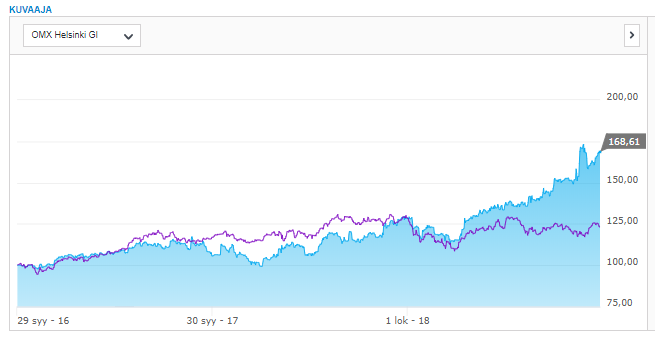
The return has been 19.0% per annum vs. OMXH GI ~7% per annum and Inderes model portfolio ~14% per annum.
Current contents:
- Hoivatilat ~28%
- Remedy ~21%
- Kamux ~19%
- Nordea ~16%
- Qt Group ~16%
Calculated with the “rule of 72,” doubling the portfolio at this rate would take approximately 3 years and 9 months.
14 Likes
Wells Fargo popped on Friday, 27.9., when a new CEO was named, already surpassing $51 on Friday. WFC shares were available in the $45-46 range throughout the summer, which can be seen as proof of God’s existence. This bank pays $0.51/quarter in dividends and has a massive share buyback program. But yes, this will reach the $55-60 level while collecting 4% dividends. However, it requires the removal of the Growth Cap set by the FED.
1 Like
Looks good 
Have you diversified into more stocks by adding new capital to the portfolio, or have the investable funds come from dividends/sales? I’m wondering because my own child’s portfolio only has three stocks, so I’m thinking about buying a couple more shares at some point  I don’t really feel like selling anything, and I don’t have the energy to pour in more capital right now. I’ve directed dividends and small profits from sales into index funds for now.
It’s certainly possible that someday I might sell off some index funds and buy something with the freed-up capital if a really appealing case comes along! We’ll see.
1 Like
Yes, in my opinion, in a child’s portfolio, where the sums are not yet high, one can go by concentrating on at most a few of the best cases in terms of expected return / profiles. This is how I’ve thought for the past few years. We also had only 2-3 stocks at a time for a long time, and only this autumn did I increase the number to five…
@anon38833097 your tactic is just good in my opinion
From memory, the story goes something like this:
In early 2016-2017, I mostly had “supers” (referring to super funds or similar), because the tactic was relatively consistent monthly saving… then perhaps after less than a year, I made a change in tactic, which so far has proven profitable. (Note, the current 3-year period is still short.)
2017-2018 The first direct purchases went with a healthcare property-Remedy (Hoivatilat-Remedy) emphasis, with one successful Nokia (Nokia) flip on the side (buy 3.95 → sell 5.3€). I had bought Remedy at 7€ and 6.8€ and Hoivatilat at 8€.
2019 H1: As saving progressed, Kamux (Kamux) also came into play (spring-summer 2019?). That’s the only one still in the red (now <5% loss), but I guess it will go into positive within 15 years 
2019 H2: After Remedy’s worst undervaluation resolved and after the first Gamstat (Gamstat) calculations, I lightened the stock (sold at 10.65€) from about 50% of the portfolio at that time to its current level. (At the same time, I also lightened my own portfolio). With the released funds, I then bought QT group (QT Group) (13.6€) and Nordea (Nordea) (5.8€). (Nordea also slipped into my own portfolio at the same time).
Of the current positions, I plan to hold almost all for a long time, but for Nordea, I’m waiting for the CMD in just over three weeks… after that, I’ll have to decide whether it remains a short position or a hold.
Overall, the story of the portfolio is still in its infancy. In such a short time, the significance of luck is still considerable. Let’s check again in, say, 5 years 
3 Likes
Okay, it has indeed gone by the book when such a short period includes one successful trade and one profit taking, from which the funds have been directed to new investments, thus reducing the dependence of one investment on the portfolio’s development, and the return expectation still seems good, based on what I know about the companies you own. All in all, I think these companies are good stock picks for a long hold. Keep up the good work 
I’m thinking about my son’s portfolio, where 3 companies form a quite large part of the portfolio, so the portfolio’s development is quite dependent on one single company. Dividends and profits* have, however, gone/are going to Super-Finland, which balances the risk of one company over time. But I’m on the same page with you that as long as the company’s fundamentals are in order and the time horizon is long, and it’s not a big portfolio, focusing on just a few companies can be quite good. In my son’s portfolio, there’s no need to sell for a few years yet. I don’t know what my son will do with the portfolio when he turns 18
*In my son’s portfolio, there was one sale; Titanium, from which the profit was perhaps 20% plus dividends, a large part went to Talenom and the rest to Super-Finland and cash.
Yeah, I guess Kamux will still rise from there =D
2 Likes
Still haven’t hit any ten-baggers yet, but at this point I could mention a couple of companies that have been good successes:
-
Remedy, in since the €6 levels (not perfectly, of course, because in the corona dip I sold at €12.5 from my AOT and bought back at €10.2 to my OST). So roughly a 5-bagger.
-
Qt, in since the €6 levels (not perfectly, of course, because in the corona dip I sold at €20 from my AOT and bought back at €17.5 to my OST). So a 5-bagger.
The good thing about the lack of perfection in the future is that despite this year’s small tax arrears, I will avoid significantly larger tax arrears in the coming years… because I switched from AOT → OST.
14 Likes
Great performance, and thank you for your excellent contribution to the forum.
What if the investments were in a book-entry securities account for 10 years, during which time the shares grew 20x?
You can use the 40% acquisition cost assumption. It would seem that AOT (book-entry securities account) is a pretty good deal for full-blooded growth companies that are held for a long time.
3 Likes
If the investment period is, for example, 20+ years, and at the 10-year mark you realize and reinvest the money, the benefit of the acquisition cost presumption might not yet be as significant as the benefit from deferring taxes.
The Nordnet blog had a bit about this; you should check it out: Hankintameno-olettama ja tilityypin valinta | Nordnet
4 Likes
Good point, should be calculated.
Somehow I just have a hunch that trusting these top Helsinki techs to still be on the lists 10 years from now is… let’s say bold?
E: kabu already posted calculations above
In early spring, I swapped my NoHo (Nordic Hotels) money for Remedy, as the general outlook seemed much better, and I can definitely pat myself on the back for that. NoHo was down -50%, which would have improved by now from those prices, but Remedy’s ride has been in a league of its own, up approximately +150% so far.
This time, it worked out to choose a company with sunny prospects over one with foggy ones. Indecision was certainly one reason why I even took such a large loss in the first place.
3 Likes
I bought a relatively large amount of Revenio in 2008, considering my wealth at the time. After that, I reduced my holdings a little bit at some point. Now, I still own Revenio with too large a weight relative to my wealth.
Otherwise, I haven’t really succeeded.
I had the same situation in January, but with Nokia. I swapped Nokia for Remedy. Nokia shares would have climbed into positive territory after a strong Q2 from the price I sold them at, but Remedy, on the other hand, is up +170% in my portfolio. I even bought a little more Remedy in March, in hindsight I should have bought more .
In March, I kept thinking that it didn’t make sense that everything was falling, even though the corona had little to no impact on some companies, or even a positive impact in the case of others. Yet, all were beaten like a stray dog, regardless of the company’s industry or anything else. I still didn’t dare to take a bolder stance because the market is always right.
In any case, I should remember these successes sometimes. For me, it’s a bit like this: if I’ve succeeded in nine things and failed in one, I only remember that one failure. I should learn to see the glass as half full, not half empty. However, if failures didn’t bother me, I would never learn from them.
Another notable success relates to transferring my holdings from AOT (traditional brokerage account) to OST (share savings account) during the deepest pit of the March corona dip. Almost all of my holdings in AOT had fallen into the red, so I thought it might be a good time to take tax losses and transfer the holdings to OST. Now, OST shows a return of just under +50%, so at least in that sense, I managed to get almost the maximum benefit from OST. At least compared to a situation where I would have loaded it full at the beginning of the year and ridden it with a full cargo to the bottom of the pit.
In addition, I must be happy with individual company selections. In my eyes, my portfolio consists only of (domestic) top companies, and I don’t have to bite my nails much during earnings seasons, unlike in the early stages of my investment career when the portfolio consisted mainly of disappointments whose price, to an amateur’s eye, was “cheap” because the share price had fallen. But it always fell even further. My portfolio content is otherwise largely similar to @Aston_Livingstone 's. The difference is that brother Aston has been a step ahead in everything, and my acquisition price is therefore slightly higher. Of course, for example, I might never have invested in Qt without Aston, so hats off to him for that. Then again, for example, Qt, Remedy, Talenom, Harvia, etc. were on my shopping list for quite some time before the final purchase decision. Then again, we come back to the half-empty or half-full glass way of thinking. Fortunately, I finally bought each of them, and looking back, even relatively early, rather than continuing to procrastinate and monitor the share price indefinitely. Hopefully, those possibly cheaper acquisition prices will no longer be remembered in retirement when the share prices of all the aforementioned companies have multiplied.
4 Likes