I don’t care to argue with someone who claims to be a professional, yet their posts suggest otherwise. There is constant news about building more nuclear power using small modular reactors (SMRs), discussions on additional nuclear capacity have been opened in Sweden, pumped-storage plants have been planned for the Kemijoki river, etc. Nothing is finished in an instant, and surely something has been learned from the OL3 project; luckily, it was finally completed after all. It can’t be helped if it’s annoying that someone was able to prepare so that spot electricity prices don’t cause distress—I recommend it to others as well. It’s true that the base level of electricity prices might rise, but not excessively; the people might take to the barricades, though that’s a rare phenomenon in Finland. This weekend and apparently the coming week, we get to enjoy the benefits of spot electricity while it’s windy; it looked like the total capacity rose close to 7,000 MWh/h on 25.1. You just have to take what you’re given, same as with the presidential election today; no one knows the winner yet while voting is still underway, and it’s the same with the electricity market—the result will be revealed in due time.
The idea that a stable 4-5 c/kWh would be a possible system is an illusion. This comment is not specifically directed at you @faravid, but this perception is seen elsewhere as well. But indeed, we will likely never return to this. 4-5 cents was based on a time when
- In Europe, Russian energy was utilized without realizing (or caring about) the risks, up to the point of dependency.
- Polluting (i.e., emission allowances) cost nothing.
- As a result of market liberalization, there was massive overcapacity from the era of “Imatran Voima”-style monopolies, for which the technical best-before date has already passed or is just about to arrive.
In the 2010s, commodity markets were in a position where the marginal price of electricity produced by those old coal and gas boilers was 4-5 c/kWh, thus severely limiting the upside for price increases. Nowadays, that marginal price has risen to 10 cents and sometimes well beyond; even if those boilers still existed, their production cost would have more than doubled, and it will rise further in the future. Not to mention what it would cost if new power plants had to be built and capital costs covered as well.
As electricity demand grows, the price will logically settle at a level that enables the construction of new production capacity. Wind power can be built at a price of 3-4 c/kWh (excl. VAT), but it is not stable. Last year in Finland, wind power earned a price 33 percent lower than the market average price for its production precisely due to that lack of stability. Calculated with those figures, wind power is still profitable if the average electricity price settles between 4-6 cents (including, of course, plenty of volatility, which creates a business case for flexibility and storage). And this is in Finland - elsewhere, offshore wind power is built at a much higher cost, creating a competitive advantage for Finnish industry.
Nuclear power appeals to those who cherish stable electricity prices, but it has a massive profitability problem. In the UK, the state guarantees 13 c/kWh (+ inflation, excl. VAT) for 35 years for a new power plant, and even that is not enough if the cost, which has ballooned to 46 billion pounds, is plugged into Inderes’s DCF model with any reasonable required return on capital. How many of those annoyed by electricity price volatility would actually be willing to sign their name to such a deal? In every country where new projects have been considered, they’ve run into the same problem: the taxpayer is called to the rescue, and who pays those taxes in the end?
Fortunately, there is a solution for the longing for a stable price: a fixed-price contract. If you consume 20,000 kWh, an 8-cent deal, for example, results in 1,600 euros in annual costs for electricity energy. If spot-price electricity gets you to 7 cents, you save 200 euros. If this can be handled effortlessly, then why not, but if it requires massive time consumption (either for optimization itself or for ranting about the matter online), that time would be better spent, for example, looking for stocks that generate alpha – you’ll likely earn that 200 euros back with heavy interest. 
Threats posed by Sweden to the entire Nordic region.
In Finland, electricity consumers would suffer a loss of approximately 2.7 billion euros per year due to investments in Northern Sweden, Sundén calculates. The cost to Swedish society would also be high.
For me, the most interesting thing in this report is that while governments on both sides of the Gulf are systematically striving to increase electricity consumption—and reduce non-renewable energy production—using the “mushroom method” (and even distorting facts/calculations), the most significant industrial entity in Sweden is funding research that provides “light in the box”: what does it mean for the country’s consumers and industry?
Fine words about open data can be found all over society, but the reality is something else entirely.
An excellent article on how withholding data reduces the risk of getting caught for market manipulation.
https://aurinkosahkovoimalat.fi/
You can use that link to check solar power plants that are in production, under construction, or in the permitting and planning phases. Currently, Fingrid reports a capacity of over 1,000 MWh/h. There are some reasonably large plants on the way; within a few years, from the beginning of March to the end of October, the production from these plants will be quite significant. Probably as early as this year, at peak times, it will exceed the power output class of Olkiluoto 1 or 2 units. Additionally, there is the self-production by private individuals. It’s a bit annoying that the panel equipment seems to come from China, but other items like inverters, mounting racks, and other gear can be sourced from Western countries too—though this is just a bit of a gut feeling. If only we could somehow get electricity storage capacity under control and make it cheaper, since these only produce electricity during daylight hours.
Functions critical to society are indeed often classified as protective work. It would be strange if nuclear power plants were just shut down every now and then for no reason.
Press release published today:
Helen Ltd is investing in a 40-megawatt electricity storage facility in Nurmijärvi. The facility is one of the first large-scale electricity storage systems in Finland.
The storage facility will be completed in early 2025.
The electricity storage facility to be built in Nurmijärvi, based on lithium-ion battery technology, consists of approximately 36 modules the size of a large shipping container, which will be connected to the main grid of the transmission system operator Fingrid Oyj running nearby. An expansion option has been planned for the 40-megawatt electricity storage project, which, if realized, will double the storage capacity. The electricity storage facility balances Finland’s electricity production and consumption by participating in Fingrid’s reserve markets.
If 20 of these are built, it’s already 800 MW, so this undertaking has to start somewhere. Small streams..
Windless days cause problems when striving for a carbon-neutral society. Some energy still needs to be produced during those times, however. Natural gas was the old solution, but it can no longer be relied upon. Naturally, Fortum and other power producers are in no hurry to find a new solution, as those windless days significantly increase the profitability of other production.
Perhaps a bigger reason is that the electricity price is not nearly high enough to justify rushing into building new baseload power. In other words, it’s just not a big enough problem yet to provide a market-driven incentive to solve it. Or well, excluding those electric boilers and such, which are already being built and which, for their part, help balance consumption and prices.
I’ll reply here.
Do you have a good source for this, preferably regarding Finland or our neighboring countries? Because that is not necessarily true in every country.
The belief that wind farms are more productive at night clearly does not hold in most EU countries.
For example, wind farm output is at its lowest point on average at around 5 am in Britain, which is also when electricity demand is at its lowest point. The same holds in Denmark and Ireland. The only country where wind farm output is higher in the middle of the night is France and perhaps Spain.
In Finland, wind power produces slightly more at night than during the day. And when I speak of “night,” I mean the hours outside of working hours, when consumption and consequently the price are lower.
That link of yours is quite old, so the increased tower size has likely not been taken into account. In 2013, turbines were significantly smaller, and wind behaves differently at higher altitudes. None of those graphs show a production peak at midday. Germany is quite close. Other countries also seem to have more offshore wind power than Finland.
I believe that’s the case, but do you have a good source for this? Or generally a source for how wind power is produced at different hours on average. It would be good to see how large the differences are and how they are distributed across the hours of the day.
The article in Hesari (Helsingin Sanomat) discusses this upcoming Helen electricity storage facility.
It certainly supports the power system and provides some balancing, but the fact that the storage is empty after 1.5 hours and needs to be recharged to be functional again says everything about the scale of the storage.
It’s likely very expensive, or else these would be popping up like mushrooms after rain to compensate for lulls in wind production. It’s a shame that the size of the investment hasn’t been disclosed in any way.
If necessary, it can feed electricity into the power system at a capacity of 40 megawatts for an hour and a half.
No, it certainly doesn’t, especially when you can look far enough past this ongoing cycle:
-
So, wind power is not built to satisfy the demand for electricity, but rather electricity demand is being increased so that more wind power can be built…
-
More than a third of Swedish wind power companies are already making a loss and are on the brink of bankruptcy. When state support ends, wind power companies will no longer be able to cover their costs. Wind power ”cannibalizes” itself.
(=when it’s windy, the turbines don’t generate euros because the price of electricity is even negative. When it’s not windy and the price of electricity is at its peak, the turbines don’t spin and don’t produce electrical energy to be billed)
Then there’s also this aspect that has so far been very successfully ”kept quiet”:
…Finland’s wind power construction is supported with five billion euros, even though it doesn’t achieve emission reductions. When taking into account the emissions from rare metals, steel, and concrete needed to build the wind turbines, as well as transportation and the reduction of carbon sinks, wind power construction only increases Finland’s emissions…
So that is an anti-wind power opinion piece, not even at the level of an article written by an amateur journalist. Everyone is entitled to their opinions, but they shouldn’t be spread here as facts. The piece smoothly conflates investing in wind power with Siemens and fails to mention how Finland’s energy production emissions would have been reduced without wind power. And there isn’t a shred of truth in those other claims either. The structure of PPA agreements was also left unmentioned. So there’s that.
And even though practically nothing in it holds true, except for Siemens’ problems, how does this relate to Fortum?
Maybe so, but not quite always — for example, right now. (EDIT: Meaning throughout the whole day today)
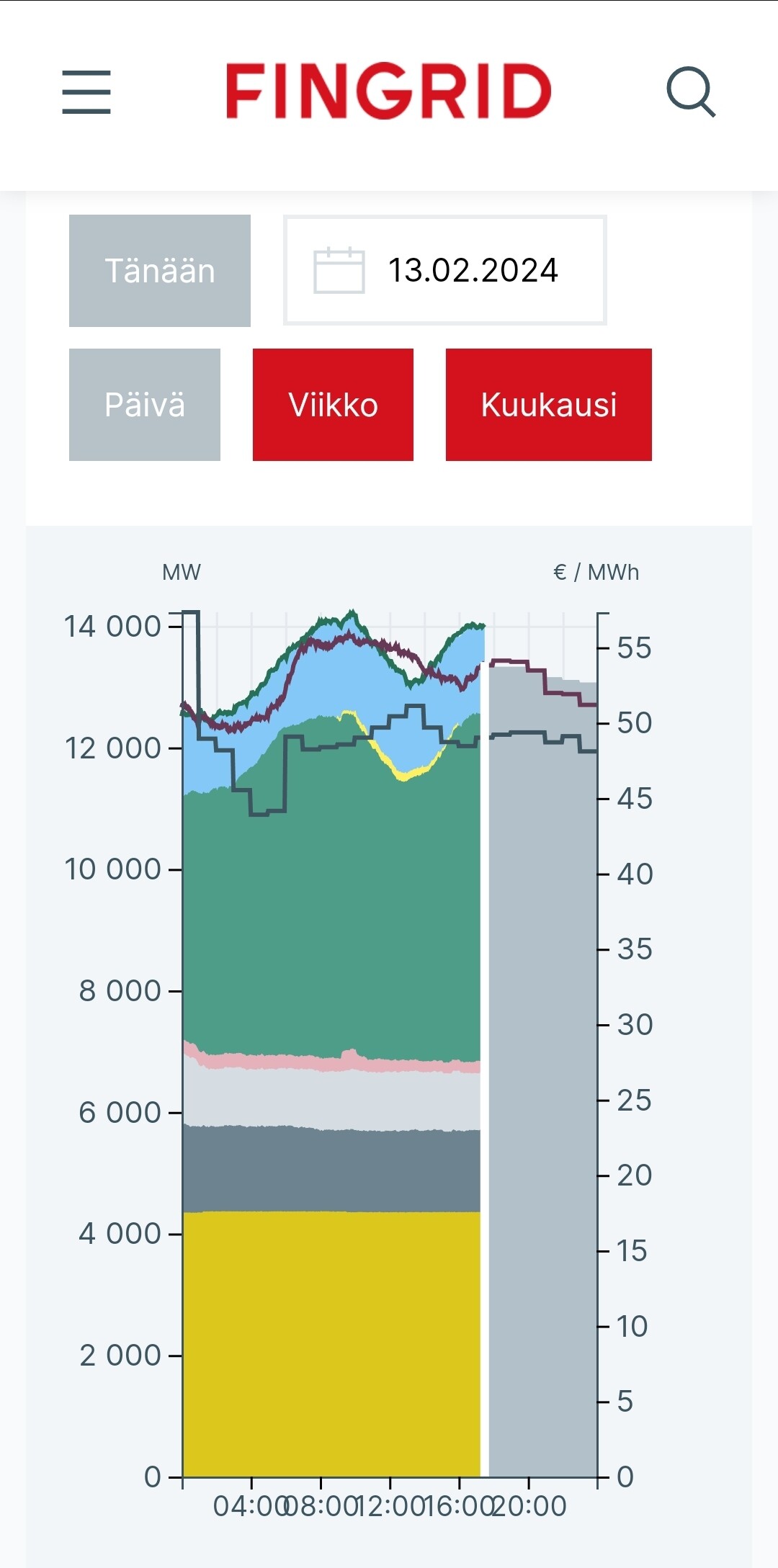
Indeed, that association isn’t one-to-one either; it’s likely intended more as a so-called “general correlation over time,” especially with the reputation wind power has currently gained in the eyes of the general public amidst the spot price determination rigmarole…
The laws of physics are indeed on the side of wind power, in their own way, admittedly:
- About 70% of wind power is produced during the six coldest months of the year. During the winter months, it is significantly windier and the air density is higher, which means more energy can be extracted from the same volume of air…
On the other hand:
- Physical electricity always comes from the nearest power plant, regardless of the time of day or season. Electricity sales are always about contracts and cash flows, not the flow of physical electricity…
(=wind turbines are not exactly competitive on their own since they can only produce electricity when wind speeds are suitable, so in addition to wind power, other production sources are almost always needed for balancing power)
…consequently, it’s no wonder if, after this ongoing stagnant phase (=it’s not worth investing in wind power & the wind power subsidy system is melting away), even Fortum will invest in wind power again, to some extent, as this will likely remain the last one for a while Pjelax-tuulipuisto | Fortum…
Yes, electricity is cheap in Finland.
Perhaps this is the reason why Harvia’s electric heater sales aren’t really taking off in Germany.
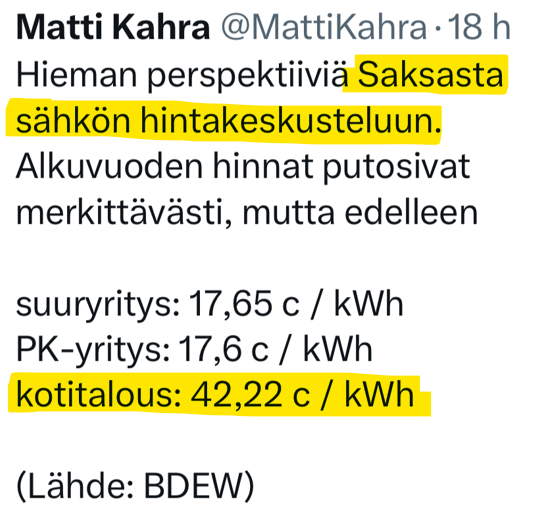
The author of the tweet seems to have thrown some figures out into the data-sphere without really breaking them down. This leaves the responsibility, in typical Savonian fashion, with the listener.
The figures are undeniably dramatic, and even I thought that things were getting wild in Germany; my own average price for the expensive month of January was 10.5 c/kWh, and the exchange area price in Finland for 1/2024 was 13.2 c/kWh (incl. 24% VAT).
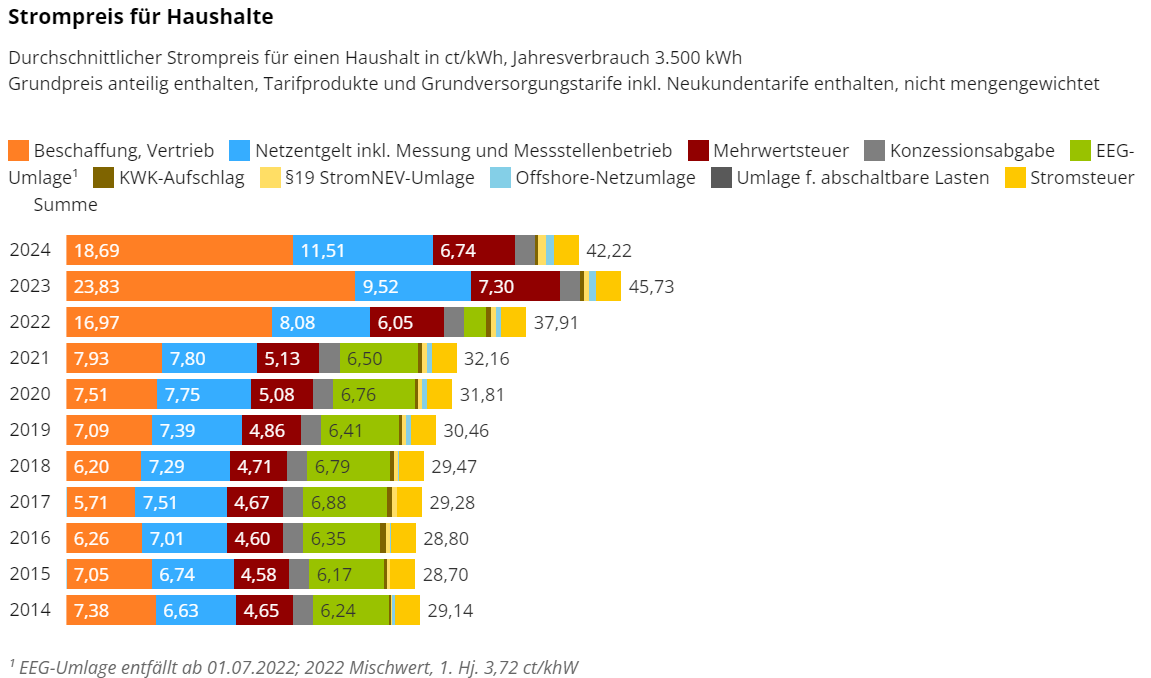
I opened the report produced by BDEW that the tweeter referred to, and the figures mentioned there actually include all sorts of things besides just the price of electricity.
In other words, what I was comparing the tweet’s figures to in my head—it was a completely different matter.
What I assume regarding the German figures:
- monthly fees prorated for a consumption level of 3500 kWh
- electricity transmission (distribution costs) incl. prorated monthly fees
- various electricity taxes. In Finland, these are on the transmission bill.
- subsidy payments EEG/Strom NEV (renewable energy subsidies), KWK (support for combined heat and power plants). In Finland, these are part of the consumer’s electricity bill within the electricity price and in general taxes.
Of course, it’s also good to remember that Germans live in a milder climate compared to Finns, which naturally reduces the need for various forms of energy for heating, and Germany’s energy policy has been to rely on gas for household energy consumption as well.
German electricity prices won’t become cheap even if someone were to establish comparability…
But it’s also not sensible to think that everything is just fine in Finland because prices, taxes, etc., are higher elsewhere.
https://www.bdew.de/service/daten-und-grafiken/bdew-strompreisanalyse/