Remedy - The pride of Finnish AAA games (Part 2)

I believe Remedy’s plan is that there will be no gap year in 2028, and I would see “AW3” in 2028 as probable if everything goes pretty much according to plan, even if there were some delays with, for example, Control 2.

I recall Tero mentioning at CMD and also earlier at the 2023 Roast that they previously announced projects perhaps too early, and if they have changed this communication policy, it’s possible that a project won’t be announced in more detail until the Proof-Of-Concept phase has been reached. At CMD 2024, Remedy also mentioned shorter development cycles between games within IPs as a goal. The technical feasibility of this goal has already been debated on the forum, but from a design perspective, this strategy must also mean that, for example, AW3 should logically remain in the same genre as its predecessor, i.e., Survival Horror.

Based on these, what can be assessed about the current status of the “AW3” project. AW2’s last DLC was released in October 2024, and the following month Remedy organized CMD, where there was likely the first mention of a “new unnamed project”. The only available team for this is the AW team, so the “AW3” mandate was certainly initiated in late 2024. Since the beginning of 2025, the game’s concept has likely been put together with the core AW team.

When the AW2 project was in its final stages (May-September), I noticed on Twitter that some Remedy employees I follow had moved to Control 2. These were mainly employees from the artist side. Now that the Max Payne Remake project is likely in its last 2-3 quarters, I consider it probable that employees, especially from the artist side, will start flowing from the MPR project, once freed up, into this “AW3” project, which should thus move into the Proof-Of-Concept phase by the end of the year or at the latest by the beginning of next year.

Here are a few clear interdependent conditions, so it’s important to note the risks involved as they are interdependent. If the MPR project launches during H1-26, and if the “AW3” project continues in the footsteps of its predecessor in the Survival Horror genre, and if conceptualization goes well, then the AW3 project could go into production by H2-26 at the latest. This then provides clear opportunities for a Q3/Q4 2028 release of the “AW3” project. And the better those conditions are met, the earlier “AW3” can go into production and improve the probabilities of the game being released in 2028. This, of course, also affects the schedules of other projects coming after this.

One positive sign for me was that there was Alex Casey merchandise among the items. Thanks to the MPR project, Remedy now has an Action Gameplay team assembled, as mentioned, for example, at CMD. My own speculation and hope is that Remedy’s financial position is sufficient to develop an Alex Casey game with this team, featuring a very strong Max Payne Noir vibe, as already seen in AW2.

7 Likes

In that sense, it would make sense that I don’t believe anyone expects a product particularly different from Alan Wake 2 in terms of game mechanics, and people don’t have the hardware to run even AW2 at its best, so new power-demanding graphics tricks wouldn’t be needed either. AW3 lives and dies by a good story and its narration, because the expectations for what makes an Alan Wake game an Alan Wake game have now been set.

6 Likes

Remedy or Rockstar were NOT seen in the live stream, but at gamescom, a new Max Payne meets Deus Ex game - Neo Berlin 2087 - was at least released. Hopefully, Remedy’s corresponding release will receive a stronger reception and be able to do even a little better.

Pretty bad Mindseye vibes, poor voice acting, UE5 asset flip, and fake gameplay footage. Almost as terrible a production as Remedy’s CrossFirex and Firebreak. At least the bar is low now.

8 Likes

Better this way, perhaps. I think it would have been a negative sign for Gamescom to put out an MPR trailer – as if Rockstar needed to test the reception of the trailer/brand before drumming it up on their own channels.

Perhaps the 30th anniversary is too close to Gamescom, and Capcom has streaming events this week. Or maybe the project is still too early for trailers, and development payments are lagging because milestones haven’t been met. Who knows :man_shrugging:

The H1’2026 release window is currently gaping empty for AAA games, and March-April would have space. Empty net would be available again:

26.2.2026 Resident Evil 9
29.5.2026 GTA VI

A Q1-Q2’2026 release window would also mean almost exactly 2 years of production for Max Payne.

This assumption practically means:

  • The Firebreak team works on Firebreak forever and/or achieves nothing by 2031.

AND

  • One of Remedy’s three other “AAA” teams sits completely idle for about five years.

I can buy the uppermost assumption based on current evidence. The lowest assumption means that Remedy’s multi-project model is a strongly net-negative entity for Remedy.

Overall, this one game per 2 years assumption means that Remedy’s game production output would be 30-50% under capacity for a good half-decade with these assumptions.

My basic assumption is a moderate acceleration of game development pace such that one game per 1.65 years → one game per ~1.4 years until somewhere around 2032.
This would already be a good performance, considering that game sizes and budgets are likely to grow significantly compared to the reference period.

A faster pace is also likely possible if Remedy were to limit game size and budget like the original Control, but the current assumption is that they will mostly stick to larger ~€50m budgets.

Some smaller gen updates or porting in between, and Tero can boast a game per year pace.

6 Likes

This is starting to sound just like 2020, when the bulls imagined that Remedy was suddenly the fastest, most efficient developer in the world by far, churning out games continuously and with every project proceeding optimally from start to finish.

In reality, that one big game I mentioned every two years + DLCs/remasters/next-gen versions/ports etc. in between years is a tough goal for a game studio of Remedy’s size. No one can afford to just throw up their hands. Firebreak’s developers are naturally merged into other teams or let go if they are not suitable. Back then I asked which comparable studio could match Remedy’s imagined unnaturally fast pace, and no one could answer. Is there an answer now as to which comparable studio of Remedy’s size can push out big games even every two years?

1 Like

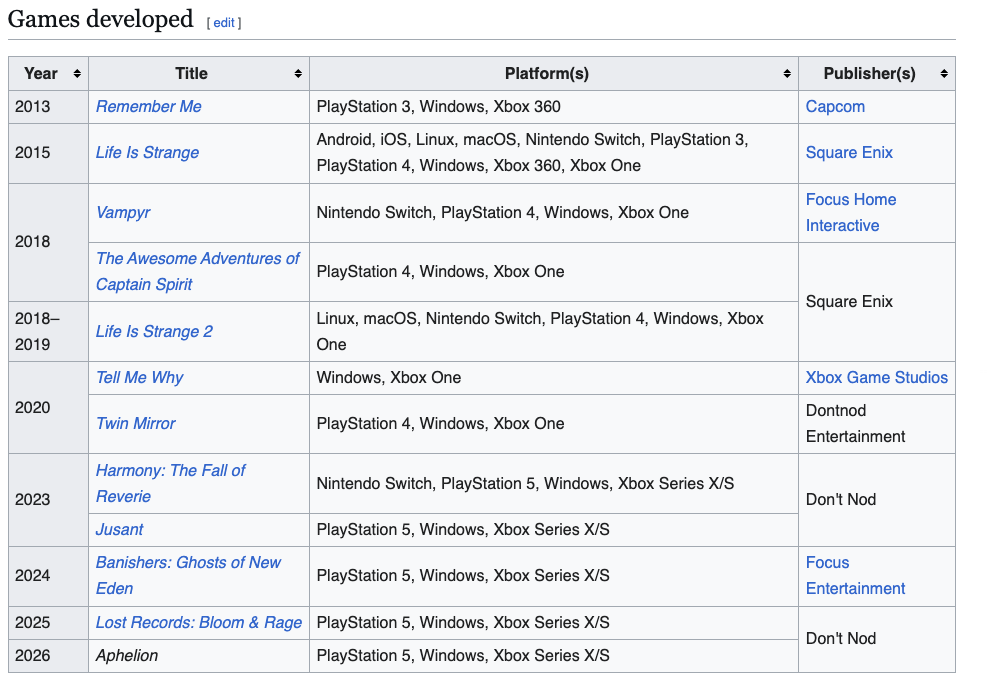
Would Don’t Nod work as a comparable, or are they considered too small? At least in 2022, the number of employees was approx. 320. Productions are perhaps more “AA” than “AAA” (but so are Control and FBC), but since 2018, almost every year (excl. 21/22, which might be explained by the pandemic) a game has been released.

Screenshot 2025-08-20 at 10.54.37

8 Likes

Roughly every 1.5 years on average, a game is released. Now, between the last two games, it’s less than a year. The company is 250 people strong (Wikipedia source, I don’t know how up-to-date the information is).

I don’t know if you misunderstood @Akee’s writing, thinking he expects 1.4 years for one game’s development. But with three game teams, which Remedy already has for these single-player games, it means a game from a specific team would be released roughly every four years. I don’t think this is a particularly impossible pace.

The biggest question is how the Northlight team, which practically has to assemble these productions on an assembly line from the late stages of production to release, will cope. So far, as with Firebreak, for example, there haven’t been any major technical issues.

4 Likes

It always gets a bit ambiguous what A-, AA- or AAA-games are. If Remedy were to make smaller games in the future, they could certainly release them more often. I’m operating under the assumption that Remedy would primarily make big/fairly big AAA games in the future, and all sorts of Firebreaks and Crossfires would be left out. AW2 is clearly AAA. Control is perhaps more like an AA+/AA 1/2. A sequel is more expensive and it also needs to look and feel more expensive.

Of those comparisons, I’d say Control is a bigger game than any of Don’t Nod’s games. There are quite a lot of smaller-scale games there. They do seem to make them quite efficiently, though. For Bloober, Silent Hill 2 is AAA. Perhaps roughly between Control and AW2 in scale. Before that, only smaller games. It’s a bit difficult to interpret what their release pace will be if they stick to larger-scale games in the future.

Silent Hill 2 was indeed released last October, and now the next game, Cronos, will be released on September 5th, and based on a quick Google search, it’s an 18-hour game, so it definitely meets the current AAA standard.

I myself fell asleep during the show. Today is the Future Games Show at 9:00 PM. I have to try to follow it without falling asleep.

https://youtu.be/afkUZBE30Wk?si=D0vepoiNFzL8EhS2

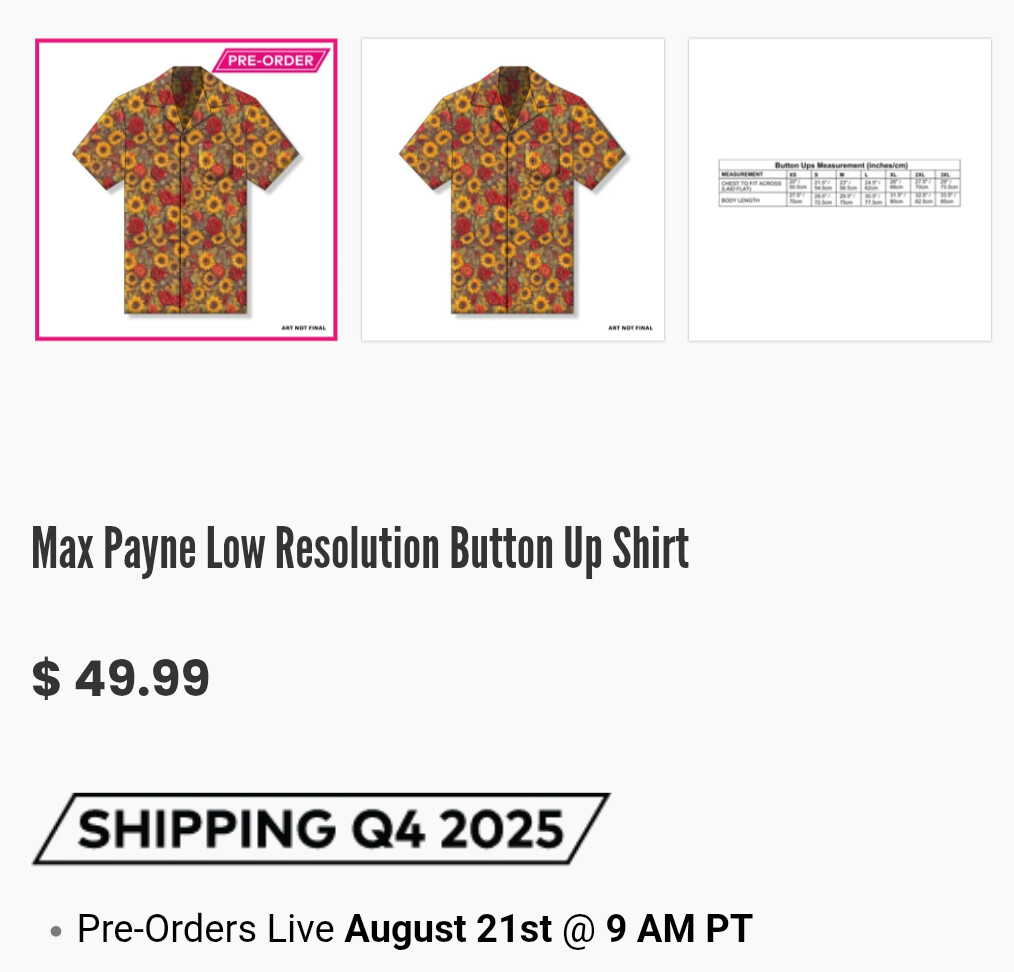
Has anyone, by the way, figured out what’s the point of releasing 30th-anniversary products three days after the actual birthday?

Screenshot_20250820-175416~2

https://www.iam8bit.com/products/max-payne-low-resolution-button-up-shirt

If we now explain my 1.4-year assumption in simple terms, it means that each team’s average game development cycle would be 5.6 years, given Remedy has four game teams. Of course, this service model team slightly breaks this. Therefore, let’s assume it’s sitting on its hands, and three teams are running games with average 4.2-year development cycles. In that scenario, things would certainly have to go very smoothly for these three teams. In itself, the Firebreak team likely has an elevated merger risk within a year or two, and it’s perhaps difficult to see Remedy restarting/investing in a fourth AAA team before any project has been commercially successful. So perhaps I can buy the argument that a game every 1.4 years is more on the bullish side than the bearish side, although I wouldn’t compare it to the “bumtsibum” (boom-boom) times just yet :slight_smile:

Major releases every two years would mean average eight-year development cycles per game for four teams, and average six-year development cycles for three teams. This already approaches the development cycles of the original Alan Wake game.

Of course, there aren’t many of these. Ubisoft Montreals, Capcoms, Square Enixs, and other larger developer-publishers are a bit difficult to compare, as they are companies with thousands of employees, and publishing activities are happily mixed in. CODs and sports games are, of course, unfair comparisons, so let’s forget those too.

In addition to those mentioned earlier, let’s mention a few more.

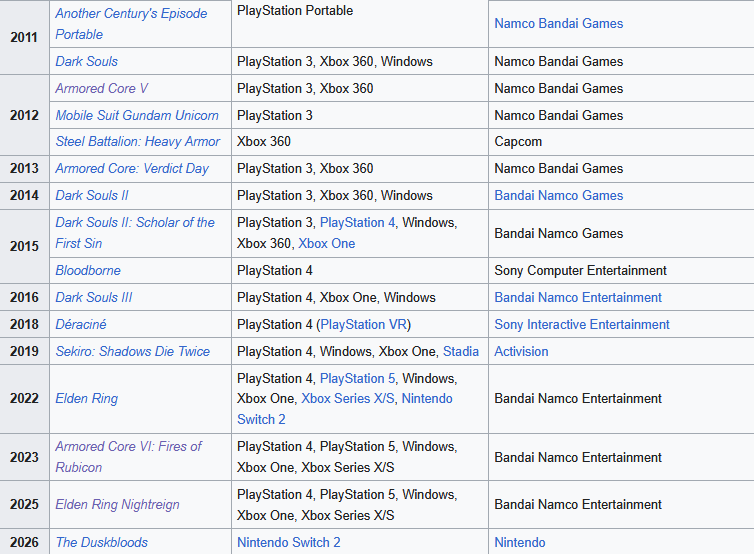
FromSoftware

This is, of course, the easiest choice. The release pace seems to be pretty much one game per year, a little more if you remove a few smaller AA games from there. A slightly larger game company than Remedy (~450 people in 2025). It operates on a multi-project model, the exact number of teams is unknown, but based on the release pace, perhaps 3-4?

There was a bit of a break between Sekiro and Elden Ring, which can be forgiven as both were overwhelming GOTY winners and sold tens of millions of copies per game at a high average price.

image

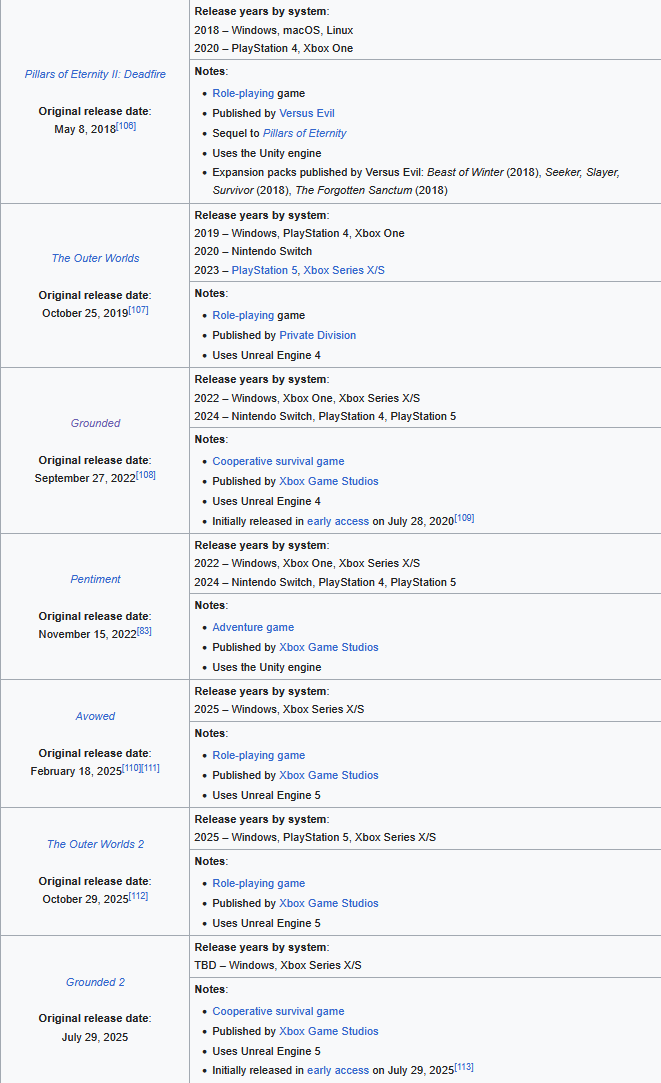
Obsidian Entertainment

In terms of size, a very close counterpart to Remedy (approx. 300 staff in 2024). In the last 8 years, 7 games have been released, although a few smaller games were included. The exact number of game teams has probably never been disclosed, but it’s likely 3 or 4. It runs a multi-project model quite successfully under Microsoft, with three game releases this year (Avowed, Outer Worlds 2, Grounded 2).

image

Insomniac Games

Slightly larger than Remedy in terms of staff (approx. 450, in 2025). No information on how many internal teams, but Studios in North Carolina and California (expensive!). It runs a multi-project model. On average, a pretty good release pace. However, the pace has now slowed down as they moved into these $200M+ games, and generally, all Spider-Man games seem to have been $100M+ budget games, the latest rumored to be $300M, although marketing budget is probably included in that.

image

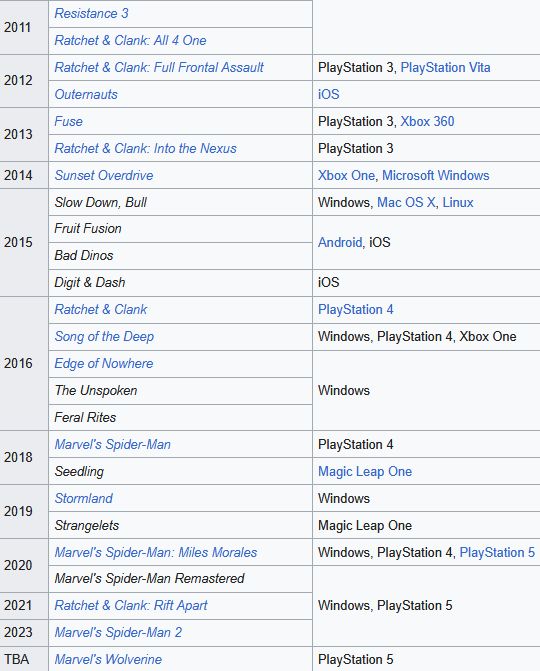
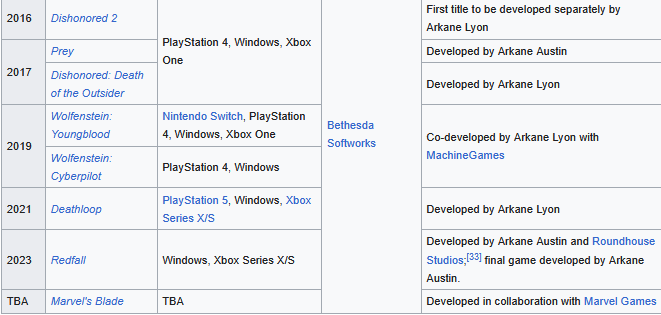
Arkane Studios

It was a smaller entity, likely under two hundred people a few years ago (150 staff in 2020). With two studios/game teams (Lyon and Texas), it had a relatively frequent release pace until Redfall. After Redfall, Arkane Texas and its 96 jobs were closed, so currently only Arkane Lyon remains, which is why it is no longer a multi-project studio. In itself, an interesting comparison, because in a worst-case scenario, Remedy follows in Arkane’s footsteps. No small or medium-sized studio can withstand three big flops in a row (Prey, Deathloop, Redfall). Deathloop, to top it all off, hits a little too close to home. Critically acclaimed, 88 Opencritic, but a huge commercial disappointment.

image

13 Likes

Now pay attention: RELEASE per year, not a new game per year! This matter has also been discussed many times in the thread.

1 Like

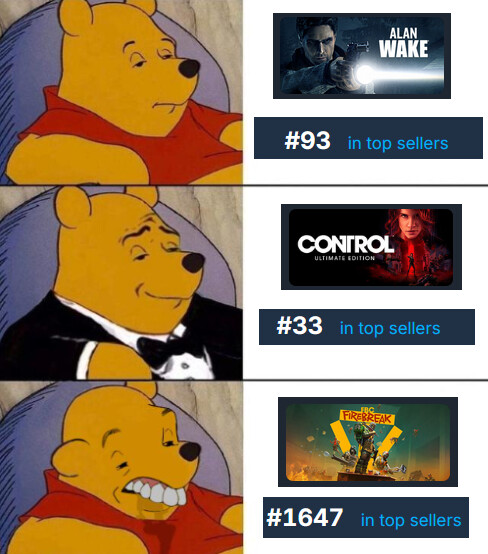
The picture says it all about Remedy’s Steam discounts.

image

On the other hand, the original (!) Alan Wake and Control have incredibly strong sales positions.

44 Likes

I find it a bit peculiar that the Steam sales weren’t made into a separate “Remedy 30” event. Even currently, several publishers have their own sale event on Steam. Control does get visibility on Steam’s front page through the heavily advertised Third Person Shooters campaign, but otherwise, Remedy’s anniversary sales don’t get much visibility.

9 Likes

It could be that towards the end of the sales, closer to the weekend, a separate “Remedy publisher sale” card will still appear on the front page; at least Control and Alan Wake seem to be trending quite well in the first days of the sales. Or maybe not.

From what I’ve been peeking at, a couple of days ago there was a publisher sale on the front page from some publisher whose name I no longer remember, which ends only the day after tomorrow, but it has already been removed from the front page. Individual games seem to largely operate by the power of algorithms, but behind publisher and genre campaigns, there’s probably also Steam’s own curation.

It could, of course, be that this is being saved for later, e.g., after September’s Firebreak patch, now that Control and Alan Wake are getting visibility anyway with that big TPS campaign.

I agree that this 30th-anniversary celebration as a whole has been somewhat of a letdown so far. If it’s because everyone at the company is busy with upcoming game projects and updates, then this is acceptable.

11 Likes

Gamalytic’s estimate is that Alan Wake has already sold almost 100k copies during this campaign. One would think and hope that this would also fuel AW2 sales. Currently, it’s in 4th place in the Epic Store. I myself bought Alan Wake for the third time because American Nightmare was missing and the bundle price was just over a euro.

12 Likes

Let’s share some thoughts and speculation again.

Remedy’s 30th Anniversary Sale Game Sales on Steam

A small review of Remedy’s week-long sale game sales estimates on Steam. The source for sales copy numbers is Gamalytic. Naturally, the figures are pure speculation based on unconfirmed third-party data and inaccurate personal assumptions.

Game RRP Discount Copies Sold 24.8-31.8 Net Sales Estimate* 24.8-31.8
Death Rally (2012) €9.99 -90% (€0.99) 250 €100
Alan Wake (2012) €15.99 -95% (€0.79) 265,000 €73,000
Alan Wake: American Nightmare (2012) €8.79 -90% (€0.87) 45,500 €14,000
Control Ultimate Edition (2020) €39.99 -90% (€3.99) 125,000 €175,000
FBC: Firebreak (2025) €39.99 -15% (€33.99) 600 €7,000
Total €269,100

*Net sales estimate = copies x discounted price x 0.7 (distribution cost) x 0.6 (local currencies) x 0.8 (VAT) i.e. copies x discounted price x 0.35. It is probably safe to assume that the significance of local currencies in these deep discounts is considerably greater than in so-called day 1 full-price sales, which are mainly EU/US sales. In other words, these games costing a few euros are likely sold more to countries where the game’s initial price, adjusted for currency, is significantly below the EU/US level.

However, a nice quarter of a million in net sales from the old catalog in a week. As @Hasty noted earlier, backlog game sales were also reflected in Alan Wake 2’s sales rankings (at full price) on the Epic Store, where Alan Wake 2 jumped to 4th place during the first days of the Steam sales, compared to previous positions of 8-10+. Alan Wake Remastered also jumped from ~100th to ~70th place during the first days of the Steam sales. In euros, the impact is likely very small.

Firebreak’s weak sales are not surprising, as I speculated even before the sales began. More on this later; let’s briefly turn our attention to Alan Wake 2 sales.

Alan Wake 2

Alan Wake 2 recently, and surprisingly quietly, went on a -70% discount (Deluxe version) on the PS Store for the first time.

image

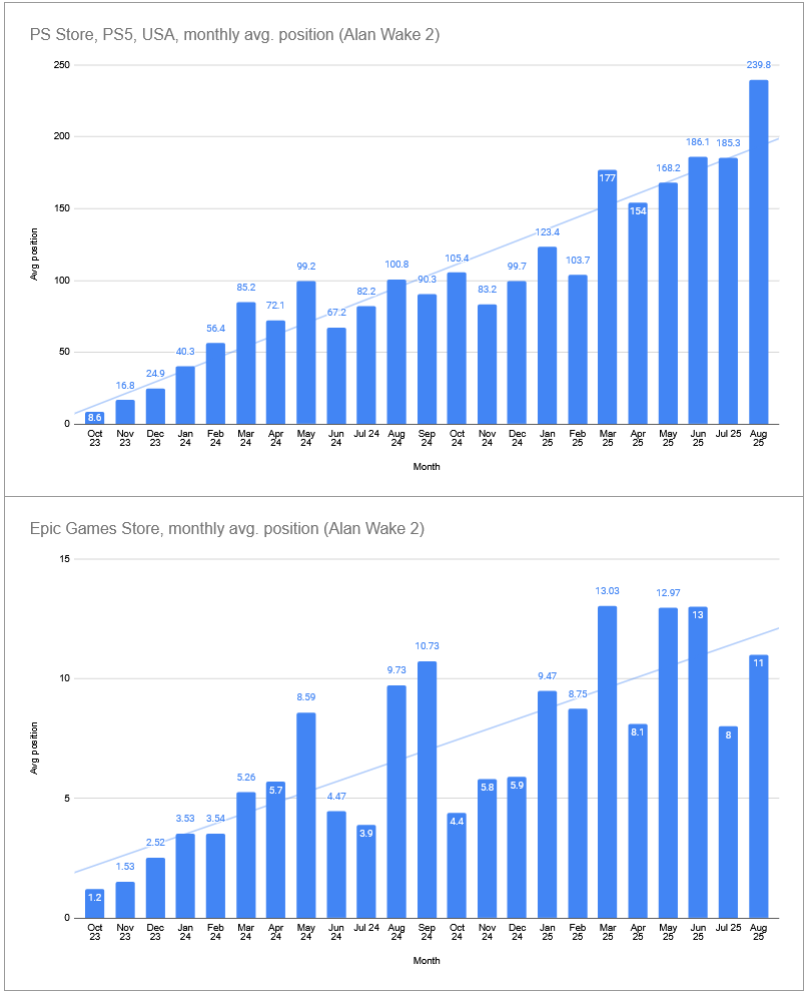
How did players receive this? Not particularly well. Based on the sales rank trend, it seems to be knocking on the door of the TOP 100 sales rank in the US PS Store (PS5) again. Today it’s at 103rd place. Quite similar to previous -60% discounts. Of course, new games are constantly being added to the PS Store, which makes it natural that maintaining sales ranks becomes more difficult over time.
image
My own tracking of Alan Wake 2’s average monthly sales ranks in the US PS Store for PS5 and on the Epic Games Store. I do not guarantee the accuracy of the presented information.

Is the rest of the year ruined?

Firebreak is struggling, and Alan Wake 2 sales are slowing down despite discounts. Q3 looks grim in light of current information, especially if development fees remain at the previous quarter’s level. H1’2025 EBIT was a mere €0.8M. The guidance is still positive EBIT for 2025, so the end of the year, and especially Q4, will be interesting, as there are currently no significant drivers visible for Q3’s operating profit, with Firebreak’s big update only coming in “Late September,” meaning not many sales days from this update will fall into Q3.

What will happen to the 2025 guidance? I don’t know, but a few thoughts on the rest of the year.

1. No far-reaching conclusions can (yet) be drawn from Firebreak’s weak sales at -15% discount.

A bold claim, I know. I wrote earlier that I didn’t understand this -15% discount, and perhaps I still don’t fully understand it, but I do understand why the discount was 15%. This is likely because for 20% and larger discounts, Steam sends an email about the discount campaign to everyone who has wishlisted the game. According to Gamalytic, Firebreak had ~320k wishlists on launch day, and these wishlisters were probably not yet wanted to be activated before the September content update. For the same reason, I consider it almost certain that a -20% or higher discount will be seen immediately with the September update. This -15% discount was likely intended mainly to serve Remedy fans, as the game was not marketed (to my knowledge) outside of Remedy’s own social channels.

The September update will likely gather players to try the game again for a few weeks, until CCUs drop again towards the next content update. And the same can be repeated indefinitely. The essential question is whether, after two (and possibly subsequent) updates, the average CCU trend is upward when compared to previous updates. If not, one could write “GG,” but that will probably remain unwritten as Firebreak does not support text chat. Player feedback or reviews might be a more important metric than CCUs after the September update. Unless Steam’s previous 30-day or “recent” player reviews rise to the 75-80% positive level, things look bad.

2. Is Alan Wake 2 heading to subscription services or new platforms?

Is this the third or fourth time I’ve speculated on this :smiley: But maybe this time! Or maybe not…
As @Relaaja aptly wrote, in the case of game companies, it’s not about who is most right, but who is least wrong. I think I’m competing in the “most wrong” category, but I’ll speculate anyway.

Since Remedy already started making more aggressive Firebreak write-offs in Q2, and maintained its forecast after Firebreak’s weak launch, I would consider possible cash flows for the end of the year that are not yet known.
One hint might be a surprising change in direction in Epic’s Alan Wake 2 discount pricing.
image
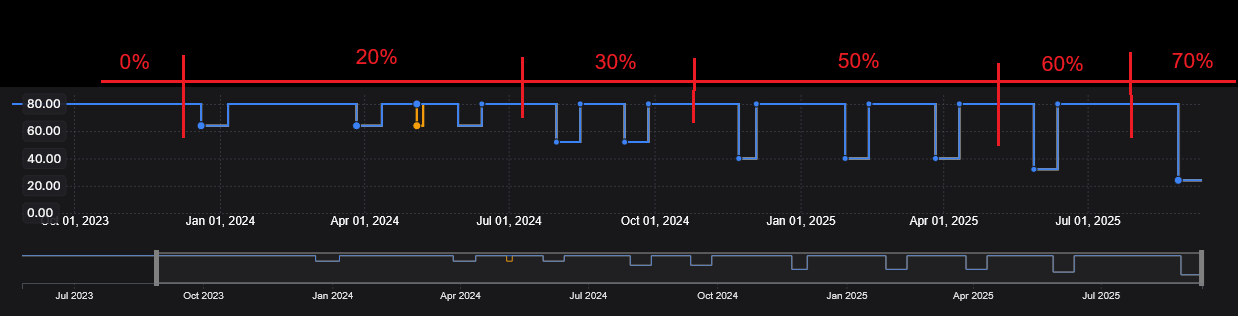
Alan Wake 2: Deluxe Edition price history, PS5 / Source: psprices.com. The standard version has followed an identical discount pattern, except that it has not yet moved to -70% discounts.

The discounts have been quite typical and consistent so far. Two or three discounts and a move to deeper discount levels. Until now, this summer, it quickly went from 50% → 70%. I believe the game could have certainly been milked with 60% discounts for a bit longer with decent sales.

More aggressive discount monetization could hint at, for example, an upcoming subscription service agreement, in which case it would make sense to squeeze maximum sales in a short time before the agreement comes into effect. Or perhaps Alan Wake 2’s sales tail has been cut off, and it’s necessary to go into deeper discounts ever faster.

For comparison, Control went into subscription services (Gamepass 12/2020) for the first time 15 months after its release. Alan Wake 2 has now been out for 22 months without subscription services. If Alan Wake 2 were to go into one of the big subscription services for, say, a year, one would imagine that at least €10M should be generated from it (€5M for Remedy), if this is mirrored against Firebreak. It is, after all, a GOTY-level game. This €5M could still potentially save the guidance (or not), if Firebreak doesn’t ignite, development fees are low for the rest of the year, and/or Alan Wake 2 sales continue to drag.

From Remedy’s perspective, it should go into subscription services. Alan Wake 2 royalties are quite modest, so it’s better if the game is aggressively pushed towards consumers from a marketing perspective, so that as many people as possible have played Control and Alan Wake games when Control 2 becomes available for pre-order someday. However, Epic ultimately decides these things, and it’s good to note that Epic’s interests (EGS users) may be very different from Remedy’s interests (new Remedy day 1 fans) regarding Alan Wake 2.
26 Likes

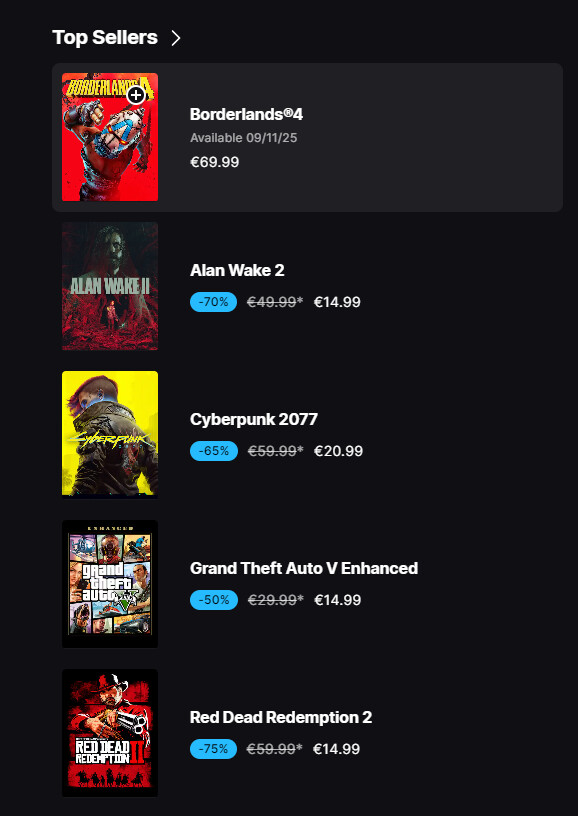
Now it seems the discounts are at least working. The AW2 base game can be found in pretty good company on the Top Seller (EGS) list :slight_smile:

image

P.S. From my own experience; AW2 Deluxe also finally ended up in my shopping cart a few weeks ago, and even though I expected good things due to its critical success, the execution is truly close to perfection :exploding_head: :heart_eyes: I don’t know how much a shareholder’s rose-tinted glasses distort the assessment, but I don’t remember when I was last this hooked and/or excited about a game. Remedy certainly knows how to make great and beautiful story-driven games, if only it could be packaged in a way that’s more suitable for large audiences…
28 Likes

Today at 4:00 PM, conveniently less than an hour long, a Nintendo Switch Direct before Finland’s basketball game. Theoretically, there might still be a small possibility for an Alan Wake 2 port.

At least in the recent marketing for Lenovo’s Legion Go 2, which will be released next month, Alan Wake 2 was heavily featured, but the performance of this device is of a slightly different caliber than the Switch 2, and so is the price, as the price of one Lenovo Go 2 can get you almost three Switch 2s.

And even if a Switch 2 port were to come, it wouldn’t necessarily be a game-changer. Although the console has sold well in its early stages, first-party games seem to be the main thing right now. Among the third-party games competing for the remaining scraps, there are bigger and more popular games than Alan Wake 2. The Switch 2 is perhaps also not the console for showcasing stunning graphics.

It’s good, however, that Remedy is involved in this handheld trend in one way or another and learning lessons, because the market seems to be strongly moving in that direction. Whether this trend is in Remedy’s interest is another question — not necessarily, at least not as long as GPUs are attached to machines for the masses and not in the cloud

5 Likes

I think I’ve speculated about this here before, but purely as speculation, I’ll throw out a slightly bigger possibility for Control’s Switch 2 release. The game has had pretty drastic 90% discounts, both previously on Steam and currently on GOG and PS5/Xbox marketplaces. To me, it feels a bit early to launch such aggressive campaigns to build Control 2 hype if the game is only coming out (at the earliest) in 2027, but the campaigns could generate good word of mouth if Control were to get a Switch 2 version released at a price of 20–30€.

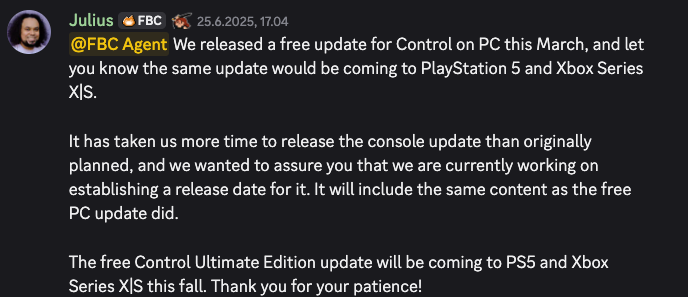
In addition to the drastic discounts, we’ve been waiting since March for the update released on PC at that time to be released on PS5 and Xbox. Could it be that a Switch 2 release is being coordinated at the same time? One can hope.

Control is also a suitable Switch 2 release in that the game was originally made for older hardware and has been heavily optimized since its release. The recently released Star Wars: Outlaws for Switch 2 received praise for its ray-tracing implementation, and Finnish forces were involved in this as well, with the port handled by Helsinki-based Ubisoft RedLynx. Surely, information exchange between developers on how to optimize games for new platforms flows when the circles are small. The bigger question mark then is a) has Remedy received a Switch 2 devkit, and if not, b) could the porting have been outsourced? It has also remained somewhat open from Tero’s “I’m not going to speculate” comments whether Remedy even has a strong desire to release their games on Nintendo consoles.

2 Likes