Railroad Companies - The Real Parlor Cars

It’s truly astonishing that the forum has, until now, lacked its own thread dedicated to pure-play railway companies. Even though “salon carriage” is mentioned in almost every thread, and the sector has come up in discussions about Berkshire Hathaway, The Perfect Company (point 5), and Global Quality Companies threads.

We are constantly looking for sustainable competitive advantages, pricing power, and quality value creation in the markets. Yet, we have overlooked one of the world’s oldest and strongest business models. Now is the time to turn our gaze to the rails, which have served as solid anchors of prosperity for over a hundred years.

Why are railway companies an exceptional investment?
The investment case for railways is built around an insurmountable moat. Building a vast railway network of many thousands of miles from scratch is impossible today due to astronomical costs and land use. This creates regional monopolies and duopolies for existing giants.

This directly reflects in their pricing power. Companies pass on inflation and fuel price fluctuations to freight rates. Since trains are significantly more energy-efficient than road transport over long distances, the relative advantage of railways is further emphasized when energy prices rise.

North American giants pass even the strictest quality analysis:

Profitability:
Net Profit Margins (NPM) are exceptional, typically 25–30%

Return on Equity (ROE): Varies by company but is consistently above the 8% target level. Top performers, such as Union Pacific, achieve ROE figures of up to ~40%, supported by active share buybacks.

Cash Flow & Value Creation:
Return on Invested Capital (ROIC) for quality operators is regularly over 10% (e.g., CNR 12.9%, UNP 16.3%). Free cash flow margins are strong, with the best reaching almost 20% of revenue.

Sustainability:
Payout Ratios are kept moderate (often 20–50%), which leaves a huge amount of capital to grow the “snowball” through share cancellations.

Mergers
The railway industry is on the verge of a historic transformation. The merger plan between Union Pacific and Norfolk Southern (estimated at USD 85 billion), which began in 2025, is creating the first true coast-to-coast giant in the United States. This has sparked speculation about CSX’s countermoves and potential cooperation with Berkshire Hathaway-owned BNSF or the new CPKC.

Companies to watch in a nutshell:
Canadian National Railway (CNR)
Union Pacific (UNP)
Canadian Pacific Kansas City (CPKC)
CSX & Norfolk Southern (NSC)
25 Likes

Of these, CNR has been on my watch list the longest, but the recent debt-funded dividend/share payments/purchases have somewhat reduced my interest. No problem has arisen from it, yet.

My gaze has thus shifted towards Canadian Pacific, where the valuation level is more of a concern.

I guess I’ll eventually get on board the train, as long as I can wait long enough.

4 Likes

It’s good to note, generally, that the North American giants own railways and operate at least freight traffic on their tracks, which differs significantly from practices in Finland and, as I understand it, in Europe regarding railway tracks. For this reason, the threshold for establishing new railways is also very high, because the tracks are not primarily publicly owned.

5 Likes

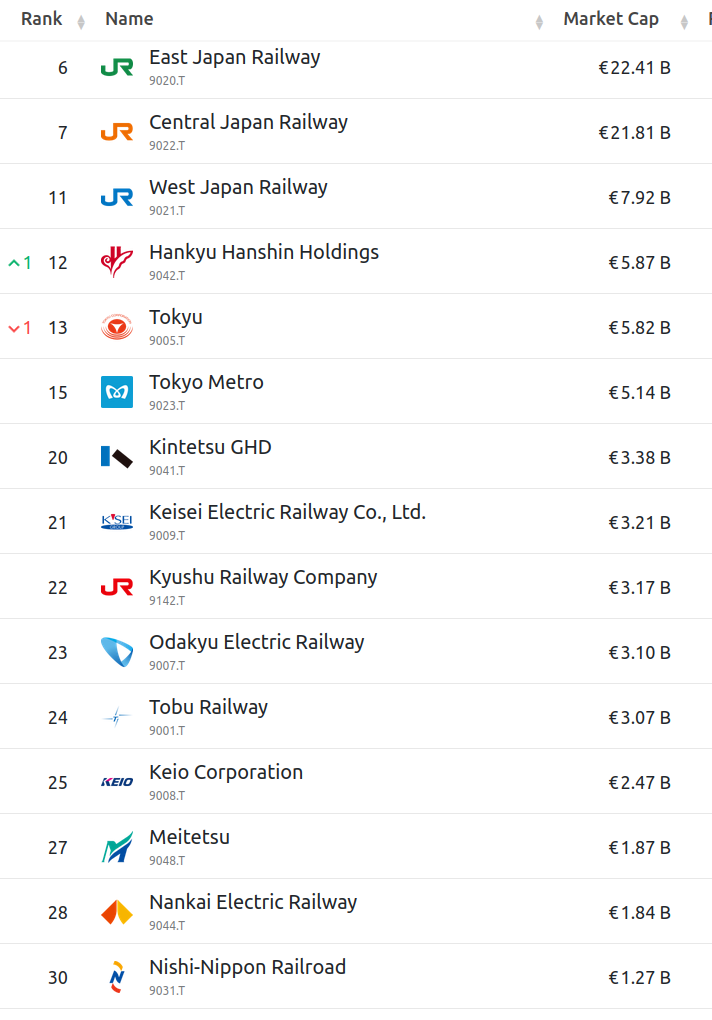
By the way, there are also railway companies in Asian stock exchanges.

Especially in Japan, there are numerous publicly listed railway companies. These companies own their tracks and are monopolies on their own lines. Unlike North American railway companies, these are passenger-focused. Virtually all of Japan’s industrial centers are on the coast, and the country has no major natural resources, so there is no particularly great need for inland freight transport.

These Japanese railway companies usually have other businesses in addition to the actual train operations; for example, they often own the properties of their railway stations, which contain various valuable commercial spaces.

Many of these are quite affordable based on earnings but have not been particularly value-creating for shareholders. Growth prospects in passenger traffic are subdued because the country’s population is still declining – though tourism is boosting it.

8 Likes

MTR Corporation (the name is an abbreviation of Mass Transit Railway) is a metro rail company listed on the Hong Kong Stock Exchange.

The company’s original main business is the Hong Kong MTR, which it operates exclusively at least until 2057. HK’s MTR has approximately 5.5 million daily passengers and a 50% market share of the city’s public transport. In connection with the MTR, the company owns shopping centers at stations and a real estate development business, which form a significant part of its earnings. Hong Kong accounts for just over half of the company’s revenue.

As a second business area, the company develops and operates metro and commuter rail lines in other cities: Beijing, Shenzhen, Hangzhou, Melbourne, and Sydney. Previously, the company also operated trains in Sweden, but this was not profitable, so the company withdrew from the market.

The Hong Kong government owns 74% of the company.

Thanks to its monopoly position, the company is profiled as a rather defensive infrastructure investment, although it also has exposure to the commercial real estate market. The current dividend yield is approximately 4% and the payout ratio is approximately 57%. The company’s market capitalization is currently approximately HKD 207 billion, or about EUR 22.5 billion.

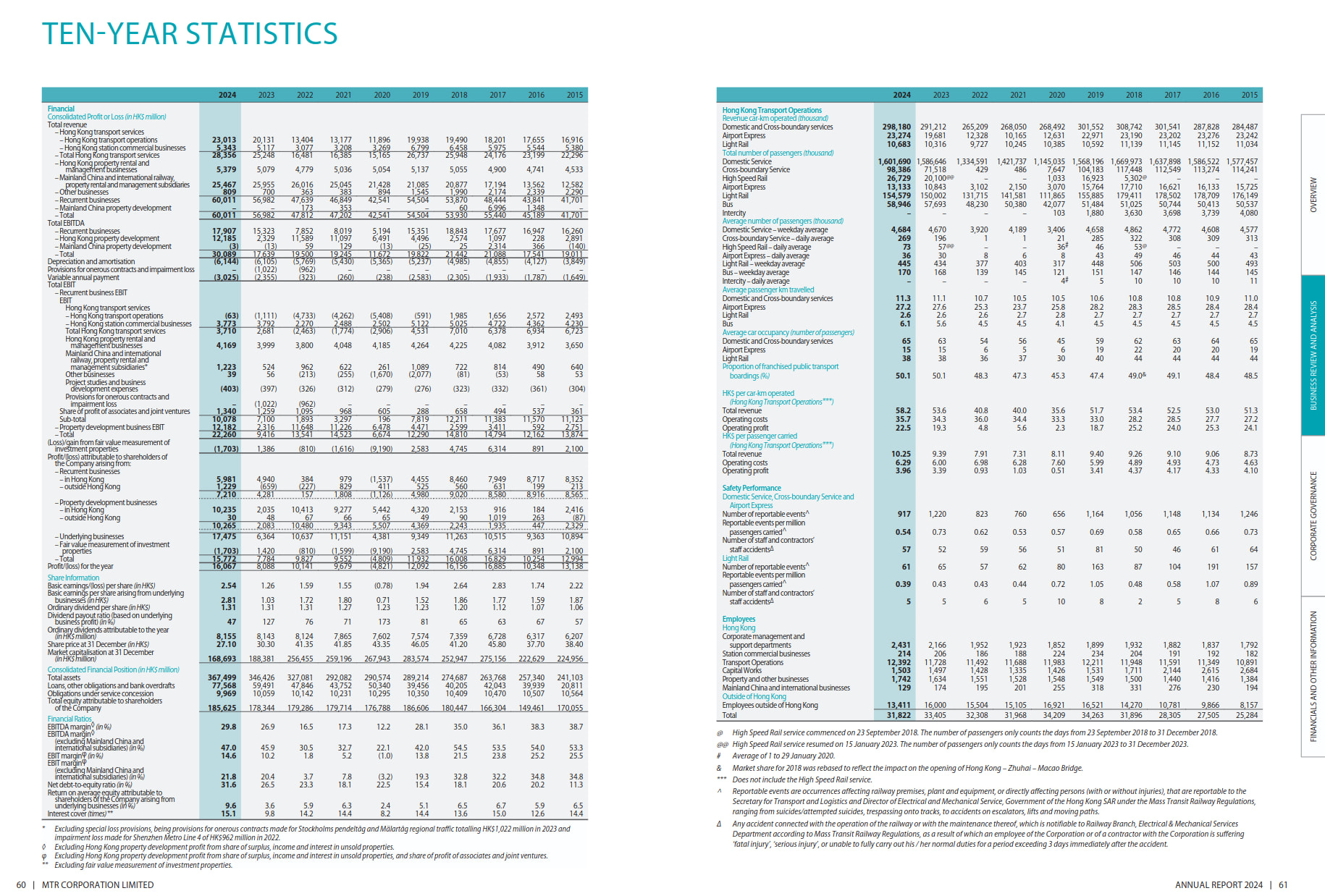
Here are the financial figures for 2015-2024 (last year’s annual report has not yet been published, so 2025 is not included) - enlarge the image by clicking.

The company can be traded on the Hong Kong Stock Exchange under the ticker symbol 0066.

3 Likes