Oil, ore, grain, containers and other cargo at the mercy of the seas and hostile parties

Are there people on the forum who are more deeply familiar with the industry or who have jumped on the hype train? Which companies in the sector are favorites and least favorites?

I believe that in the best-case scenario, oil tankers can generate a fortune for their owners, meaning an increase in invested capital by tens of times within a 1-3 year timeframe. Below, I will try to explain why.

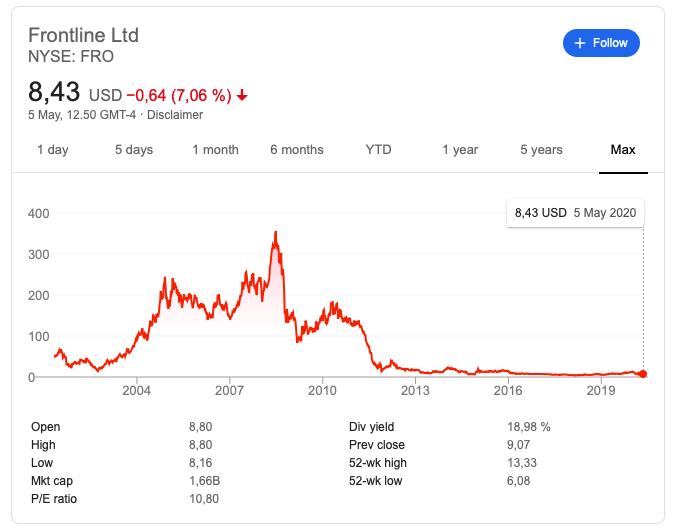
Oil tankers have been the worst-performing asset class of the previous decade, including dividends. The image shows the stock chart of the largest company in the sector since 2000.
The industry is what is called super-cyclical (compare mining companies), where profits are purely driven by the law of supply and demand. Within the industry, it is also very difficult to create a moat relative to peers.

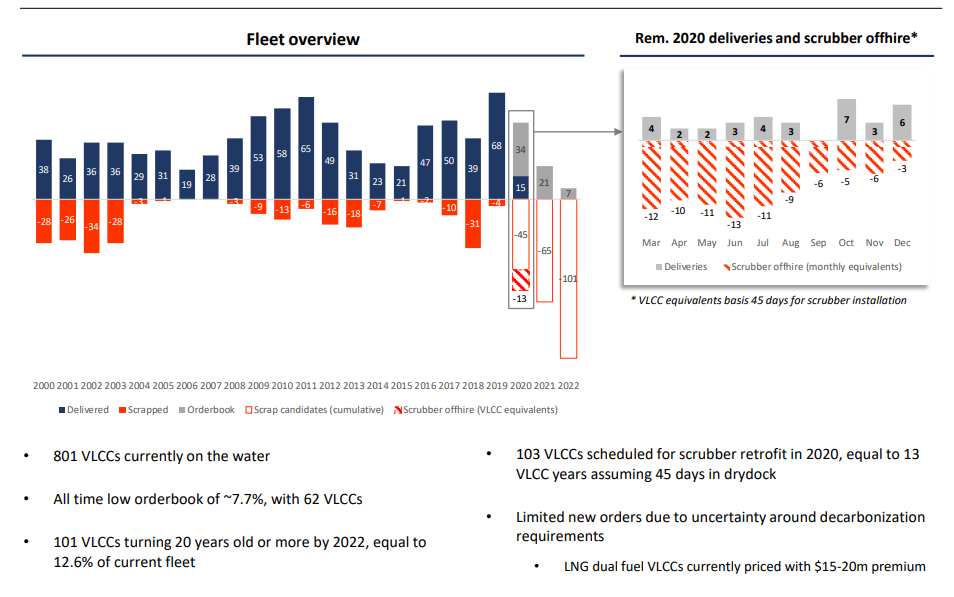
At the peak of the cycle, too many new vessels are ordered for long-term demand, and when demand decreases, the oversupply of vessels in the market ruins the profits generated from transporting oil. (This has plagued the sector for the past 10 years.) Conversely, when enough vessels have been retired, the rates paid for transporting oil increase. The lifespan of vessels is approximately 10-20 years.

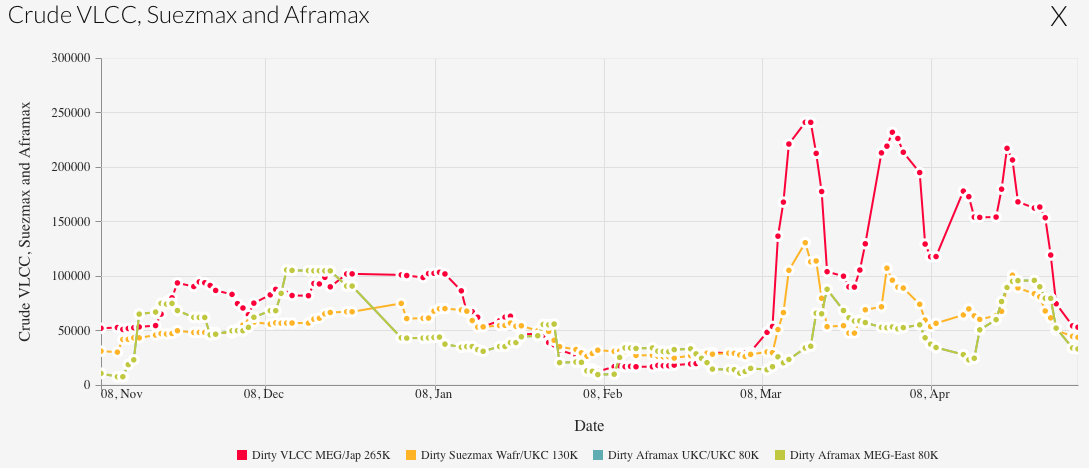
Companies’ profits are simply generated from rates exceeding vessel costs, i.e., compensation paid for transporting or storing oil. Costs are relatively fixed, so an increase in rates can significantly leverage profits when the return relative to costs improves. (For example, if a vessel’s costs are €20,000/day and the rate is €60,000, a profit of €40,000 is generated. Currently (5.5.2020), rates are approximately €160,000 per day for a large VLCC tanker, so in this example scenario, a profit of €140,000 per vessel per day is generated.)

The last cycle peak was around 2008, as can be seen from the stock chart above. Now enough time has passed for natural attrition to begin. Combined with the IMO2020 decision to reduce sulfur emissions from vessels by requiring the installation of “scrubbers” on vessels, this further promotes the retirement of older vessels, as it would not be economically viable for vessels with a short remaining lifespan.

The effects of IMO2020 began to be seen in tanker prices last year, with rising stock prices towards the end of the year.
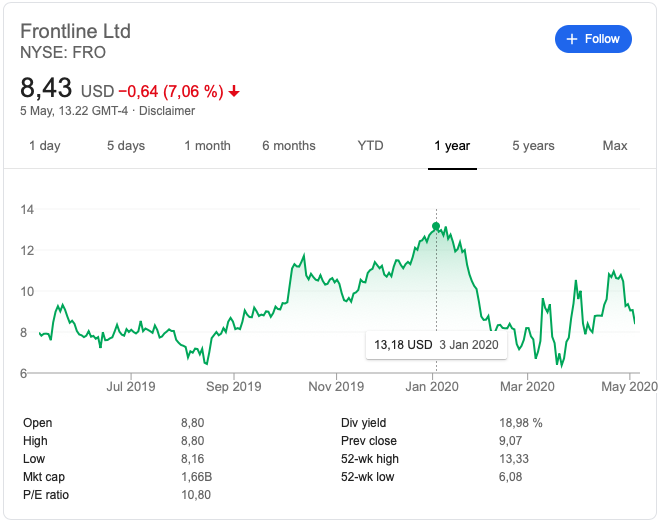

However, tankers also took a hit from the coronavirus, bringing stock prices back to all-time lows.

Now tankers have made headlines due to their excellent situation related to oil contango. That is, when land-based storage facilities are full of oil, oil has had to be stored in tankers. This has pushed rates to historical highs, and tanker companies are making more money than ever.

The possible and even probable cycle turnaround initiated by IMO2020 is therefore still an ongoing scenario, and in addition, companies are more profitable than ever, but stock prices are still well below YTD highs. From the beginning of the previous cycle to its peak, stock prices rose by thousands of percent. Market psychology naturally strongly influences this. Super-cyclical industries tend to rise very quickly, which, once the rise begins, attracts interest from other investors. The peaks of these industries’ cycles typically involve strong bubble formation.

How could the masses be so wrong about tanker pricing? There are many possible answers:

  • The industry is small, with the largest companies having market caps of approximately 2 billion.
  • The industry is followed by very few analysts due to its hated nature and the worst returns of the decade.
  • The industry is considered dying, often justified by glancing at the stock chart without understanding the cyclical nature of the industry.
  • Currently, bear arguments are largely based on a rapid decline in current high rates, which may be possible, but this overlooks the natural increase in rates due to the underlying cycle turnaround.
  • The industry couldn’t be less sexy when asked by anyone other than ship enthusiasts (they exist, I have worked in ship-related jobs).
36 Likes

Could you suggest a few companies, or perhaps an ETF or something else? It sounds almost like the semiconductor industry. :smirking_face:

3 Likes

Oil tankers are divided into crude and product tankers. Crude tankers transport “dirty” crude oil and product tankers transport “clean” refined products.

Purely dirty companies:
DHT Holdings
Euronav
Nordic American Tankers (most hype)

Mixed (both):
Frontline
Diamond S Shipping
Teekay Tankers (also gas)

Refined products:
Scorpio Tankers

edit: corrected error where Frontline was among the dirty companies even though it’s a hybrid

5 Likes

On Twitter, two gentlemen named Jarmo Friman and Mikko Leivo, who are traders, have, in my opinion, done a great job of highlighting this sector in their feeds. I personally have EURN and GLNG in my portfolio.

2 Likes

1 Like

I have TNP in my portfolio, which falls into the “mixed, both” sector. The position is the smallest in the portfolio, a so-called small speculative play.

NAV (Net Asset Value) probably has the most hype, as mentioned above, which is why valuation levels are already quite high.

1 Like

The hype around Nordic American Tankers (NAT) is strongly linked to this video. Stock channels with large followings on YouTube have also been hyping NAT specifically, which caused its stock price to soar relative to others. Now, however, it has also fallen sharply in recent days, likely due to a moderate rise in oil prices and profit-taking. NAT rose by approximately 200% in a couple of weeks when the hype began to build, so profit-taking is understandable.

1 Like

The video discusses the current situation in the oil market.

Interviews and podcasts for those interested in oil tankers:

From the time before contango

Recent interview with Euronav’s CEO Spotify

and Frontline’s CEO interview
https://seekingalpha.com/article/4340837-frontlines-ceo-on-tanker-market-podcast?fbclid=IwAR0ETEx1-FY_FfXnJp-_B94hY1ExNClguc5SIseQ57ogHIcXhs8qurI6slI

1 Like

You can follow product and crude tanker rates here:
https://www.ssyonline.com/free-charts/tanker-tce/#

2 Likes

There’s been a huge variation in rates even before the coronavirus. What’s the long-term average? It seems that the worst of the rate surge only happened in April, so the biggest spike will probably only be visible in Q2 results. The biggest change appears to be in the rates for large tankers, LR2 (clean) and VLCC (dirty). I should find out which operators have a lot of these in their fleet. Many thanks for starting the thread. I might have to take a position, as it seems that the hype hasn’t badly affected these yet. Scorpio Tankers seems to be announcing Q1 results today, so I’ll be waiting for the share price reaction.

2 Likes

Got our own thread for tankers too :+1: I have DHT, FRO, and NNA in my portfolio.
DHT released its Q1 results yesterday, which were as strong as expected. EPS in the first quarter was almost as much as the whole of the previous year combined, an additional $57 million in debt was repaid, and still, the dividend was raised. Even better is expected in Q2; the forecasted Q2 revenue is already higher than Q1, even though 25% of capacity was still available.

https://ml-eu.globenewswire.com/Resource/Download/d98a1a31-08cf-4334-a5d1-47843763f1fe

It will be interesting to see if we finally get an upward price reaction; so far, tanker stock prices have shown a direct negative correlation with oil prices.

2 Likes

My trading targets have been FRO, TNK, DHT, and NAT. It seems the best days are already behind us unless expectations for rising oil consumption falter. Texas WTI inventories are almost full. These are “dangerous” trading targets in that one doesn’t dare leave them overnight in this sentiment, so if a trade goes in the wrong direction, it must be cut with a tight stop-loss. I don’t know the industry at all, so I have no view on longer-term investments.

2 Likes

Thanks for the mention, @Yanos (I don’t trade, though), but my own hypotheses have been way off on this, so I wouldn’t rely on my statements.

The opening post builds a narrative that I don’t think is entirely accurate.

  • IMO2020: One expectation was a slowdown in traffic (even if the number of ships remained constant, supply would shrink as the same volume moved slower) and the slow removal of older, non-scrubber-equipped tankers (a reduction in supply).
  • IMO2030 standards are still unclear, so even if charters rise, new investments won’t be made (this, of course, isn’t actually true).
  • This creates pressure on charter rates, and on the other hand, supply may return more slowly.

But the 2019 rally was mainly due to the trade war, COSCO ship blockades, Middle East problems, etc., geopolitical coincidences that tanker investors (including myself) did not predict.
The presumed effects of IMO2020 have still not materialized particularly clearly.

Then came the coronavirus, and oil demand collapsed. Bad for tankers and again geopolitics. And off we went again, this time only downwards, and again no one predicted this.

Now the charter market is very strong, especially as tankers are used for oil storage (as the opener mentioned), and it’s true that profitability is excellent.
DSSI, for example, owns roughly 50 MR tankers and 15 Suezmaxes.
The break-even for ships is something like $13.5-14k/d for MRs and $20k/d for SUEZ. And these are fixed; after this, profits pour in.
MR charter was $72k/d and Suez $79k/d last week when I last checked.
So, an MR tanker alone makes $58k/d, or $21M per year. 50*21 => $1B per year. Factor in that utilization isn’t 100% and there’s some maintenance, and we’re at $800M per year just for MR tankers.
The company’s market cap is under $500M, and debt is $755M. Due to past losses, there are hardly any taxes, and depreciation is low.
So, there’s a lot of earning potential.
BUT 1. some contracts have been signed for 6-12 month runs at lower prices.
2. Almost all of those >$100k/d contracts were canceled when we dropped from the peak.
3. At these prices, few long-term contracts are made.
4. It’s hard to say how long the current floating storage situation will continue.
5. Storage has put the brakes on scrapping older tankers. And, as I understand it, Chinese ship leasing companies will accelerate newbuilding (hearsay).
6. A lot of cheap tank capacity is now being built rapidly onshore = the floating storage story weakens.
7. Demand will potentially be under pressure for a long time, leading to an oversupply of tankers.
8. If the US (largest oil producer) - China (largest oil consumer) situation escalates further, trade routes shorten (some US-China tankers will shift to the Persian Gulf-China route, which is >2X shorter, thus cutting demand).

My point is mainly that the current floating storage theme was again a new surprising and unpredictable turn and shows that now geopolitics and the real economic effects of the coronavirus are the drivers of investment.
After the floating storage story (2-6 months?), ugly results could follow again for several reasons.
Predictability is really weak, as the last 9 months have shown. All major value drivers and destroyers have come out of nowhere.

On the other side of the coin, of course, the next couple of quarters will be very good, and if the company allocates its cash flows efficiently by 1. fixing the balance sheet, 2. buying cheap shares, 3. paying dividends, 4. not investing… this will greatly reduce future risks.

In the above, I’m mainly talking about dirty (crude oil) tankers.

Hype requires a very strong sentiment behind it, and I don’t see that myself.
Harris Kupperman, mentioned here, is a great follow, and his website/blog https://adventuresincapitalism.com/ is also very good + funny.

9 Likes

Good answer and thanks for the corrections. I’ve also been following your blog.

Regarding onshore storage, based on what I’ve read, building approved storage facilities takes at least six months, so they shouldn’t offer quick relief to the situation. The construction time is so long that the decision to build them wouldn’t be straightforward, as if the situation resolved itself, the extra storage would be unnecessary. Of course, it’s possible that in some countries, they might be built faster with lighter permits.

However, having looked today, the latest rates have fallen sharply from their peaks. If this is permanent, the drop surprised me with its speed.

2 Likes

It’s good to keep Mikko’s “but” list in mind, as well as the fact that tanker companies have historically been extremely poor long-term investments. This year’s Q1 / Q2 results will be record-breaking, and many companies will distribute a large portion of their earnings as dividends. I personally assume that 20% dividend yields may attract new investors in the short term, especially in the current market environment where the trend has primarily been dividend cuts.

On the other hand, tanker valuations are quite low at the moment, so the downside risk is relatively small if the trade does not develop as desired for some reason. Fingers on the sell button, we’ll monitor the situation, likely at least past the Q2 earnings announcements.

4 Likes

@anasalhajji on Twitter is someone I would listen closely to regarding anything related to oil.
He said that in Texas, they are now building additional tankers within a 3-week timeframe.
Several people questioned this, and one contractor said they could build those within 3 months, plus an extra month for contingency due to the coronavirus.
But I have to say, this is an area I’m not familiar with, so I can’t comment on it meaningfully myself.

I also know that Saudi Arabia should have a lot of land storage, and that the Saudi state oil reserve (whose size is a bit of a question mark for everyone) is spacious.
Still, 40 supertankers with goods are coming from Saudi Arabia to the Gulf of Mexico within the next 30 days, which is like forcing storage on the US side to be full.

Many components, a lot of geopolitics.
The fact is, how long the floating storage story will work is a question mark. I myself would be willing to say 6 months, but it depends on the contango and charter levels.
And looking further ahead, the uncertainty following this very moment is, in my opinion, the biggest explaining factor for why prices are what they are. If the real economy slumps badly and for longer, we will have harsh results in 2021.

That’s why my own position has been cut to the bone. Enough so that I don’t have to think about selling and can let things happen. A lot of future economic weakness has been priced into these, while the general markets have already priced in a V-shaped recovery.

2 Likes

I have Hunter Group in my portfolio.

I’ve heard about the IMO2020 standard and its anticipated effects on tanker availability. However, my own case is based more on NAV.

Hunter Group has seven new identical VLCC vessels with scrubbers, four of which are in use and three will be delivered during 2020. Their breakeven is reportedly around 23,000 USD/day. In the current situation, that should yield a good amount of profit.

Hunter Group’s enterprise value is approximately 600 MUSD, of which the current market value is 208 MUSD. If the enterprise value is divided equally among the owned tankers, one tanker’s share of the enterprise value would be around 85 MUSD.

Hunter Group had an 8th vessel, which it sold at the end of last year for 98 MUSD. If all vessels were valued at this price, the enterprise value should be about 80 MUSD higher than it is now. With debt being constant, this would mean an 80 MUSD upside potential for the market value compared to the fair market price, which should be some 30-40% above the current share price of 3.6 NOK. In this case, the NAV is just the resale price of new ships, and there would not be significant goodwill.

The company itself describes the fair market price of a similar brand new VLCC as a little over 100 MUSD, but perhaps it’s better to be more conservative and use the transaction price at which a similar vessel has actually been sold.

To this should be added some profit to be obtained in 2020. Based on NAV, it should be a perfectly viable case without speculating about floating storage or similar.

Nothing can be said about any USD-China trade war or Saudi oil flexing. These start as quickly as they end. Similarly, it’s hard to say when oil consumption will pick up. The order book for vessels for the coming years is currently low, but new orders can probably be placed with about a year’s notice.

4 Likes

What was the ticker for that Hunter Group? With that name, I only found some 3-person company directly on Nordnet, so it’s probably not it?

1 Like

I also just started looking into Hunter Group today, and in my opinion, it seems like an interesting and reasonably priced target.

2 Likes

The ticker is Hunt and it’s a pretty small company.

2 Likes