Raketech cash flow from gambling

What does Raketech do?

Raketech is a Swedish company listed on First North, focusing on digital marketing and performance-based business, particularly in the gambling industry. Its core business involves driving traffic to its partners’ gambling sites and acquiring new customers for these sites. Raketech creates and manages gambling content in various forms, such as review sites, recommendation portals, and comparison sites. Its business model is based on Raketech receiving a commission when a user they have referred starts playing on the sites (e.g., opens a gaming account, makes a deposit, and starts playing).

Why is it an interesting investment?

Raketech is an interesting investment for several reasons. It operates in a highly profitable industry where digital marketing for gambling is continuously growing. The company has a strong position in its key markets and benefits from the ongoing global expansion of the gaming industry. Additionally, its revenue model, based on performance-based commissions, makes it a generator of relatively stable cash flow, as it can scale its business with relatively low additional costs. Raketech’s business generates strong cash flow and has the potential for significant growth in the future.

What are the risks?

There are significant risks associated with Raketech’s operations. The gambling industry is a strictly regulated sector, and legislative changes, such as licensing requirements and marketing restrictions, can weaken its earning potential in certain markets. Reputational and responsibility risks are also substantial, as ethical issues related to gambling and responsible gaming requirements may negatively impact industry players. Furthermore, competition is fierce, and new competitors could displace Raketech’s market position, which could reduce the company’s market share and thus its cash flow.

What is the risk/reward?

Raketech’s risk/reward ratio is attractive because a free cash flow (FCF) of approximately EUR 18 million is forecast for this year before earnout payments. At the same time, Raketech’s EV (Enterprise Value) is approximately EUR 60.6 million, making the EV/FCF approximately 3.34. Redeye’s bear, base, and bull cases are 11, 32, and 66 SEK, while the share price is currently around 7.3 SEK. Raketech therefore has the potential for strong growth and stable cash flow, making it an interesting investment. However, the nature of the regulated industry and potential legislative changes bring significant risks that could weaken the company’s ability to generate results. It is necessary to assess how much weight is given to the growth potential relative to risks such as tightening regulation and increasing competition.

Why is the share price low?

Mainly because Raketech acquired Casumba Media in 2019, an acquisition in which earnout payments played a significant role. Initially after the purchase, Casumba performed like a dream, which caused the earnout payments to rise very high (approximately EUR 34 million of the amount still remains). However, once the earnouts were locked in, problems began in Casumba’s business. Recently, its growth and profitability have been much weaker than before.

7 Likes

Screenshot 2024-10-17 131452

4 Likes

What is the dilution effect if the earn-outs paid in shares are realized according to the worst-case scenario? If those valuation multiples were adjusted for the dilution effect…

1 Like

The dilution effect has been taken into account in Redeye’s reports. If you apply a 6-7x EV/EBITDA multiple, you get Redeye’s base case, which is 32 SEK. Currently, the stock is trading at around 2x EV/EBITDA (forecasts for 2024) considering the dilution. And with this, cash flow almost directly corresponds to EBITDA. Raketech: Soft start to Q3, but will likely be the low point of the year (redeye.se)

I’d personally guess that the stock is currently being weighed down by the company paying off those earn-out debts with its own shares, and the other party then selling them on the market. I personally got involved with the company back at the 15 SEK levels, and today I averaged down my price a bit. We’ll see if it was a mistake or not. I wouldn’t find it at all unlikely for the price drop to continue, at least until the next quarterly report or similar. The major shareholders don’t seem to have been on the selling side, which is a small comfort, but let’s see.

1 Like

A separate thread for Raketech as well, excellent! I’ve been involved with this for a few years myself, and it’s easy to say now that my position was weighted too heavily; I’ve accumulated quite a lot of losses… Raketech is a very interesting company, but specifically, that Casumba acquisition has proven too expensive relative to its current cash flow (Google’s algorithm changes shifted business elsewhere) and is currently weighing on the share price. Raketech even started paying dividends last year, but they put them on ice in the spring. There is still plenty of potential here, and Redeye’s base price could be realized, BUT I wouldn’t jump in just yet. If a rise begins, there’s still time to get on board later; I would wait for at least the Q3 figures first. The company now needs to be able to show that the dive in numbers has ended or at least stabilized. Q2 didn’t look very promising in this regard, so I really wouldn’t hurry yet.

In any case, a significant improvement in earnings is expected for the company next year, as accounting depreciation and amortization will decrease by about 5c/quarter from Q4 onwards, meaning 2026 alone will see 20c in additional profit from this. This doesn’t improve cash flow, but the bottom line improves, and this has been correctly noted in Redeye’s analysis as well. So, if the current business even roughly holds up and the earnings improvement from depreciation/amortization is taken into account, the company will generate about 8c EPS per quarter from Q4/2025 onwards, meaning roughly 30c–40c a year. In that light, a 60c share price doesn’t seem too bad. But the question remains: what is the company’s earnings power after that Google algorithm change, and more light will be shed on this in the Q3 release in November. If the decline in results doesn’t turn around, there is a risk that share issues will be organized to pay off the final installments of the Casumba acquisition.

4 Likes

Q3 was yesterday and we still haven’t properly recovered from Google’s Cloud Core (or whatever it was) update. Revenue 12.9 million and EBITDA 3 million.

I became interested in investigating when the company was at the bottom of my watchlists at -30% yesterday (or thereabouts).

The CEO also shed light on October and November:
" Outlook

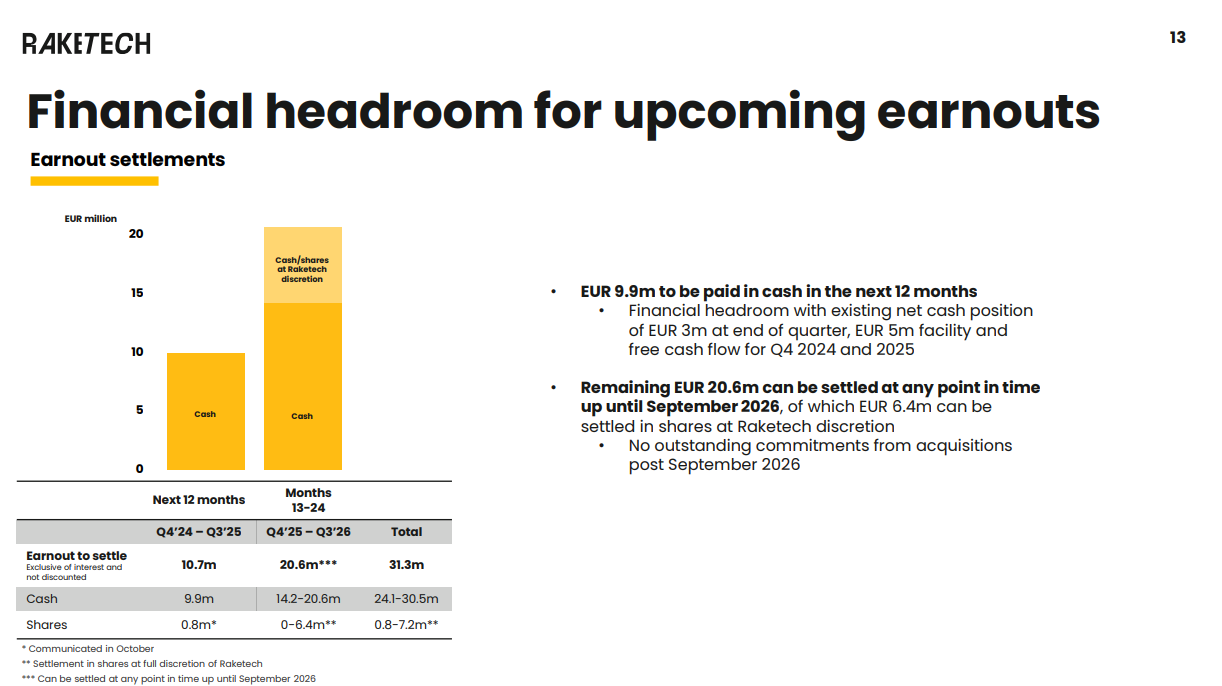
October revenues reached EUR 4.0 million (EUR 7.7 million, of which EUR 0.4 million from the divested advisory business). Despite a challenging environment for the sector in general, we see a sequential improvement into November, and we forecast Q4 2024 adjusted EBITDA to be slightly ahead of Q3 2024. This indicates that reaching the lower end of our full-year guidance of EUR 17 to 19 million in adjusted EBITDA will be difficult. Visibility is limited due to the ongoing operational challenges for our publishers within Raketech Network, and around the expectation of a usually stronger second half of Q4 for both casino and US Sports. Free cash flow before earnouts is projected to be at least on par with EBITDA, allowing us to meet our upcoming earnout commitment of EUR 9.9 million, payable up until the first half of next year. The remaining earnout obligation of EUR 20.6 million can be settled at any point in time, at our discretion, up until September 2026."

According to the company’s view, next year’s Casumba payments will be handled just barely with cash, but with these results, the 2026 obligations won’t be paid purely with cash in time. It has been a catastrophic deal for Raketech.

I don’t think next year is even that tight when there is €5.5m in cash at the end of Q3. If we assume that things get even worse and the company generates, say, only €13m in cash flow per year, there shouldn’t be any problem with that 9/2026 payment either, because if it’s very close, a company generating good cash flow (and otherwise debt-free) can get a quick loan for a few million without having to start pushing out a share issue.

1 Like

I don’t understand the narrative of why this is considered a debt-free company.

According to this recent slide, there is 31.3 million to be paid by Q3 2026. There is currently three million in cash, and there are seven to eight quarters until Q3 2026. Even after the three million, they would need to be able to make just under 4 million in profit every quarter just for the earn-outs, and the current result was 3 million.

image

If they get back to growth, it’s obviously not an impossible task, but it’s by no means a risk-free situation either. Currently, the trend has still been in the wrong direction following Google’s algorithm changes.

1 Like

In my message, by the term “Otherwise debt-free” I meant the situation in 2026, where only the final earnout remains unpaid and after that the company is debt-free.


Divinesia

3 h ago

Theres no way Raketech can deal without new issues from 2026 obligations with these results.

I am an optimist and believe that there will be no need to resort to a share issue. I bought shares.

1 Like

That’s right, it’s not worth listening to others too much when making your own decisions and research. :slight_smile: And my own research is only a couple of days long, so I’m surely still missing the big picture. That’s partly why I’m being bearish, so I can dispel my own fears guided by those who know more.

And a small dilution isn’t the end of the world, especially if the stock’s valuation rises again. Right now, Raketech’s valuation feels practically free, there’s no getting around that.

At the very least, the company is going on my watchlist too; hopefully, the end of Q4 goes better than the start and things improve in 2025.

2 Likes

Let’s dive into Rake’s numbers. Revenue last year was 77.7 MEUR and cash flow before investments was 21 MEUR. This year, revenue stands at 48.8 MEUR and cash flow at 14.4 MEUR. If the final quarter is at the same level as Q3, we’ll end up at about 17.5 MEUR (assuming the change in net working capital is zero in Q4).

Rake’s EV is approximately 17.5 + 42.2 - 13.1 = 46.6 MEUR. So EV/FCF is 2.66. This could reasonably be, for example, 10-12 once the earn-outs are paid.

Let’s assume the share price doesn’t rise before the earn-outs end. There is 31.3 MEUR to be paid and roughly 7 quarters left, so with cash flow, we can pay 17.5 + 3/4*17.5 = 30.6 MEUR, and the rest is financed with cash (which is 5.5 MEUR), leading to a situation where the market cap is 17.5 MEUR and cash flow generated is 17.5 MEUR. Adding 4.8 MEUR of cash on top of this, we get EV = 12.7 MEUR. To reach a conservative 10 EV/FCF multiple, the market cap would be 179.8 MEUR. This means a share price of 179.8/45.224227 = 3.975 EUR, or 46.01 SEK.

Thus, the return would be (46.01-4.33)/4.33 = 9.62586 * 100% = 962.6%.

You’d think people would be interested, but no. The stock is being beaten down day after day…
What have I missed, because the scenario above easily withstands a possible small dilution or a decrease in cash flow to, for example, 10 MEUR per year?

1 Like

Is it more logical to think about future cash flow before changes in working capital? At that time, it was 3.3m in Q3, i.e., 13.2m / year, if the current pace continues.

With this calculation, there would be 23.1m in cash for the earnout and 5.5 would be paid in shares, meaning just under 3m would need to be financed with debt.

The market is likely pricing this such that even the current level is not final, but revenue will still decrease and thus cash flow as well.

3 Likes

Or then it’s not pricing anything, but rather it’s about Casumba’s sellers dumping over a million shares that were given to them on Oct 16. :grinning:

3 Likes

The trip to Japan really turned out to be expensive for the company.

https://igamingexpert.com/news/affiliates/raketech-japan-casumba/

Agreed yesterday, the sale of Casumba comes with no upfront payment. Deal terms cite that an ‘unnamed buyer’ will pay in monthly instalments until December 2029 at an 8% interest rate to acquire Casumba and related assets outright. At closing, the deferred consideration was valued at around €7m, with €5m of value reflecting credit risk and the extended schedule.

2 Likes