…or would they enable buying a home at current price levels during a time of high interest rates?
I’ll remind you again that high interest rates are currently being used to stifle German inflation, which hits Finns particularly hard due to their variable reference rates.
Why should we promote a situation where prices that have risen to record levels do not react sufficiently to the rise in interest rates? But you are absolutely right, the tax deductibility of interest would leak into prices and the effect you are calling for would materialize.
Oh, so inflation is now only a German problem?
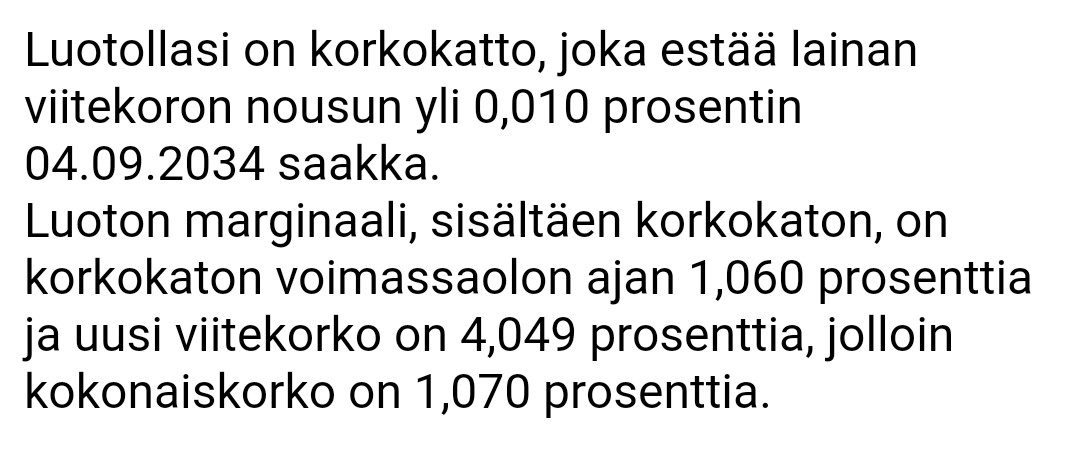
P.S. Today the notification shown in the image popped up in my online bank. In the future, it would feel quite futile to start taking responsibility for one’s own financial decisions, e.g., in the form of interest rate hedging, if society wants to send a signal that it will indeed become a significant payer of the bills during headwinds.
I also have personal interest rate hedges, which, however, have nothing to do with the European Central Bank’s interest rate policy. The central bank’s rate hikes are not driven by Finns having excessive disposable income that needs to be absorbed through interest rates to prevent it from pushing up inflation.
It’s worth remembering that infrastructure construction is largely dependent on public investment, so it doesn’t really reflect the current economic cycle. Projects are also very long-term. Only now is the situation that has been expected for quite some time starting to manifest concretely in new construction as well.
Renovation work might even gain some momentum from the stalling of new construction. However, the problem there, especially for small construction firms, is that when there are no new development projects, the supply of labor shifts to renovations → margins start to erode rapidly, and then the shakeout begins. This development may not have even properly started yet. Hard times are ahead.
Primarily, what I meant in my previous post was that media headlines like “Construction in a deep freeze” and “Building permits slumped by -70%” can give someone not specifically familiar with the construction industry the impression that all construction has almost ground to a halt. The discussion is perhaps a bit more pessimistic than reality at the moment because almost everyone is focusing on what is most depressed (new residential construction), even though it is only part of the truth. Of course, all construction is linked in some way, but I still think the situation should be viewed as a whole.
Construction as a whole is not (at least not yet) in a deep freeze, and a temporary dip in building permits does not automatically mean that the majority of construction industry players will face insurmountable difficulties.
One can always hope for higher quality and better-articulated journalism, and on the other hand, wasn’t there a headline recently asking, “Is it worth ever investing in the Helsinki Stock Exchange again?” There is probably some connection to the current situation there too, but it’s still rather overly pessimistic headlining for those who understand market cycles and know that a market decline can also be a long-awaited investment opportunity.
Construction companies whose business models are more resilient during downturns can be excellent investments when all firms in the sector are being lumped together. This is another reason why I would aim to understand the different sub-sectors within the industry as well as possible.
Today’s A-Studio featured a segment on the distress in the construction industry, with Minister of Economic Affairs Wille Rydman and Aleksi Randell, CEO of the Confederation of Finnish Construction Industries, as participants:
Not much was promised from the state’s side. Randell called for, among other things, the restoration of the right to deduct mortgage interest and the reduction or abolition of the transfer tax. Rydman shot down the restoration of interest deductibility as convincingly and briskly as a politician possibly can. And the journalist didn’t suggest a thousand-euro bet to the minister about reversing his opinion.
There was less commentary regarding the transfer tax. I did a bit of Googling and found that the state likely collects around 400 million euros a year in transfer taxes from housing. With home sales stuttering, it’s undoubtedly less. I don’t believe for a second that they are ready to narrow the tax base that drastically. Some have suggested that this tax revenue would need to be replaced by increases in property tax. Well, there is already plenty of pressure for increases there even without that.
This is in the US, then, where the economic cycle is “slightly” different than here. In terms of timing, it certainly gives food for thought. YIT has already shown some proactive movement and risen over seven percent from the bottom in the midst of all this gloom, so at least not everyone thinks the end is near just yet
The discussion about removing or lowering the transfer tax will only delay the unblocking of housing chains, as homebuyers wait for this additional discount of at least €2,000 and, at most, well over €10,000.
We have reached the point where the media is “sensationalizing” news articles related to construction.
Anyone who has followed the domestic economy even somewhat diligently could have predicted the collapse of construction as early as 9 months ago. Now the media has simply brought this to the attention of the general public. The media always needs a topic to feast on; in six months, this topic will be behind us and a new victim will have been found to take its place.
And the Housing Fair will indeed continue again in 2025.
Raappana, after all, belongs to the Laestadians, and there are many Laestadians at KPMG, especially in Oulu. An acquaintance of mine from Oulu, who ran a business for 20 years, noted as far back as 10 years ago, if I recall correctly, that without Laestadian contacts in the Oulu region, it’s useless to imagine running any business—especially a profitable one. The Laestadian mafia is also visible in the allocation and size of the city’s commercial plots. No need to even say who has priority.
According to RT (Confederation of Finnish Construction Industries), construction directly employs 210,000 people in Finland. When various services are added, the figure rises to 300,000. Taking into account jobs in the construction product industry, the employment impact of construction in Finland is as many as 380,000. The figure is nearly 17 percent of the total number of wage earners.
Thanks @Mörkö for that image; it provides a good indicative overview of the situation across different sectors, even though it’s from the spring. In this case, “civil engineering” (maa- ja vesirakentaminen) refers to infrastructure construction. As I understand it, “non-residential construction” includes industrial facility projects.
Future forecasts are updated, but if you are interested in the current volume of construction, that image is still quite well up to date in that regard.
The link’s headline is pure clickbait, if not outright distasteful. No matter how bad things get, I hope it’s crystal clear to everyone that all 210,000 (or 380,000) employees in the sector are not going to end up unemployed.
It’s irresponsible to even write that hundreds of thousands are going to become unemployed. Especially when the article also states that the construction union fears the number of employees will drop from 210,000 → to below 170,000. By what logic does that result in hundreds of thousands more unemployed?
Juhana Brotherus, Chief Economist of Suomen Yrittäjät (Federation of Finnish Enterprises), sharing his views.
I didn’t actually see any 10-point list; it seemed to be clickbait.
Not much content. Here is perhaps the only highlight from the article:
“For example, converting offices into apartments should be made easier. Currently, they can involve rigid permit processes and high fees.”
Brotherus would also dismantle regulation. He would do this regardless of the economic cycle, but especially now. According to him, more projects would become profitable if, for example, parking space requirements were more flexible."
The amount and duration of permitting and bureaucracy seem to be something quite incomprehensible in Finland. It definitely should be eased and streamlined, but preparing the matter and pushing it through to implementation probably won’t help in this crisis at all; rather, results will only come years from now.
“According to an expert, one of Finland’s largest housebuilders was bound to fail, but seven others will survive”
“Jukkatalo’s management was asleep at the wheel. The cash flow result was already nearly 11 million euros in the red in 2021; the company became indebted and failed to adjust its costs.”
 There is probably some connection to the current situation there too, but it’s still rather overly pessimistic headlining for those who understand market cycles and know that a market decline can also be a long-awaited investment opportunity.

