Timing is an art form. It always depends on the investment target, of course, but before the turnaround, your ownership stake could be anything after hybrid loans, share issues, etc.
In itself, I agree.
Timing is an art form. It always depends on the investment target, of course, but before the turnaround, your ownership stake could be anything after hybrid loans, share issues, etc.
In itself, I agree.
I don’t know how the state would help the employer or the worker in a bad spot? More debt, somehow putting borrowed money to use, which is then collectively paid back on top of old debts…
But in any case, I suspect there will be a long queue at the pay security (palkkaturva) desk and unemployment funds will once again be bone dry. The year 2008 is still fresh in memory.
There’s plenty of time to buy construction companies later. If we imagine that interest rates drop to the 2-3% level by next summer, employment stays at a good level, and wages rise, then construction companies would start getting customers. Order books would start filling up in autumn 2024, and payment for these projects would reach the Q2-Q3/2025 interim reports at the earliest. I’d argue this is wishful thinking; not all three of those conditions will be met by next summer.
Do you remember when Lehto’s target price was 16€?
This might have been around 2017 or 2018 when the share price was hovering around 10€. I remember buying back then because of OP’s target price; luckily I didn’t hodl.
At this point, in my role as the thread creator, I’ll speak up and clarify that the intent was to create a thread about the construction industry/sector, not residential property investing.
I certainly understand that we are talking about the end product and that its pricing affects the sector itself, but rental yield calculations and similar debates should be kept to the relevant threads.
I also understand that this topic evokes strong emotions, as it affects everyone in some way. However, I hope the discussion remains focused on companies in the sector and the industry’s macroeconomics.
Edit: Thanks to the moderators for cleaning things up. 
To get the conversation back on track, let’s do another poll.
Which indicators do you primarily follow when considering buying a company in the construction sector?
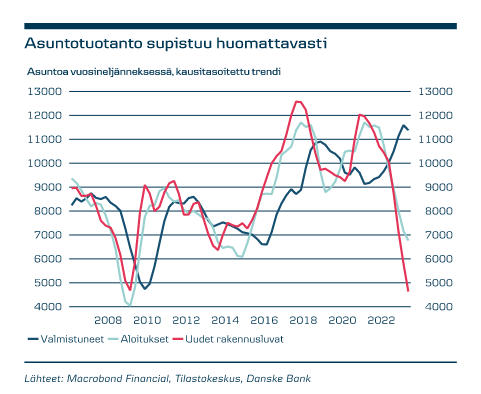
Speaking of Hervanta. The plan is to build housing for about 2,000 residents in the northern end of Hervanta. A lot of groundwork has already been done in the area. Now, things are at a standstill because there is no demand for the apartments, and only one apartment building is up at all, and even that is visibly half-finished. Infrastructure has already been completed (by Kreate), and for example, the overpasses crossing the main thoroughfare are cut off on one side, waiting for the housing projects on that side to proceed.
Aamulehti just did a story on this, unfortunately behind a paywall. The picture, however, illustrates the situation well 
Participants in the housing project, picked directly from the article:
“Originally, agreements for the area were made with Skanska Talonrakennus oy, Setlementtiasunnot oy, and Hartela Länsi-Suomi oy. However, Skanska withdrew from the project in the summer of 2023.”
I don’t really know anything about this sector, but to a layman’s ear, it sounds like fairly active risk management on Skanska’s part. I would assume their cash position could have handled the construction, but if they see that the project doesn’t make sense at this point in time, they’d rather leave it undone. Well-managed large firms often tend to come out of a crisis even stronger. At least they have the leeway to buy distressed operators for a song, as was previously mentioned. I’ve started considering taking a position.
However, residential property investors are a fairly significant factor when considering housing demand. When returns on residential property investing are low, the demand for apartments suitable for rental use decreases, and this is also reflected in the profitability of construction companies. The same, of course, applies to commercial construction as well.
But anyway, you’ll find more in the residential property investment thread…
Touching on the discussion related to the title, although the talk is about recession speculation.
Apparently, this link hasn’t been shared here yet, so I’ll post it. The reason, captured from the context:
Both economists mention the distress in the construction sector as a potential threat, the multiplier effects of which may be wide-reaching.
I have noticed that in the media and in discussions, construction is almost “synonymized” with residential construction. Headlines emphasize how much building permits have fallen in terms of percentages or square meters. For example, in this news article https://www.ts.fi/uutiset/6058398
When looking at the big picture, it’s worth remembering that construction is more than just new homes.
Infrastructure and renovation construction are not doing particularly poorly. Demand, need, and funding decisions operate with a slightly different dynamic than in residential production. Industrial construction projects also follow their own logic.
Here are also some quite interesting recent statistics:
Construction turnover decreased by 4.1% year-on-year in July 2023
https://www.stat.fi/julkaisu/cl8ec7twik7w00cupxuioztqm
YIT’s CEO appeared on Rahapodi:
The right-wing government is going to resuscitate a lifeless corpse with an ARA cannon, explosively increasing the rental housing supply in markets that are already momentarily saturated 
How about restoring the mortgage interest deduction? It would at least help consumer demand.
Currently, high interest rates are due to the central bank, where Finland’s situation has little impact on decision-making.
Through taxation, we could nationally address the impact of rising interest rates on housing demand.
Starting with a bit of humor…
But I wonder if there are more of those. At least the CV is impressive 
It seems to have paid off quite well for him  :
In this case as well, the neighbors certainly have something to cheer about, after first paying as much as €6k per square meter in the metropolis called Joensuu, only to have a fine ruin like that left next door for an indefinite period. Of course, it’s better that way—that the neighboring building goes bankrupt rather than the fellow shareholders in your own building.
It would be a fairly unusual move, considering what changes are being made to housing benefits.
The right to tax deductions for mortgage interest was phased out over a long transition period. It was implemented not only by all* parties, but also by the will of all parties.
*) With the exception of Movement Now (Liike Nyt), which is the only parliamentary party that has not held government responsibility.
ADDITION: And apparently, Movement Now (Liike Nyt) is also unequivocally against restoring the right to mortgage interest deductions:
How should people struggling with the mortgage interest rate squeeze be supported nationally when the central bank is fighting against Germany’s elevated inflation figures?
Finland’s inflation, at least, is not caused by consumers’ excessive financial resources.
The sensible sizing of mortgages and, for example, obtaining interest rate hedges is the responsibility of each borrower.
Euribor rates are currently at around the 4% level, which is certainly high compared to what we have become accustomed to in recent years, but it is something every borrower should be able to manage. If they can’t, then they need to rethink their income and expenditure structure.
One way or another, subsidies drive up housing prices and increase taxpayer costs.