A thread was missing about an industry that interests many and is unfortunately strongly trending at the moment. In Europe, defense budgets are being rapidly increased and equipment is being modernized. It includes both names familiar from other contexts and names completely unknown to the general public. As long as there isn
20 Likes
Rheinmetall, whose share price has risen YTD +75%, just announced it will hire an estimated 1,000–3,000 new employees to meet growing domestic demand.
7 Likes
You could shed some light on what these companies are known for. Rheinmetall probably produces cannons for tanks?
Saab also jumped +30%. I think a lot of their stuff comes to Finland, for example.
8 Likes
At least some of the ships have Bofors bow guns. Bofors is owned by Saab.
Edit. In fact, all Finnish missile boats and also minelayers seem to have Bofors guns.
It seems that Bofors’ gun production is no longer owned by Saab, but they have sold it to BAE Systems.
3 Likes
Apologies, I’m going to jump outside of Europe with my own statement and open the game with Canadian Mission Ready Solutions. If the war escalates more broadly and the Americans (or NATO) jump on board, this tiny company will likely be involved somehow. It’s a Canadian company, but by far the most important client is the US government. They don’t supply weapons or means of destruction, but rather maintenance and protection equipment for soldiers, firefighters, and other so-called front-line personnel.
The company’s IR presentation can be downloaded here: https://mrscorp.com/download/corporate-presentation/
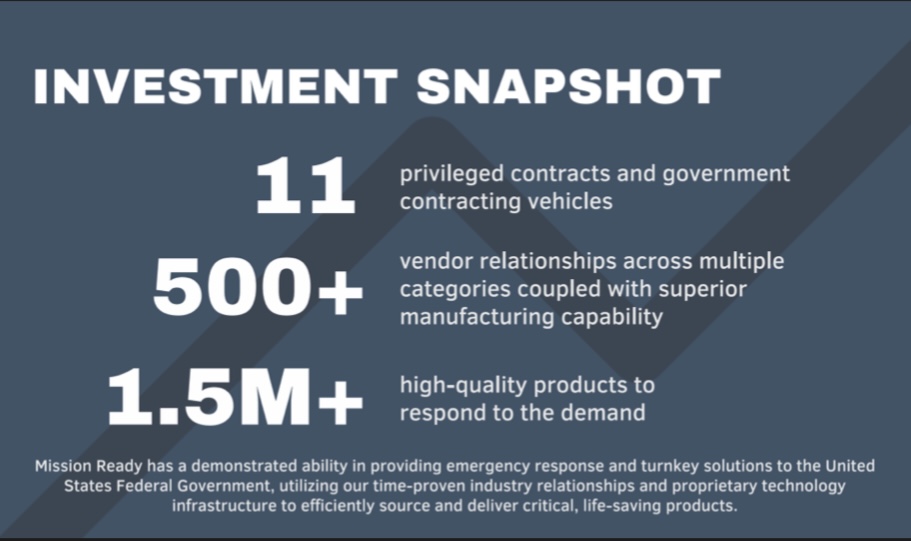
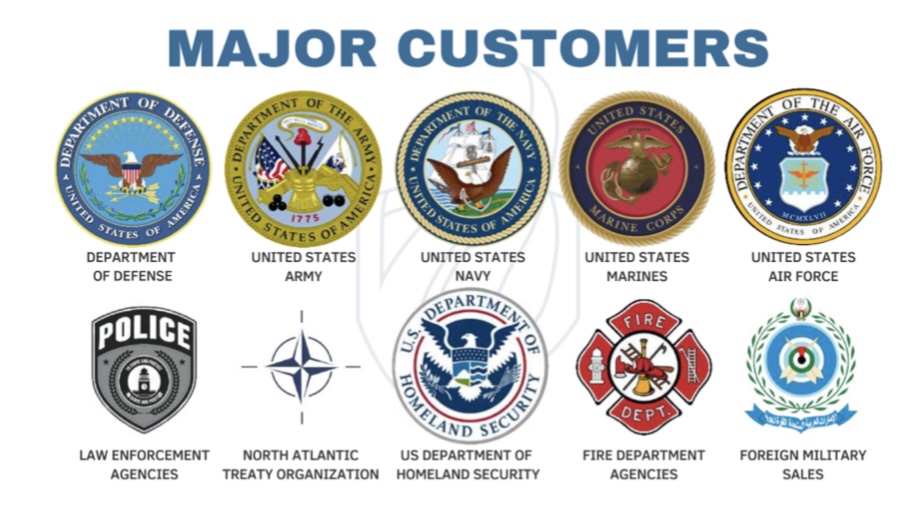
Well, as we know, the US defense budget is quite large, and the government has made a regulation that a portion of deals must go to smaller players to prevent Raytheon, Boeing, and others from operating as monopolies. Partially as a result, MRS, which has a market capitalization of CAD 55 million, secured a nice deal at the end of last year: Ihre Datenschutzeinstellungen
And in addition to this, there are a few catalysts that forced me to add this to my own portfolio:
So, in the US, the government “tenders” deals, and each company can submit an application. The aforementioned tenders are in MRS’s area of expertise. Especially regarding the latter, ballistic combat armor, I am confident. Why? Because MRS designed that product and they have a joint patent with the US government for it, so the deal slipping to someone else would be a small surprise. The armor deal is estimated to be worth 400-500 million US dollars over 8 years. Those cold-weather boots are also a multi-year, nine-figure deal. The application period for both has closed, and we are now living in suspense every other day, as the recipients of the deals will be announced within 1-180 days of the application closing.
In addition, the management has stated that the company has submitted bids for many other tenders, but these two are the largest and most probable. In a way, this is almost like playing the lottery, because the turnover of these smaller players largely depends on these deals. High risk, high reward.
Since they operate with the US government, competent lobbyists are needed. Fortunately, there are a few:
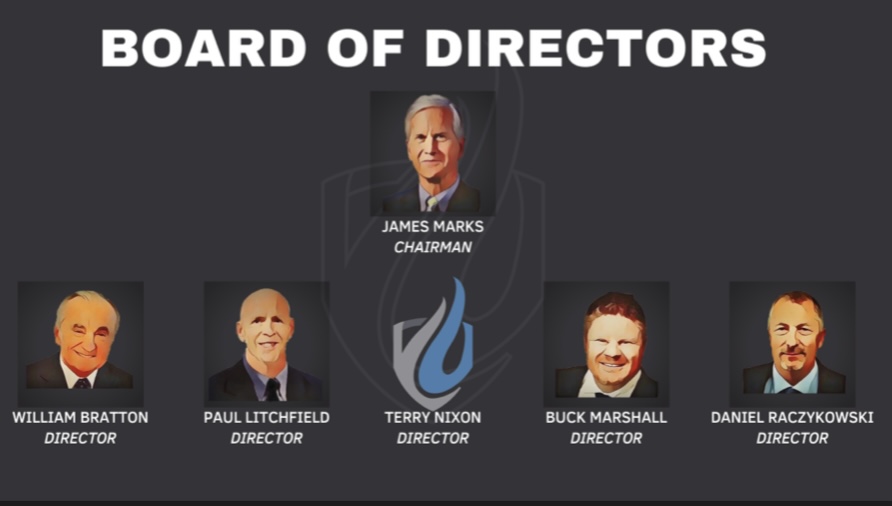
For example, Chairman of the Board James “Spider” Marks is a familiar face on US television, especially now in connection with the war in Ukraine, as he is a war analyst for CNN (and other channels? I don’t know). https://edition.cnn.com/profiles/james-spider-marks-profile
William Bratton, on the other hand, is the former police chief of New York, with connections to higher authorities, and Paul Litchfield has worked in high positions at the UN, etc., so on their behalf, things should be well underway. Now the company just needs to perform and win those deals.
17 Likes
Boforss seems to have good sales for NLAW anti-tank weapons.
2 Likes
Rheinmetall manufactures cannons, tanks, wheeled off-road vehicles of all sizes, sensors, anti-aircraft solutions, simulators, and supplies. Additionally, they produce engine parts for the automotive industry, air purification systems, and are involved in hydrogen fuel cell ventures with Daimler Truck.
Rheinmetall itself apparently prefers to be a systems supplier, which from the perspective of aftermarket sales and profitability is probably a better concept than the idea of just selling someone a cannon and a box of grenades. Perhaps Defence Systems as a Service is the goal of all current companies in the industry.
CEO Armin Papperger seems like an easy interviewee, so stories about him and the company constantly appear in German newspapers. Among other things, he has emphasized the importance of social and environmental responsibility even for the defense industry. Rheinmetall states that it is strongly involved in implementing the green energy transition (which may not be related to military equipment at all).
5 Likes
Alright, I’m going to dig into this a bit since I promised I would in the coffee room. I’m interested in the defense industry, especially defense technology. Mostly, of course, because the topic is currently very relevant, but it could also offer some investment opportunities as one country after another begins to increase its defense budget. Of course, I assume that stock prices have already anticipated this possible positive development in the coming years, but let’s treat this as a research exercise into a new industry.
Now follows some miscellaneous and unorganized chatter on the subject. I’ve never explored military technology in any way before, so I’m starting from scratch and will jot down observations as I go.
First, where to begin? A few options came to mind for how to start digging. Feel free to suggest better ways if you think of any.
-
Choose one country and look at its equipment – > overall picture of the military’s armament and the companies that produce equipment.
-
Choose one large defense company and look at its product portfolio – > overall picture of what a typical large company in the sector might do.
-
Choose a market overview – > overall picture of the sub-segments related to the industry and where future opportunities might lie.
-
Choose a scientific approach – > what scientific fields or similar are related to military technology and what kind of commercially produced equipment/services each field practically needs.
1. Equipment of one country, Germany
Let’s take Germany as an example from the first category. My understanding of military matters is limited to my time in the army and following news about Ukraine, so don’t expect a very deep analysis.
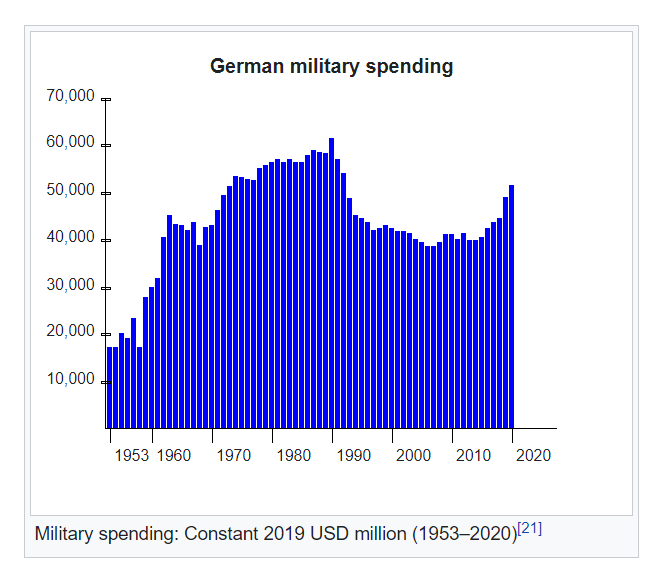
The defense budget seems to have fluctuated quite a bit. First, growth until the end of the Cold War, and then a somewhat calmer period for the last few decades. Now, Germany has talked about significantly increasing its budget. It’s quite a cyclical market, and I would assume that for other countries, too, defense spending goes down during peaceful times and budgets grow when tensions rise.
As I browse Germany’s equipment, it’s really diverse. All sorts of guns, cannons, cars, tanks, planes, and ships can be found. And at the same time, I get the feeling that maybe the big money isn’t in these piles of iron, but I could be wrong, of course.

My initial feeling was that some kind of high-tech solutions would be the most attractive. For example, various communication solutions, artificial intelligence, radar/satellite/space solutions, robotics, etc. And it’s always better if the business could have continuity (e.g., sold as a service) or scalability (high-tech mass-produced business, scalable software solution, etc.), but it doesn’t immediately come to mind which solutions in military technology would then succeed in utilizing these.
I tried to google high-tech solutions of the German army, but as an amateur, I don’t get very far. Maybe it’s wiser to move on to a company-specific review.
2. A large defense company as an example
What are the world’s largest defense/military technology companies? According to Google, the top-10 are here:
Lockheed Martin appears to be the largest, with almost all of their revenue coming from the Defense segment. I searched online for LM’s annual reports, IR presentations, and quarterly reports, and oh my goodness, what garbage these are in terms of infographics. Finding such dry presentations and reports among OMXH companies already requires a certain kind of special expertise. They should go for some job coaching with Harvia’s communications people for a bit, then these reports would be more pleasant to read. Just look at these graphs, which remind me of my first Excel scribbles from village school:

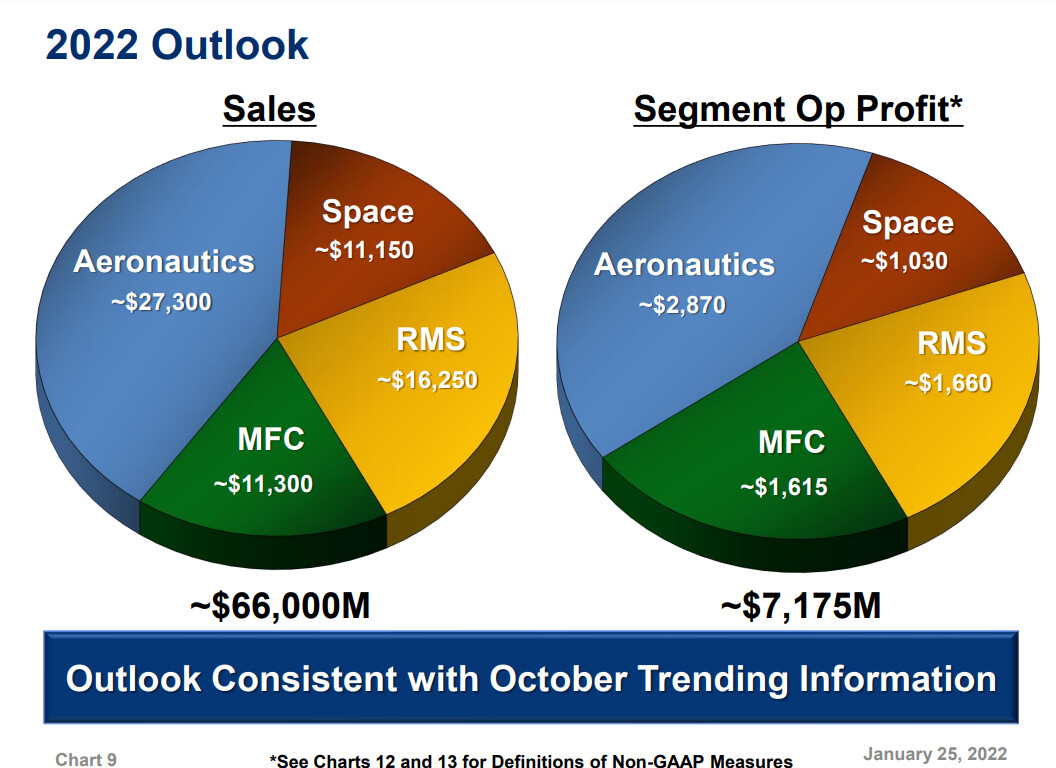
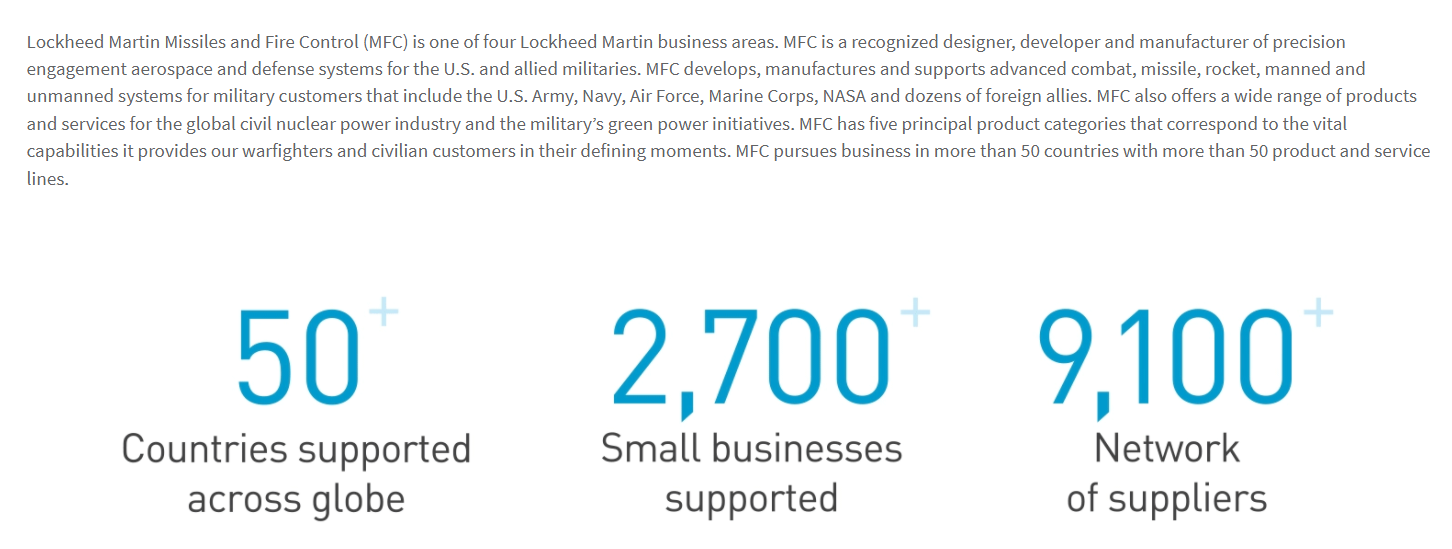
If we take, for example, the MFC = Missile and Fire Control segment, it alone contains a brutal number of different products:
Here is the Q4/2021 presentation in its entirety (if its appearance causes distress, don’t open the annual report at all):
https://investors.lockheedmartin.com/static-files/6c484df3-a389-4180-8047-afb99bab38a9
And what’s interesting is that there are so many customers also from outside states. Who knows what various private armies, security groups, and similar customers they have.
By the way, looking at a big company like this makes me realize that these don’t fit into my investment strategy at all. They are quite bloated organizations, seasoned with moderate growth, a cyclical market, and political risk. It feels like if one invests in this sector, it has to be a smaller company that is growing significantly in its niche and operating in a radically growing segment. Feel free to give suggestions either directly about companies or about growing “military industries.”
By the way, let’s take a couple of pictures from neighboring country Saab for comparison. They seem to have a bit more effort in their investor communications. Creating an overall picture is immediately much easier:

There’s also a market overview:
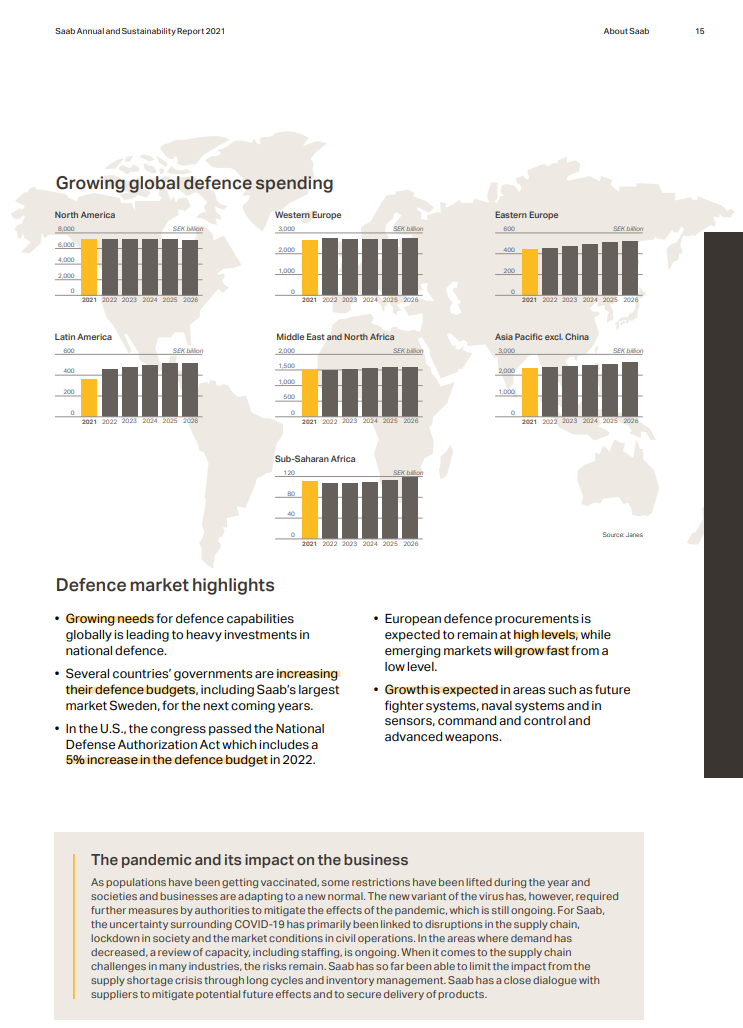
Apologies that this is becoming such a screenshot-heavy message, but this is interesting. Here, 5 key businesses and key markets are itemized. They have been very forward-looking, as Germany is a key market for 2022, and it is now increasing its defense budget by, was it, 100 billion euros. Surely Saab will find something to deliver there too.
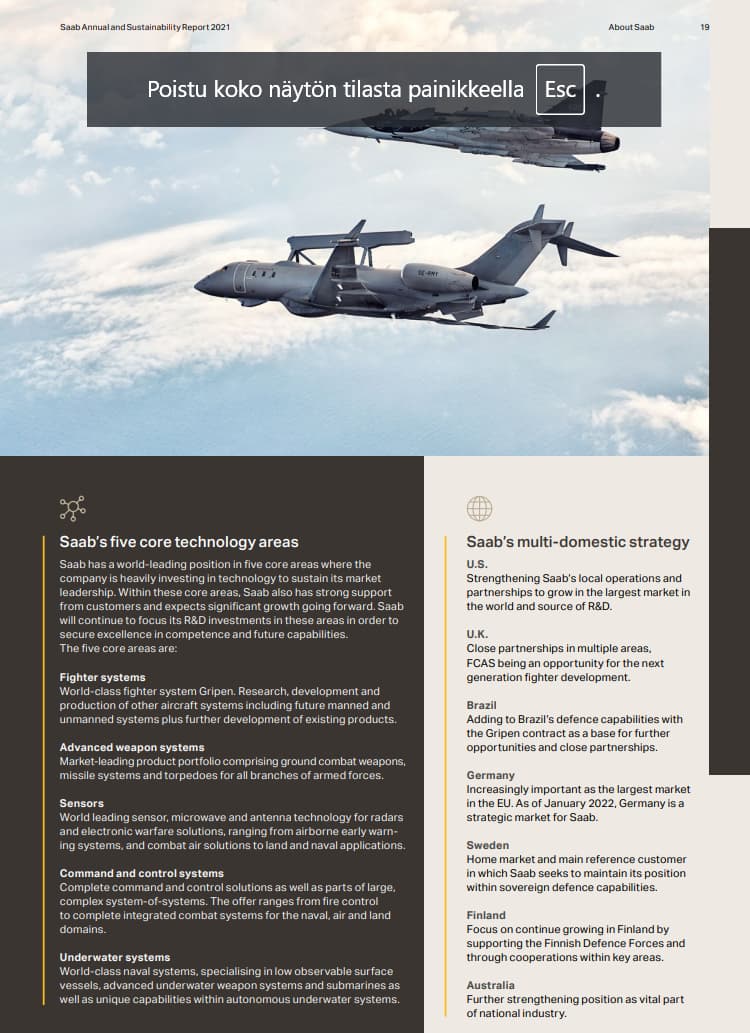
This report might be interesting to read through entirely. A good report like this from a large player gives a good overall picture of the entire market. If anyone else is interested, here’s a direct link:
Well, in these 45 minutes, I haven’t gotten much more than a slightly more confused feeling about the whole industry. Now for a ski trip, and then I need to watch Iivo’s victory from Holmenkollen, but I’ll continue to delve into this topic when I have time.
Quite a “reclusive badger” message. 
22 Likes
I believe that based on the war in Ukraine, the armed forces of different countries will be very carefully reviewing their equipment, considering which combat assets play the biggest role in successful battles. The role of anti-tank (AT) equipment and air defense stands out quite a lot, as do drones in combat and reconnaissance.
In addition, two factors will certainly give a significant boost: firstly, a thorough review of combat stockpiles. Yesterday, I saw a news report stating that a large portion of the AT equipment sent by Germany to Ukraine was unusable due to storage errors. The operational reliability of Russian equipment, alongside maintenance, also seems to be somewhat inconsistent. The second factor is the expansion of armies and reserves, which practically means an increasing need for all products required by armies.
2 Likes
I hold General Dynamics in my portfolio. It’s a dividend aristocrat that has raised its dividend for 30 consecutive years. The company currently has an order backlog of nearly $90 billion. With several countries now vying to increase their defense budgets, I believe in its continued success.
5 Likes
I can’t quickly find information on whether it’s for subscribers only, but let’s take a few relevant quotes below so that non-subscribers can also grasp the plot.
With Germany’s defense budget initiatives, a few of the German armed forces’ trusted companies climbed 40-50 percent on the stock market.
I assume that the biggest increases in defense budgets will come precisely to Europe, so the trusted suppliers of European countries are likely to be the ones who benefit most from this situation.
In Europe, the largest arms manufacturer is the British company BAE Systems. In addition, the Italian Leonardo and the French Thales are among the world’s most influential arms companies.
Russia’s invasion of Ukraine has fundamentally changed the outlook for the European defense sector," JP Morgan analyst David Perry wrote on Monday, according to Reuters.
All in all, the largest arms exporters are in the United States, and China also appears to have major players.
And it is also noteworthy that even now, before the approval of increasing defense budgets, the use of military equipment and solutions has increased sharply:
The United States decided over the weekend on an additional $350 million in aid to Ukraine. The country has already supported the Ukrainian armed forces with a billion dollars during the year. The EU, on the other hand, intends to spend 450 million euros on fighter jets, weapons, and their transportation for Ukraine.
It also occurred to me, would @Juha_Kinnunen have a few tips on what kind of things to focus on if one wanted to search and analyze European defense/military technology companies? Where could one get some kind of overall picture of the high-tech solutions market and the growing smaller companies there? And presumably, in this sector, the political world brings its own chapter into play?
I need to read a bit of Juha’s Bittium report today, to see if I can gain some further understanding from it.
4 Likes
The Bittium report does indeed mention players in the defense sector, but unfortunately, it contains very little concrete information—Bittium focuses on tactical communication, which is a relatively small niche in the defense market. Plus, there are all sorts of other business operations.
Unfortunately, I can’t think of any report or page that comprehensively covers the overall picture in a sensible way. Various consulting firms do offer free overviews, and these can be found by Googling, for example, “Defense market.” Deloitte and PWC were at the top of the search results just now. Generally speaking, it’s worth noting the market divisions and the blatant favoring and support of domestic solutions. This is why Germany’s decisions specifically impacted German companies. Everyone seems to have their preferred suppliers, but then again, the United States, for example, is involved in many areas.
Unfortunately, I can’t offer more help at the moment.
8 Likes
Rheinmetall’s earnings release in the morning. They estimate sales to grow by 15-20% this year. Order backlog is currently larger than ever. However, in 2021, sales growth came mostly from the civilian side, from automotive industry orders.
https://ir.rheinmetall.com/websites/rheinmetall/English/3031/annual-reports.html
3 Likes
Rheinmetall unveils a new radar system. There should be demand for systems like this that track mini and micro-sized flying threats, based on the type of warfare we’ve seen in recent weeks.
https://twitter.com/rheinmetallag/status/1510947853245505541?s=21&t=snuatGKePJOB5xjRVXd4LQ
4 Likes
This doesn’t seem to be confirmed information, but I saw it on Twitter
https://twitter.com/alexluck9/status/1513053684502241283?s=21&t=eswS1m-pNbOYAkjB6pUTFA
3 Likes
Rheinmetall received an additional order for one hundred Boxers from the British. It includes all three variants (armored personnel carrier, command vehicle, and ambulance). The stock price has reacted +6.5% since yesterday.
4 Likes
Good news from Mind Technologies. Additional deals worth 7.3 million for this year were just announced, and more are coming.
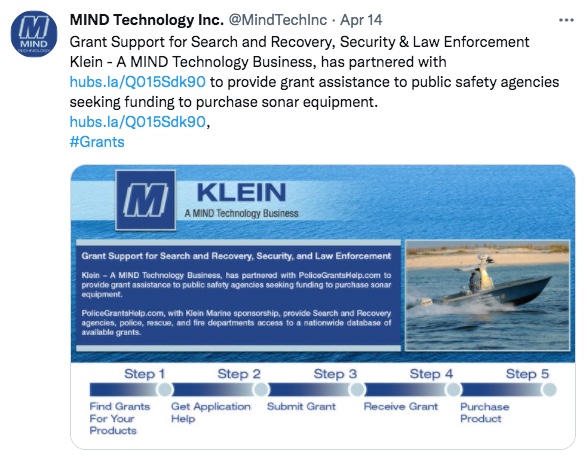
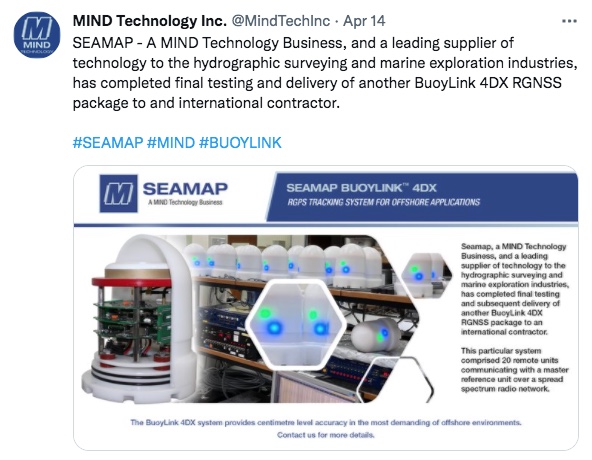
Risks are decreasing, and the future is getting clearer. I’m firmly on board.
4 Likes
Saab AB’s Q1 2022
“Order intake increased by 38%, driven by medium-sized orders across most business areas.”
Saab reminds us that delivery times are long, so the war in Ukraine will not immediately be reflected in revenue. The share price has shot up in recent weeks. The previous CEO said years ago that if European countries raise defense budgets to the 2% level, it will exceed the industry’s capacity.
And by the way, the Q&A was comical, they expected a flood of calls from analysts, but not a single call 
5 Likes
I did a quick, small-scale preliminary screening based on the TOP100 list of companies.
I sieved out companies where over 90% of their operations are focused on the defense industry, and then sorted them by P/E ratio in the following order:
Leonardo (IT) PE 8, Helicopters, aviation and support, cyber, electronics. Revenue +5%
Vectrus (US), PE 11. Logistics solutions. Revenue +28% y/y
LIG NEX1 (S. KOREA), PE 12. Missiles, sensors, communication links, drones, automation. Revenue 14%
Northrop Grumman (US) PE 13, does almost everything. World’s largest ammunition manufacturer? Revenue -3%
BAE systems (UK) PE 15, assault and transport vehicles e.g. CV90, Bofors and naval guns, howitzers and all ammunition supplies for ground forces. Revenue +2%
Huntington Ingalls (US) PE 16, Navy. The only manufacturer of nuclear-powered aircraft carriers in the US. Revenue +2%.
Lockheed Martin (US) PE 19, Aircraft and air defense, as well as communication systems. Revenue +3%.
13 Likes
Since the previous writer brought up companies, everyone immediately understands that they are giants in the defense industry. Valuations seem quite modest if you look at the P/E ratio. At this juncture, it came to my mind to ask what kind of opinions readers have about the Finnish company Bittium?
Bittium’s current business (Defence LV) is utterly insignificant compared to the companies the previous writer mentioned. I’m wondering what will happen to Bittium’s Defence business in the future. The company does have a approximately 200 Meur letter of intent with the Finnish Defence Forces for new SDR radios (=order), the delivery of which has not yet begun. At the same time, the company has a slight opening to international markets through Estonia and Austria. Bittium’s Defence market is truly enormous through its new products, and I personally believe they will find their place in the world, but how? Will some giant buy up the ready-made top products for themselves? Will the company get a white-label agreement with some giant? Or does the flea have a chance to grow from almost nothing into something big independently? In my opinion, being independent would require separating the business from the current one.
I don’t think Bittium can ever have a better momentum with its Defence business than it does right now. Finland bought fighter jets from America, Finland is joining NATO right now, Bittium’s products are ready and, as far as I understand, extremely competitive, and defense budgets globally are significantly increasing at the moment. And let’s mention the so-called Megatrend in Defence, which practically means all countries in the world must gradually renew their communication equipment from mere speech to data- and sensor-capable communication devices.
If you want quick information on whether Bittium’s products are competitive, the short video below, in my opinion, tells more than a thousand words:

Here’s more information about the company, as the CEO visited an investment fair in May of this year:
6 Likes