{“content”:“I was thinking of going for this the day before yesterday… A newly listed company. Now we need the collective intelligence of the whole forum to discuss this… hit or miss?\n\nhttps://www.nanox.vision/\n\n \n\n\nBasic rundown:\n\nTraditional MRI machine: \n- cost 3 million per unit\n- weighs hundreds of kilos per unit\n- only 1/3 of the population has access to these, and many won’t even go due to claustrophobia\n- doctor must be present (image interpretation, etc.)?\n\nNanox:\n- cost 10k€ per unit (i.e., 1/300th)\n- weighs 70 kg per unit\n- remote connections, database, AI, etc., so the doctor doesn’t have to be present in that part of the world\n- aims to cover the missing 2/3 of the world’s population as well\n\nThe problem now is valuation, understanding the competitive landscape, etc…\n\nhttps://www.morningstar.com/stocks/xnas/nnox/quote\n\nhttps://www.itnonline.com/content/nanox-launches-digital-x-ray-device-accompanied-ai-based-software\n\n\u003e Once regulatory approval is obtained, Nanox plans to penetrate the global market by deploying its Nanox System in collaboration with governments, hospitals and clinic chains. The company will offer its Nanox.Arc under a pay-per-scan business model, at affordable and substantially lower prices than currently available alternatives.The Nanox.Cloud is being designed to provide an end-to-end medical imaging service, that covers AI analysis and more. The Nanox System is designed to enable medical screening as a service to improve the accessibility and affordability of early-detection services worldwide.”,“target_locale”:“en”}
After a quick look, I wouldn’t invest in that yet; I didn’t really get anything out of it besides numbers and promises…
And that device seems too good to be true and to work as healthcare requirements demand.
Here’s an example of a typical agreement:
Nanox Signs Agreement With SPI Medical for the Deployment of 630 Nanox.ARC Units in Mexico
Subject to regulatory approval and acceptance test, the agreement guarantees minimum service fees of $119 million to Nanox over seven years aiming to service both public and private sectors
According to the agreement and subject to regulatory approval, SPI commits to a minimum annual service fee to Nanox of $17 million per year, guaranteed by a standby letter of credit in favor of Nanox and renewable on an annual basis.
Quickly calculated from that, Nanox will get about $27k in service revenue per unit per year.
According to the company’s own communication, the plan is to initially deliver 15,000 devices in the near future, which would mean over $400 million in service revenue per year in the coming years if realized… plus the devices, of course.
Quite an interesting new technology. I didn’t delve into the valuation, but rather browsed the technology on a general level, and if it lives up to its promises, it could genuinely be a groundbreaking innovation in imaging. A few things remained unclear, however.
- In your introductory post, you compare Nanox to MRI. As I understand it, these are not competing technologies. It remained somewhat unclear which device Nanox wants to compete with (MRI, CT, PET are mentioned on their websites). All these machines have different functions and are used to diagnose/monitor different types of diseases. I simply don’t believe that Nanox would replace all of them. Considering the video and other materials, I’d guess it primarily challenges CT imaging.
- If this is the case, CT imaging devices already come in quite mobile sizes today. For example, O-arms (Google “O-arm”) that fit into operating rooms are already commonplace.
- Liability and legal issues of imaging interpretation. If I understood correctly, images taken with Nanox devices are transferred to a cloud server, from which any “freelance radiologist” can interpret them from anywhere. This would be an excellent technology for developing countries where alternative diagnostics are likely “no diagnostics,” but in developed countries (at least in Finland), radiologists bear official responsibility for the images they interpret. This is a crucial reason why, for example, X-ray images interpreted remotely in India have not made a breakthrough. In addition, another related problem is clearly the sufficiency of the workforce. Even now, in developed countries, radiologist resources are scarce in many places. If the number of images to be interpreted starts to increase exponentially, who will interpret them? Who guarantees the quality and takes responsibility?
Here are a few risks/questions that came to mind. Otherwise, I am very positive about all such developments in the field of medicine. As an investment case, I will continue to follow, but I will wait for good user experiences and preferably publications in reputable (Impact Factor-equipped) journals in the field before pressing the buy button.
Here, I think they were still waiting for official approval (FDA)? The plan was 1000 devices by 2021 and 15000 by 2024.
Quick comment based only on a quick look at the company’s website.
From the introduction video, I understood that the device apparently aims to compete mainly with computed tomography (CT scanning). Roughly, the advantages of a CT scan over an MRI scan are speed (10-15 min vs. 30+ min), better availability, and lower cost. The disadvantage is the ionizing radiation exposure to the subject.
What immediately catches the eye of an unspecialized employee in the healthcare sector is that there is no mention of radiation doses/harm in the introduction video. CT imaging, which I interpret the device as competing with, causes significant radiation harm. For example, a CT scan of the abdomen or lumbar spine is roughly equivalent to 2 years of natural (= cosmic background radiation + radiation from soil and building materials) background radiation. A regular chest X-ray is about 6 days, while an MRI causes no radiation harm at all. One CT scan of a large anatomical area roughly increases the absolute cancer risk by 0.05% or a 1/2000 probability of developing fatal cancer due to radiation during one’s lifetime.
The company’s vision, as I understand it from the introduction video, is “preventive imaging for every person on Earth - one scan per person per year.”
Compared to the overall risk for a Westerner to get fatal cancer from non-radiation causes (roughly 20%), the risk at the individual level is not large, but over 20 years, this risk has already increased by 1% absolutely (5% relatively). Although the risks are “small” at the individual level, this 1% increase has significant health socioeconomic disadvantages, and I do not fundamentally believe in widespread preventive imaging with a modality whose operation is based on ionizing (= radioactive, health-damaging) radiation.
In addition, ionizing imaging radiation has other harmful effects besides cancer deaths, such as reduced fertility. On the other hand, the lifetime radiation risk for an 80-year-old man is completely different from that for a 20-year-old woman.
I am not an expert in radiology or physics. But without information about a SIGNIFICANT reduction in radiation dose, it is impossible for me to believe in the company’s vision, and for this reason alone, I would keep my money far away from the company. If the company’s vision were to have a CT device in every hospital worldwide exceeding a certain population responsibility threshold, the vision would be more credible to me, and I would probably examine the company more closely.
EDIT: I misunderstood the vision. They are talking about every person on Earth having ACCESS to imaging at least once a year, not about imaging people preventively.
However, they talk about prevention and imaging simultaneously. I’m not entirely sure what they mean by preventive imaging for cancer in this context.
- Imaging symptomatic patients (status quo)?
- Imaging asymptomatic patients at high risk of cancer (e.g., for lung cancer with low-dose chest CT)?
- Or imaging completely asymptomatic people? Mammography is probably one of the only imaging studies where mass screening of the entire asymptomatic population is medically and economically sound.
I assume they mean point 1, i.e., screening for symptomatic, probably advanced, cancers in developing countries. For this to be preventive, developing countries would also need adequate conditions for cancer treatment (sufficiently broad and diverse stocks and supply chains for cancer drugs, skilled (cancer) surgery, and expertise and equipment for radiation therapy).
Even if an imaging device is available, the benefit of imaging will not be achieved if cancer treatment is not good enough. I don’t know about healthcare systems in developing countries, but it might be that cancer treatments are centralized and not necessarily accessible to the entire population.
EDIT2: My point went way beyond the investment case, and quite strongly 
Here’s an article about a competitor and that technology:
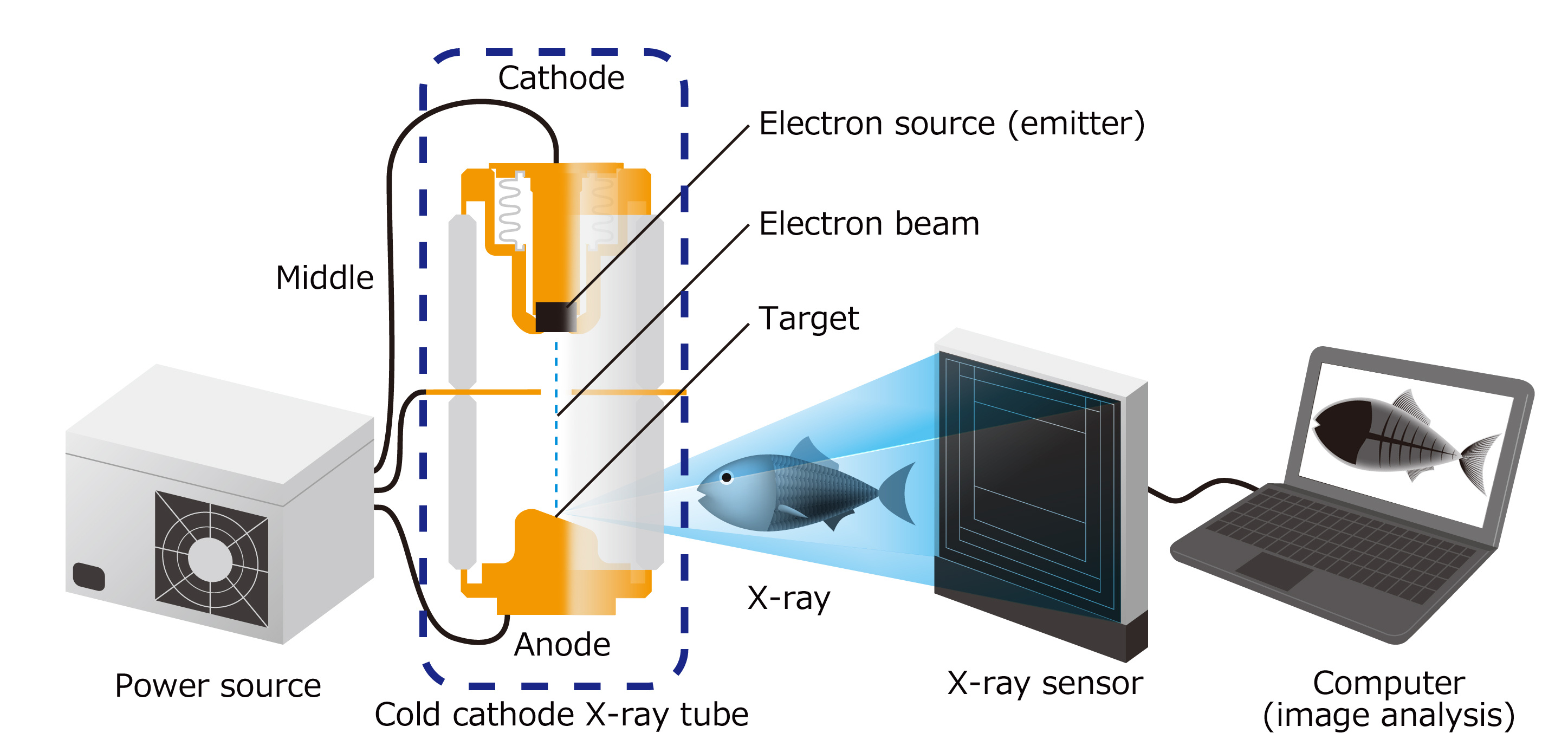
A cold-cathode X-ray tube using carbon nanostructures uses a cold cathode with an electron source coming from carbon nanostructures. The electron source emits field electrons from the carbon nanostructure’s tip. Unlike conventional hot cathode X-ray tubes, in which electrons are emitted when tungsten filament is heated, this product does not require filament heating, therefore making it smaller, lighter and more energy-efficient.
The field electron emission method allows the instant irradiation of X-rays when needed, which can reduce the dose of x-ray equipment and can extend the life of x-ray tube. According to a Meiden study, the product is smaller than half the size of conventional hot cathode products and thus expected to downsize and lighten X-ray inspection system.
https://www.auntminnie.com/index.aspx?sec=road&sub=def&pag=dis&ItemID=127225
In their preclinical study, the researchers used a specially designed device that contained sealed ceramic-type cold cathode and hot cathode x-ray tubes and a flat-panel detector. From there, they internally developed a carbon nanotube emitter and x-ray tubes designed to function at high anode voltage without arcing.
The carbon nanotube-based cold cathode x-ray source emitted 20% less radiation while producing the same image quality with the same exposure time as the hot cathode x-ray source. In addition, the response to digital pulses was three times faster with the carbon nanotube-based cold cathode x-ray source. The cold cathode source also had a 40% smaller focal spot size.
Using a carbon nanotube-based cold cathode source in a mini C-arm fluoroscopy system provides improved function, higher-quality x-ray images, and reduced radiation dose, compared with a hot cathode x-ray source, the researchers concluded.
https://www.businesswire.com/news/home/20200728005719/en/Nanox-Exceeds-100M-Crossover-Investment
Here’s a brief overview of Nanox, its strategy, and a discussion of threats.
Threats:
-Nanox’s ability to develop and produce a working prototype of the Nanox.Arc;
-Nanox’s ability to successfully demonstrate the feasibility of its technology for commercial applications;
-Nanox’s expectations regarding the necessity of, timing of filing for, and receipt and maintenance of, regulatory clearances or approvals regarding its X-ray source technology and the Nanox.Arc from regulatory agencies worldwide and its ongoing compliance with applicable quality standards and regulatory requirements;
-Nanox’s ability to enter into and maintain commercially reasonable arrangements with third-party manufacturers and suppliers to manufacture the Nanox.Arc;
-the market acceptance of the Nanox.Arc and the proposed pay-per-scan business model;
-Nanox’s expectations regarding collaborations with third-parties and their potential benefits;
-Nanox’s ability to conduct business globally
In my opinion, there’s a lot of potential, but also a lot of risk. I understood that there isn’t a single working device yet (highlighted in the quote), which for me creates a high barrier to getting involved just yet. Definitely one to watch!
More agreements / MoUs from this year:
If imaging studies are performed non-specifically, the problem becomes harmless incidental findings, which lead to expensive further investigations, follow-up, and patient anxiety. A fairly large proportion of people have various cysts and nodules inside their bodies. Costs increase, but the benefits are smaller than this.
Radiation doses in various imaging studies: Google Image Result
Exactly, and this is what I at least tried to criticize in my writing: that the company, in my opinion, did not succeed very well in explaining its vision and impact in its presentation video. A typical investor presentation, with flowery words like “preventive” and big visions without much concrete detail. An investor who doesn’t understand healthcare might believe that “preventive” here refers to a bigger pie (primary prevention of cancer), than what the company’s market actually is (secondary and tertiary prevention).
Of course, CT devices diagnose much more than just cancers, but in the company’s presentation, other uses remain unclear.
My own values regarding imaging background radiation values are taken from HUS, where the average effective radiation doses are smaller than STUK’s averages. Globally, doses may be higher than HUS’s values; in Finland, I believe radiation safety and the justification principle of radiation research are taken into account quite well.
This is discussed in the Motley Fool industry focus podcast, episode title: “The Tesla of medical imaging?”
Key takeaways:
-Technology developed by Sony 10 years ago, since then development has been abandoned and Nanox has acquired the technology and developed it for the past 8 years.
-Disruptive business model: the device costs about 10,000 dollars to manufacture (Foxconn manufactures it - the same company that makes iPhones). The device is given free of charge to the customer, after which revenue is collected at 14 dollars/scan. The agreement stipulates that the devices must take at least 240 images/month. This makes about 3400 dollars/device/month.
-Thus, the device’s payback time is 3 months. The model is called “Medical Streaming as a Service” or “MSaaS” - which is more attractive to the customer than a device costing a couple of million and paid for upfront.
-A fleet of 15,000 devices is achievable, with orders already from many countries.
-It is emphasized that it can “tenbag” or you can lose almost everything. The riskiest investment they have talked about on the podcast.
So this appears to be an X-ray imaging device. In the pictures, Nanox.Arc is smaller than a typical CT imaging device, but they don’t even have a prototype yet, right?
However, a simple CT device can be obtained for a few tens of thousands of dollars (purchase price, not manufacturing cost). Of course, imaging devices can cost millions, but Nanox.Arc, aiming for wide distribution and bulk imaging, is unlikely to compete with the sharpest high-tech.
If the device costs at least $3400 per month, the costs can exceed the purchase cost in just a couple of years. Even less than a year with a used but functional device. It’s not immediately clear that this system would have a great competitive advantage in terms of price. Rather, it sounds like it quickly becomes expensive. However, this cannot be said for certain.
For this reason, I also got the impression that the bottleneck is not the hardware or the costs, but diagnostics. So maybe the advantage would come from the cloud? However, the website states that the availability of imaging systems is precisely the limiting factor.
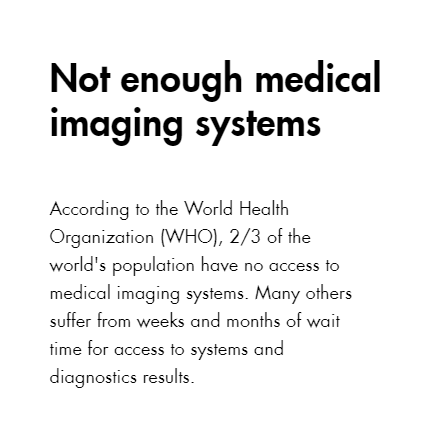
Or rather, this. The WHO’s claim is probably true, but it doesn’t automatically stem from a lack of systems if people can’t access care. There are also people dying of hunger in the world, and it’s not due to a scarcity of food (i.e., not enough for everyone).
But OK, this doesn’t matter. Revenue comes from contracts, so you just need to calculate how many devices can be delivered and how much margin comes per device. This is then compared to the market value.
15,000 devices would generate at least over 612 million in revenue per year. Market cap is now 2.8 billion. I listened to this podcast, and 15,000 is “if all goes well,” in 2024. I.e., buying now would mean a 2024 P/S of 4?
Then you would still need to know how much revenue flows into profit.
However, this is exactly the kind of thing that bags a hell of a lot, even if it never comes close to its vision. So just jump in.
https://www.sec.gov/Archives/edgar/data/1795251/000114036120017084/nt10006151x8_f1.htm
You can wade through Nanox’s F-1 Registration Statement, which is some kind of application required for listing on the US stock exchange. You might find something useful there.
Picked from there:
We introduced a working prototype of the Nanox.ARC in February 2020 and, if cleared, we plan to deploy the first Nanox.ARC in the first quarter of 2021
So a working prototype has been successfully built, but it is still not certain that the technology can be integrated into a commercial version:
Although we have produced a working prototype of the Nanox.ARC, we may not be able to successfully integrate our X-ray source into the Nanox.ARC or any medical imaging system.
Well, I don’t know if the cloud would be an advantage either. Even now, a radiologist interpreting CT/X-ray images doesn’t need to be near the imaging device; the images are transferred immediately to the imaging software (e.g., Sectra offers such a solution), from which they can be viewed instantly throughout the hospital district. If necessary, images can be quickly sent elsewhere in a matter of minutes.
In imaging, it also matters what one wants to find, and if (when) something is found, then what? Some people certainly want to know “what does the spine look like on an MRI scan,” but if it doesn’t change the patient’s treatment, the only outcome is increased costs and wasted resources.
Perhaps the mindset in the US is different, where from a Finnish perspective, unnecessary imaging is business, but that is also likely influenced by the local “lawyer business,” which probably steers people towards conducting examinations “just in case.”
It’s a bit challenging to estimate the market size for this company. In many contexts, Nanox.Arc has been compared to a CT imaging device. In Western countries, there are on average about 20 CT devices per million inhabitants:
https://data.oecd.org/healtheqt/computed-tomography-ct-scanners.htm
Nanox’s CEO has stated that the initial target markets are the USA, Asia, and other developing countries:
Initial target markets are the United States, Asia (through South Korea’s $260 billion SK Telecom group) and developing countries with little or no current access to medical imaging.
Source: ISRAEL21c: Now part of the Unpacked family
This encompasses approximately 6 billion people. 20 Nanox.Arc devices per million inhabitants would make the market size 6,000 million inhabitants x 20 = 120,000 devices. However, it’s difficult to believe that developing countries will come close to that 20 devices per million inhabitants for a long time. If we approach the matter through Nanox’s vision, that everyone would undergo imaging once a year, then 20 devices per million inhabitants would not be enough at all.
In the CEO’s interview, there was also talk about reducing radiation exposure with Nanox.Arc. Apparently, it’s possible to control the radiation time better than with traditional X-ray devices, thus reducing exposure in at least some cases. Mammography was mentioned as an extreme example where exposure can be significantly reduced. Is there also a market niche for Nanox here?
In some cases, the system could reduce exposure time dramatically,” Poliakine tells ISRAEL21c.
Mammography is an extreme — and extremely exciting — example.
Poliakine says Nanox could reduce the time needed to complete a mammogram by a factor of 30. And the system does not require pressing the breasts between two plates.
Too difficult a case for me to grasp. What is the realistic market size? Nanox’s potential market share? EBIT margin? In addition, there’s the risk that the device may not even be able to be manufactured. But it will be interesting to follow how this progresses.
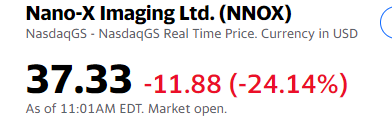
Target price: 0 dollaria
https://seekingalpha.com/news/3614142-nano-x-slides-citron-takes-aim-blatant-stock-promotion-seen
Looks like some short fund… still offering a free flight with it.
I’m definitely following this out of interest and for the joy of learning

edit: also adding the link to the report since it’s public
https://citronresearch.com/wp-content/uploads/2020/09/NANO-X-a-Complete-Farce-on-the-Market.pdf
](https://www.nanox.vision/%5Cn%5Cn!%5Bimage%7C690x408%5D(upload://zFfiDIAB84PCSieVDXPWGyym6Cx.jpeg))
This Nanox seems to be a bit like Butterfly Networks, which raised 370M USD in funding and developed a handheld ultrasound device that works with an iPhone and utilizes AI in image processing. The difference is that Butterfly’s idea was good and Nanox’s is not.
As Citron’s report also states, imaging is a very competitive industry. The so-called Big Iron (CT, MR, PET) class is led by the trio of Siemens, GE, and Philips, with Canon, Fuji, and Samsung as challengers. There is more dispersion in other device types. For example, Helsinki-based Planmeca also does well in cone-beam CT.
The Siemens, Philips, and GE trio have enormous R&D resources and they work closely with universities and research institutes around the world, starting from basic research. The trio aggressively researches new imaging methods and technologies. A quick Google search shows that at least Siemens has also researched this:
I must say, my own interest dropped at the point when they presented their vision of 1 CT image/year for screening in the video. It made me think that this is a company from outside the industry entering a market that is a red flag for me, and I wondered if this vision is being sold to investors unfamiliar with the field.