It’s a matter of principle, at least in my opinion: who would want to end up having to discuss things with their employer (representative) if they simply don’t want to participate in a(n) (protest) expression for any cause, ideology, theme, etc.?
11 Likes
The pushiness. It’s a bit like how few people are bothered by religious people, but many are irked if they come to preach unsolicited. Let alone if a religious ideology is pushed into schools as creationism, for example. Another thing is the kind of stances often associated with Pride, such as Soviet flags and the like.
One can have many opinions on whether either of the above represents Pride as such, but these things are repeatedly linked to the theme, and the organization makes no effort to distance itself from them.
More generally, Pride, environmental protection, and unfortunately many other things are muddled by the fact that various political movements seem to have become deeply entrenched in them—movements that have nothing to do with sexual minorities or environmental protection, sometimes even quite the opposite. It also feels like the original primary values have taken a back seat. In my opinion, this could be compared to, for example, an association promoting children’s sports starting to take a stand only for capitalism, stock investing, and the market economy, to the point where their official statements, event speakers, flags at events, etc., were primarily about this agenda and children’s sports were sidelined.
30 Likes
And you don’t even need to read to the end, as that was already right in the headline. And it’s quite something to invite someone to discuss the matter after first stating a desire for legislative changes to trample the rights of the person you’re debating with.
Otherwise, I have nothing to add to the good points raised by users Sentinvenyttäjä and mskomu.
6 Likes
I am not bothered by the diversity of sexuality and gender in any way. Nor does environmental protection provoke any negative thoughts; on the contrary, it is an important issue for me. Instead, what bothers me is Pride (or Seta, which promotes it), Elokapina (Extinction Rebellion), and other similar radical ideological activist organizations and their way of advocating for these important issues. They don’t seem to want to engage in a genuine discussion about the goals they are pursuing, but rather want everyone to think and express things in a way that they approve of. Either you are in complete agreement with them about everything, or your opinions are wrong and you get a suitable label slapped on you. This very absolute way of promoting important issues does not achieve any good; instead, the people they want to influence just start to get fed up when, for example, their commute is hindered by road blocks, and attention is diverted away from the cause itself.
The credibility of Pride and similar movements would increase significantly in my eyes if they would accept the criticism they receive and engage in some kind of self-reflection regarding the way they promote their cause, and understand that not everyone has to think about things in the same way. Disagreement is acceptable, at least in Finland, where most people are happy to let everyone be exactly who they are, but where not everyone wants to become a mouthpiece for a highly political organization to promote that cause (myself included).
35 Likes
That right there is the core of the problem, and the other issue is that these entities pushing for “equality, nature conservation,” etc., lie with a straight face, claiming it is not about ideology.
If you look at, for example, Women’s Day marches for women’s rights, you can’t help but notice symbols of various extremist movements being carried. In these cases, some even wave flags for Palestinian nationalism.
It would be truly refreshing to see organizers start systematically banning all political symbols from their events. It might significantly increase the number of participants.
11 Likes
I promised myself and the moderators that I would no longer deviate from the forum’s investment topics, but I will make an exception for this one comment, because my original, now-deleted comment was moved here from the coffee room. I hope no one finds this post offensive, but rather that it might encourage some self-reflection regarding one’s own values, if there is a perceived need for it. If not, then that’s fine. Live and let live.
In my opinion, sexual equality and parity are not an ideology, a movement, or an opinion. It is a human right. I don’t believe the matter is political in any way. Gay people exist across all party lines.
Opposing or denying equality and parity, on the other hand, seems to be a very political topic. Through ideologies, movements, and “I have freedom of speech” style opinions, people want to express how sexual equality and parity are not accepted. Even openly gay right-wing politicians seem to oppose “that wrong, leftist homosexuality.” Why? Is sexuality a political weapon in Finland in 2026?
What does it really matter who is sleeping with whom, as long as no one is hurt, coerced, or exploited without consent? Shouldn’t the fact that people find each other and can enjoy their lives in a way that suits them be a happy thing? You don’t have to like everything yourself, but what if you focused on the things you personally consider important in life instead?
I understand the feeling of things being shoved down one’s throat and I agree with that myself, but have you seen the shirt that all the other team members wanted or at least agreed to wear? Was it too bad? What would have been lost if, like the rest of the team, they had worn this shirt for one evening?
In a civilized country like Finland, accepting diversity should be a given. And because it isn’t, these rainbow themes are unfortunately needed to the point of exhaustion.
This is all I think about the matter and all I have to add. In my opinion, the topic is not political, so the politics corner (just like the entire forum discussing investing) is the wrong place for it. I don’t follow this thread anyway, because daily politics or party politics don’t interest me in the slightest.
For these reasons, I will not comment further on this subject.
9 Likes
Yes, but Pride does not promote these things, even though it claims to so strongly. Pride ideology includes discrimination, as was seen in this shirt case, when the person exercised their freedom of choice. In Pride, the “wrong-believers” (read: e.g., Finns Party members (persut)) belonging to sexual minorities are also driven away just because of their wrong opinions—opinions that aren’t even related to the whole topic.
There are also differing opinions within minorities regarding, among other things, men’s participation in women’s sports leagues or being in locker room/toilet facilities, or especially the administration of hormone treatments to children. For these, people are then condemned and driven out of the Pride movement.
This is the problem with the Pride ideology, not that one wouldn’t support equality and equity.
49 Likes
This habit of leftist activists of turning all popular movements into totalitarian ideological gibberish is fascinatingly described as early as Theodore “Unabomber” Kaczynski’s 1995 manifesto.
He was bitter about how the urban liberal left was constantly taking over ecological movements as early as the 1980s, and systematically watered down various Green parties away from nature conservation by displacing the original agenda.
A quote from the book “Industrial Society and Its Future” (summaries of the subject’s thoughts by an author who wrote about the manifesto and the Unabomber):
Earth First!, a direct-action environmental organization founded in the United States in 1980, quickly fell victim to a leftist occupation, resulting in a large portion of its old members leaving the organization […] Suddenly, nature conservation meant, among other things, development cooperation, feminism, and the promotion of ‘well-being’.
It is fascinating to read that manifesto published in 1995, where the same political patterns are still repeating. When you consider, for instance, how the Occupy Wall Street movement—one of the most significant modern-day protests against the current economic system—was hijacked and suddenly became about racism, intersectional feminism, etc., and then the movement was watered down and died. This way of operating by the left is almost so systematic even 20 years later that one could almost think it is deliberate suppression of activism on behalf of the elite.
13 Likes
Now it is really worth delving into, for example, discussions on the history of metal music or hobbyist forums for the Warhammer miniature game. Or actually, anything that people are passionate about. The same constant always repeats: everything goes to ruin when it becomes mainstream, and things were always done properly in the past, whereas nowadays they are done poorly. In political movements, you simply can’t help it if you want to get anything done. Mainstreaming is required in a democracy if you want things to change. In the case of Seta, people tend to have both a political and a sexual orientation. It is indeed pertinent to ask why leftists are overrepresented in everything related to Pride? It likely relates directly to the fact that the National Coalition Party (Kokoomus)/Finns Party (PS)/Christian Democrats (KD) axis has done its best to block the rights of sexual minorities in parliament whenever it has been possible.
6 Likes
Even the ancient Romans… maybe not quite, or I don’t know. But the same phenomenon is also described by George Orwell in his book The Road to Wigan Pier. Mind you, in it he criticized how the intelligentsia hijacked the labor movement in 1930s England. But otherwise, I don’t believe the phenomenon is strictly “left-wing,” but rather generally that certain types of people feel no qualms about pushing what they consider to be important issues in places and at events that are dedicated to some other important cause. And these don’t necessarily even relate to politics, although they usually do.
2 Likes
So what are these rights then? The only one that comes to mind is the marriage act from years ago, which Kokoomus, for example, supported.
2 Likes
Now, if you recall, Pride refused to collaborate with the National Coalition Party (Kokoomus) because nearly half of the party’s MPs opposed the amendment to the Trans Law. This isn’t a left-right divide, except for those obsessed with US-style LARPing and culture wars. It’s also worth remembering that Pride did accept collaboration with the Helsinki branch of the National Coalition Party in the same year, as the Helsinki branch is more progressive on the matter than its parent party. Pride is not a place for parties to polish their image if nearly half of the party’s MPs are completely opposed to the cause Pride promotes (the rights of sexual and gender minorities).
7 Likes
Of course, that Trans Act is also just one piece of the entire sexual minority issue. Without knowing the National Coalition Party’s (Kokoomus) agenda any better, I believe that even there, sexual minority issues are not seen as “from the devil,” nor are sexual minorities categorically dismissed. But of course, I would think that for the Pride community, it is such a sore spot that it was perfectly fine to refuse “cooperation” within the framework of their agenda. But the point originally was that, I suppose, in the name of equality, others should also have the possibility to be against Pride’s agendas without the fear of being stoned, just as Pride has the possibility to choose its partners within the framework of its own agendas. Equality in both directions, then, not just one.
It’s considerably easier to hijack an existing movement than to start a new one. At the same time, you get a ready-made membership, most of whom won’t leave, at least not right away.
2 Likes
This still reflects the outcome of World War II: two extreme ideologies clashed, one won, and even today it is interpreted that one was evil and the other was good. In my opinion, both are equally bad.
What I really can’t understand is that Palestinian flags were waved in the Pride parade. Palestine is led by Hamas, which believes that a swiftly executed death penalty is an appropriate punishment for anything other than marital sex between a man and a woman.
9 Likes
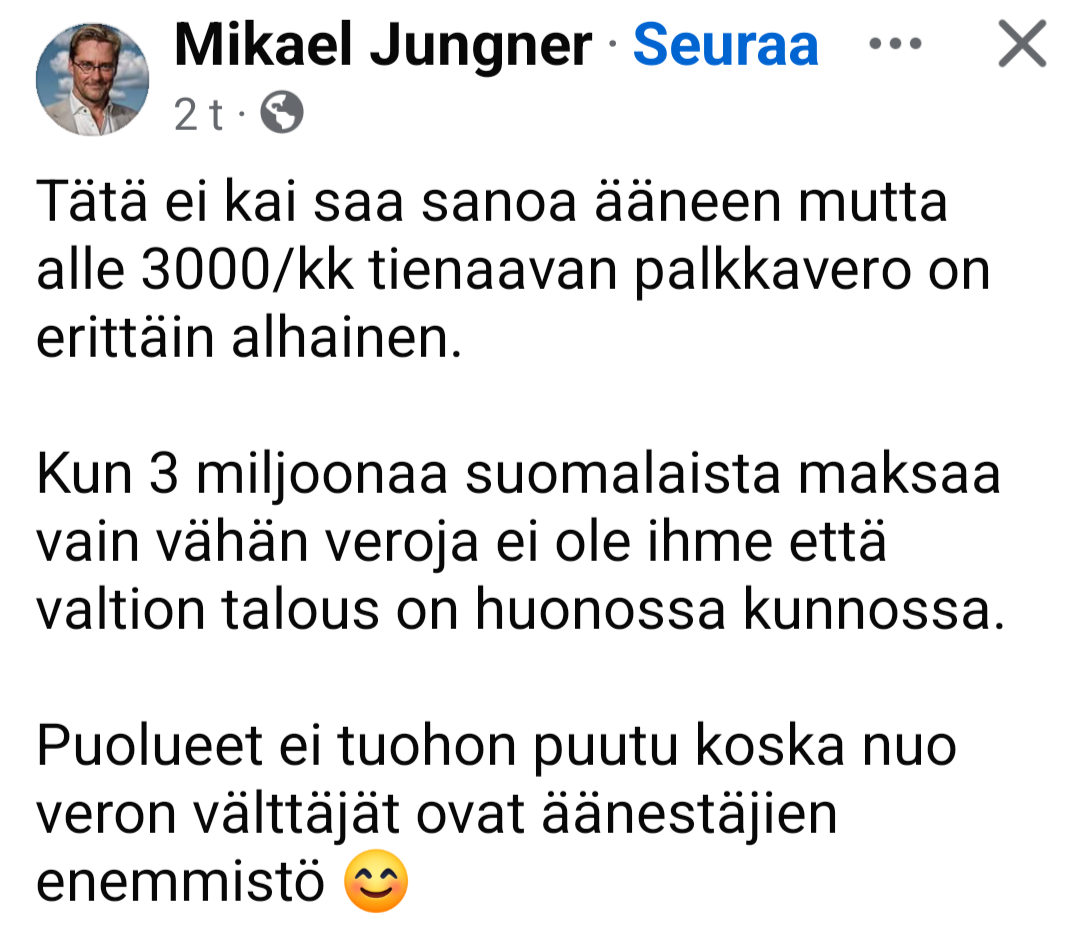
I don’t really know what to say to this… I guess I’ll just have to leave this here, as it leaves me speechless! 
6 Likes
The Transgender Act and the marriage law you mentioned are, of course, these latest major milestones. The National Coalition Party (Kokoomus) specifically did not support them; instead, they refused to take a side and ended up competing for the title of the most socially conservative party in parliament with the Finns Party (PS) and the Christian Democrats (KD). Every other party, including the Centre Party, managed to adopt a supportive stance.
4 Likes
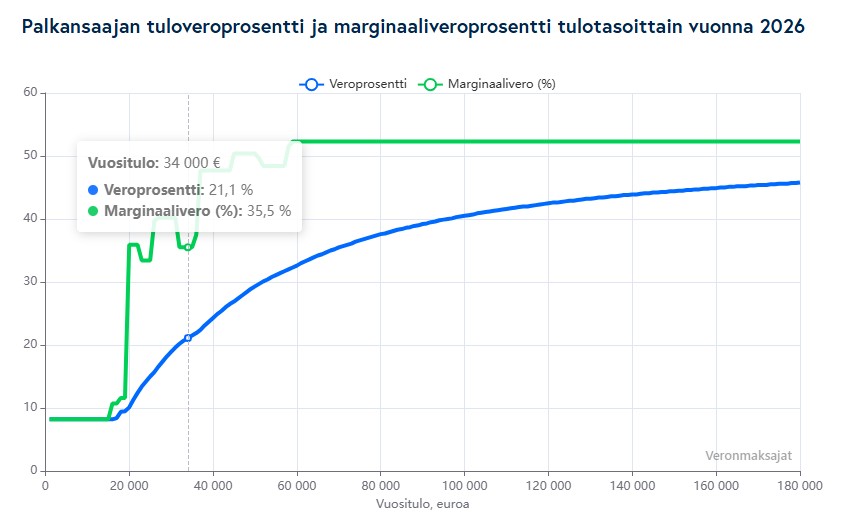
You should have said something. Mikael is actually on the right track here. For example, someone earning 35,000 euros a year pays 7,525 euros in taxes. In contrast, someone earning 70,000 euros pays as much as 24,850 euros in taxes, which is well over three times the amount even though the salary is only double.
Nowadays, as equality is discussed at every turn, the most equal approach would be for everyone to have, for instance, a 20 percent flat tax. That would be true equality. It’s a pity we are unlikely to see this, at least not in my lifetime.
26 Likes
It is indeed the case that unless the left wing manages to create an “underclass” in Finland through its taxation and sin tax decisions, the Left Alliance will soon run out of supporters once the Finnish economy finally starts to pick up.
4 Likes
I’m hoping for a 0% flat tax! (Sarcasm)
Let’s be realists, though, and suggest flat tax rates where the tax revenue would at least be sufficient. And who benefits from tightening the taxation of low-income earners so much that they end up relying on social assistance? Shouldn’t wages first be at a level where you can actually make a living? You can’t squeeze blood from a stone. Finland is a country of low-income earners, and if we want consumption, as is trumpeted everywhere, then we need to get consumers here.
4 Likes