Politics Corner (Part 2)

Just a side note: having been on this forum for a few years, I know of two other active participants besides myself who likely have some degree of a leftist worldview. Actual members of these parties are presumably even rarer here. I emphasize the words “some degree.” So I’m not quite convinced that your message will reach the right people specifically on the Inderes forum.

In itself, the topic seems very timely and interesting, but the war in Ukraine takes up about 80% of the time I can spend on YouTube, the remaining 20% goes to investment topics, and among those is Alex’s Ticker Symbol You, which covers AI investment cases. The latter channel is good because the material is condensed into a very compact format, and I’ve at least learned some basics of the AI field and investment cases.

I did take on the challenge and tried to get started with the video, but unfortunately, the subject matter got lost in some Rahapodi-style banter (which Martin Paasi is quite good at). There were no timestamps, so I tried fast-forwarding, but at some point, I just had to give up simply because I just don’t have the time for this right now.

As a development idea for this interesting theme, I’d say that a good topic shouldn’t be forced into “entertainment,” as many of us prefer compact formats. Timestamps wouldn’t hurt either. Then there’s something like Lex Fridman’s Zelensky interview, which can easily take a couple of hours, so one can delve deep sometimes if the topic is truly moving. But if there were some AI editor that could create a “banter-free” version of this, I might try again.

By the way, here is a link to Alex’s channel below, if anyone is interested.

2 Likes

Just like for any other work, of course. You can find it there below the line in the financial statements.

Were things better before, or were they really? Misunderstandings have always existed—intentional, semi-intentional, and unintentional. When times are tough and the economic situation is tight, people’s patience runs thin, and even a small spark can trigger a massive chain reaction. The Finns Party (Perussuomalaiset) has often emphasized that things must be spoken of by their real names, even if things get a bit messy in the process. People should perhaps be a bit more tolerant and not always take offense. In fact, I am of the opinion that in immigration and education policy, for instance, the Finns Party has played an important role in bringing difficult issues to light, albeit sometimes in a politically incorrect manner.

But then, if you demand tolerance, you must also be able to tolerate and accept criticism yourself. You must also understand that criticism is not always fair or proportionate to the matter at hand. In a difficult economic situation where a party is in government, you can always blame your predecessors up to a point. But now that the government term is approaching the home stretch and there has been a chance to show results, one must realize that in the prevailing economic and unemployment situation, the atmosphere begins to tighten, and the parties in government naturally become targets. Is this fair to the Finns Party? Not always, but it’s a career choice, and Riikka Purra can always take comfort in the fact that during the next government term, other parties and politicians will surely take hits in the same way if they express themselves inaccurately, whether through a Freudian slip or otherwise.

But was everything different before? In my opinion, no. It has always been the case that seemingly small sparks have caused great destruction. Like Marie Antoinette, who supposedly told the poor to eat cake. Or allegedly said so. Most likely, she never said it, but a fabricated story was enough for an angry populace. What we learn from this is that it’s not worth playing with fire; you have to be able to hear people’s feelings. Even so, one can be misunderstood, but at least the chance of that decreases if one has political tact. This is a difficult game for a populist party accustomed to expressing things in a colorful and sometimes provocative way.

For truly, the higher our unemployment rates are, the hotter tempers flare. Fortunately, however, our society has developed in a much more humane direction over the last few hundred years. Things weren’t better before—at least not if we go back to the times of the French Revolution; today’s politicians get off quite easy.

3 Likes

Thanks for trying to go through this anyway. I made an AI summary of the key terms I covered, in case you don’t have the energy to spend an hour on this:

Development Environment and Tools

VS Code or Google Antigravity (via the Windsurf acquisition) = IDE/code editor
Three windows in Antigravity: files/repo, terminal, AI chat prompt
GitHub / Git = version control; Sami’s repo: github.com/samiettinen (~6.7M lines of code)

Vibe Coding / AI-Assisted Programming

Claude Code (Anthropic) and OpenAI Codex generate code from natural language prompts
Workflow: write vision in the prompt → AI generates code → check for errors → paste error → “fix yourself”
Lovable (Swedish, ~$7bn valuation) = simplified no-code/vibe-coding for beginners; automatically selects a Supabase database and builds a React frontend with HTML/CSS

Stack and Infrastructure

Python / TypeScript / Node.js = programming languages
Supabase = database (white label PostgreSQL)
AWS, Azure (Microsoft), Google Firebase, Upcloud = cloud services
MCP server = software database interface call (e.g., Statistics Finland data)
API calls = fetching data directly without Excel (e.g., S&P Capital IQ, St. Louis Fed / FRED, Eurostat)
SSH = remote management for Mac Mini

AI Models and Tokenization

Anthropic Claude (favorite), OpenAI GPT, Google Gemini, Grok (Musk) = foundation models
Tokens = unit of AI usage; Sami spends ~€300/month
Inference = the model’s “thinking” process/computation

Bots and Automation

Samantha = Sami’s own AI bot, runs on top of Open Claw, accessible via WhatsApp
Consiglieri = Sami’s personal “second brain” app, runs natively on iPhone (Xcode development)
Scripts as scheduled runs (cron-style in the cloud)

Financial AI Applications

Claude in Excel and Claude in PowerPoint = Anthropic’s office integrations
DCF model, LBO model, comparable companies = via prompting into Excel or directly into code
S&P Capital IQ API integration coming → bypasses Excel entirely

I agree that the “tone of voice” I used is arrogant. Sorry about that. The world is just no longer that safe left-right bubble it perhaps still was at the end of 2025.

1 Like

This raises a question: did you use similar scripts before AI became generally available? Also, are you aware that they aren’t actually anything new, but coders have been using them since the 80s? If the answer to the first is no, then you are certainly a fine example of what the AI revolution makes possible.

2 Likes

I don’t know if this has been addressed in some thread already, but I think the moderation should remove all posts that contain AI-generated summaries, images, overviews, etc. They poison the discussion and turn everything into bland slop. Can we no longer be bothered to think for ourselves?

14 Likes

I am not at all disputing the evaluation and streamlining of public spending cuts and the efficiency and necessity of operations. However, it would be even more essential to generate growth; that is precisely what Finland has lacked for decades. The debt ratio decreases much more favorably through growth.

1 Like

I haven’t done anything more than some simple mouse-dragging scripts before. Sure, back in the 1980s, I was a good coder by the standards of that time.

I would then ask you – have you used 2026 AI programming platforms like Claude Code Max and AI work platforms like Claude Cowork? If you have, then you haven’t used them properly if you genuinely believe that they only make “scripts”.

1 Like

Thank you for this summary! Inspired by it, I gave it another listen and now the whole video has been watched through. I learned a lot of new things, and once I get around to it, I will also post some substantive feedback related to the topic. In any case, what immediately comes to mind with all modeling is what data is used, what questions are asked, and what new relevant information (and with what level of precision) we get about, for example, government finances that we don’t already know? Personally, I belong to the school of thought that we have the same old problems in government finances from one year and decade to the next. It’s not that the problems aren’t already known, but rather that no party dares to solve them for fear of the voters.

Of course, it is clear that these new tools offer entirely new opportunities to delve much deeper into details, problem formulations, and perspectives—for instance, regarding the balancing of Finland’s government finances—that were previously not possible. Undoubtedly, the state budget will be analyzed many times over from various angles using these new tools in the future. Then, the most important thing must still be remembered: the implementation of things. In the future, with such good tools available, there will be even fewer excuses for not getting the government finances into balance.

3 Likes

I haven’t. Of course, I know that AI is used to code much more than just database browsing scripts. I tip my hat to you for clearly integrating AI fully into your work, and I hope you benefit greatly from it. My skepticism towards this AI boom stems from how it appears to me: I don’t work sitting at a computer myself, and I try to minimize my time spent on the internet as much as I can. As an outsider, the AI craze manifests in two ways: the amount of content has exploded, and the quality has dropped in at least the same proportion. How have you handled quality control in that AI-based workflow of yours?

The point is, what makes you believe that economic growth could be achieved in Finland without shrinking the public sector and increasing the role of the market economy? The public sector constantly takes resources and potential away from the private sector’s ability to produce that economic growth, for example, through taxation and labor. Finland’s track record of economic growth is abysmal under the conditions that have been created in the country over the decades. This is likely indisputable. Despite this, many people seem to believe that economic growth will just magically take off, perhaps just this once, without streamlining the public sector and making taxation internationally competitive, even though the evidence shows that this belief has little foundation. It cannot be overemphasized that in a global economy, we compete globally against other countries, so it should be self-evident that adapting conditions to meet the prerequisites for economic growth should start by comparing Finland’s conditions to those of other countries and learning from where things have worked.

17 Likes

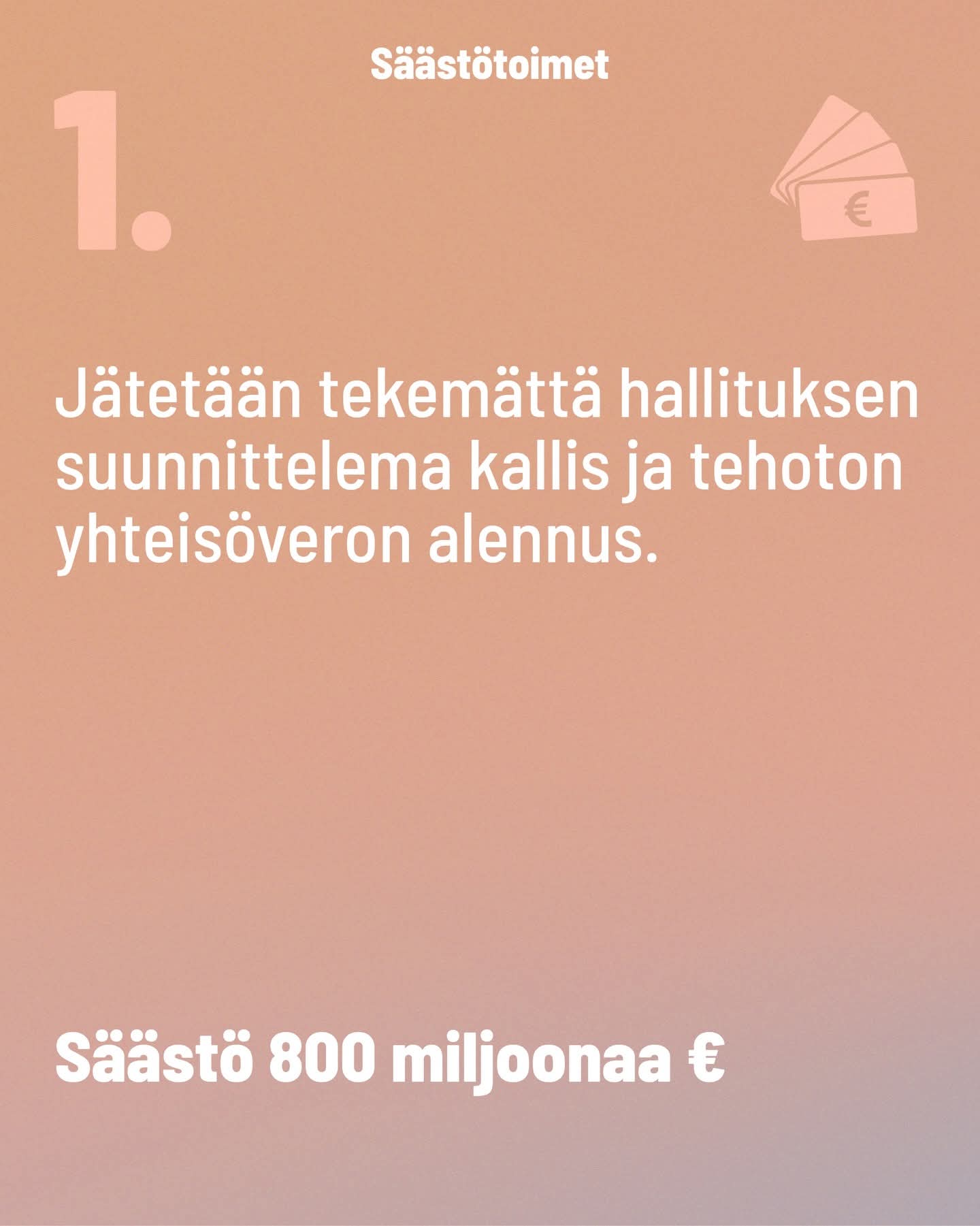
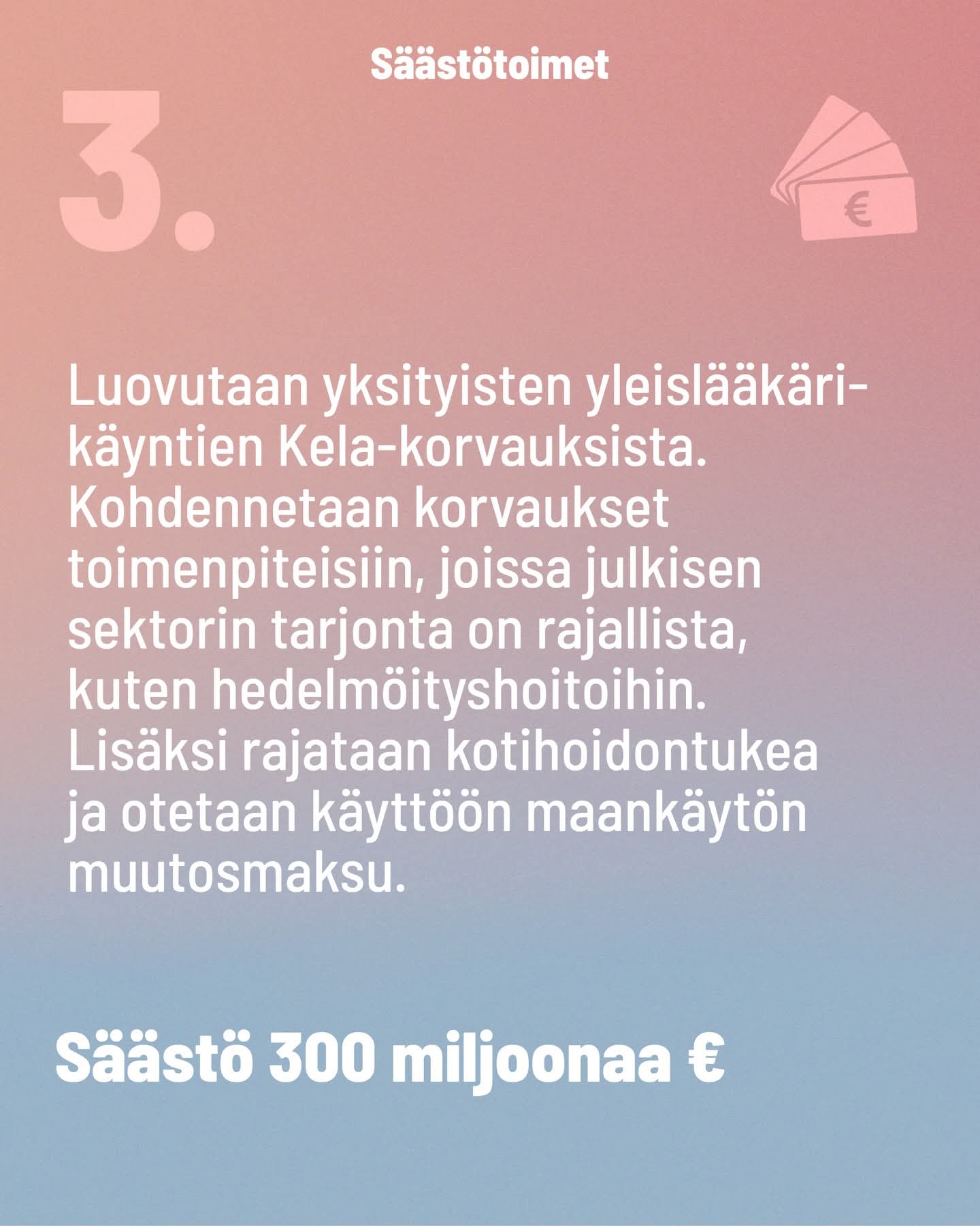
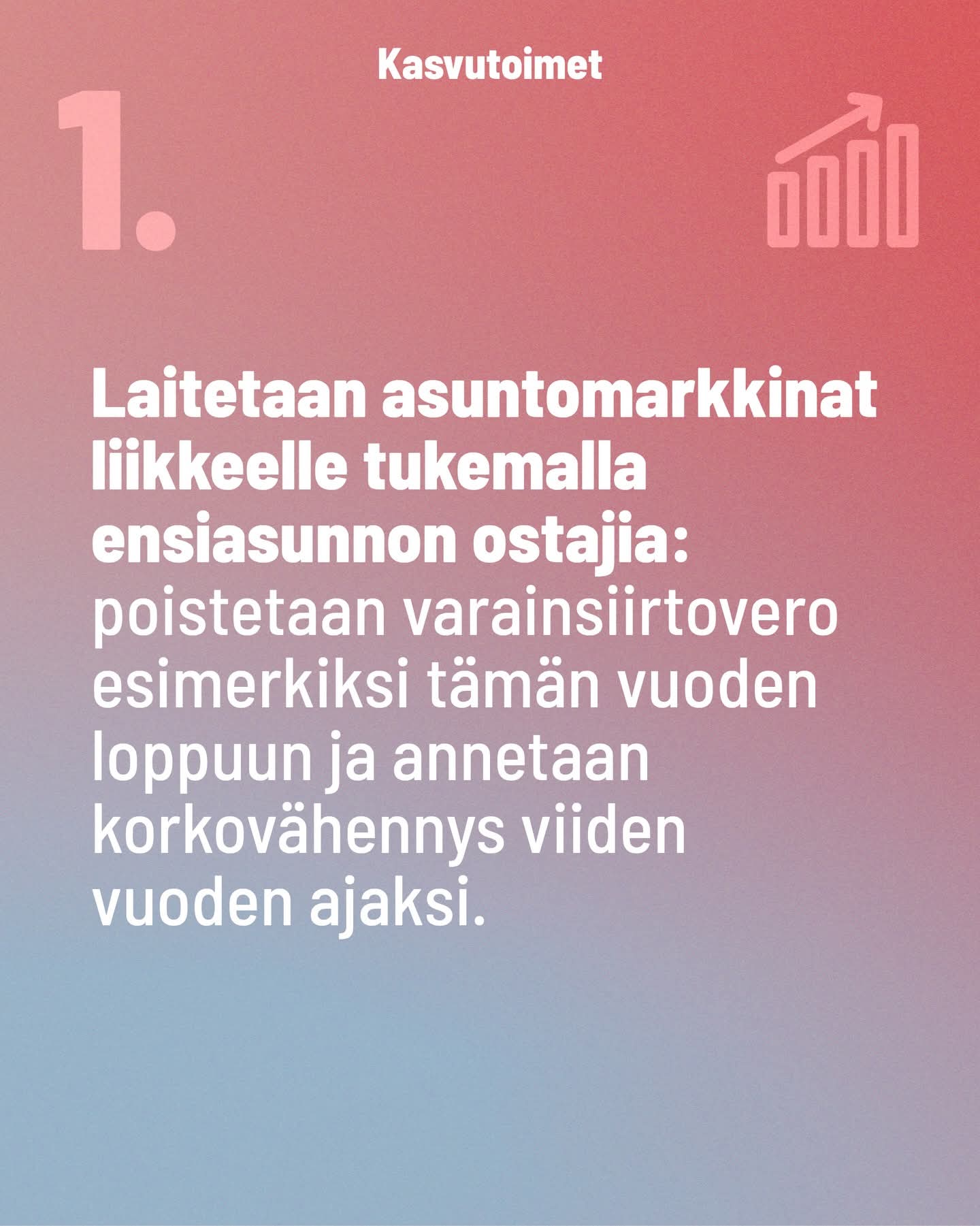
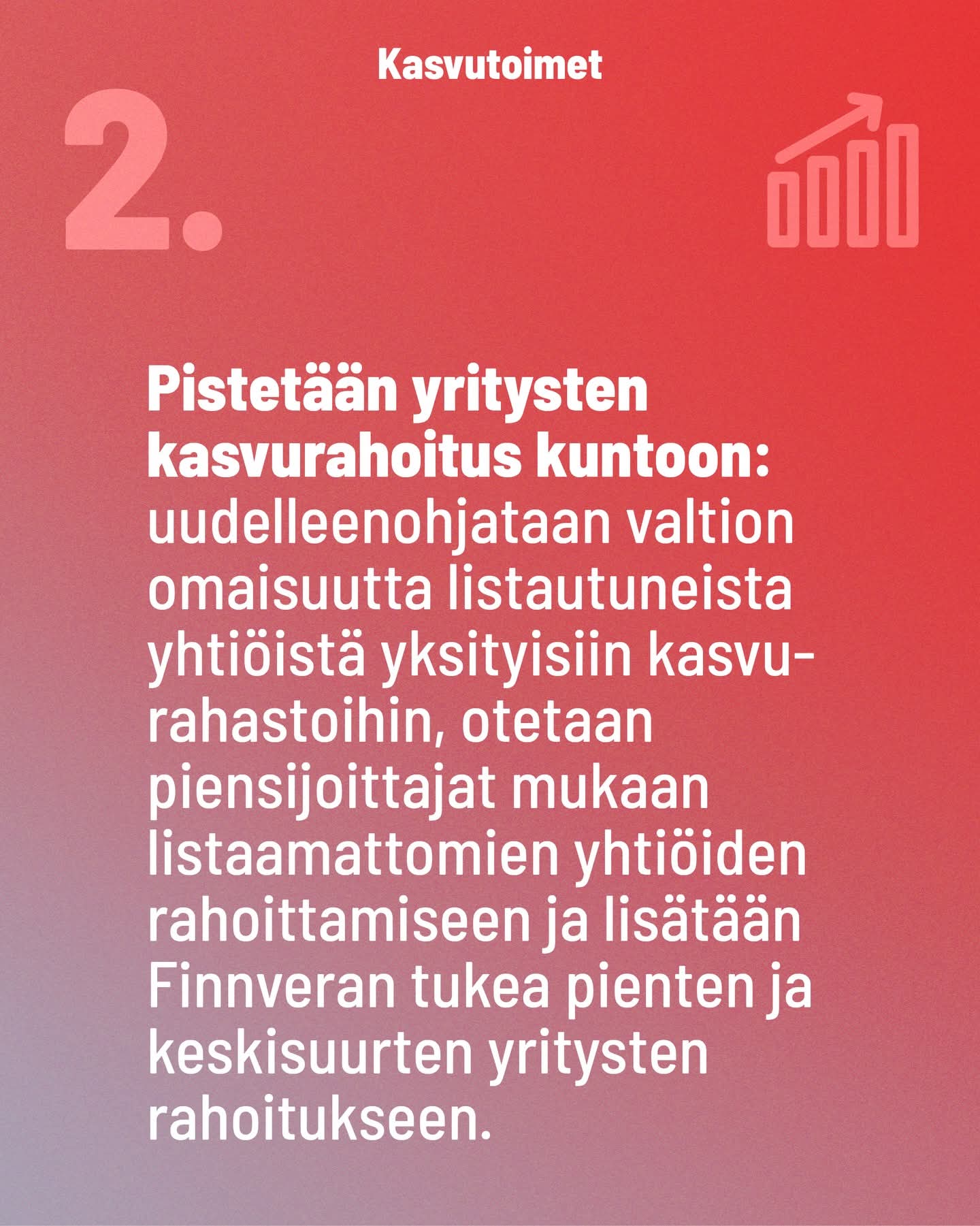
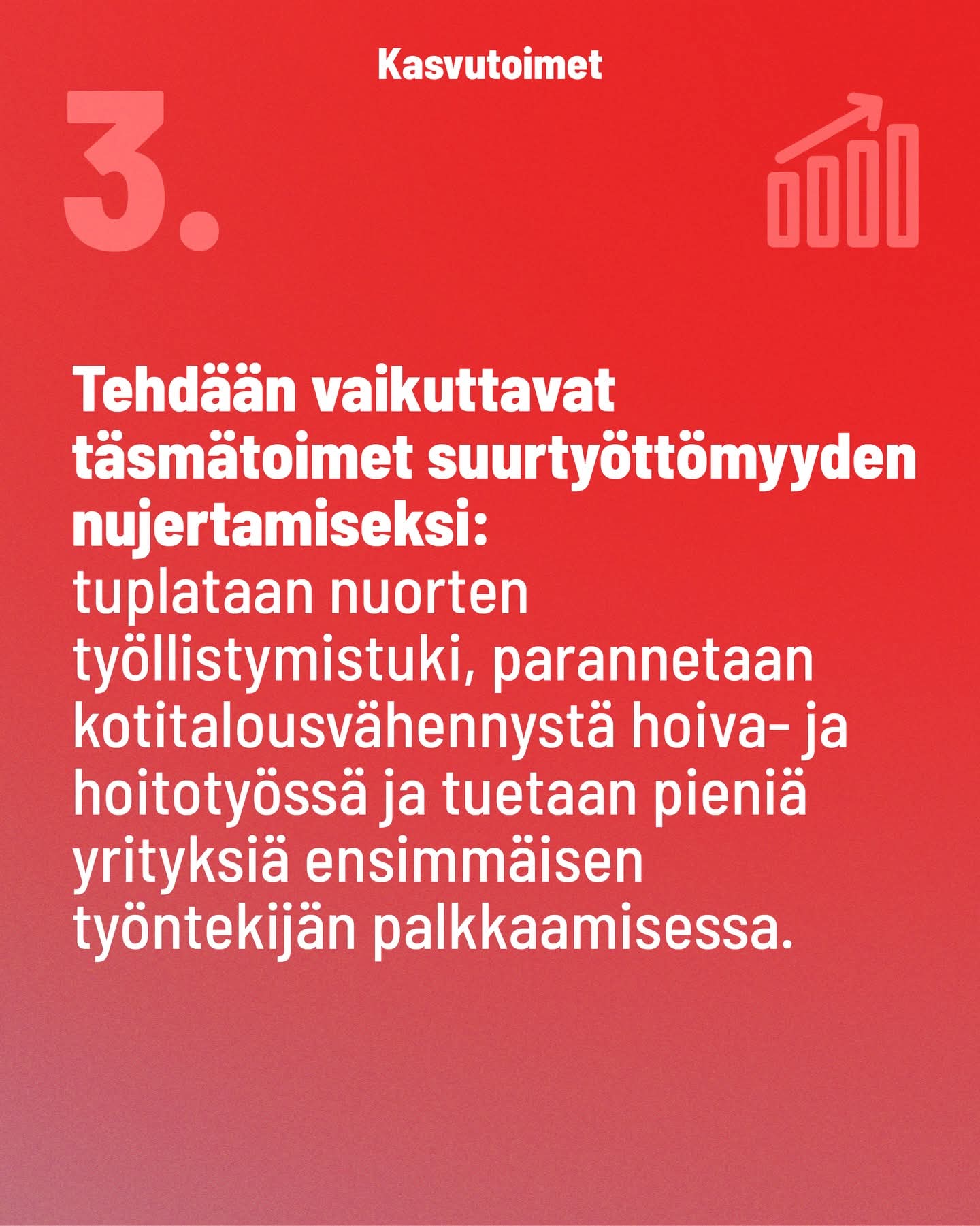
Lindtman revealed additional adjustment measures required by the debt brake for the spring framework session. Three savings and three growth measures.


Perhaps the most striking part is that 5% withholding tax for institutional investors. In other words, a Social Democrat is now proposing to tax the trade union movement!

Also: “One billion euros of state money would be pumped into growth funds by 2030 by selling holdings.
Lindtman would also like to involve retail investors in the financing of unlisted companies. This, however, would require easing regulation so that it would be easier for banks and financial institutions to offer growth funds to consumers.”

6 Likes

Usually, when some left-wing/Green party proposes something, it makes me want to puke (:face_vomiting:), but now they’ve somehow managed to conjure up proposals that, at least at a quick glance, don’t cause unbearable pain :thinking:.

Well, it’s hard to imagine the Center Party agreeing to the second point, and the National Coalition Party is unlikely to agree to cutting “funding” for private healthcare providers. Canceling the corporate tax cut is a bit “eh,” but if they actually managed to find a more efficient use for the money to drive economic growth, then why not—as long as they don’t start raising taxes compared to the start of the government term.

Funding things by selling equity (or other) holdings is almost invariably a failed move by the state, so it would require some seasoned veteran professionals to plan out where the proceeds are invested so they don’t just go down the drain again. Also, the privatized asset shouldn’t end up with prices hiked by +50% for citizens/customers within a few years while the new private owners milk the company dry for dividends even more than the state did.

8 Likes

The Social Democrats have a brilliant list there.

It’s truly great that the Social Democrats, often labeled as “commies” by the right, are proposing what are inherently quite communist actions: reducing business subsidies that weaken productivity and agricultural subsidies for unprofitable farms.

The government, however, will be the last to weaken preservative business subsidies, as we’ve seen from Purra. Practically all significant cuts to business subsidies have been cancelled. The confectionery tax was scrapped after Fazer put Purra in her place, the cuts to shipping subsidies were abandoned, and most recently, the cut to data center tax breaks was restored as an equivalent subsidy.

Currently, unproductive sectors are particularly popular with the government parties, especially the Finns Party. Peat production is being touted by many Finns Party MPs right now, even though it’s only possible through heavy subsidization. A couple of weeks of freezing temperatures had MPs clamoring for the whole industry.. :grin: Fur production has already received its few hundred million in support in recent years, not to mention the billions in the “growth rocket” of agriculture.

Employment subsidies and hiring incentives for small businesses are, on the other hand, the right temporary measures in this country with the worst employment development in Europe. It’s cheaper to help companies hire than to pay unemployment benefits. Currently, the aim has mainly been to reduce working. The removal of the exempt amount (protected part) of unemployment benefits is an example of a measure that ended even minimal work for the unemployed. A completely senseless and demotivating solution. It’s easier to return to the workforce if you do at least some work. Now you are penalized for it immediately. The most important thing is to do absolutely nothing. People don’t even dare to do volunteer work at the moment, as it also reduces unemployment benefits if it’s perceived to be anything other than charitable work.

9 Likes

A very good list from Lindtman. If only we could also get:

  • Tax relief / tax exemption on retained earnings if they are used for investments (the so-called Estonian model). This would be a total no-brainer growth measure with a reasonable price tag, as it would directly reduce the need for public investment from tax funds required by the parliamentary R&D agreement. It could also be implemented, for example, as a multiple deduction right for a fixed term.
  • Fixed-term tax exemption on business sales if/when the profits are invested in founding a new company (the so-called US model).

Add pensions to that to boost incentives for the working-age population, and it would be a near-optimal combo for me. However, one hardly dares to expect this from the Social Democrats.

6 Likes

Personally, I was quite disappointed with this announcement from the SDP, because this list was far too narrow and short regarding agriculture. It is telling in itself that of the parliamentary parties, it is specifically the SDP that brings up these austerity measures targeting agriculture, not the so-called Finnish right-wing parties (by “so-called,” I don’t include the Liberal Party). At the same time, it’s important to call things by their real names. Sometimes business subsidies and agricultural subsidies get mixed up in people’s talk.

In agricultural subsidies, there is currently a problem, for example, that they are often paid

a) to those who are already doing well and

b) to those for whom agriculture is a part-time hobby.

c) for activities that have no credible or sustainable economic foundation.

The end result can be an entrepreneur who is up to their ears in debt due to investment subsidies, spending their life working from morning till night on an over-invested agricultural business. It’s hard to get a sensible hourly wage from such work, not to mention having time for a social life, starting a family, etc.

This is a topic that very easily evokes emotions, because many have roots in the countryside and thus have an emotional bond, for example, to their own parents’ hard lives as agricultural entrepreneurs. But Finland is now in a situation where even difficult issues must be discussed.

Something always has to be taxed, and the larger the subsidies we have, the more human labor must inevitably be taxed. There is also a challenge here for AI if one tries to dig through the state budget book for all the line items showing how agriculture is supported directly or indirectly. The Liberal Party has already done this work well, but surely not every stone has been turned yet.

Over the years, through its own stupidity, the SDP has branded itself too far to the left with small and slightly larger announcements on things about which they should have remained silent. This savings list was a step in the right direction (literally), but there is still a long way to go to become a right-wing social democratic party.

I want to emphasize here that I do not want to provoke. This agricultural topic is highly charged, but on a personal level, I have nothing against farmers and agricultural entrepreneurs. Instead, I would like to fix the unhealthy and expensive system surrounding agriculture. It isn’t even in the farmers’ interest. On the contrary, I see many farmers as victims of this system.

5 Likes

Is this that ‘better’ kind of freeloading now? How on earth can this be justified? Shameless. Immoral. :face_vomiting:

32 Likes

Valid points raised regarding agricultural subsidies. Indeed, we must be able to discuss agricultural subsidies critically. I myself represent a full-time farmer, whose livelihood comes from beef production and crop farming.

Farmer subsidies are paid per hectare of farmland, and animals receive subsidies calculated as livestock units. For example, a cow is 1 livestock unit and a bull is 0.6 livestock units, and the subsidy paid per unit varies by region—in practice, the A-B area is Southern Finland and the C area is Northern Finland. Part of the agricultural subsidies are EU-funded and part are national subsidies. The system is very complex, but I won’t start explaining the whole convoluted web here. It’s quite a long story.

Agricultural subsidies have been decreasing continuously per unit. Fifteen years ago, approximately €620/ha was paid per hectare of field; nowadays it’s €450. This is in the AB area. The fact that the subsidy amounts for farms published on the disclosure days for the largest agricultural subsidies are increasing is due to the growth in farm size. The number of farms is constantly decreasing, so the structural development is proceeding quite according to forecast, as I understand it.

Among animal species, cattle are supported the most. Monogastrics, i.e., pigs and poultry, are supported the least.

The problem with agricultural subsidies is that their purpose has become blurred. Originally, agricultural subsidies were intended to lower food prices so that the poor population could afford to eat. Those times are long gone, and the current system is something that depends on who you ask. Are the subsidies for security of supply, financial support for the farmer, water protection, climate goals, or industry support?

Finland has strengths in agriculture. Our most important advantage in agriculture, especially in livestock production, is water. In Finland, we can wash machinery with drinking water, and it doesn’t really even cost anything.

My own views on agricultural subsidies: The system should be drastically simplified and, at the same time, options that bring practically nothing productive should be weeded out. Organic subsidies are one example of such senseless wasting of money. Another relic of the past is agricultural replacement services (lomituspalvelut). These come from the Ministry of Social Affairs and Health budget, so they don’t affect subsidy amounts, but it’s still an institution that costs a hell of a lot compared to the benefits.

Cutting from agriculture is a tough pill to swallow for almost all parties. If farms turn off the lights, the food industry ends at the same time. At Finland’s cost levels, it’s not worth processing food using imported raw materials. Now, farms have started selling cattle abroad. This is at least an indication that Finland’s primary production isn’t quite as uncompetitive as people say.

I enjoy reading discussions about agriculture, even when critical views are presented. The agricultural budget is in the magnitude of 2 billion, and the value of the grocery trade is 7 billion.

21 Likes

In Finnish agriculture, I have wondered about so-called bulk production and the lack of investment in specialization, where the Finnish climate could serve as a competitive advantage. While it is certainly easier in many ways to produce the same as everyone else, profitability in agriculture is most often shockingly poor. The Finnish climate is well-suited for caraway production, for example; Canada is the world’s largest producer of mustard, and perhaps it would suit Finland well too. There are plenty of chicken farms in Finland, but why not try to raise more unconventional birds on a larger scale? For instance, guinea fowl and quail would likely yield a better return. Even in agriculture, it could be profitable to differentiate oneself from other producers and seek competitive advantages both in Finland and internationally.

4 Likes

You are absolutely right. Blindly engaging in bulk production is foolish at best if you can’t succeed in it. Farms are all very different and vary in size, so the same concept doesn’t even suit everyone. Let’s limit the discussion to crop farms and provide context on the challenges of this sector. The prevailing situation is that Finland has a grain surplus, so prices are the world market price minus shipping costs. Domestic industry pays a better price, but in a surplus situation, they can cherry-pick—meaning they can raise quality requirements to a level that excludes many batches. They get premium quality cheaply. Standard business. Why does Finland have a grain surplus? We are a small country by population relative to our surface area, so production comfortably exceeds consumption. Over the last thirty years, livestock production has shrunk, and this further reduces the demand for grain. Especially the decline in cattle has meant that fields previously used for grass are now used for grain cultivation. Why is everyone growing grain? A large part of Finland’s 45,000 farms are part-time, meaning the owners work outside the farm or have other business activities. However, grain cultivation can be handled alongside other work with modern machinery. This situation should not be a surprise to any farmer. If you absolutely want to farm, you should consider a more diverse range of crops. Of course, it’s not quite that simple, as caraway cultivation, for example, is contract-based, and contracts for next year were full even before Christmas.

Farmers are also competitors with each other, just like other businesses. We compete most for land. Whether it’s a rented field or a property for sale, the highest bid usually wins the tender. If you have rented a field for, say, €500/ha, which is a somewhat normal level in the AB region, and you grow wheat at a price of €160/t with a yield from a poor rental field of 3.5t, the revenue from the field is €450 (subsidy) + €560 (sales). Then we start deducting costs. Rent €500 + own seed 250kg/ha €50 + fertilizer 400kg €200 + crop protection €40. Drying €15/t (€50) + freight €40. Total costs €880/ha. Roughly a thousand euros in revenue, and with costs deducted, €100-150 is left for machinery and your own labor. Of course, the calculation changes if the yield level rises above 5t/ha and the price is, say, €220, let alone €380. But one should be realistic in these calculations. Farmers should just understand to stop farming if it’s not profitable. There’s no point in pumping subsidies into it. And no more has been promised anyway.

10 Likes