Pepsi - Why not Coca-Cola?

Pepsi is a globally recognized carbonated soft drink with a cola flavor, manufactured by PepsiCo. In 2023, Pepsi is the world’s second most valuable soft drink brand after Coca-Cola.

Company Origins

Pepsi was first created in 1893 by Caleb Bradham, a pharmacist in New Bern, North Carolina. Originally named “Brad’s Drink,” it was sold in Bradham’s pharmacy. By 1898, the name was changed to Pepsi-Cola, reflecting its cola flavor and its alleged ability to aid digestion (though the drink never contained pepsin, a digestive enzyme). In short; despite a promising start, Pepsi struggled financially and went bankrupt in 1923 due to post-war sugar price fluctuations. Charles Guth bought Pepsi’s assets. He reformulated the drink and replaced Coca-Cola with it in his stores.

Growth and Innovations

Pepsi rose to popularity during the Great Depression by marketing its bottle, which was twice the size, at the same price as Coca-Cola, emphasizing “value for money.” This strategy was supported by the famous “Nickel, Nickel” jingle, which became an effective marketing tool. The brand also made strides by targeting its advertising to African American consumers, a largely neglected demographic at the time. Pepsi’s positive portrayal of African Americans in its advertising significantly increased its market share.

Cola Wars and Internationalization

In the mid-20th century, the “Cola Wars” began between Pepsi and Coca-Cola, as both companies competed with aggressive marketing campaigns. Pepsi launched the “Pepsi Challenge,” a series of blind taste tests where consumers claimed to prefer Pepsi over Coca-Cola. This competition escalated with Coca-Cola’s launch of New Coke in the 1980s, which was a direct response to Pepsi’s growing popularity.

Pepsi’s international expansion was successful, including a groundbreaking barter deal with the Soviet Union, where Pepsi products were exchanged for Stolichnaya vodka. This helped Pepsi in its internationalization, where it sometimes surpassed Coca-Cola in popularity.

Modern Innovations

In the 21st century, Pepsi continues to innovate by diversifying its product portfolio and adopting new marketing strategies. It maintains a strong position in global markets, while constantly adapting to consumer preferences and trends.

Throughout its history, Pepsi has demonstrated resilience and adaptability, turning early setbacks into opportunities for growth. Its ability to innovate in both product range and marketing strategies has strengthened its position as a leading brand in the competitive world of soft drinks.


More from an Investor’s Perspective:

PepsiCo has utilized innovative marketing strategies, such as iconic advertising campaigns and sponsorship deals, to strengthen its brand. The company has also expanded internationally, which has brought additional market share, especially in the non-cola sector. For example, Gatorade has grown into a leading sports drink brand, and Aquafina has become number one in bottled water. The company’s diverse product portfolio provides a competitive advantage, but due to market dynamics, new innovations are constantly needed, and others are also innovating.

Pepsi competes closely with Coca-Cola. Competition requires continuous investments in product development and brand building. The company’s extensive product portfolio, which includes Frito-Lay and Quaker Foods, supports its financial performance. Pepsi has also made significant investments in research and development, which has helped improve product quality and increase sales.

It is thought that in the future, PepsiCo should focus on healthier alternatives, such as vitamin-rich drinks and healthy snacks, to meet changing consumer needs. For investors, this means opportunities to benefit from the company’s innovative products and international growth – though they can also make mistakes and increase costs, or lose to competitors. Expansion into new markets, such as healthy snack products, offers new growth opportunities. The company’s strategic focus on conquering new markets and developing products makes it an attractive investment target for many in the long term.

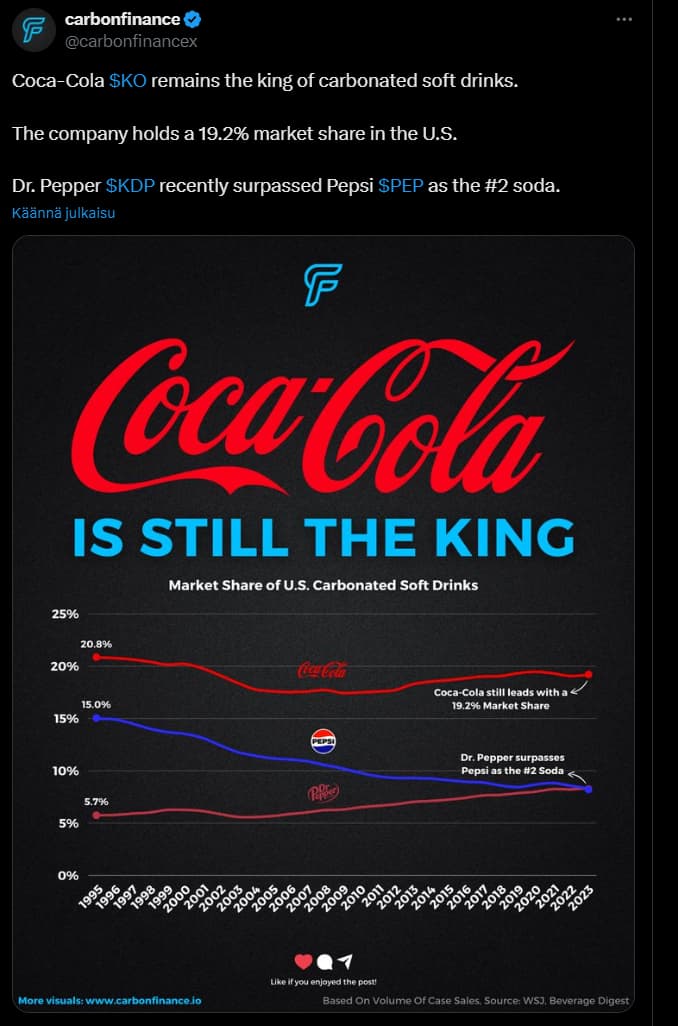
Pepsi is no longer the second largest, as I claimed:

https://x.com/carbonfinancex/status/1815487200886202723

Key Figures

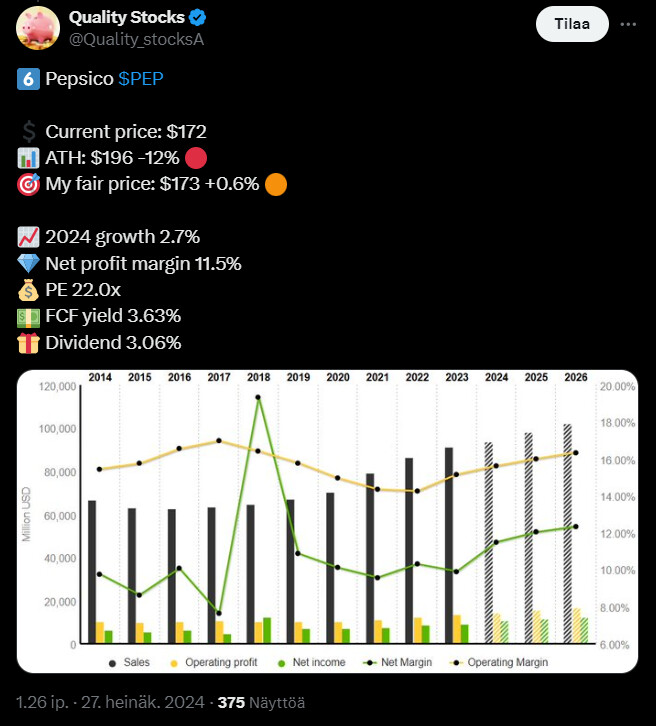
P/E : 28.6
P/S : 2.56

Annual Dividend Yield 3.14 %
Quarterly Dividend 1.36 USD

https://x.com/Quality_stocksA/status/1817144434959479261

21 Likes

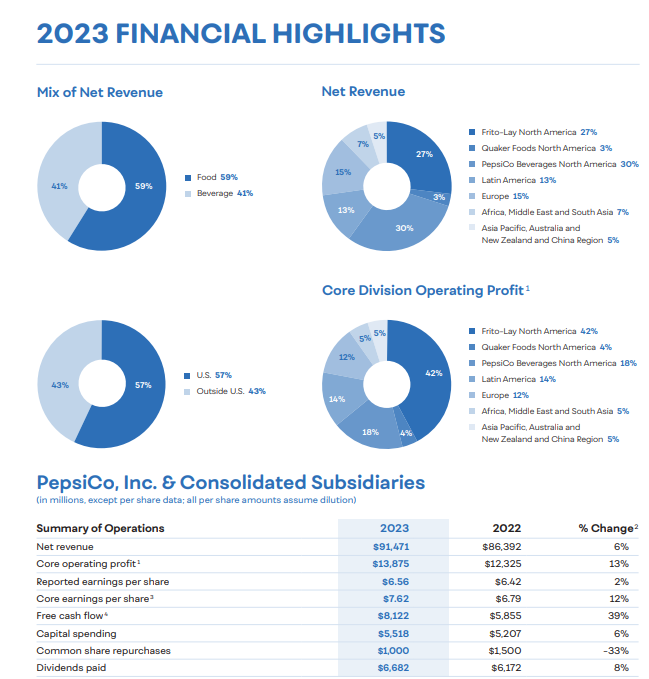
As a Coke investor, I must emphasize the significant difference between the companies: 59% of Pepsi’s business is food, and especially chips. Coke, on the other hand, focuses solely on beverages.

19 Likes

For many, business operations in Russia certainly matter as well. Both Coke and Pepsi still operate there, but Pepsi operates with its own global production and just opened a new factory of its own there, whereas Coca-Cola operates under the name of a subsidiary acquired there in the past, using only local materials. A slight difference, but it may influence the decision of which one to buy, if you buy.

https://leave-russia.org/pepsico

In 2024, the American company PepsiCo started the operation of the first phase of the factory of snacks and salty snacks in Russia, near Novosibirsk. Despite the war, the company has been operating in Russia for over 60 years, and opened a new plant with a production capacity of 60,000 tons per year.

https://leave-russia.org/coca-cola-hbc-ag

“Multon Partners” (that was the name of the Russian juice company, which Coca- Cola HBC bought in 2005). “Multon Partners” will focus on the production and sale of local brands “Dobry”, Rich and “My Family”, it was said in the release - and it was emphasized that the raw materials will be exclusively local, that is, The Coca-Cola Company will not supply concentrates for beverages.

9 Likes

There is actually a significant difference there because Coca-Cola HBC (Coca-Cola Hellenic Bottling Company) is, despite its name, its own separate company listed on the London and Athens stock exchanges. (The Coca-Cola Company has a 21% minority stake in it and is thus the second-largest owner, but it does not have a controlling interest [except, of course, regarding its own brands]). In other words, HBC’s subsidiary is doing something in Russia that is only indirectly related to The Coca-Cola Company.

10 Likes

Pepsi reports its earnings on Tuesday. :slight_smile:

A short while ago, Pepsi announced it is acquiring Siete Foods for $1.2 billion. Siete Foods, founded in 2014, is a Mexican-American brand that produces traditional tortillas, sauces, and snacks. The acquisition complements PepsiCo’s portfolio and expands its offering of healthier alternatives. Pepsi’s CEO stated that the company values Siete Foods’ authenticity and passion for cooking. Siete Foods’ founder expressed excitement about the partnership and hopes it will also inspire other Latino businesses to succeed while preserving their cultural heritage. Of course, considering Pepsi’s scale, it’s not a massive acquisition.

What are your thoughts on Pepsi as an investment and what do you expect from Tuesday’s results?

https://x.com/patientinvestt/status/1842600618466349057

image

5 Likes

Pepsi’s most interesting part is the chips + other snacks. They are growing, albeit at a moderate pace. The beverage side is okay. Good cash flow, but it’s unlikely to grow more than the rate of inflation. Personally, I prefer Pepsi over Coke, both as a drink and as a company. Pepsi is a member of the dividend club.

7 Likes

DividendDude apparently sees Pepsi as cheap and picks up more, because of the dividend and his view of it being cheap.

https://x.com/DividendDude_X/status/1843098868361441746

image

3 Likes

Pepsi vs CocaCola

image

image


This tweet manages to pack in a lot of information about this company. :slight_smile:

https://x.com/InvestorArmands/status/1843305959499644951

image

image

3 Likes

Q3/2024

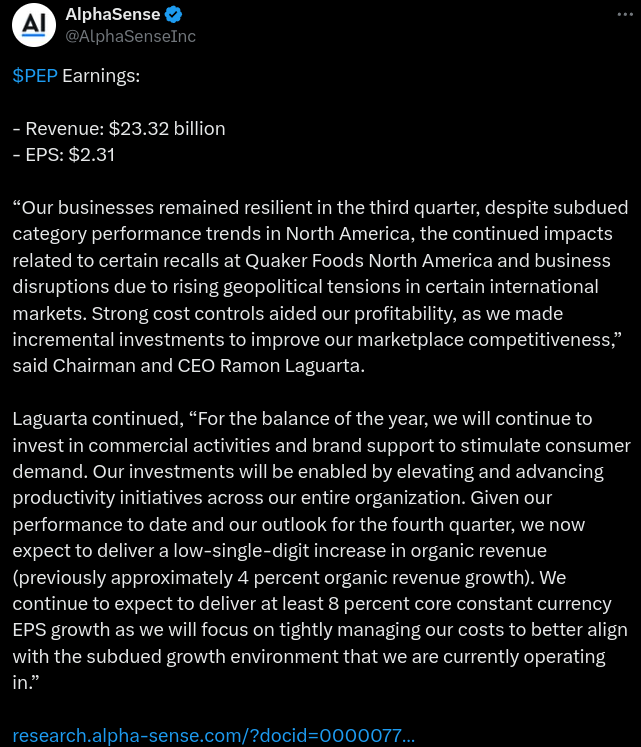
Pepsi’s CEO stated that although the North American markets were weak and Quaker Foods recalls and geopolitical tensions disrupted operations, the company’s business remained strong in the third quarter. Good cost management helped improve profitability, and Pepsi made additional investments to strengthen its competitiveness.

The CEO also said that during the remainder of the year, the company plans to continue investing in marketing and brand support to increase general consumer demand.

The company now expects modest organic revenue growth and at least 8 percent growth in earnings per share, focusing on tight cost management.

https://x.com/AlphaSenseInc/status/1843612342111568244/photo/1

image

Image

4 Likes

The tweet below discusses the decline in sales volumes over the longer term, yet price increases have kept sales growing. On the other hand, what happens if sales volumes fall—surely prices can’t be raised at the current rate indefinitely, or can they? :slight_smile:

https://x.com/finchat_io/status/1845421807421043195

image

4 Likes

That really is quite a clickbait tweet. Pepsi is practically a mini ETF in terms of diversification, and price hikes have likely occurred with every manufacturer in the food sector.

3 Likes

@Sijoittaja-alokas I added the word ”no” to the thread name, which I assumed was missing. Change it back if I assumed incorrectly :blush:

1 Like

Here are some of Pekka’s thoughts on Pepsi when he was asked about this company. :slight_smile:

https://x.com/vontuchman/status/1858125388213280997
image
image

6 Likes

@Heikki_Keskivali and the Pepsi tweet :slight_smile:

What thoughts does this tweet evoke in you?

https://x.com/hkeskiva/status/1858610167689904335
image
image
image

2 Likes

The snack side is less familiar to me, especially the US market, so my impression is that the brands are weaker and the market is more fragmented than in cola drinks, where two giants dominate and the rest are “budget brands”.

Different types of snackable food substitutes are unlikely to decrease, but the products and, along with them, the popular brands are in constant flux. A few years ago in Finland, the lobbies of shopping malls were flooded with the scent of Arnold’s donuts, and nowadays they have Jungle Juice Bars; the change is quite significant.

As for the RFK Jr selection, apparently PEP → KO + MCD would be the winning move :grinning:

image
Even during the previous term, Trump posed with McDonald’s food at least a couple of times.
image

2 Likes

On the contrary, snacks are overwhelmingly dominated by Pepsi (Lay’s). Share of mind is strong in this category.

image

4 Likes

Pepsi has become an allocation stock, someone like me eagerly watches Pepsi, how it gets too cheap and thinks ‘it can’t drop any further’. :cowboy_hat_face:

Pepsi might be a bit interesting though… :thinking: :point_down:

https://x.com/DividendDude_X/status/1868757057371095054
image
image

3 Likes

Here’s a pretty good tweet thread comparing Pepsi and Coca-Cola. It includes good graphs, etc. :slight_smile:

https://x.com/Ranked90/status/1865836798611730467
image

Rest of the tweet thread

image
image
image
image
image
image
image
image
image
image
image
image
image
image
image
image
image
image
image

4 Likes

https://people.com/subway-will-switch-to-pepsi-soda-products-in-2025-8612873

Subway is switching to Pepsi products after more than 20 years of selling Coca-Cola. According to the news, this is only for the US market, but as an owner of PepsiCo, I naturally hoped that it would later be worldwide, although I can’t say whether Subway’s country-specific organizations have a say in this.

1 Like

At least from Subway in Finland, you can get Pepsi. So, it seems that the choice between Pepsi and Coke is country-specific.

2 Likes