Regarding the sum-of-the-parts calculation in Panostaja’s latest analysis. I don’t understand it, so my username alone obliges me to ask about its logic. So
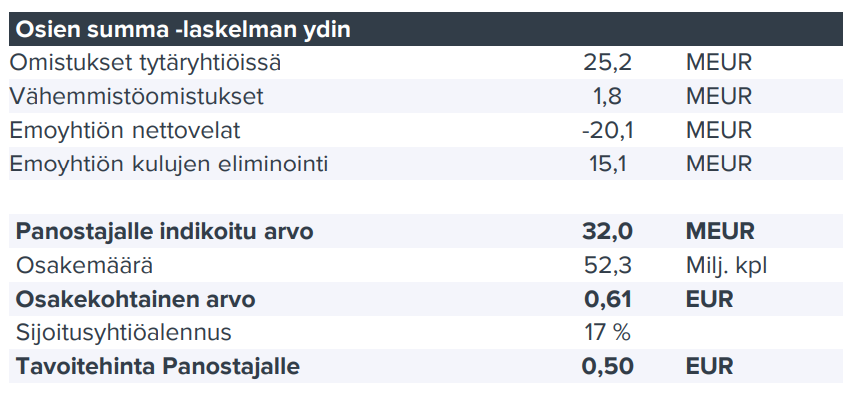
You mention several times that the parent company has a significant net cash position of 20 MEUR. Why is this net cash shown with a minus sign in the sum-of-the-parts calculation? Additionally, why aren’t the parent company’s costs negative? By “donkey logic,” these should be exactly the other way around. However, the final result (indicated value) suggests that +20.1 MEUR and -15.1 MEUR were factored into the calculation. Could you break this down for me?
Hi! This presentation style is easily misleading, so it’s another good question to clarify.
Essentially, the calculation subtracts the parent company’s net debt. However, since the parent company has a net cash position, the net debt is approximately -20 MEUR. When this is subtracted, the sign naturally becomes positive, even though we are initially subtracting net debt. Alternatively, one could add the net cash in this case, which would make it a clearer addition, but this has simply been the prevailing presentation style for a long time.
The elimination of parent company costs follows the same logic and is always negative. So the calculation works exactly as you think, but it’s not calculated as a straightforward addition; instead, the formulas are + + - -.
I’m not sure if this clarified things, but in practice, the calculation works exactly as you thought
I’ve actually been waiting for a long time for Grano to start streamlining its operations so that the portfolio company can eventually be cashed out. The weak economic cycle just adds its own spice to the mix. I would have preferred to see those efficiency measures during a better cycle… but better late than…
Grano starts change negotiations again. A month ago, Panostaja’s CEO implied in an interview that, in addition to the personnel reductions in October, the layoff options negotiated in the autumn would be sufficient in their flexibility. Three months after the previous negotiations ended, new ones are now being started. It is difficult/impossible to interpret this news as positive in light of Grano’s demand outlook. Not to mention employee job satisfaction. This is quite a dismal investment company altogether.
“If the plans are implemented, they could lead to the termination of employment, changes in employment terms, or conversion to part-time work for an estimated maximum of 84 people.”
You couldn’t even call the previous rounds proper change negotiations when looking at the headcount and the market cycle. I personally see this reaction as positive. Better this than to just sit idly by.
Grano has about 870 people, so a headcount reduction of this scale will already start to show somewhere.
It’s been the same story in the rest of the printing industry. At PunaMusta etc.
Stock exchange release 10.10.2023
“As a result of the negotiations and the reorganization of operations, a total of 43 positions will end. The company will terminate 27 employees, and there are 16 job description changes under threat of redundancy. In addition, the company plans to implement fixed-term layoffs for personnel, with durations varying from two weeks to a maximum of three months. The redundancies are intended to be implemented as soon as possible, and the layoffs as soon as possible and by 1 May 2024 at the latest.”
So in September-October, the view was that the aforementioned redundancies and the layoffs to be started as soon as possible were sufficient. Now the company has stated that it’s not enough after all, and the recently decided 1.2 MEUR permanent cost savings are insufficient. One could certainly spin this as positive as well Personally, I interpret it as Grano being adrift, demand outlooks being even weaker than in the autumn, and there still being too many fixed costs in the current situation. This kind of development is worrying for getting Grano sold. As noted in Inderes’ analyses, 50% of the business is in the declining printing industry anyway. And these change negotiations will AGAIN result in extra cash-flow-impacting expense entries. So it ruins either the Q1 or Q2 result depending on which one it’s recorded to.
It’s clear that sales are stalling, but the positive thing is that they are reacting quickly rather than waiting for heavy losses. Decisions need to be made during a downturn, and this is the right call.
If a company is just hovering around a few million in operating profit year after year, you’d think they would have streamlined operations long ago given that level of revenue. There should be a “results or you’re out” mentality.
How is a printing press worker supposed to generate results if the order books aren’t filling up? It’s obviously clear that declining business often leads to layoffs. Whether that counts as any kind of operational efficiency or rather just downsizing is certainly open to debate.
Juha has written comments regarding Grano’s change negotiations.
Panostaja’s clearly largest investment, Grano, is starting change negotiations targeting the entire personnel of the Grano Group, excluding the subsidiary Grano Diesel. The planned structural and organizational changes, along with other cost-saving measures, are estimated to achieve annual cost savings of approximately EUR 4.5 million, which are expected to be fully realized in the 2025 financial year. The need for new cost savings is not surprising, but the scale is surprisingly large at first glance. This may indicate that the market situation has deteriorated further and Grano’s revenue is under greater pressure than anticipated.
The use of Hygga Flow is expanding to a new county in Sweden. Now that news about these new locations is coming in at a good pace, it would be interesting to know the revenue Hygga generates from them. Perhaps the software will finally gain a sufficient customer base and make operations steadily profitable?
Oscar Software gets a new CEO from its competitor, Lemonsoft.
Thanks for bringing this up, I haven’t paid much attention to Panostaja lately, so I had to review the materials a bit.
This is indeed a wild card, and at least in the last quarter, CoreHW’s performance based on Juha’s comments (Premium report) leaves a lot to be desired.
"CoreHW’s revenue in Q4 was only EUR 1.5 million, which was the biggest disappointment in the report (forecast EUR 2.6 million as in Q4’22). Revenue fell sharply (approx. 44%) from the comparison period, but also weakened from the levels of previous quarters. With the cost structure being largely fixed, the Q4 operating result was EUR -0.6 million, while our forecast was EUR +0.1 million (Q4’22: EUR 0.5 million). According to the company, the background to the low revenue and consequent decline in profitability is the clearly slower-than-planned completion of customer projects that were more challenging than expected, as well as cost-intensive investments in the product business’s commercial organization and R&D. We had tried to take the latter into account in our forecast, but the project issues came as a surprise to us. Generally, CoreHW has succeeded well in its projects when they have had them.
The company has initiated measures to rectify the situation, and results are expected from the first quarter of the current financial year. Nevertheless, in our view, uncertainty regarding development has clearly increased, and our forecasts were lowered.
We received very little new information about CoreHW’s budding product business. According to the company, based on customer feedback, the technology’s performance is excellent, which is naturally positive. According to the company, there are several potential customer accounts, but the company still emphasized that ramping up product sales requires long-term work and also depends on the R&D cycles and commercialization of customers’ end products. Because of this, visibility is limited even for the company itself. However, the first customer accounts have progressed in their R&D, and the gradual increase in order sizes anticipates a shift to production in the first half of the next financial year. The company is still aiming for significant growth in product business revenue in the 2024 financial year, and ‘significant’ likely means a million euros in a relatively short timeframe, even on CoreHW’s scale. In our own forecasts, we expect a product revenue of EUR 0.5 million for the financial year, weighted towards the second half. A significant earnings contribution from products should not be expected yet in the 2024 financial year."
That’s why it’s a wild card, as there’s no visibility into that, but in Tommila’s interviews, there is talk of major international corporations as potential customers for CoreHw’s indoor positioning and revenue in the millions. They are unlikely to be talking just for the sake of it, and this is supported by Business Finland’s involvement as well as their own investments, into which an additional 4 million is being injected. If there were no potential here, it’s unlikely such sums would be used for R&D/commercialization. That money has to be recouped through sales to the bottom line, which implies several millions in revenue to actually get something to show on the bottom line.
Of course, one can always paint a rosy picture, but commercialization has indeed begun here, and they’re unlikely to start that without the products having been road-tested with several customers. And I don’t believe a firm of this size would pour millions into something whose potential hasn’t been thoroughly vetted. Well, we’ll see. “If” is always “if,” but usually, those small growth outfits with many “ifs” are priced accordingly. But at the point if and when that first major customer actually places an order, the price for the whole of Panostaja could be something else entirely.
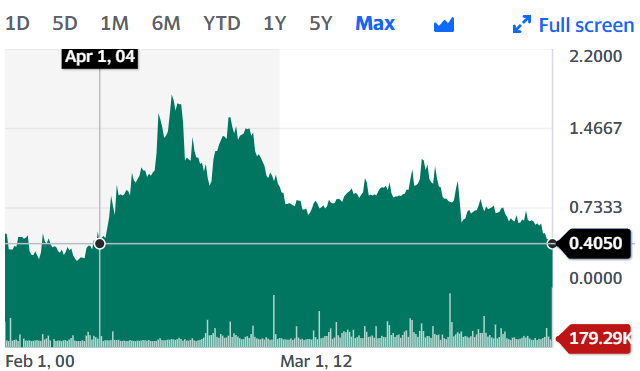
Usually, share price movements are not a matter for company threads, but in Panostaja’s unenthusiastic (=consistent with the share price) company thread, I thought I’d showcase the situation anyway (chart is from Yahoo Finance). I recently wrote in the Coffee Room about how, over a 15-year period, Panostaja has provided a negative nominal total return, including dividends. I didn’t even calculate the real return.
Since an investment company’s fundamentals and share price follow each other in the long run, it is interesting to note that Panostaja was last available at this price about 20 years ago.
I personally invested in Panostaja at the beginning of this year, which is why I’m somewhat interested in the company. On the other hand, perhaps I should have looked more closely at the management team, the board, and performance in accordance with W. Buffett’s teachings before investing.
The long-term total return is certainly anemic. There’s no other way to put it. Generally, increasing shareholder value is in everyone’s best interest when it comes to money and ownership.
I’ve owned the stock on and off over the past 10 years, and now I’m considering getting back in the game. Things could hardly get much worse for the share price, considering the cash position is solid and there’s no major crisis—at least not publicly.
Panostaja has the cash and the organization; I would assume it would be possible to make some strategic moves.
Is there a lack of vision, despite having the funds and the opportunity? It is still a buyer’s market for M&A if one can look past the current economic cycles.
Perhaps everything is currently characterized by a sort of stagnation. The owners, the board, and the executive management really should address this. Or bring some new perspectives to the table. Nothing ventured, nothing gained. Some risks should be taken.
It’s not really my business, but there are numerous companies on the market looking for new owners. I would assume new moves could be made. Or at least I hope so, since I’m about to jump back on board.
I wonder if anyone has ever speculated about who might buy Grano. That would be quite a deal if some sort of merger between a couple of companies were to happen. A quick look at the field brings a few players to mind. PunaMusta, perhaps as a larger one, or am I completely off the mark regarding the business of the aforementioned companies?
Panostaja unfortunately has a recent history of significant acquisitions that destroyed shareholder value: Despite restructuring efforts, the subsidiary Takoma was filed for bankruptcy in 2017. The staffing company Carrot was under Panostaja’s majority ownership from 2018–2021, and in that short time, Carrot went into a tailspin and quickly ended up being sold at a loss to Carrot’s individual owners.
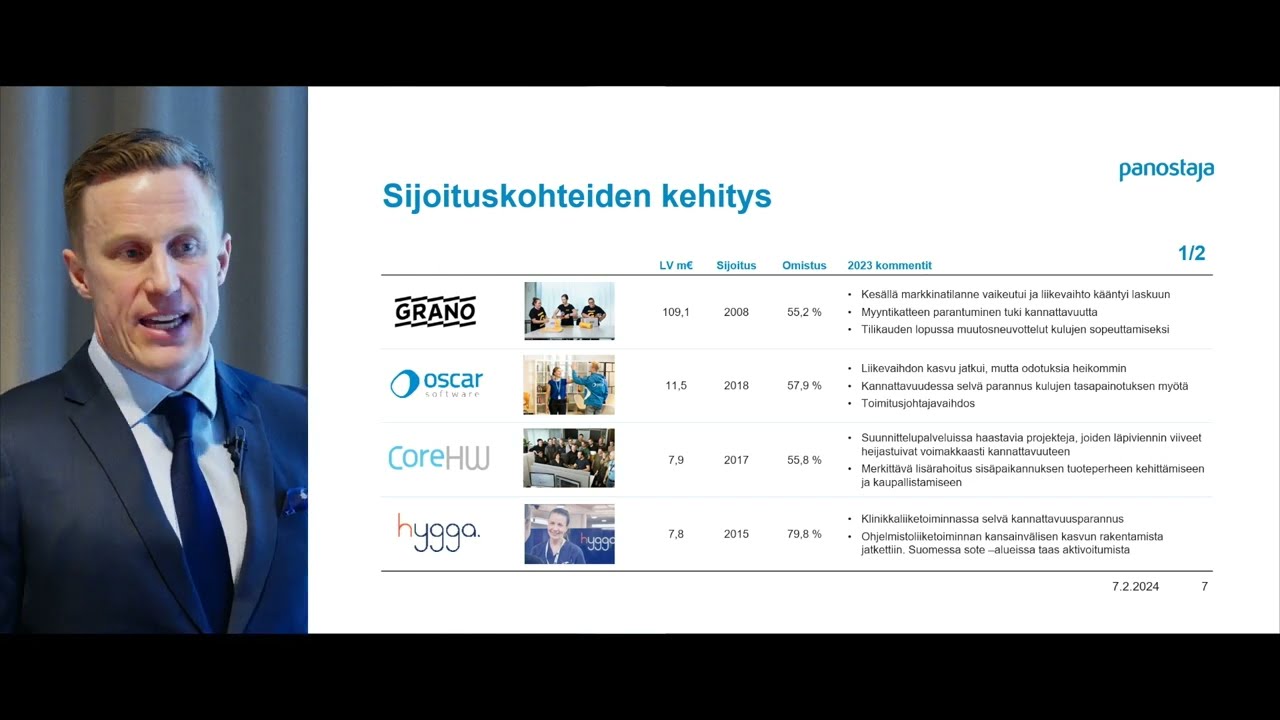
To an outsider, it looks like Panostaja has been somewhat paralyzed regarding new acquisitions because they simply cannot afford any more failures. The number of holdings (Grano, Oscar, Corehw, Hygga, and Gugguu) is already below the target number of companies in the portfolio, and the relative weighting of the investments is totally disproportionate. At the same time, Grano is once again undergoing change negotiations (muutosneuvottelut).
Panostaja’s portfolio has shrunk considerably over the last 10 years. The largest holding operates in the digital printing industry, which is certainly not a growth industry of the future. If the next acquisition is not a significant success, Panostaja’s room for maneuver will begin to run out. While we wait for something to happen, group expenses keep rolling in and continuously destroy shareholder value. It is not an easy situation, but then again, the share price is at a level reflecting disappointment and disbelief at 0.3980 euros.
Occasionally, the thought occurs that an investment company worth about 20 million euros no longer belongs on the stock exchange. At the very least, being listed hasn’t provided any substantial benefit in terms of shareholder value.
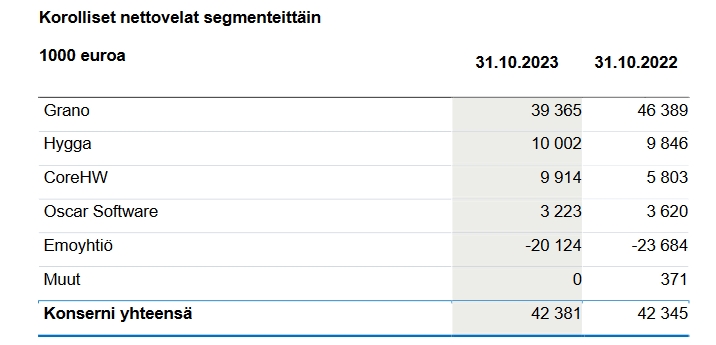
Panostaja’s net cash (which I believe Critter1 was referring to) is approximately EUR 20 million.
From Inderes’s analysis on December 18, 2023:
“The parent company’s balance sheet remains strong and net cash is a significant EUR 20.1 million, including interest-bearing receivables, which are certainly not directly liquid assets.”

 Personally, I interpret it as Grano being adrift, demand outlooks being even weaker than in the autumn, and there still being too many fixed costs in the current situation. This kind of development is worrying for getting Grano sold. As noted in Inderes’ analyses, 50% of the business is in the declining printing industry anyway. And these change negotiations will AGAIN result in extra cash-flow-impacting expense entries. So it ruins either the Q1 or Q2 result depending on which one it’s recorded to.