Thanks for the latest inderesPod, it was a really interesting session! It was especially comforting to notice that even a professional can be a few years late in opening a portfolio I made the same mistake with my firstborn; when the second one was born, the portfolio was already open before the christening (opening was successful in Nordnet even before the name was confirmed). My bad conscience has been appeased by extra bonuses put into the firstborn’s account, as otherwise we operate on an equal sum principle for fairness.
Quite bold choices were found in the portfolio opened for @Mikael_Rautanen’s child in the pod! In my children’s portfolios, I have tried to stick to companies that have preferably been profitable for decades and have stable outlooks. So far, direct stock selections have been made for about 5 companies, and additionally, monthly savings in index investments for the US market (Handelsbanken USA index fund) and Superrahasto Suomi.
For the sense of ownership and interest in companies, I consider it important to include direct stocks, even if they perform worse than the index. My 3-year-old son is interested in vehicles, so his largest (and at the same time best-performing) holding is naturally Ponsse My daughter, on the other hand, attended physics lessons when she was little, so her first holding was appropriately Vaisala.
It would be interesting to hear how other forum members save for their children? Has the child’s portfolio performed better or worse than your own? For me, the time period for comparison is still too short, but so far, in the last year’s returns, the children are ahead.
Hey. This is a great topic opener. And thanks to Mikael and Juha for an exemplary podcast.
Currently, we have one daughter, a little over 2 years old. Because of this, the review period is also short; the girl’s portfolio has been active for almost exactly two years…
The plan is to save monthly into funds. In addition, an initial larger investment was made at the beginning to allow for direct stock purchases.
The current weighting is as follows:
HOIVA 38%
REMEDY 51%
Superfund Finland 7.4%
Superfund Sweden 1.7%
(Previously, there was also Nokia, from which I managed to exit with a couple of hundred euros profit at a price of 5.3€. Remedy replaced it.)
From October onwards, the plan is to double the monthly savings amount and subsequently allocate it evenly across all four superfunds.
The development has been better than dad’s portfolio, at least I’m really happy about that
I bought Hoivatilat for my own daughter, no others yet this was a good opening! I try to find companies whose potential is still hidden but can grow significantly while a 2-year-old becomes an adult. Qt is another one I’ve been thinking about. What if in 16 years, that software was found in every flying car
It seems many forget that potential dividend income currently affects, for example, the amount of student aid. So, if one buys shares directly for a child (vs. growth funds), this is worth remembering.
It will be interesting to see how the upcoming share savings account (osakesäästötili) affects this; that is, whether Kela (Social Insurance Institution of Finland) will consider dividends accumulated there for student aid in the future. I haven’t found any information on this anywhere, has this issue been discussed?
Good point. As for my own child, I’d say that probably, for example, Remedy and Hoiva have been bought “a long time ago,” before I hand over the portfolio to the child in 16 years. If a miracle happens and they haven’t been bought out, then those will be converted into fund investments in 15 minutes before the studies begin. It’s also essential to consider that it’s difficult for me to know what kind of KELA (Social Insurance Institution of Finland) regulations will be in force in 16 years.
The oldest grandchild coming of age next year will get access to a portfolio, likely worth around €6-7000.
Annually, I buy an additional couple of hundred euros worth of 2-3 selected stock series for each grandchild. Penny stocks and tech leaders. Some have seen hundreds of percent increases.
The older children are already interested in investing themselves and follow the stocks in their portfolios, we have some fun discussions!
Thanks for the feedback! One noteworthy theme I’ve been considering is to compile a portfolio solely of cleantech companies. Since we’re saving for future generations, and for them, a habitable planet in their adulthood is likely more important than monetary returns. Unfortunately, the selection around my core expertise/knowledge is quite limited, as I don’t want to pick companies from abroad that I’m unfamiliar with. Of course, technology will solve these problems, and also Loudspring is… under consideration…
I’m subscribing to your content and buying Remedy for my daughter too. It’s a nice long-term investment that’s fun to be a part of. I also have it in my own portfolio. It’s such a reputable name in the industry that even small bumps won’t bring it down.
I have also read about the current study grant problem, which directs investments to funds. However, direct stock investments make investing so much more interesting that I am willing to take this “risk.”
I haven’t seen any mention yet of whether it will be possible to open an investment savings account for a child at all? In the very long run, the deferral of dividend taxes alone will have a significant impact on the effect of compounding, so I hope the account will be made available.
I like these Hoivatilat investments for a child. In the best case, the child can use “their own” property in kindergarten
@Mikael_Rautanen, would it be more effective from that perspective to align your own portfolio with this ideology? If/when it is significantly larger than the child’s portfolio, the positive environmental impact would also be more significant. For my part, I will at least for now avoid Loudspring for children’s portfolios, because my own investment in that company in the summer of 2017 is one of the main reasons why I have been behind on the children’s portfolio for the past year The investment decision at that time was almost purely ideological, as independent valuation was almost impossible. In this regard, it was nice to try the calculator on Loudspring’s website to see how many resources my ownership had saved: the impact is surprisingly large based on that. However, I exited with a loss of about 65% when my faith ran out: in the future, I would rather directly support, for example, some nature conservation organization
What do you think about buying stocks like Facebook, Google, and Amazon for children? These companies are likely to be a very integral part of people’s lives in the future as well. Safer than small Finnish companies? Without underestimating Finland’s home-field advantages, of course.
I asked Kela (student financial aid) about this (dividend income - student financial aid), and the lady said that according to today’s rules, if the income is less than 11k/9 months, it does not affect the receipt of student financial aid in any way.
Good thread, and an interesting podcast episode. I’ve also been picking stocks for my 2-year-old, almost since birth. Currently, my son’s portfolio includes Titanium, Harvia, and Efecte. It has a mix of stable dividend companies and riskier growth companies. Intended for long-term holding. The portfolio’s size is now roughly the price of an older car, a few thousand. Hopefully, investing will continue even when he’s an adult, and he won’t immediately buy some junk flying car with all the money
I’ve primarily considered investing dividends into index funds. Currently, a couple of years’ worth of dividends are in cash; I haven’t invested anything into funds yet. But the intention is to put them to grow wisely, of course. Continuing stock picking might also be possible when attractive opportunities arise.
The idea is to grow my son’s wealth a bit and simultaneously demonstrate concretely that investing and saving are wise, but this whole thing is also interesting in itself—how big the portfolio will be in about twenty years Sometimes unexpected situations can arise in life when you have to sell stocks due to financial need, and there’s always a risk of selling at the wrong time. This problem doesn’t exist in a child’s portfolio; those stocks stay there. They are no longer my money but the child’s. That’s why it’s nice to see how the sum has been able to grow peacefully year after year.
Small edit; investing for the little one started almost immediately with fund investing. After a few years, I decided that stock picking was our thing, so I liquidated the funds and bought stocks. Currently, I am satisfied with the portfolio’s content.
I’ll continue. It’s great to hear that others are also taking care of their children’s investments. I encourage other parents to do this too, and it doesn’t matter if the child is already older. My parents didn’t buy me (or many others, I’m sure) shares when I was a minor; I only started investing now, in my early twenties. In this matter, I intend to do things differently for my child. I’ve tried to explain this investing thing to my folks, but yeah, I don’t know if they understand.
I like the allocation in my son’s portfolio because it has a mix of stable dividend companies and growth-oriented firms. I got some “encouragement” while listening to this podcast regarding things that had been on my mind, especially diversification and taking risks. Indeed, two or three stocks can be enough if the time horizon is a decade or two. I also like having some safer companies in the portfolio, whose dividends can always be reinvested. But there are as many strategies as there are investors. As long as the child’s money is “somewhere” producing returns and you sleep well at night, that’s already pretty good.
Yes, the ideology of my own portfolio is also gradually shifting in that direction, but somehow investing for my own child made the matter much more concrete. Of course, it requires a bit of mental struggle to decide how much you emphasize the impact of a company’s business on society in your thinking and how much you are just seeking absolute returns. Perhaps the most important thing is to realize that the world’s biggest problems are also the world’s biggest business opportunities for good companies. So, these things are by no means mutually exclusive. And I don’t demand that a company has a direct positive impact. For example, Nokia builds global infrastructure that enables innovation, which in turn solves the world’s biggest problems.
“When listening to the episode about investing for a child, it occurred to me that one influential factor is the 20,000€ limit for guardianship. It significantly affects investment activities and the child’s finances once you have to justify all actions and ask for permissions.”
I hadn’t considered this, is it really that bureaucratic?
That kind of system is regulated to protect a child’s property. Otherwise, parents could easily use the property a child receives to cover expenses for the child and the family home. The problem is whether we want to protect a child’s property from exploitative parents or enable stock trading in a child’s name.
It’s perfectly fine to save for a child through indices, as the difference to stock investments in such a case is probably quite marginal. If, on the other hand, one wants to engage in active stock trading for the child’s benefit and expects to get good returns this way, then one can easily set up an investment company and have the child become a shareholder in it.
I had a strategy for this, where I bought a few thousand euros worth of Talenom shares for my daughters at 12 eur/share. And I think it’s 500 eur in Verkkokauppa.com. My daughter is 2.5 years old. So her “driving license money” is invested now. Verkkis is weighing down the returns a bit at the moment, bought at 5.50.
 I made the same mistake with my firstborn; when the second one was born, the portfolio was already open before the christening (opening was successful in Nordnet even before the name was confirmed). My bad conscience has been appeased by extra bonuses put into the firstborn’s account, as otherwise we operate on an equal sum principle for fairness.
 My daughter, on the other hand, attended physics lessons when she was little, so her first holding was appropriately Vaisala.
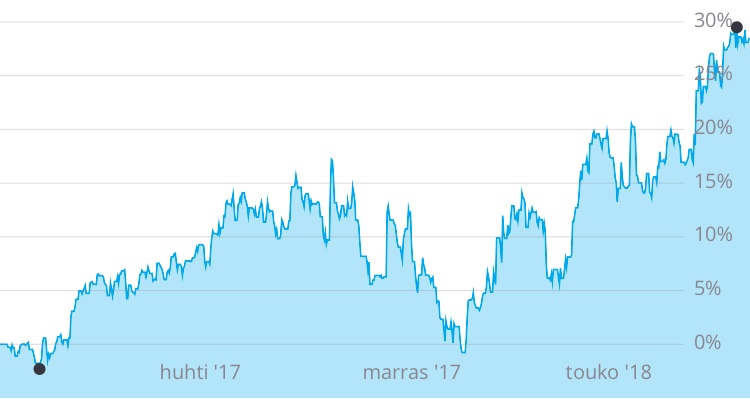
 this was a good opening! I try to find companies whose potential is still hidden but can grow significantly while a 2-year-old becomes an adult. Qt is another one I’ve been thinking about. What if in 16 years, that software was found in every flying car

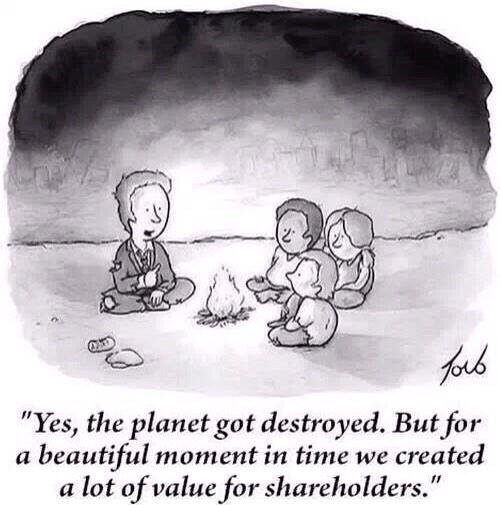

 The investment decision at that time was almost purely ideological, as independent valuation was almost impossible. In this regard, it was nice to try the calculator on Loudspring’s website to see how many resources my ownership had saved: the impact is surprisingly large based on that. However, I exited with a loss of about 65% when my faith ran out: in the future, I would rather directly support, for example, some nature conservation organization
