Oma Säästöpankki

Here’s a new and fresh perspective regarding money laundering. I haven’t gone through all the previous posts here, so if there’s been discussion on the topic before, I didn’t notice them:

Excerpt: 4.3 What does this mean?

FIN-FSA’s observations describe a bank that meets the criteria for a structure enabling money laundering:

✓ Weak customer due diligence
✓ Ultimate beneficial owners unidentified
✓ Origin of funds undetermined

This does not prove that money laundering has occurred. It proves that the structure would not have prevented it.

An article that asks good questions.

5 Likes

Ilkka-Pohjalainen reported that three former board members will be charged with insider trading.

8 Likes

Three former OmaSp board members to be charged | Ilkka-Pohjalainen

There’s the link, probably a paywall at some point. I’ll quote the names from the article:

The accused are Aila Hemminki, Jyrki Mäkynen, and Jaana Sandström.

The prosecutor also made decisions not to prosecute at the same time. Heli Korpinen, Jarmo Salmi, and Kari Mononen were cleared of suspicion.

3 Likes

It’s again now, regarding the individuals in question, that they are being prosecuted over “coins”…

From memory, the deals have been small, especially when compared to the millions with which the Pasis have played “roulette” in the house in question. Liiri’s actions would also be interesting; he has, however, known quite a lot…

4 Likes

The old wisdoms and facts from the banking sector have always held true. It is regrettable that Omasp’s board failed to grasp this, instead allowing management free rein to boast about their success and their customer-centric, effective operating model, which consequently attracted all high-risk customers. In its ignorance, the administration also handsomely rewarded those “charlatans.” Typical of savings banks, Omasäästöpankki has also suffered from an amateurish and seemingly ignorant administration. Moreover, the foundations, as owners, have appointed pleasant amateurs to remunerated board positions, thus contributing to the genesis of these problems. The only “professionals” were in management, but even they operated in the wrong way, as has been demonstrated.

15 Likes

The annual reports of the five largest owner foundations of Oma SP have now been unearthed, revealing that the foundations had agreed among themselves on a 10 million euro protection commitment for the bank’s board.

The full article, with the original foundation annual reports available for download at the end:

Quoting from the article: ”In the 2024 financial statements of three foundations, the protection commitment is reported as an off-balance sheet liability. The financial statement of the South Karelia Savings Bank Foundation (Etelä-Karjalan Säästöpankkisäätiö) states:

"A commitment given by the five largest owner foundations to the members of the board of Oma Säästöpankki Oyj, the purpose of which is to expand the management’s liability insurance and to commit the board members. The commitment is not joint and several, and the amount presented here is the maximum amount of the South Karelia Savings Bank Foundation sr’s liability."

13 Likes

Quite a lot seems to be turning up from that nest. I wonder if the foundations

have acted in accordance with their rules and the Foundations Act when they granted the bank’s board members

massive indemnity agreements. I don’t believe that granting such guarantees falls within the scope of foundation activities, nor is it likely in accordance with the Foundations Act. Guarantees have been granted on behalf of individuals unaffiliated with the foundations. There would be work here for investigative journalism and the authority supervising foundations. I wonder what the stance of the foundations’ auditors has been? Have they stated anything in their audit reports?

Once again, we see how the affairs of “ownerless money” are managed. A few individuals are running a roulette in a state of total ignorance; this has been a perpetual nuisance and problem in savings bank communities, which has led to a poor outcome. The OmaSp structure is a sick system that should be completely dismantled and its operations shut down.

13 Likes

I reviewed all the foundation reports available on the site, and not a single auditor had made any remarks regarding the matter.

Furthermore, it turned out that two different foundations even share the same auditor.

8 Likes

Just guessing how CEO came to the 14% ROE target: “We can’t beat Nordea with 15% ROE achievement (yet), so let’s aim a little lower: 14%.” :slight_smile:

Holding the shares till the price reaches 1.0 P/BV.. then, will make further decisions..

1 Like

It’s important (also for Kasper Mellas) to remember that it is difficult to compare Oma’s ROE and CET1 ratio to those of other banks, since Oma does not use the IRB approach.

If looking at the plain (but telling) equity-to-total liabilities ratio, Oma is at 8% whereas most other banks are around 4%. Oma’s solvency is about twice as high as peers’.

In other words, Oma could operate with a lower CET1 than peers and still be better capitalized.

1 Like

Here are Kassu’s comments on OmaSp’s new strategy and new targets :slight_smile:

Oma Säästöpankki published its updated strategy and financial targets for the period 2026–2029. The new financial targets set by the company are very ambitious relative to our current forecasts and, in order to be achieved, require a strong earnings turnaround and normalization of the risk level. In our view, no significant changes were made to the actual strategy itself.

3 Likes

Nothing is mentioned about loan portfolio growth. Nor about customer base growth. Both are likely on a downward trend. My own estimate, as even loan payout takes two weeks and there is a 3-8-fold verification process for approval.

3 Likes

I don’t know where you calculated these from, but here are the equity ratio figures based on my own calculations at the end of 2024 (equity/total assets):

  • Aktia 5.7 %
  • Ålandsbanken 6.2 %
  • OP Group 11.1 %
  • POP Bank Group 12.1 %
  • S-Bank 7.4 %
  • Savings Bank Group 9.2 %
  • Nordea 5.2 %
  • Average 8.2 %

As for the use of internal models (IRB):

  • Aktia has internal models in use for about 43 % of its exposures (retail customers)
  • OP does not use internal models at all
  • Ålandsbanken has internal models in use for the majority of its exposures
  • POP Bank does not use internal models at all
  • Savings Bank Group does not use internal models at all
  • Nordea uses internal models almost exclusively
  • So, internal models are used by every other one

However, it is quite true that staring solely at CET1 figures does not always tell the whole truth.

4 Likes

Today, even Seiska has picked up on the theme, albeit from a perspective that fits the magazine’s profile:

3 Likes

I have to say that the new strategy is a real disappointment. It is based on an unrealistic pursuit of “sustainable growth” for which there is no supporting evidence. In the background is a long continuum of declining volumes, revenue, customer numbers, and results. All of this is now supposed to turn around as if by magic. The only thing that has been growing is costs, as we well know.

Apparently, due to the pursuit of growth, the planned profit distribution is once again falling far short of the level of banking sector peers.

The weakest valuation multiples among profitable companies on the Helsinki Stock Exchange could be corrected by focusing on cost management and profit distribution. I am particularly surprised by the complete silence regarding share buybacks (at least nothing has caught my eye, correct me if I am wrong). With the P/B ratio being around 0.7—about half the level of Aktia and Nordea and only one-third of Ålandsbanken—buying back and canceling shares would be an effective way to increase shareholder value. It just doesn’t seem to interest the company. In my own assessment, this would be a potential turnaround case; the biggest question mark seems to be the impact of “ownerless money” (isännätön raha), which has been discussed a lot in the forum discussions. The interests of the old boys’ network override the interests of shareholders. Hopefully, I am wrong.

11 Likes

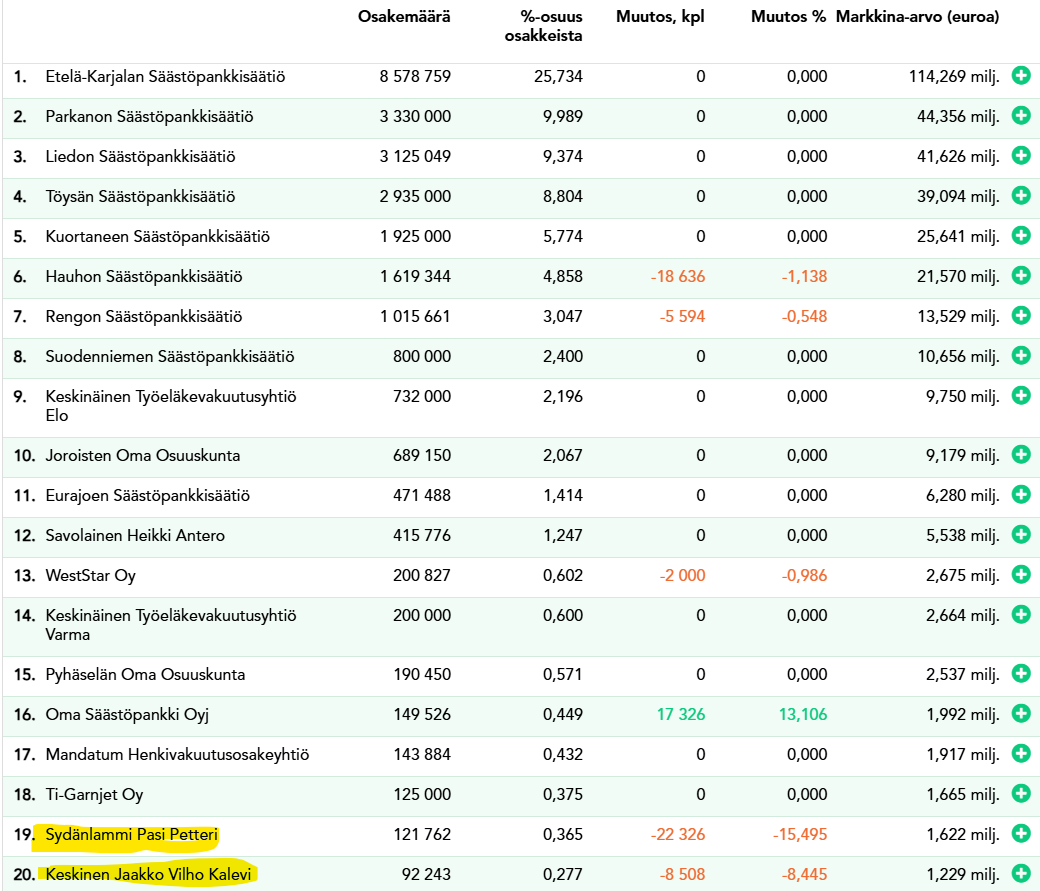
Looking at the largest shareholders, it’s not worth doing buybacks here.
The biggest ones already own this anyway..
Ex-banker and an obvious larger client included in the Top 20.

2 Likes

Jaakko Keskinen is a long-standing, steady major investor who is, of course, also a client or partner of financial institutions—or however you might phrase it.

So, isn’t Keskinen a “business partner” of Oma Savings Bank, meaning more than just a customer…?

Here are Kassu’s pre-comments as OmaSp releases its Q4 results on Thursday :slight_smile:

We expect OmaSp’s result to have declined year-on-year. At this point, the decline in earnings is driven solely by the contraction of net interest income, as profitability in the comparison period already suffered from a clearly increased cost structure. Additionally, our focus is, as usual, on the development of credit losses and the quality of the loan portfolio. Our operational forecasts remain unchanged, but following the strategy update, we have slightly revised our profit distribution forecast upwards.

1 Like

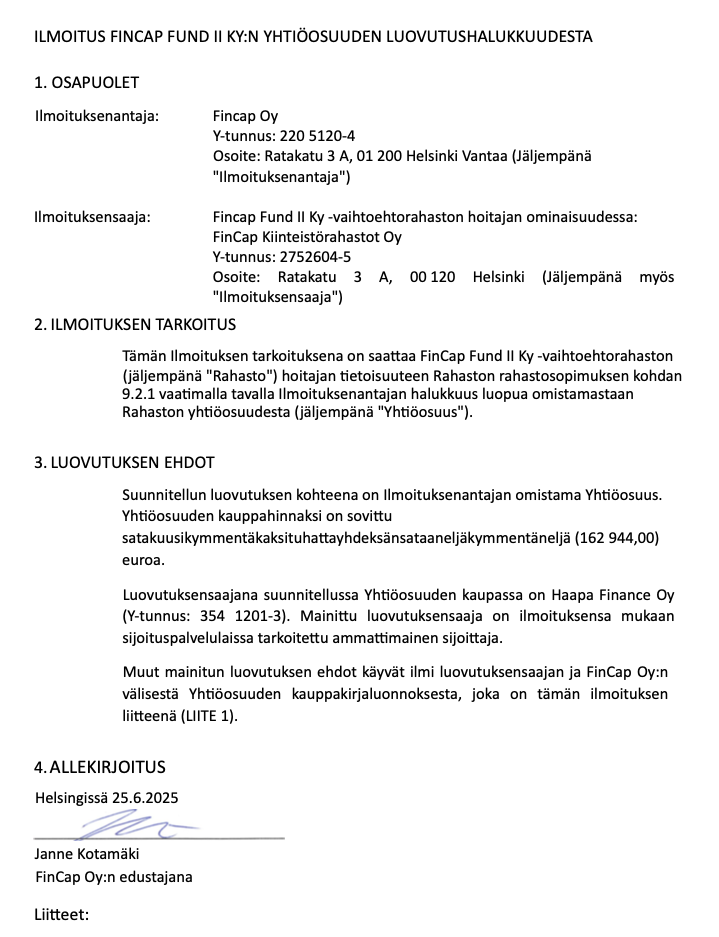
I just had to take a look at how the current Haapa asuntorahasto II Ky (Haapa Real Estate Fund II LP) is doing (and a few other things as well).

First, a little history:

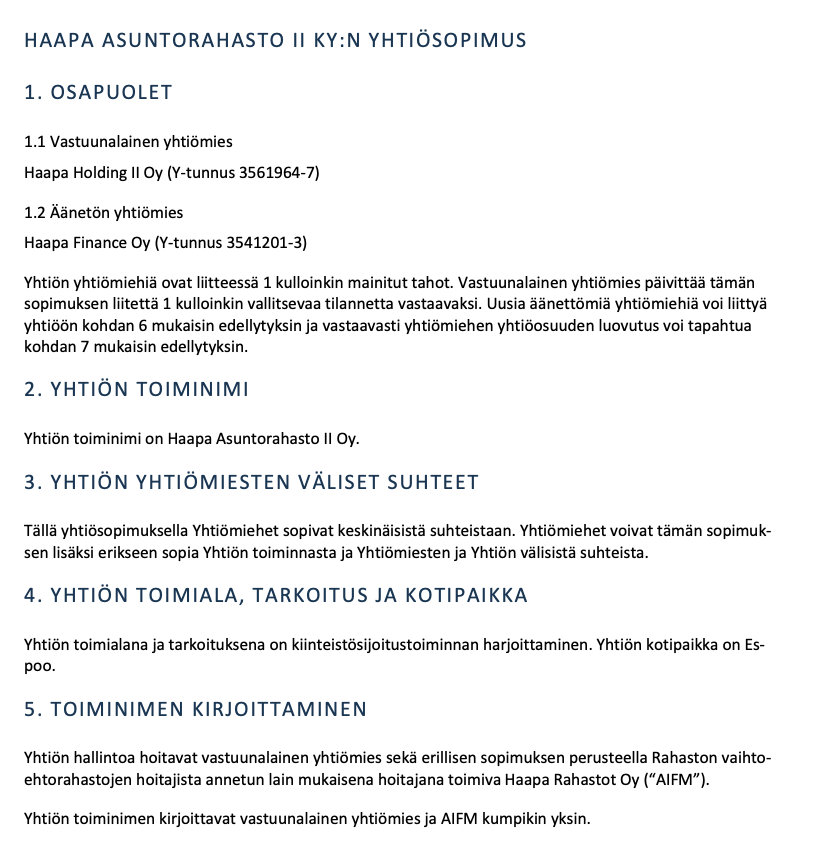
A new partnership agreement was made and signed on September 1, 2025:

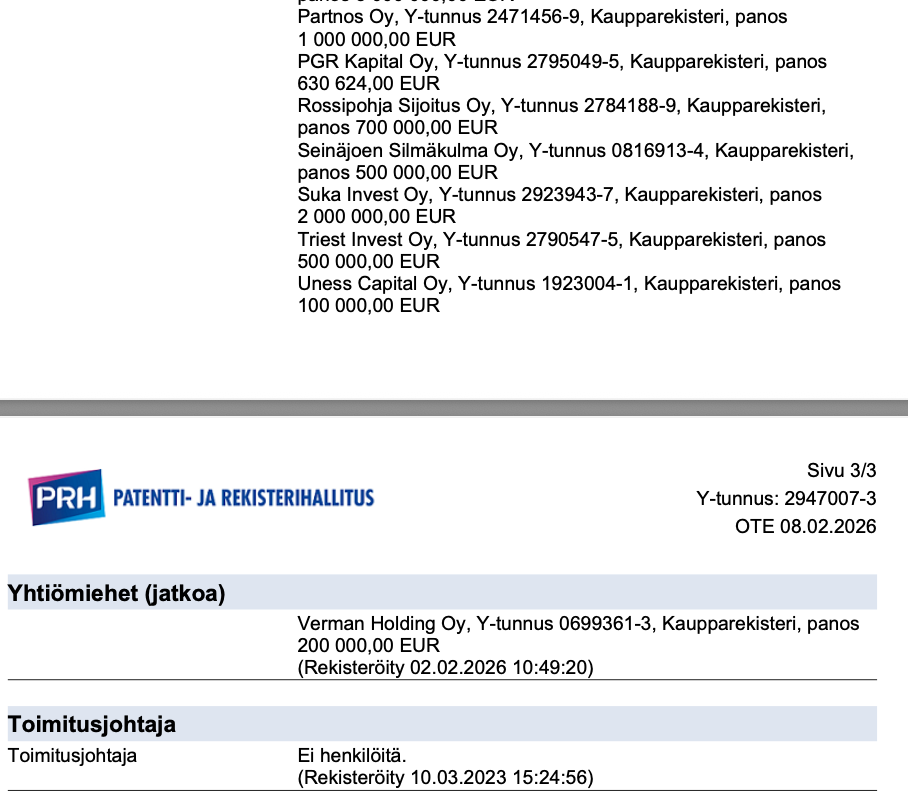
Haapa Holding II Oy manages the affairs, and Juha Kivimäki, formerly of FinCap, also serves as a proxy (prokuristi). A company founded with €0 in equity doesn’t exactly inspire confidence.

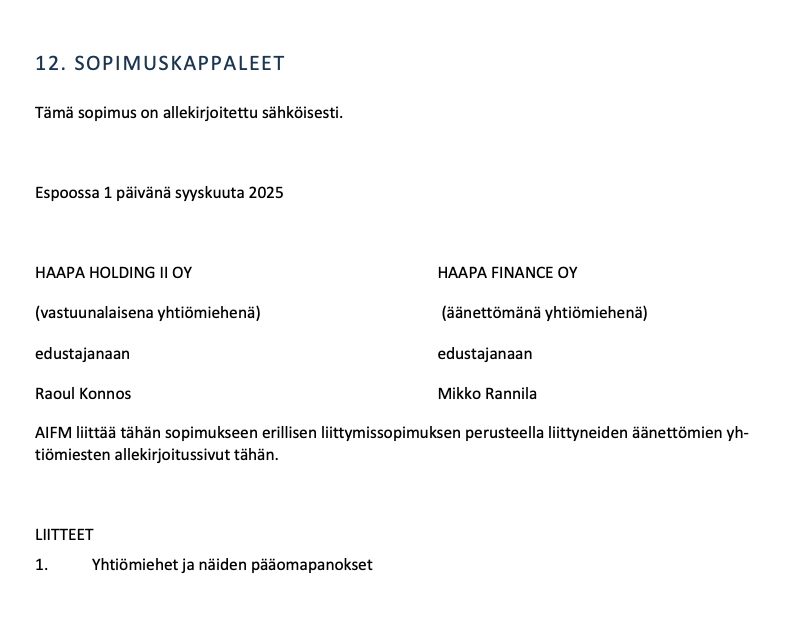
Signatories:

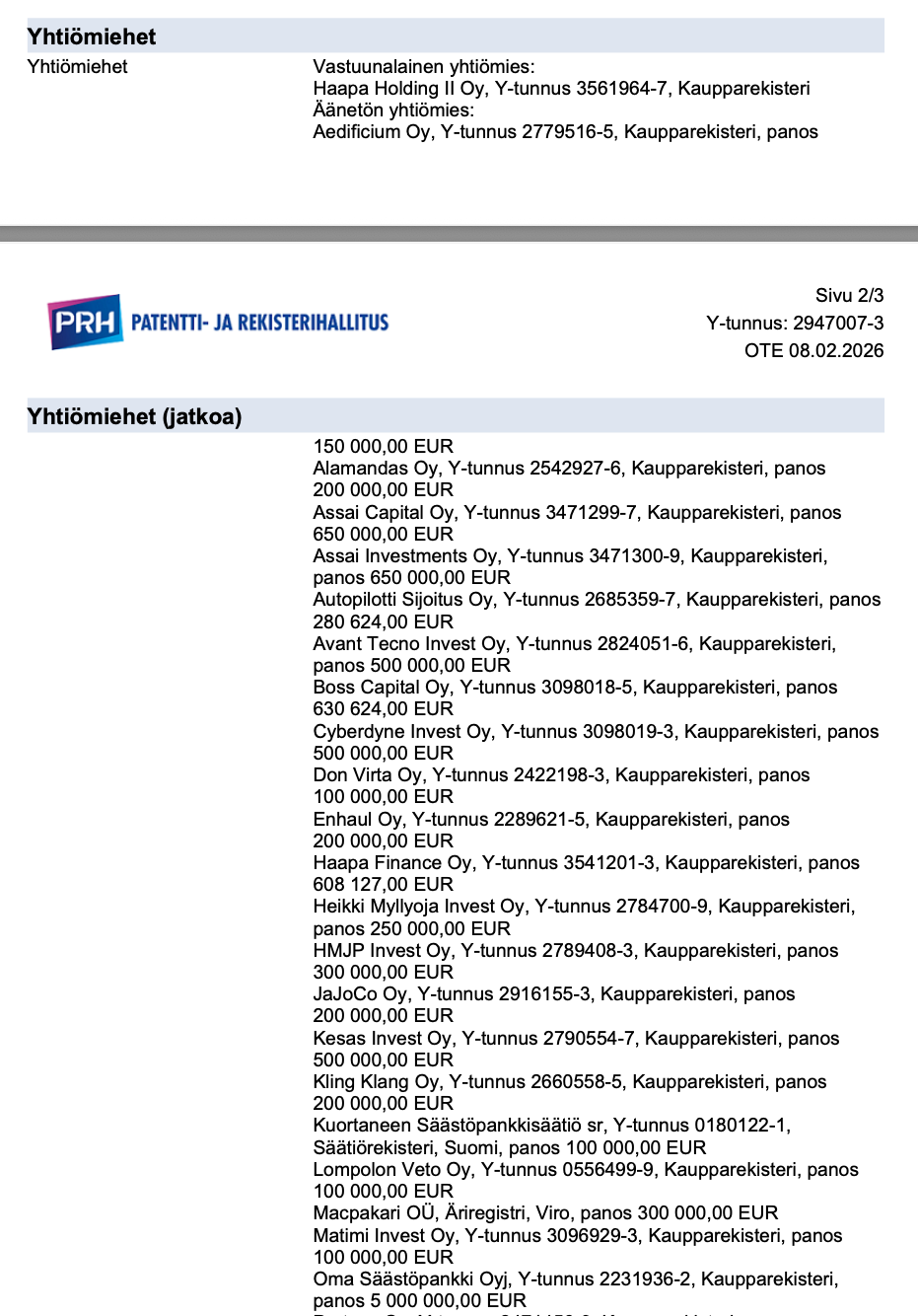
The current partners and capital contributions can be seen in the trade register extract.

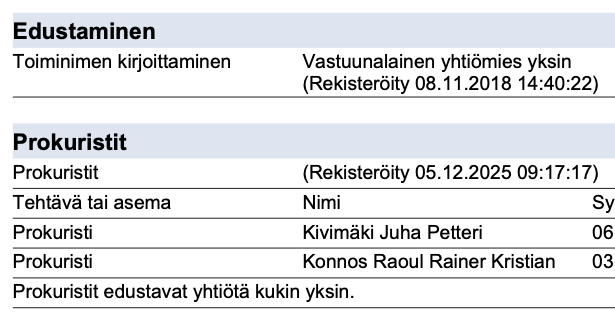
Proxies for Haapa asuntorahasto II Ky:

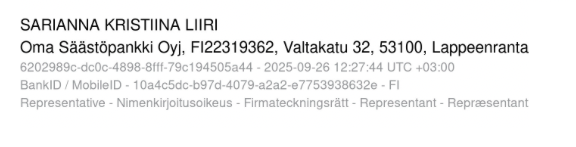
On behalf of Oma Säästöpankki, the new partnership agreement was signed on September 26, 2025:

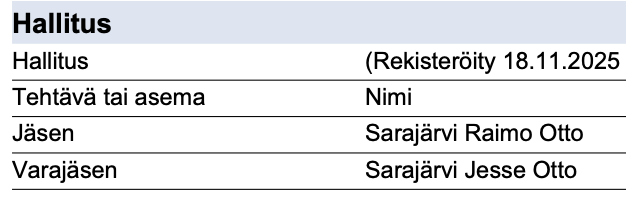
In this context, it is also worth mentioning that other arrangements have been made elsewhere, primarily regarding Kotamäki and Sarajärvi:

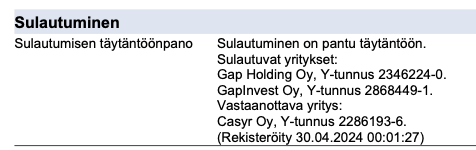
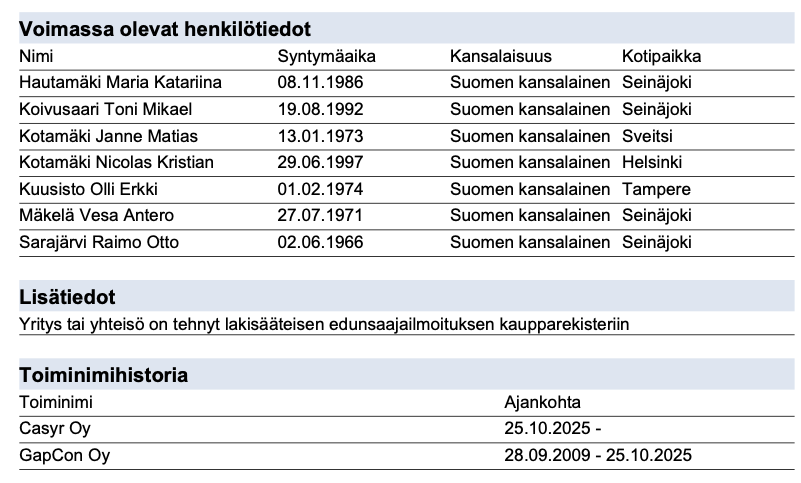
The former GapCon Oy has been renamed Casyr Oy (ID: 2286193-6)

And Gap Holding Oy and GapInvest Oy have been merged into it:

The information for Casyr Oy also showed that Kotamäki does indeed live in Switzerland nowadays:

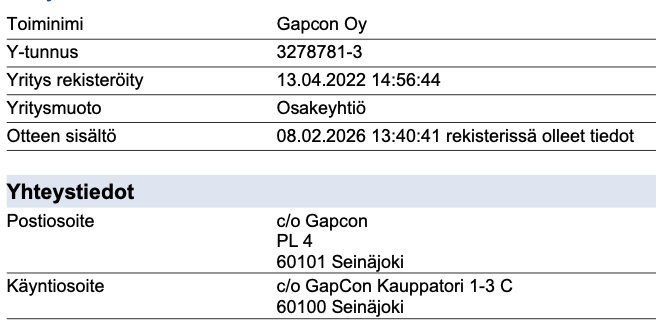
And the former shelf company GH Asunnot Oy has been renamed Gapcon Oy:


On the timeline, the date of establishment likely coincides with the first problems that arose from the FIN-FSA (Fiva) side.

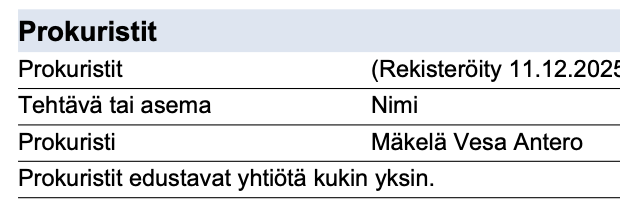
In the new Gapcon, power is exercised only by Sarajärvi, with Vesa Mäkelä holding proxy:

Finally, a few words about the audits related to this scenario: A structural independence problem in auditing? The case of SK-Reviisorit, Mikko Sillanpää, and KPMG

An auditing network operates around Oma Säästöpankki (OmaSP), where the same auditors simultaneously oversee the accounting of both the bank’s owners and the bank’s largest debtors, even though the interests of these two clients are conflicting.

SK-Reviisorit Ab is an auditing firm based in Seinäjoki that simultaneously audits two entities critical to OmaSP. The first is the Parkanon Säästöpankkisäätiö (Parkano Savings Bank Foundation), a significant owner of the bank. The auditor-in-charge is Simo Viitaniemi. The second entity is the FinCap network’s >16 companies, which represent the bank’s largest individual credit risk. These include, among others, FinCap Oy, Casyr Oy, Gapcon Oy, Citytontti Oy, Koy Sofianparkki, Haapa Holding I, Haapa Funds, Seinäjoki Stadion, Train Factory companies, and As Oy Lauttasaaren Linnahovi, etc. The auditors-in-charge are Petteri Myllymäki and Toni Koivusaari.

The conflict is structural. From the owner foundation’s perspective, the auditor should critically assess whether the bank’s loan loss provisions are sufficient, as understated provisions threaten the value of the foundation’s ownership. From the perspective of the FinCap companies, the auditor should evaluate whether the financial situation of the companies is presented correctly, but an overly critical assessment would lead to larger loan loss provisions at the bank, which in turn would depress the value of the foundation’s ownership. SK-Reviisorit sits on both sides of this equation.

The situation is deepened by the “Koivusaari bridge.” Toni Koivusaari (b. 1992) sits on the board of SK-Reviisorit Ab while also serving as a deputy auditor for Tilintarkastus Mikko Sillanpää Oy. Mikko Sillanpää, in turn, audits the Kuortane Savings Bank Foundation and the Töysä Savings Bank Foundation: totaling >14% of the bank’s voting power. Through Koivusaari, these two auditing chains are linked: Sillanpää is responsible for the foundations, SK-Reviisorit is responsible for the FinCap network, and Koivusaari is in both organizations. It’s worth noting that Mikko Sillanpää is the spouse of OmaSP’s former communications director, Minna Sillanpää.

The third layer is KPMG, which simultaneously audits both Oma Säästöpankki itself and the South Karelia Savings Bank Foundation (Etelä-Karjalan Säästöpankkisäätiö). Thus, the same auditing firm sees the true state of the loan portfolio from within the bank and, on the other hand, evaluates the financial statements of the foundation, where the OmaSP ownership is by far the largest asset.

Overall, the auditing of at least four of OmaSP’s nine owner foundations is directly linked to the auditing of the bank’s borrowers: either through the same firm (SK-Reviisorit, KPMG) or through a personal bridge (Koivusaari). This is not an isolated disqualification situation, but a systemic independence problem.

The accounts of the Lieto Savings Bank Foundation are audited by Ernst & Young, and the 2024 financial statements reveal that Lieto has also participated in the management’s protection commitment.

I look forward with interest to seeing what the earnings release on February 12, 2026, will contain.

18 Likes