The Juju brand doesn’t resonate with me at all. It reminds me of cheap children’s birthday party drinks, like Mehu-Katti.
For example, Celsius is a new brand that even a grown man wouldn’t be embarrassed to buy.
The Juju brand doesn’t resonate with me at all. It reminds me of cheap children’s birthday party drinks, like Mehu-Katti.
For example, Celsius is a new brand that even a grown man wouldn’t be embarrassed to buy.
The Polish and German markets are so competitive that they are the last countries in Europe to consider expanding into. Investing in Bosnia and Herzegovina seems like a good move.
In recent years, Olvi has invested significantly in its supply chain and logistics capabilities. These investments include, among others, the new high-bay warehouse in Iisalmi as well as automated order picking solutions, which enable customer orders to be delivered across Finland with greater efficiency.
The goal of restructuring the operating model is also to provide customers and partners with a single, clear ordering and delivery process and to leverage Olvi and Servaali’s shared sales organization.
“The reform is a natural continuation of the development work through which we have already brought the Olvi and Servaali organizations closer together. By combining our operations, we can serve our customers and brand partners even more efficiently going forward, as well as build a stronger foundation for growth in the Finnish market,” says Servaali’s Country Manager Anna Ekström.
As a result of the business transfer, Servaali Oy’s current contracts, liabilities, and business operations will be transferred to Olvi plc as of October 1, 2026. The change is primarily legal and organizational. Cooperation with partners, commercial agreements, and contact persons will remain unchanged.
“Brand partnerships are an important part of our strategy. This change strengthens our ability to serve our customers and partners even more comprehensively in the Finnish market through a single organization,” says Olvi’s Chief Commercial Officer Jouni Saarinen.
Olvi Group’s operating profit for the fiscal year 2026 is expected to be EUR 80–85 million. Previously, the expected operating profit was reported to be EUR 84–90 million. The change in the near-term outlook was influenced by weaker-than-expected earnings performance in the Other Europe segment and cost pressures resulting from the geopolitical situation. The company will continue measures to curb cost pressures, improve operational profitability, and pursue growth in new markets.
The company will next comment on its financial performance in connection with the Q3 interim report, which will be published on October 22, 2026, at 9:00 a.m.
There has been news coverage about the money stuck in Belarus following the profit warning. However, this overlooks Lidskoe’s minority stake in the Bosnian brewery. The rationale behind this ownership is to enable intra-group financing. This allows funds to be transferred to expand the Bosnian business operations without state sanctions, as Bosnia is not on Belarus’s list of “unfriendly” countries. It’s unlikely that all the money can be pulled out, but it eases Olvi’s financing needs and provides proper resources (chips to play with) for Bosnia.
This is worth keeping in mind when assessing the company’s seemingly attractive multiples. You can find breweries with even lower multiples and without the geopolitical risks, e.g., Molson from the US.
Olvi’s Q3 is out today. Supported by acquisitions, net sales grew and earnings also ticked up slightly; organically, net sales were flat and earnings declined. Guidance was already lowered last week and implies that Q4 earnings will fall short of last year, so the trend is downward—which, according to the company, is due to both a sluggish market and cost inflation, as already referenced in the profit warning. Things remain difficult in Denmark, with performance deteriorating further.
Regarding Belarus, funds are now completely locked up there:

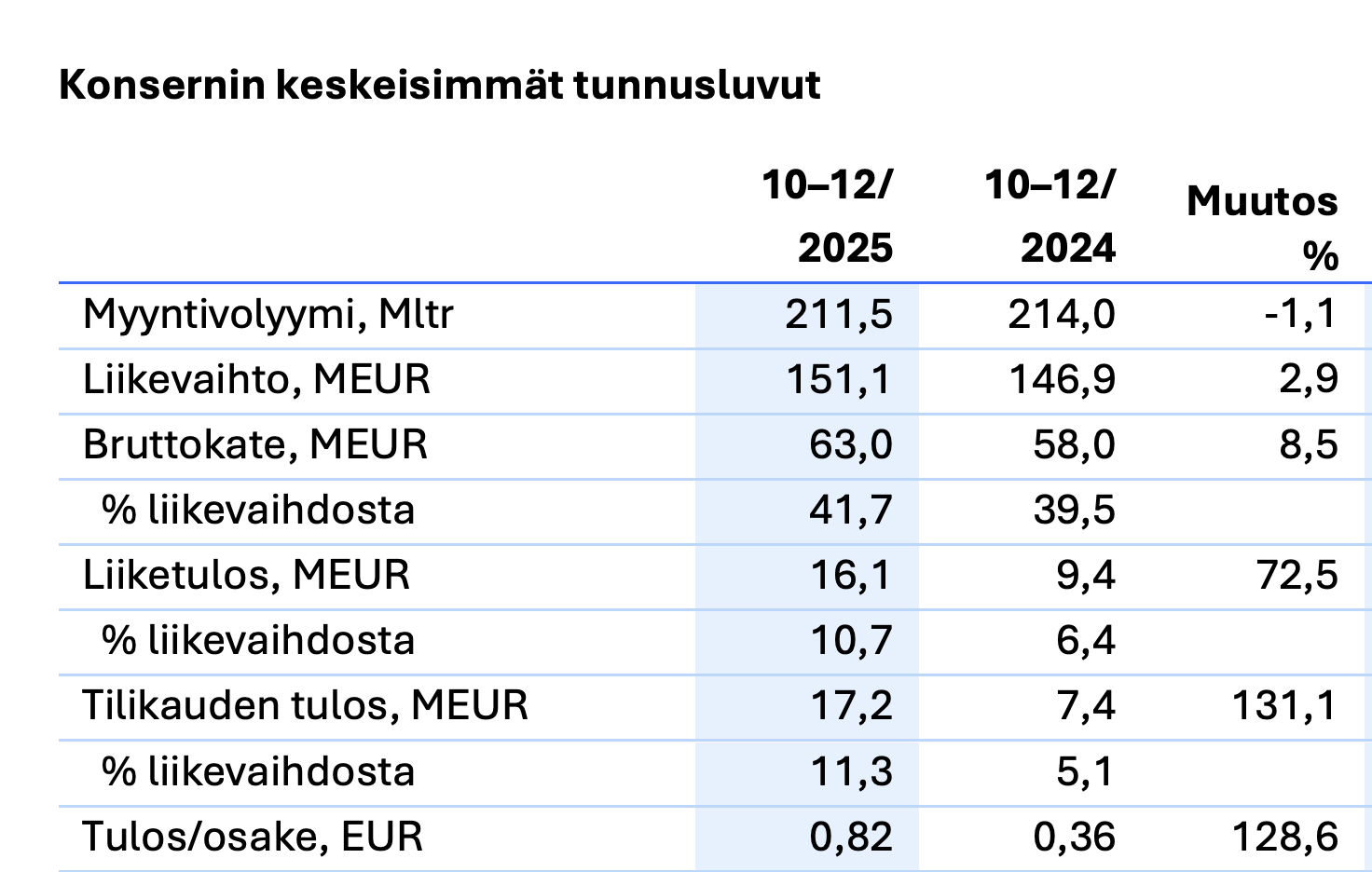
In my opinion, it’s also worth noting regarding Olvi that last year’s Q4 was somewhat engineered to meet the guidance for the 2025 financial year. Earnings grew over 70% in Q4 2025 as costs were cut towards the end of the year. Perhaps they didn’t want to carry out a similar project now, especially since the CFO seems to have changed as well.
However, considering the context that operating profit for FY2025 hardly improved overall, the end of '25 was exceptional.
Another factor is the four acquisitions and how they are reported:
This year, integration costs are booked under normal operating expenses and reduce Olvi’s reported operating profit. They have not been adjusted out of a separate comparable result.
From Olvi’s interim report:
“However, profitability during 2026 will still be burdened by, among other things, takeover and business development costs.”