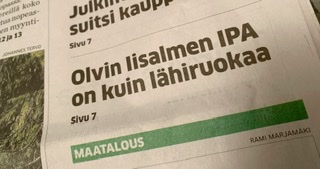
Now in spring 2020, there is an exceptional situation in Finland and globally due to the coronavirus pandemic. Restaurants in Finland have also been ordered to close. Borders have also been closed. What are the thoughts on Olvi as an investment on the forum?
Kalsarikännit (drinking at home in your underwear with no intention of going out) are growing in popularity, so I would expect the decreased restaurant sales to be offset by rising retail sales. One would think they’d do better than many other businesses in these conditions, but I don’t have an opinion otherwise, as I haven’t been following.
Does anyone here who has followed the company more closely know how large a portion of the turnover comes from sales to restaurants, bars, events, etc., or generally if the biggest profits are made in certain quarters?
I actually consider Olvi to be the safest Finnish listed company. The stock price drop during this crisis has been a bit surprisingly strong; I assume the recovery will happen quite quickly. Olvi is quite stingy with paying dividends, but in return, the company has been able to invest well. The return on equity is at a good level. Competent and proactive management, stabilizing ownership structure.
I haven’t followed Olvi closely, but I have over ten years of experience in brewery sales, some of which was at Olvi.
In the brewery business, generally the biggest single factor for a successful year is the summer weather; if it’s warm, people consume a lot of high-margin products, specifically those single-serving packages placed in refrigerated display cases in stores. In restaurant sales, the largest volumes have long been with Koff and Hartwall. These same companies will be the biggest sufferers when people don’t consume products in restaurants, on terraces, and at festivals. It’s also worth noting that breweries suffer when large groups no longer flock to passenger ships and cart away crates of drinks from there.
I could imagine that the biggest winner in this case is the tax authority, as people, while laid off, switch to drinking one-euro Finnish lager specials found in supermarkets. A few years ago, roughly 70% of the wholesale price of a non-refundable special offer beer from the supermarket went to the taxman. In the retail world, large breweries negotiate annual contracts with chains, and in these contracts, high-volume special offer beer is usually a nearly zero-margin “loss leader.” Other campaigns and activities linked to the same contract usually bring money into the house. For example, a well-timed price campaign for a proprietary, high-margin product (e.g., Olvi’s long drink, KevytOlo mineral waters) can be very profitable for the brewery.
Regarding Olvi, one should also consider the group’s foreign factories and brands; my memories of these are so vague that I don’t dare write more about them
This didn’t directly answer the question, but perhaps someone is interested in reading some general, albeit a few years old, information about the brewery industry.
Sales and operating profit are growing strongly in Lithuania and Belarus, while elsewhere the growth is more moderate. The operating profit of these two countries, at 16.5m, is already close to the operating profit from Finland, at 18.7m. For Olvi, it is good that Belarus is fully open and the ice hockey and football leagues are running as if there were no corona. Olvi has more staff in these countries than in Finland, Estonia, and Latvia combined.
Corona will naturally cause a big dip, but a good position in nearby emerging economies is not a bad strategy. And naturally, Olvi is one of the cornerstones of my own portfolio.
I’m going to the local Prisma with a mask on to map how much shelf space Olvi has.
I’ve already noticed that beer brands in Finland have their own quite strong fan bases according to locality, even though new products come and go.
Let’s hope that the previously mentioned well-performing countries will continue to stay open and drink beer. The competition is indeed tough.
I still forgot to mention in the previous message that Olvi produces a lot of private labels for retail chains operating in Finland, e.g. S-Group’s mineral waters, Rainbow beers (a pint can found in every S-Group store), Pirkka beer, Lidl’s protein drinks (similar packaging to Teho-Sport)…
Olvi also has a warmer organization than its main competitors and takes good care of its employees. Many have been on the company’s payroll for a long time and are clearly proud of their workplace. If a consumer wants to favor a domestic company and a domestic product, Olvi is the best option among the three large breweries.
In my own case, I eventually “had enough” of retail and the brewery world, so I haven’t followed this sector in detail anymore. Since then, I’ve started consuming brewery products again, but 95% of the money goes to local smaller players. Now that I’ve written about things in a couple of messages, I’ll have to put Olvi on my watchlist and pick it up for my portfolio when a good opportunity arises.
The Teho Sport product family belongs to Olvi, and I believe the drinks are made in Iisalmi, while the bars are made somewhere abroad. I was involved in launching these products onto the market about five years ago when recovery drinks/sports supplements were a real hit product category – if I recall correctly, it was the fastest-growing segment in all of Ruoka-Kesko for a couple of years in a row. Olvi reacted quickly and capitalized well on the hype, simultaneously expanding its portfolio to better suit sporting events and sports halls.
Pepsi and 7Up sold in Finland are manufactured under license by Hartwall.
This is a pretty important reason for me to be involved. Similar care is clearly visible in another Upper Savonian company, Ponsse. I haven’t encountered such a culture in many other companies I know well.
A few years ago, Lithuania significantly tightened its alcohol laws; the age limit was raised, sales hours were shortened, and taxes were increased. Apparently, growth didn’t falter because of that.
It remains to be seen how significant the end of passenger imports from the Baltics to Finland will be for Olvi; Estonians are unlikely to be able to consume the entire A. Le Coq production themselves. On the other hand, Olvi is well-positioned in the domestic market, and people are now buying their drinks from here. In recent days, concerns have been voiced about the increase in alcohol consumption.
The technical implementation of Olvi’s AGM video stream was probably handled by amateurs. A pathetic performance. However, there was nothing wrong with the numbers presented by the CEO. Olvi is steadily moving forward.
The closure of sales channels by authorities in several of Olvi’s main market areas poses a challenge for the coming months, in particular, to predict the development of profitability despite the growth in retail sales. For this reason, the Olvi Group withdraws its profit guidance for 2020.
Olvi’s restaurant and passenger traffic sales account for approximately 8% of total volume. If half of this is lost this year due to the coronavirus, it means that the total volume will decrease by about 4%. At least some of this will be compensated by increased retail sales. The Q1/2020 review provides some indication of this: total sales volume grew by 11.5% compared to the reference period, revenue by +9.8%, and operating profit by +30.2%. I can’t be worried.
It’s pretty hard to be hugely worried about that. TE’s article from a couple of weeks ago highlighted the same point, namely the small share of restaurant sales.
However, a minor risk mentioned in the article is that in “crisis situations” the average price tends to drop slightly as sales of the cheapest products increase the most. So, sales grow, but the margin doesn’t necessarily follow suit. If restaurants are doing poorly (with bankruptcies looming), some receivables might go unpaid, but those probably aren’t extremely large either.
The company is in a strong cash position. The P/E ratio is getting quite high, but its significance also depends on whether one is considering buying now (like myself) or just enjoying the ride.
Instead of layoffs, Olvi has hired more staff in Finland and increased shifts. Goods are manufactured as much as possible for storage. With these actions, the company is preparing for high demand and illness cases.
I returned as an owner of Olvi before the interim report and added a bit after the report. An interesting report and also the fact that both beverage companies on the stock exchange decided to start messing around (guidance removed only fifteen minutes before the interim report) in the same way with their guidance. This put a crack in Olvi’s beautiful image.
Does anyone have information about the restaurant share of the Estonian segment? On the other hand, Estonia has had to be trimmed, so it’s both good and bad that the crisis hits now.
Olvi’s position in the Finnish grocery trade is strong, as mentioned; smaller breweries have had difficulties getting shelf space, which has been heard from the market.
Olvi is chugging along, but is it chugging a bit too fast? Olvi’s earnings report has perhaps been the most convincing for me this earnings season, at least in terms of investor communications. The effects of the coronavirus were detailed so carefully that it was a pleasure to read. We haven’t really received such investor-friendly reports from anyone else.
However, I would comment a bit on the previous share of restaurant and passenger traffic sales. By no means is the halving of that likely to be the only blow Olvi will have to take this year, and I don’t think it’s worth thinking that increased retail sales will compensate for it. As for the total sales volume, the report stated that the effects of the coronavirus only began to show from mid-March, so the strong growth in Q1 is mainly explained by the period from the beginning of January to mid-March. We can expect significantly worse figures from the following quarters, which will, of course, be very much affected by the nature of various summer events and similar things, i.e. how much people are able to move around in the summer. The significance of Q1 for the whole year is ultimately quite small, and the important seasons are yet to come. The effects will certainly affect retail volumes in the coming months as well. From an owner’s perspective, this hopefully opens up good buying opportunities. Olvi is a pleasure to own.
Does anyone know of relatively recent (i.e. updated after Q1/20) target prices (12 months) for Olvi? Inderes doesn’t follow it, if I remember correctly, but perhaps OP, Danske, Handesbanken, or Nordea do?