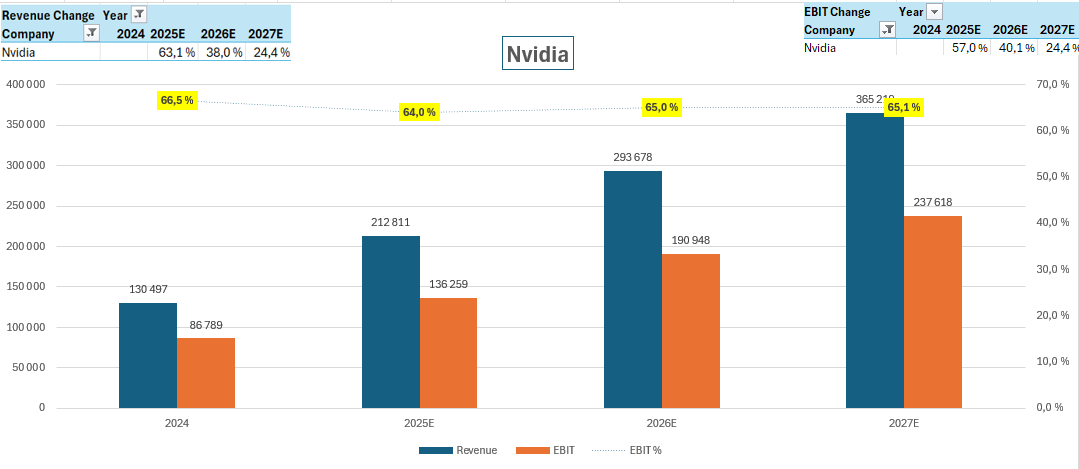
Great results and guidance from Nvidia. Consensus estimates may not have been updated yet, but I’m estimating the full fiscal year’s results based on what has been achieved and the guidance. Q1/2025 operating profit % was only 52%, which slightly pulls down the full year’s percentage. The level is high in any case.
The pace will slow down slightly in the coming years but will remain at a high level.
Certainly, something can be achieved with a shovel, while others dig more with Bertha’s TBM. It’s true that in a large part of customer discussions, I get a comment from an above-average coder saying that it would take me half a day with Python. The manager sitting next to them then looks confused, wondering why we haven’t done that already last year…
In my opinion, this discussion confuses individual small use cases with the path to a larger transformation. Technology companies need AI in all their products to maintain competitiveness. This change requires volume in data, computing power, and models.
Perhaps NVIDIA’s customers are just so stupid and buy too much without their own intelligence.
We only have one Internet, which has already been harvested as training data. New data is no longer easily available, and increasing the size of models raises costs significantly more than the improvement in the model’s intelligence. Perhaps an analogy easier for Tesla forum members to understand is that it’s like trying to build the world’s tallest skyscraper. Each new floor costs significantly more and adds complexity than its benefit to the developer and residents. That’s why most skyscrapers don’t try to reach the clouds, because scalability breaks down when the number of floors becomes ridiculously large.
At the smaller end, the situation is the opposite. Year after year, only a fraction of the computing power is needed to perform the same task. When GPT 3.5 Turbo was released, running it required a huge amount of computing power supplied by Nvidia. Now I can run better models myself on a work laptop, and Nvidia’s servers are not needed. The same will happen in the future for ChatGPT 5 and Claude’s current code models and everything else; you’ll be able to run them on your home computer if needed. Once there is enough intelligence available to perform a task, there is no point in paying a premium for renting or buying an Nvidia graphics card sold with a 90% margin. The vast majority of the world’s AI needs could already be met with existing hardware if the software were just better optimized.
In a few years, we have managed to get those expensive models, which used to run on dedicated cards, to work even on an iPhone with mobile phone power. As this development continues, the amount of dedicated computing power required will plummet, because your phone, home computer, or work computer is good enough and smart enough to perform the operations you want from AI. It just takes time, because optimization work and ecosystem building are done by people now and will continue to be done by people.
Surely the same hardware will perform better with software optimization, but are you taking into account the growth in demand in every single sector? You are certainly wiser than me on the subject, but I dare to challenge that not all of these AI applications are known or can be used yet. AI can be applied in every field, new fields can be created that use AI, and all of this will vastly increase demand. At some point, a ceiling will surely be reached, but in Nvidia’s case, the 25E P/E is around 40 and is expected to fall even lower as investments grow; I don’t see any signs of a fire sale. Margins will certainly drop over a 5-year span, but old hardware must be replaced every 5 years, and at that point, buyers will consider whether to buy more expensive hardware that is more efficient and uses less energy, or cheaper and worse.
I would be more concerned about these hardware buyers, who are supposed to generate the returns. But somehow, I believe that the management of all Mag7 companies employs people wiser than us, whose assessments indicate that operations will be profitable in the future. I don’t believe companies would invest such large sums based solely on a good hunch? For Nvidia, the investment case is roughly the same as in other sectors: is there enough demand, is there a competitive advantage and technological leadership, and what is the supply.
I don’t quite understand this logic. So you’re claiming that you can train and use Chat-GPT 3.5 on a regular work laptop nowadays. Could I get some evidence for this, because as I understand it, slightly different hardware has been used for training?
The public internet is certainly not the broadest training data. Technology companies already have broader datasets from their own operations, not to mention data from the scientific community, data from official processes, industrial sensor data, and all recorded A/V data. Are these models going to be trained on work laptops in the future, and will NVIDIA be replaced by software?
But why would this require additional separate computing power? Let’s take, for example, building an AI application for a medium-sized company’s automated invoice processing. What is the most cost-effective solution? A regular server box with a good CPU and plenty of memory. A graphics card is not needed at all, and the AI model can be run purely on the processor. Of course, if you buy it from a Finnish consultant, they will sell you an Nvidia box, because the CUDA ecosystem is the most familiar and developed for them, but that’s a different matter. It’s not about hardware and computing power, but about software and the underdevelopment of ecosystems. In the future, these massive computing clusters will no longer be needed, any more than an IBM mainframe in a company’s basement.
I argue that if all the discussants in this thread tried running llama.cpp on their home computers for a couple of hours, things might become clear in a completely different way:
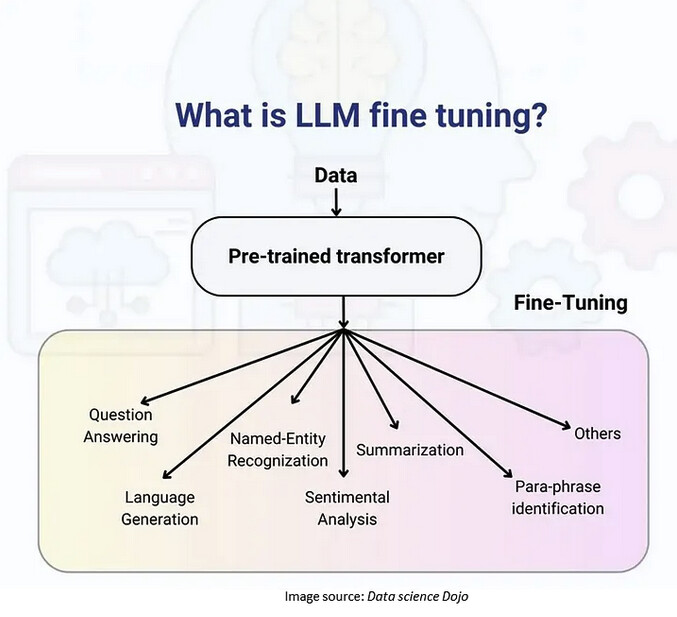
Of course, I’m talking about inference, not training, because nowadays the goal is no longer to build separate foundational models for applications, but to use models already trained by others and fine-tune QLoRA on top of them at virtually no cost. Fine-tuning, of course, requires renting high-end graphics cards from the cloud for hours, but the model’s inference itself can be done with light hardware:
The cost of creating small foundational models has also plummeted, and training a foundational model at the level of GPT-3.5 Turbo can now be done with significantly lower computing power. Bleeding edge models are, of course, a separate matter, but ordinary people don’t need them for anything.
All current text-based language models derive the majority of their intelligence from literature accumulated throughout human history and Internet text production. The proportion of companies’ own data compared to, for example, Wikipedia, Reddit, and all literature available for training is quite small. Own data is definitely beneficial, but the greatest impact is achieved in small-scale and specialized models (where the proportion of one’s own training data to all of the model’s training data is maximized), which do not require much computing power compared to the largest models currently available and in use. Nor during the training phase.
I am even more confused. The amount of data from Reddit, Wikipedia, and publicly available literature is in hundreds of terabytes. Google’s internal data volume is measured in petabytes, including YouTube in exabytes. Secondly, why should the AI business be based on text-based language models when companies also use cameras and videos for business?
If QLoRA is the answer to everything, let’s take a use case then. How do you train and fine-tune an AI application with QLoRA from a text-based language model on a work laptop, an application that accurately answers the question: what is the price of electricity in Finland next Monday at 10 AM? Then you compare the model’s inference to creating your own model with NVIDIA hardware and software, training it with all the private Nordpool data, precise weather data, and Fortum’s production/sales historical data, etc., totaling about a few hundred terabytes.
Good discussion! In my opinion, @Pohjolan_Eka has a very valid point. I have also written that in practice, in the slightly longer term, mere zero growth in capex investments (i.e., in Nvidia’s hardware demand) requires exponential growth in token production. For example, by making AI replacement investments that maintain the same performance, capex levels will decrease, because the same token output can be produced with new generation AI infrastructure at a fraction of the cost compared to previous infrastructure. Magnificent 7 -yhtiöt ja niiden tulevaisuuden näkymät - #1363 käyttäjältä Roope_K
I don’t fully agree that all the hardware Nvidia has sold recently wouldn’t be needed to meet the current token demand (quality and quantity). Inference runs are currently revenue-optimized not only for quality but also for energy consumption, and both these constraints require the use of the best models and the most efficient perf-per-watt hardware, which is currently offered by Nvidia and its latest generation of hardware. For example, Dylan Patel of SemiAnalysis has talked about this, as have Altman and Natella in the podcasts linked a few messages above.
Even less do I agree with the idea that GPUs wouldn’t necessarily be needed for inference at all. Anyone can try running models locally on a CPU with Azure’s Foundry Local by following these instructions with a couple of minutes of installation work: Get started with Foundry Local - Foundry Local | Microsoft Learn. For example, a 3.5B parameter Phi model (which is certainly not a top LLM Leaderboard model) already clogs up the machine so badly that you don’t need to do anything else. The task is much more pleasant when an H100 is available, which can spit out answers in under a minute. A basic perceptron needed for invoice processing is, of course, a different matter, but such models were not behind Nvidia’s increased demand in the first place.
No, it doesn’t. There, @Kasleew already mentioned a few domains that will multiply computational requirements many times over in the future. The token consumption of agents alone is already a massive step-change compared to these chat assistants. Another misconception is that all input data has already been used. It hasn’t, only the surface has been scratched. If any of these domains connected to the physical world materialize, it inevitably also means that input data changes from text to modalities whose bandwidth requirements (and thus computational requirements) are something entirely different from text, which is a highly compressed format. For example, video data, which smart robots, for instance, would need, has hardly been processed by AI chips yet.
Regarding Nvidia’s results, it is indeed incomprehensible that the company is still accelerating growth to a whole new level at this stage - even without sales to China. One noteworthy point is that Networking revenue alone was $8.2B (i.e., almost 2x AMD’s entire data center sales), which means 162% y-o-y growth. And when considering the scale of AI infrastructure construction, which places enormous demands on networking, then this is indeed a good foundation, even if there were temporary weakness on the GPU side.
My job involves doing a bit of everything with those models. In my opinion, Pohjolan Eka is a bit off track, because in reality, speed and quality often matter most, and you don’t get that locally. These are numbers thrown off the cuff, but… Here are a couple of devices I have available:
Mac Studio Ultra M3 (96GB RAM) - costs 5k€, so not a device for every home. In practice, if even slightly larger data comes into the model, you’ll miss your mom, because it’s slower at processing it than a 10-year-old Nvidia GPU.
A 5-year-old gaming PC with an Nvidia RTX 3080 (a pitifully small amount of memory on the graphics card). With this, all more sensible models are just a dream, although those it does run work somewhat but are still 1/10 or 1/20 the speed of real cloud hardware (Cerebras, Groq).
In professional use, we practically use all models from Anthropic, Google, and OpenAI, and no, it doesn’t even cross my mind to run their equivalents myself because they are simply shockingly slow to run locally, and secondly, reasonably sized models perform much worse than the best ones you can’t get for yourself.
So: I don’t believe that the majority of end-users or even organizations should start developing their own specific models that ‘run on a phone cluster’ as Eka said, but rather, in practice, they will buy ‘good’ ‘cheap enough’, and this again leads to the moat of Nvidia, AMD, and some even faster solutions (Cerebras, Groq) which I don’t see being resolved in the coming years.
As long as running models in the cloud doesn’t cost an organization an exorbitant amount, it’s much more sensible to use cloud models and leave capex to others (you get the best result at a reasonable price), than to tinker with something locally.
The only angle where local execution truly makes sense is either regulatory or other processing restrictions (whether it’s a phone, laptop, or your own data center).
I haven’t personally invested in any single company, because with current valuations, I’m not entirely sure who will win, and the losers will certainly come crashing down at some point.
Not even close; instead, you take a pre-trained over-parameterized model, attach your new data weights to the old model’s weights, which still requires a fraction of the computational power for training, and voilà, you have a new model ready for use in whatever environment you desire. You can do this with or without Nvidia and CUDA.
I’m not off track; your examples already show that you’re running models that are too large, with too much context.
The Ultra M3 isn’t very good at matmul, so prompt processing takes a long time. Reduce the model size, and you’ll definitely reach a thousand tokens per second and get over 50 tokens per second in inference. If the run isn’t time-critical, then slow PP isn’t a problem even with larger models.
The RTX 3080 has enough memory for much smaller models, which can handle all common tasks. Of course, if you want your own waifu simulator on your home computer, then you’ll need to get more powerful hardware, such as a 3090 or two.
Just a couple of years ago, I would have agreed with you, and back then I was constantly drooling over more powerful hardware, and nothing seemed to be enough. But such huge leaps have been made in small models that I had to change my thinking. This is also why edge computing in IoT devices is becoming widespread at a tremendous pace, because AI can now be run locally on a sensor instead of the sensor sending data to a central server’s compute cluster.
Having seen a few raw material cycles, by the time you notice an oversupply in the market, it’s already too late, because there are so many projects in the pipeline that oversupply will crash the market.
My thesis is based on the idea that the majority of AI application models for practical life will operate in the sub-10 billion parameter range in the near future. Models of that size are easy and inexpensive to train, and they can be operated on ordinary computers, especially since the weak PP performance, which acts as a bottleneck on the hardware side, is a temporary problem that other manufacturers have also woken up to. Today’s 7B model is equivalent in performance to a 70B model from a couple of years ago, and if the development trend continues along this path for the next few years, then the idea of a collapse in computational power demand doesn’t sound as crazy as it might initially seem.
Of course, there will be needs for traditional giant models in the market, but whenever a smaller model reaches a ‘good enough’ level, it will displace the larger model from the market because its computational power and memory requirements are smaller. Unless small models encounter significant limitations at some point, this current and observable development path will eventually lead to a collapse in the need for separate computational power, as ordinary computers become ‘good enough’ and computation shifts from the cloud to the edge.
It strongly depends on the use case. Some hobbyists are currently building machines for AI inference without any graphics cards at all. For background solutions that are not time-critical, performance is often good enough even with CPU-only inference:
Of course, in the real world, a situation where one operates on such an extreme budget that additional graphics cards cannot even be acquired, or where no graphics cards are available for computation at all, is very rare.
I find it amusing that you say I run models that are too large with too much context, when I actually need both large context and a large model. For example, at some point during the summer, we processed a fairly large text corpus, and surprisingly, running it locally took about 100x longer than with Groq. I could have used a worse model, of course, but I compared the results, and a local small model still produced ‘something’ (= poor results) 10+x slower than a larger model run on Groq. Surprisingly, it was run on Groq because the result was obtained in minutes, not a day.
The assumption that ‘a small amount of data and a crappy model’ is sufficient is a bit silly when users actually want high-quality results quickly. For this equation, the solution is most often a medium-sized model in the cloud that is optimized for the task, or a large model that is not (and orders of magnitude more hardware at the edge than I have at home or even in the office).
Local models are suitable when there’s no hurry (i.e., the user isn’t waiting for a result) and there are no quality requirements. But if model results are actually compared, small models very rarely compete with SOTA in anything more difficult (and the situation is still the same, at least in the things we have genuinely tried in real life with real models).
I find it difficult, for example, to sell software that is ‘almost as good as X, but much slower and destroys your phone’s/laptop’s battery’. I’d guess that product X, which uses a cloud service, would then be the winning choice.
Don’t get me wrong, I also run models here at home, but they are purely for hobby purposes. In a work context, one must start from the requirements and choose a model (+ its potential further development) and its usage method that is good. For this, 100% of the time so far, the answer for us has been in the cloud, but perhaps the situation will change.
I doubt that the market will be won by small models whose results contain uncertainty. The business case for AI collapses into risk assessment when the resistance to change justifies human work as better, despite its errors. Perhaps functional requirements with benchmarks are a better starting point for a project than some old hardware where AI has to operate.
Furthermore, even if small models are efficient in many advisory use cases, the demand for NVIDIA and the investments behind it are driven by the platform race for large models, just like in cloud services or mobile operating systems. Large models then give rise to smaller models – or has some small AI model now emerged without the legacy of a larger one? There’s also a geopolitical question here: will the development of large models then be left to the Chinese?
As an aside: many have probably noticed how the “Big Short” man, Michael Burry, has said that AI companies’ practice of extending the depreciation of their hardware over a 6-year period is the biggest scam of the era, and how such accounting trickery makes companies’ results look up to 20 percent better than Burry believes they actually are.
Well, now, in Nvidia’s earnings call, CFO Colette Kress stated that their H100s delivered 6 years ago are still in full use…
That’s just how it goes. The hardware you mentioned is quite capable and suitable for AI purposes, but if you try to run models that are too large with too much context on it and expect immediate answers, you will get frustrated. It’s not the hardware’s fault; the culprit sits between the hardware and the chair
While I would like to assure you that local execution currently has its own niche in the AI ecosystem and that you can do more with it than you seem to give credit for, even for paying customers, this is probably not the right thread for such a discussion. I’ll just state that the tool must be chosen according to what one wants to achieve.
The prevailing idea in the current consultant meta seems to be to sell some SOTA-model contraption to overly hasty buying customers after a data renovation, quickly attach an MCP server to it, and then move on to the next project with big money in their pockets.
Buyers’ lack of expertise combined with intense haste almost inevitably leads to enormous inefficiency in AI projects, which inflates the need for computing power and thus Nvidia’s sales. It would therefore be strange to assume that the current gold rush in AI projects is on a sustainable footing, because in previous similar situations, after the initial hype, buyers start to emphasize real results and cost-effectiveness when investment money again has a genuine price.
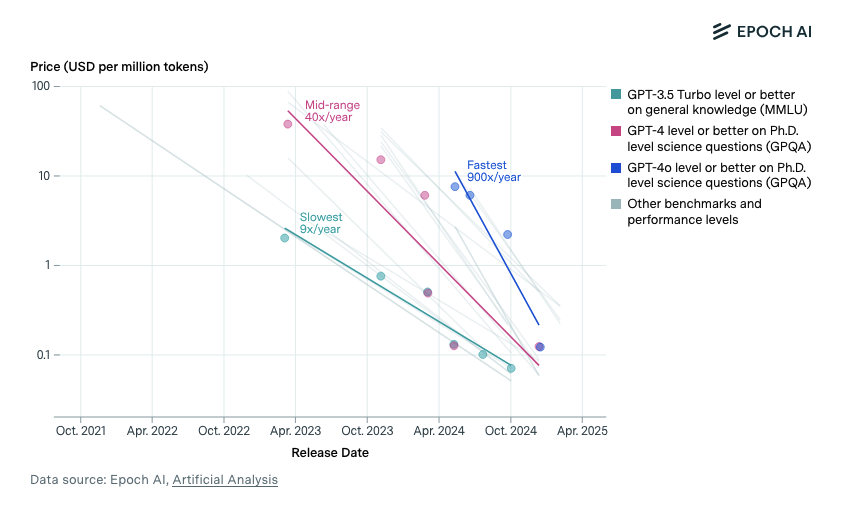
My earlier fact (about the qualitative improvement of smaller models) does not only apply to local models, but it applies in exactly the same way to cloud providers’ own commercial models. These models require less computing power year after year to offer a sufficient level of intelligence, and this can be implemented more cheaply and faster than before. Of course, if your requirements exceed the level of the very best model, then you will not benefit from this phenomenon.
Due to the improvement in the efficiency of models and the software ecosystem, in typical use cases, the same AI task can be performed in 2025 with less computing power than would have been required to perform it in 2024. And the same phenomenon of decreasing computing power requirements is expected to continue in 2026, 2027, etc. For this reason, prices can continue to be significantly reduced:
Interesting analogy. In the IT sector, software developers usually always manage to gobble up extra capacity somewhere. Let’s think about a web browser, for example. One was already running in 1995 on the then-PC’s 16MB of memory. Fast forward 30 years to today, and a web browser that essentially performs the exact same task as in '95 consumes hundreds of megabytes of memory.
If you consider the example above, the idea that the same task constantly requires more computation or memory no longer seems so impossible.
I thought, since the thread name is ‘enabler of the impossible’, that to my eyes, this use of the SPV instrument on such a large scale looks bad, and that the party would continue. Is it still expanding, or will it?
Interesting analogy. In the IT sector, software developers usually always manage to gobble up extra capacity somewhere. Consider, for example, a web browser. Such a browser was already running in 1995 on a PC with 16MB of memory. Fast forward 30 years to today, and a web browser that factually performs the exact same task as in '95 consumes hundreds of megabytes of memory.
Jevons’ paradox has indeed been empirically observed to be true: software can be pushed out faster when high-level abstraction languages are used, precisely at the cost of resource utilization efficiency. However, the claim that today’s web browser performs the same task as in '95 struck me as a bit off. In '95, web browsers primarily supported opening and viewing documents, but with Web 2.0 (approx. 2005-), websites became much more interactive, and browser functionality began to be properly developed (and even more so when Internet Explorer was finally phased out at the end of the last decade). Nowadays, browsers have so many interfaces and features available that they are the de facto standard platform for all new software, whether for local desktop use or in the traditional style as a web application. Modern browsers are therefore much more complex entities than the ‘games’ of 30 years ago.
Modern browsers are indeed much more capable constructs, which explains the size difference.
It is also very likely that AI tools will develop and gain more complex features. The hype word of the day is “Agentic” where an AI agent directs things and sends new queries to other AI models, perhaps using an entire family of different models for different tasks. We are very much in the early stages of their development, and presumably all available resources will continue to be used as more resources become available.
Agentic AI are autonomous systems that plan, execute, and adapt actions to achieve goals with minimal human intervention. Unlike traditional AI that follows pre-defined rules or requires step-by-step prompts, agentic AI can perform complex, multi-step tasks by using large language models (LLMs) for reasoning, planning, and making decisions. These systems can also collaborate and use “tools” (like APIs) to interact with other systems and even self-correct their plans through a process of reflection.
As software is optimized and perhaps they can handle some work with fewer resources, the work becomes more complex, and still all resources are used…
Today, I got to see a language model in action in a realistic process. There was a doctor and patient simulation, where the patient had sustained a knee injury during hobbies. The doctor asked for background information, interviewed the patient, examined them, measured pressures, sent them for an X-ray, and analyzed the images with the patient.
The AI created a 95% complete patient record from the conversation. The doctor adjusted 5% of the texts. So, the AI listened to the conversation between the patient and the doctor and generated the patient record entry immediately after the appointment, and the doctor promptly adjusted the texts, which then seamlessly flowed into the Kanta services.
This, in my opinion, is a good example of how AI removes intermediate steps from a process.
Most often in Finland, things still go like this: The patient visits the doctor. After the appointment, the doctor dictates the patient record text using a dictation device. Then, secretaries listen to the dictation and type it into the patient record. And then the text still needs to be approved by the doctor for the information to be confirmed and transferred to the Kanta services. It takes a long time, employs many people, and involves many steps where errors can occur.
In some places, things already go like this: After the appointment, the doctor dictates the patient record text using a dictation device (guiding the texts to the correct fields with speech markers), and AI generates the text. The doctor corrects and approves the AI’s text, the information is confirmed and transferred to the Kanta services.
Now, in Finland, things could go like this – right the first time: During the appointment, AI listens to the doctor-patient conversation and immediately generates a patient record solely from speech, and the texts automatically go into the correct fields. The doctor checks and marks it as complete right away. (No dictation devices are needed, nor any guidance to the correct fields while the doctor is speaking).
This was a tip for Orpo’s government on how to improve doctors’ productivity by approximately 20-30% immediately, and also improve the quality of appointments and patient satisfaction.
Yes. In the MSFT conference call, it was mentioned that Dragon Copilot’s Ambient listening AI is already being rapidly deployed in the USA. Regarding the Finnish release, I don’t expect anything. Perhaps by the next decade, we’ll get some tenders and manage to choose the cheapest unusable contraption.