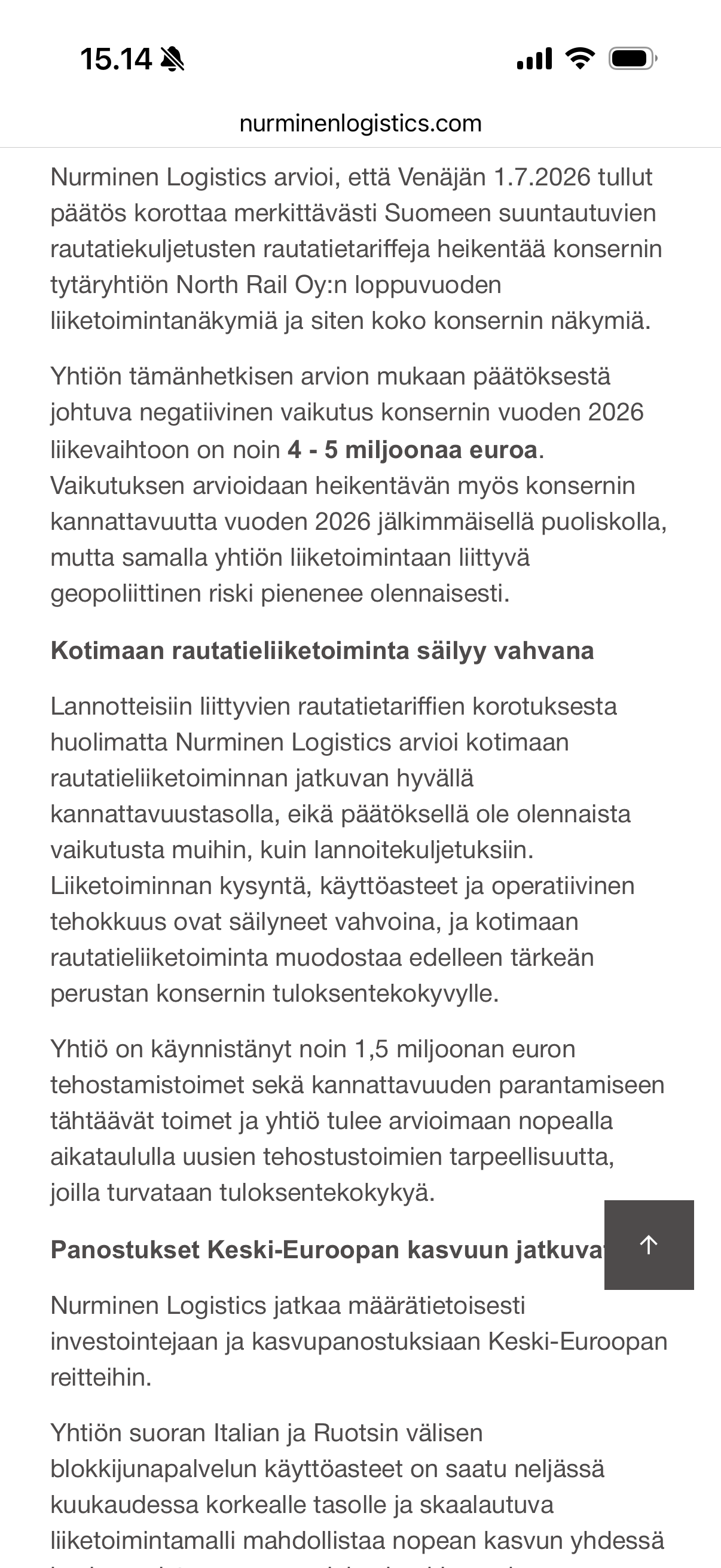
Further information and a profit warning (negari) have just been released:
11 Likes
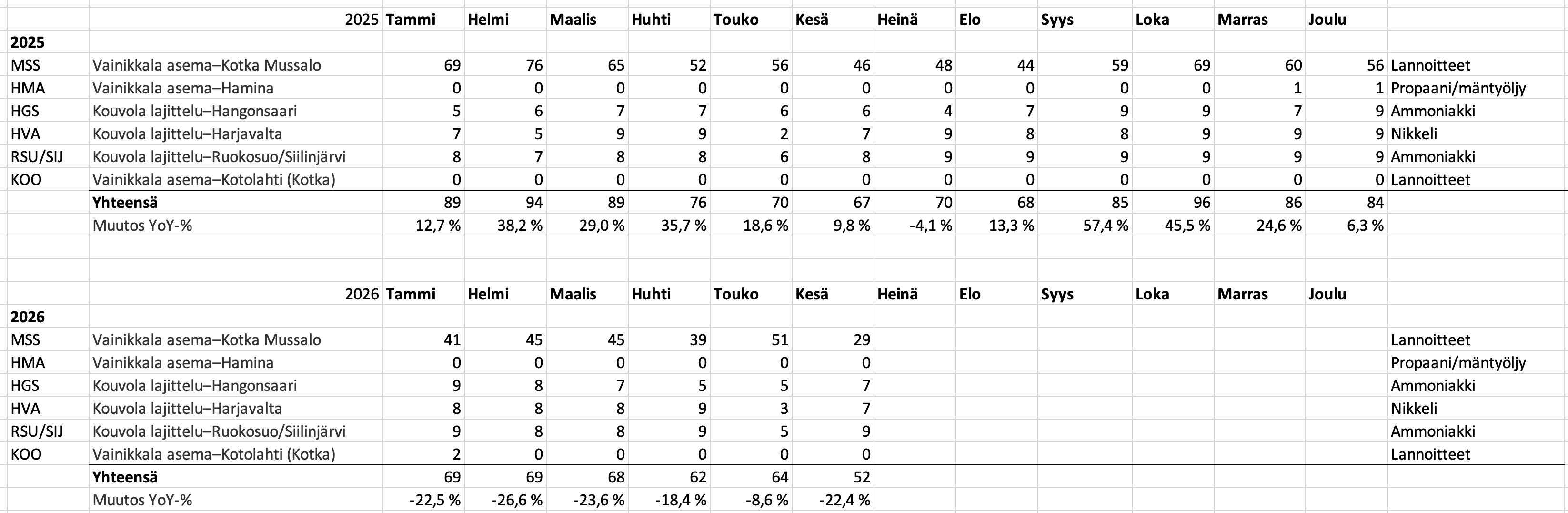
Quite interesting that 82% of shipments are ending, yet revenue drops from 32.8 million by only 4 - 5 million; meaning these remaining 22 trains per month would generate an annual revenue of 28 million euros.
Finding this a bit hard to believe right now.
7 Likes
What does domestic rail traffic consist of? As I understand it, they have previously had import and transit traffic.
3 Likes
A few posts above, there is a tracking update made by Ilkka, which I will quote here.
So, it only has traffic from Russia.
5 Likes
Here are Petri’s comments on Nurminen’s profit warning.
Nurminen Logistics issued a profit warning on Thursday, driven by Russia’s decision to significantly increase tariffs on rail freight destined for Finland. This did not come as a surprise to us, as we commented earlier on Thursday that Russia’s actions would clearly increase forecast risks. We will update our forecasts in the coming days, and according to our preliminary assessment, there will be significant downward pressure on our earnings estimates.
EDIT:
Thanks, and good thing you mentioned it – I’ll post it on the Forum administration channel just in case someone is still around.  Well, maybe Petri will get to it first.
2 Likes
If someone has access to Maaseudun Tulevaisuus, there is a news headline now: “Yara: Ammonia exempt from Russian railway tariff increases.” Of course, there are some import limits on ammonia from Russia now, so it remains to be seen if this still has an impact. 15 ammonia shipments to Uusikaupunki have been canceled this year, if I calculated correctly from there. (4 to Siilinjärvi)
4 Likes
A notification about premium content appears
Ping @Petri_Gostowski
1 Like
Savon Sanomat has new information on ammonia tariffs based on the previously mentioned announcement from Yara. The ministry is also commenting on the matter:
Ministerial Adviser Titta Berlin from the Ministry of Agriculture and Forestry states that the authorities interpret the 0.25 coefficients for ammonia and nickel as exceptions, not additional multipliers. This means that their tariffs will remain doubled as previously decided in April, and will not, therefore, increase eightfold. The exception coefficient is in effect until the end of October.
8 Likes
Thanks for pointing that out, it’s been fixed now and should be visible without premium now
8 Likes
Here are Petri’s comments on Nurminen’s North Rail initiating change negotiations.
2 Likes
Is this maximum of 25 layoffs about half of the company’s staff?
Regarding the subsidiary North Rail Oy, that does indeed seem to be the case. However, let’s keep in mind that the total number of personnel for the entire group was 181 people at the end of last year.
1 Like
The co-determination negotiations (yt-neuvottelut) are only at North Rail, not the entire company.
It’s pretty harsh if the revenue drops by a few million as announced in the stock exchange release.
3 Likes
It looks like there’s at least a four-week break in traffic in Uusikaupunki as well, judging by the canceled trains, even though those ammonia shipments weren’t supposed to be under any major transport constraints. (Let’s remember that in 2024, Uusikaupunki was completely without rail freight between mid-March and mid-August, and in 2023 there was a long pause before North Rail started operations altogether.)
Revenue would drop quite a bit if that’s what they’re planning. Of course, if North Rail were to, for instance, lease its own rolling stock to others, that would bring in some compensatory revenue, but perhaps not a huge amount per year.
2 Likes
Regarding North Rail, it is worth remembering that you cannot just lease the equipment (locomotives) alone; you would also need to lease the drivers who have the necessary certifications. It is unlikely that someone like Fenniarail would train their drivers for those locomotives for short-term, temporary use. If the surplus wagons are fertilizer and ammonia wagons, there probably isn’t much demand for them from other operators either.
1 Like
I think that out of that 32 million, only 4-5 million euros of revenue will remain.
And even that is a lot if you look at the actual transports completed.
Even though they announced in the stock exchange release that revenue would drop by that amount.
I still bet it’s a bit more than 4–5 million, but probably not more than ten. Even at Yara’s plants, North Rail has separate shunting locomotives in both Siilinjärvi and Uusikaupunki. You don’t just bring and take cargo with a line-haul locomotive (though, admittedly, you don’t need a separate shunter in Harjavalta).
Of course, one could try to calculate it roughly since we know the transport routes and volumes; it was 32 million last year, but a bit less the year before at 28 million, and 24 million the year before that.
Well, it’s unlikely that North Rail leases its equipment to others, even though they themselves seem to have those two most recently arrived Dr21 locomotives as leased rolling stock from Operail. I don’t think North Rail owns any wagons at all, and the ownership of the wagons is probably somewhere in Russia.
1 Like
Here is Aapeli’s preview report ahead of Nurminen’s Q2 results on Friday, July 24th.
Following last week’s profit warning, we have significantly lowered our earnings forecasts for Nurminen Logistics for the coming years. The profit warning was driven by Russian tariff increases, which hit the volumes of the high-margin North Rail. In terms of earnings growth, the success of ramping up the intra-European rail business is becoming even more central. With the decline in the share price, we believe the potential of European traffic offers a sufficient risk-adjusted return expectation.
2 Likes
As for North Rail, it is natural to consider the export duties as “final” and, consequently, to view this business as lost. However, we have enough experience with Russia’s decisions that I would not be at all certain that the same increases will remain in effect next year. One would think that fertilizer exports would bring in much-needed foreign currency for Russia.
7 Likes
On the other hand, in the Vainikkala-Kotka case, those fertilizers aren’t staying here; they are being transported elsewhere. Likewise, Russia can still earn money from fertilizer exports if the ship simply picks up the fertilizers from a Russian port instead. It was different in Niirala, where fertilizers were actually being hauled into Finland for sale, but I don’t think Nurminen had any part in that. (FoxRail handled the shunting work there, and the fertilizer plant is right next to the railway yard.)
3 Likes