The company already had exceptional expertise at the start and they had all the data from the Norwegian era available in at least some way. They clearly set out to pick the routes that Norwegian had managed to turn profitable over the years. However, Norse lacks all the strengths with which that profitability was achieved on those few routes. Namely feeder traffic, brand, and a loyal customer base. Regarding the affordable leasing agreements, only one was still under a power-by-the-hour (PBH) agreement at the turn of the year, so even that advantage is already becoming history.
Your mention of a debt-free balance sheet goes beyond my comprehension. A company that owns practically nothing, but has liabilities of over a billion krones on its balance sheet, is not debt-free. Bank and other interest-bearing debts are missing from the balance sheet because no one will give a loan to such a setup.
I was talking about Norwegian’s old planes, the value of which you have praised above. The wet lease agreements started this year with Nigeria don’t sound to me like an easy way to make money. The agreements with Air Europa are also on the home stretch.
Yeah, credit card companies don’t want to pay back ticket revenues of a bankrupt airline to customers.
You are now confusing cash flow and profit with each other. June is unlikely to lift the Q2 result into the black in Norse’s case, so Q3 may well be the only profitable quarter of the year.
I wouldn’t want to start arguing about Norwegian, as it’s not relevant for this company, but the operating environment was completely different. The financial crisis, the Euro crisis, etc., in a zero-interest-rate environment provided a very exceptional and different operating environment compared to what 2024 is shaping up to be. This is a regrettably typical phenomenon in investing—becoming a prisoner of the past when the world around you has changed. Norse is not Norwegian long haul. For better or worse.
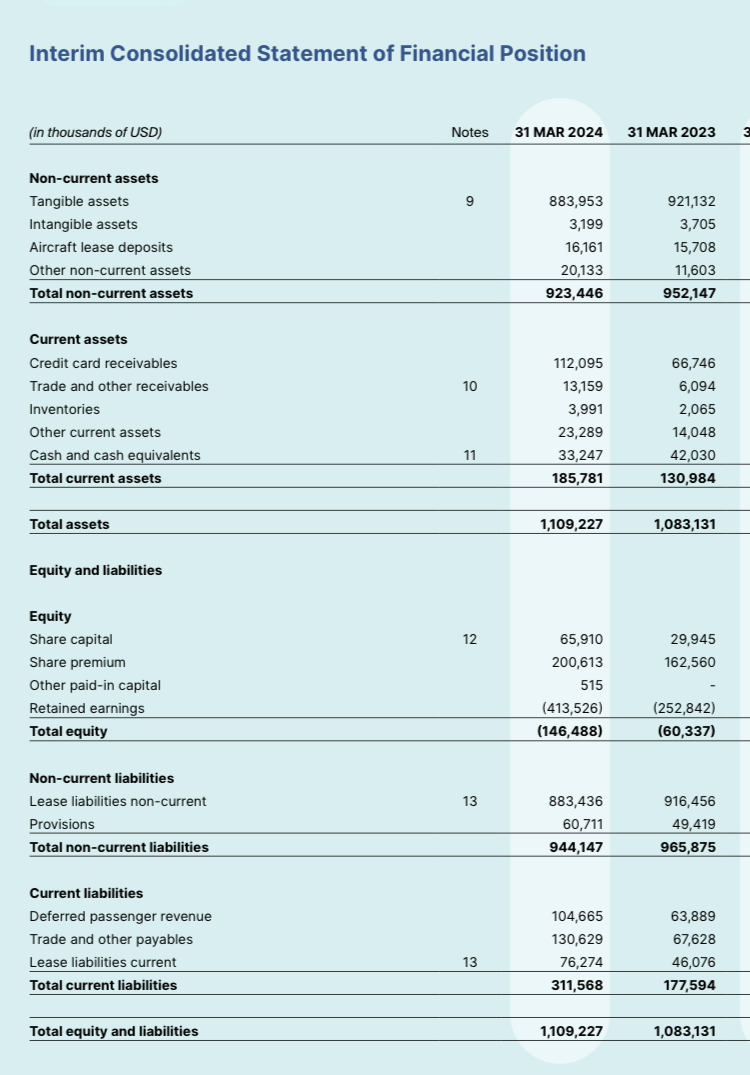
To me, it’s easy to understand that lease liabilities are not strictly debt, and no sane investor treats them as debt, otherwise you end up with crazy conclusions. For example, in Finland, many owners of “net debt-free” apartments would suddenly find themselves up to their ears in debt if (maintenance fee * the building’s remaining lifespan in months) were counted on the debt side, if liabilities are always considered debt.
On the contrary, if the leasing agreements are made on terms better than market price, as in Norse’s case, then they are an asset because they have a positive market value.
Extreme example: You won a lease for a brand new Tesla Model 3 for the next five years for €20/year in a competition. Do you have
a) debt worth €100?
or
b) a valuable contract that you could resell at a good price on tori.fi?
Norse has financed its startup with equity instead of debt, which is a great thing for new investors because the share dilution effect doesn’t affect them. It also means the company has financial headroom to take on more debt in the future if needed.
Now you are talking about planes that have nothing to do with Norse. I haven’t followed their fate nor “raved” about them. Norse is not Norwegian long haul.
Norse’s challenge is indeed that the company doesn’t have enough flight traffic on the East-West axis during the winter season, so in addition to charters, it makes sense to look for flights on the North-South axis. Nigeria’s couple-of-months ACMI experiment and this new South Africa scheduled service are sensible openings. This business is indeed not easy, and taking planes into own use in stages is sensible from a risk management perspective alone.
I’m not confusing them. Norse receives payments from credit card companies so late compared to traditional airlines, and the customer profile differs clearly, so the cash flow only comes through in Q2, which makes cash management during the weak winter season difficult. This is, of course, with the reservation that at some point Norse manages to negotiate better terms, but predicting this in advance is difficult.
I also take it as a given that with these passenger numbers, Q2 will be positive in terms of profit, and talk of a share issue in the fall can be dismissed.
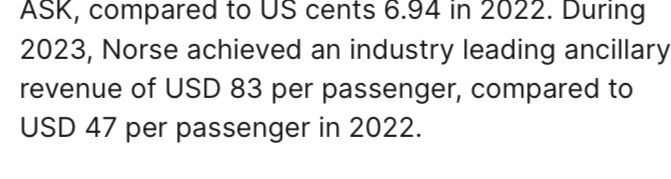
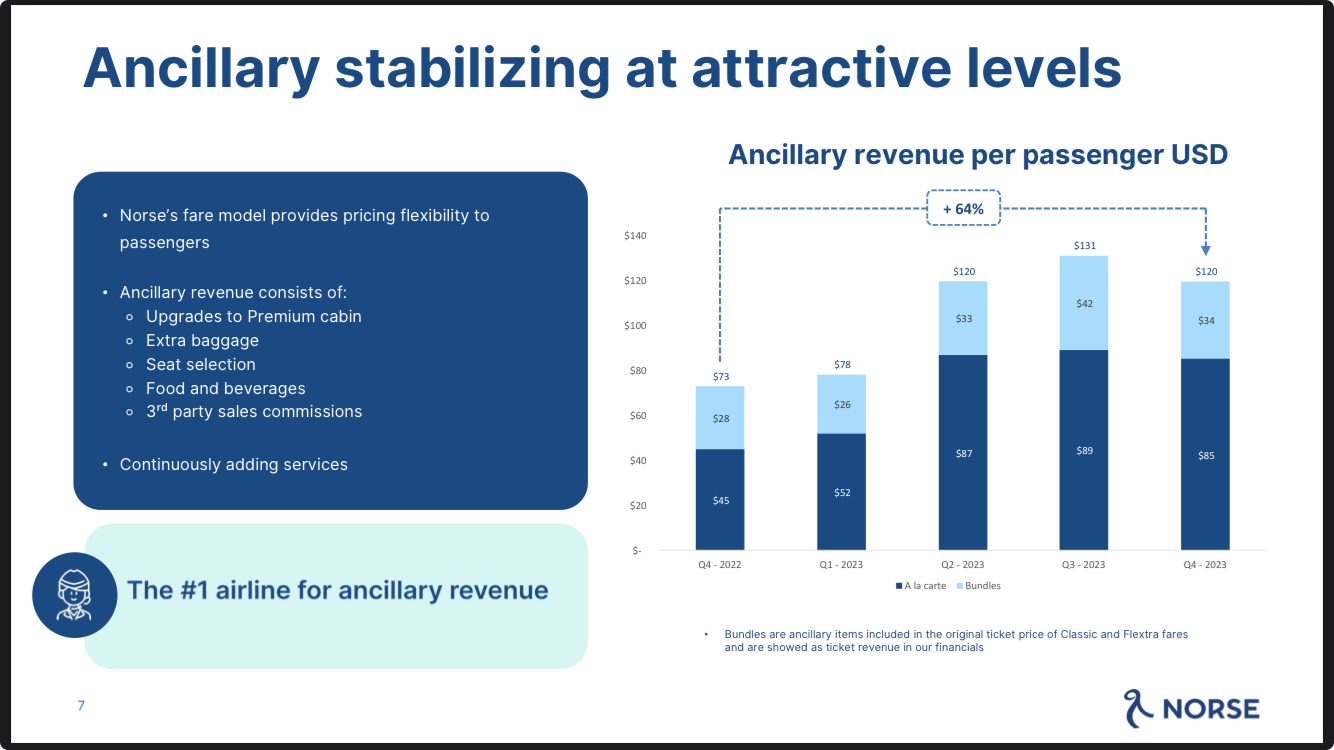
It is completely in line with Norse’s strategy to fill the planes as much as possible with lower starting prices than competitors and then squeeze money out of customers through ancillary services. There has been huge progress here, and according to the company’s communication, the trend for 2024 is also on the rise.
You clearly disagree with the sensibility of this company as an investment, but I find it quite outrageous to call this a pump-and-dump thread. Creating and updating this thread has taken a considerable amount of my time, and I believe the posts I’ve made have included comprehensive justifications.
Even if I am completely wrong about this stock (which happens regularly, too), it doesn’t mean I haven’t sincerely believed in what I’ve written. It is also not fair to try to shift the responsibility for other investors’ investment decisions onto my shoulders. Ultimately, it is the investor’s own responsibility where they put their money, and hopefully, there is more thought behind the investment decision than just following an internet pseudonym.
It seems messages get deleted very easily here if you don’t swallow all the claims without question. Should we just sit here humming along and patting each other on the back for good boosts? I will, however, respond to a few claims presented above; let’s see if this one gets deleted too:
Aircraft leasing agreements are very rarely sellable, so their market value is zero euros. Additionally, Norse received power-by-the-hour (PBH) agreements for a period of 2 years, and now they pay fixed rent for their planes like other companies.
Norse has lost its equity along with the losses, so it has no equity.
The company reports ancillary services in a unique way compared to other companies in the industry, but even considering those, the company’s revenue was, for example, 2/3 of its costs in Q4. Taking all income into account, the company received 4.2 dollar cents in revenue while costs were 6.72 cents. From there, it is a reaaaally long way to a profitable business.
People here are tired of listening to accusations of irresponsibility. Everyone makes their own investment decisions.
Where did you get the information that they are rarely sellable? Why, in the case that a leasing agreement cannot be sold forward, couldn’t the whole company be sold along with its leasing agreements? P1 has posted sources in the thread according to which an investment bank is involved for a corporate restructuring etc. Do you have better sources and if so, would you post them in the thread?
This whole investment case practically relies on Norse’s leasing agreements having value for the shareholders. It is not meaningful to have a discussion where you state the value is a flat zero because you think it is a flat zero.
For those following the industry closely, that is common knowledge. Also, slots for aircraft ordered directly from manufacturers cannot be sold forward because the agreements with the manufacturers prevent it. When selling an entire company, the situation is of course different, because the contracting party remains the same.
Norse has been saying since the beginning of the year that they have buyers lining up. The responsibility for the credibility of the message lies with the listener, as with these stories here.
This case is on thin ice if it relies solely on that. However, I read above that they are making a profit hand over fist.
Hardly anyone flagged your previous message because you disagreed, but because it was unnecessarily aggressive. It is, of course, a huge benefit to the discussion that an experienced investor like yourself plays contrarian in the thread.
Er, these contracts are certainly compared to similar ones available on the market, and Norse has the opportunity to sublease the planes further, thereby earning the difference between the contract price and the market price. Another clear option is, of course, that the entire company is sold and the buyer gets those good leases.
Nowadays, Norse does indeed pay a fixed price, but according to the company’s announcement, the contract does not include inflation adjustments or similar clauses, which I understand other companies normally have in their contracts.
I mean, the company’s financing has been arranged through equity financing, i.e., share issues. This is a huge plus for new equity investors, because the cost of financing has been paid by previous shareholders, and there is no interest-bearing debt acting as an anchor on the company’s cash flow. Past losses are someone else’s problem.
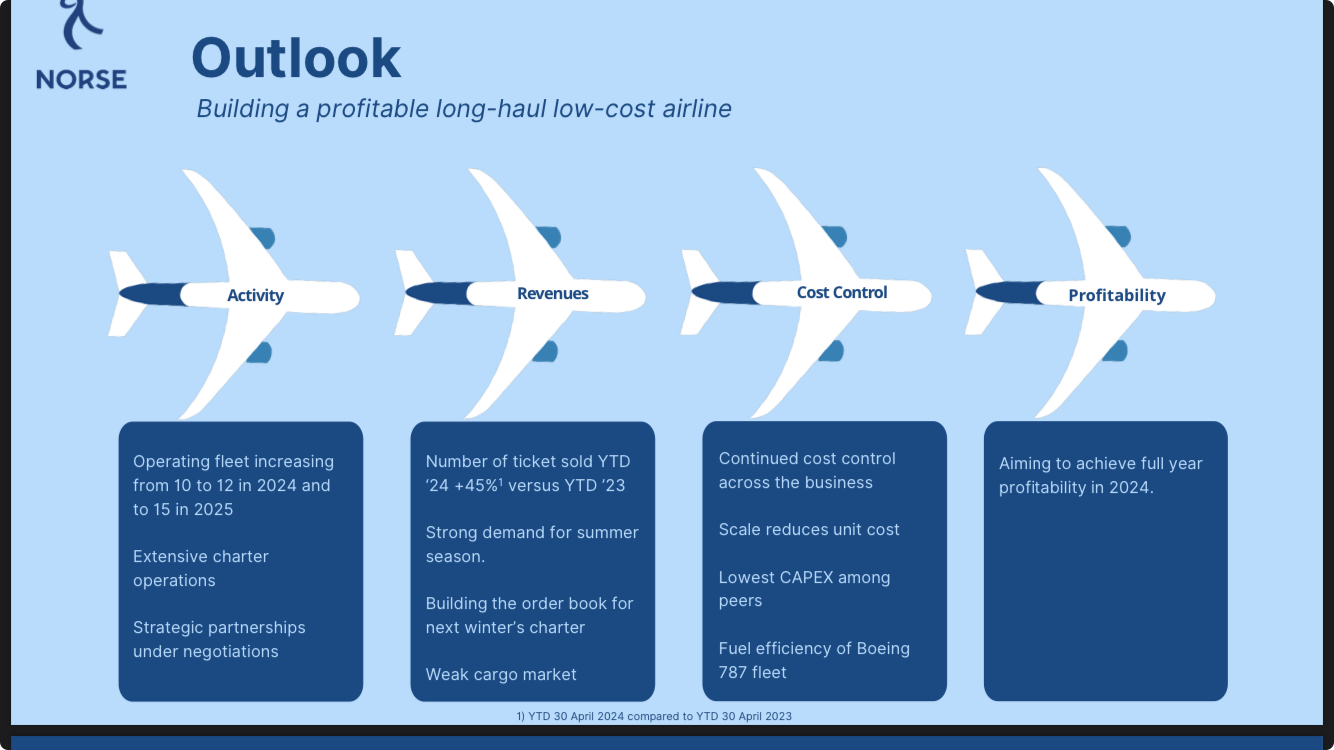
Q4 and Q1 are very difficult for Norse during the winter seasons, and with poor choices, a lot of money can be lost then; one cannot expect more than a zero result at best from these quarters in the future. A sufficiently large profit must therefore be made in Q2 and Q3. Now they are getting a few more planes for the summer, and the ramp-up will continue until 2025, when all 15 aircraft will be in use. Of course, if this is not successful, the company’s business logic will break completely, but so far all signs indicate that this summer will be excellent.
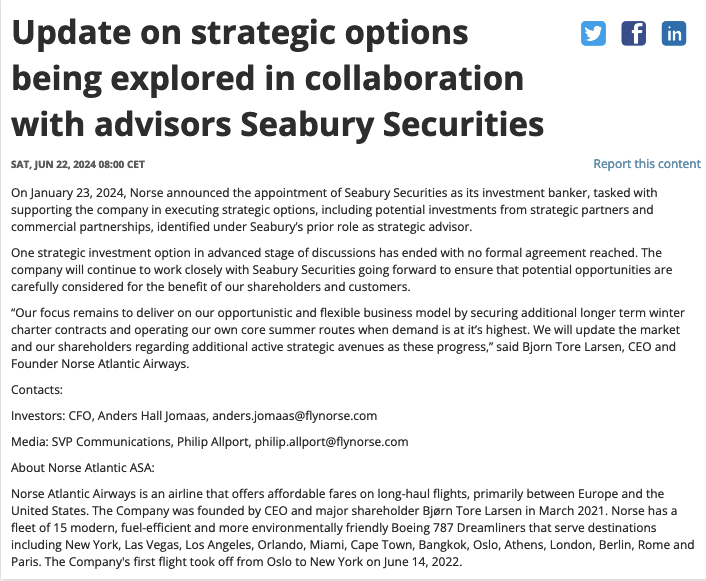
Past experiences have shown that when a low-priced company hires an investment banker to explore ‘strategic alternatives’ and communicates that there is external interest, the chances of an M&A (mergers and acquisitions) event or other arrangement are very high.
In practice, two catalysts for a share price rise from current low levels are being offered for the coming months. An M&A event or a successful Q2 & Q3 in terms of business and stronger investor confidence in operational activities.
Of course, there is a lot of risk here, but at least for me, the expected return is sufficient
• Revenue increased by 97% to USD 78.2 million in Q1 2024 compared to Q1 2023
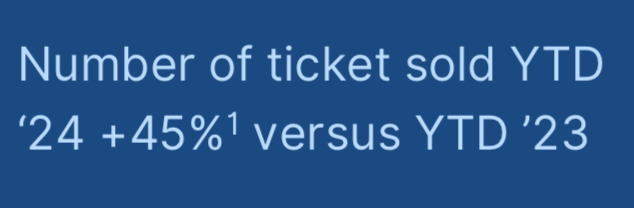
• 201,462 passengers carried in Q1 2024, up 83% compared to Q1 2023
• ASK up by 72% in Q1 2024 compared to Q1 2023
• Load factor increased by 19 percentage points to 73% in Q1 2024 compared to Q1 2023
• Strong operational performance as 100% of planned flights were completed during the quarter
• Record high number of ACMI and charter operations, totalling 107 flights during the quarter
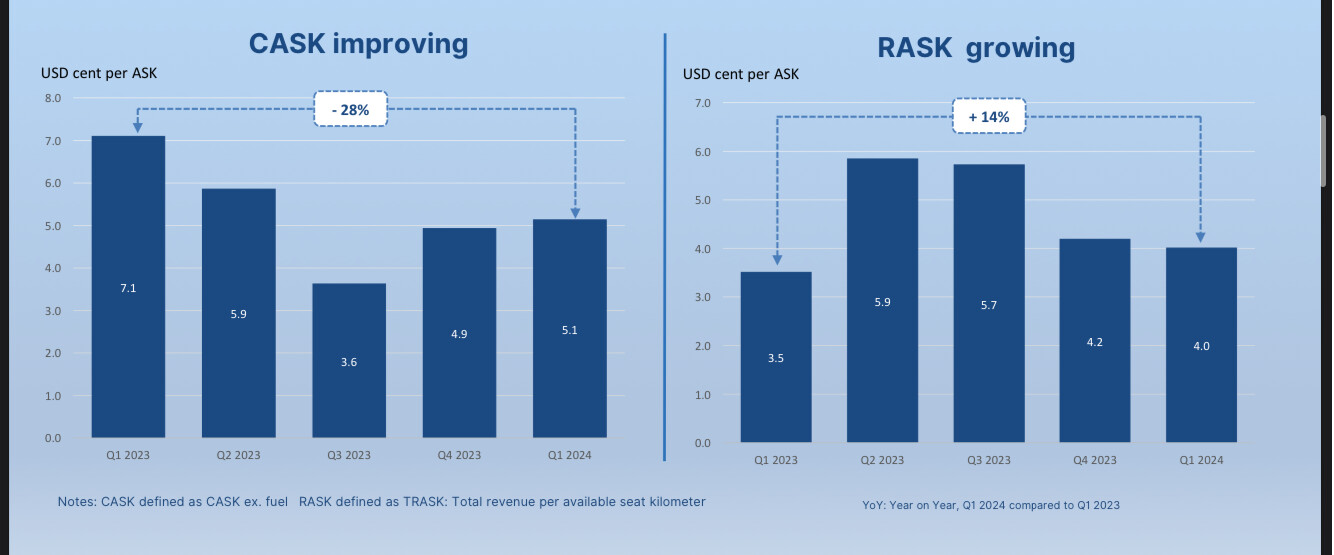
• CASK numbers improving, CASK ex fuel being down by 28% in Q1 2024 compared to Q1 2023
• Total cash held at end of quarter at USD 33.2 million
• Subsequent to the quarter end, a USD 20 million revolving credit facility was secured from Norse’s two largest shareholders for the purpose of providing a liquidity buffer prior to moving into the more cash generative summer season
• Strategic options continue to be developed and explored in collaboration with advisors Seabury Securities
“The first quarter has shown major improvement on all metrics compared to the first quarter of the previous year. ASK was up about 72% year-on-year, and load factors increased by 19 percentage points with improved revenues per passenger. Norse Atlantic continued to demonstrate robust operational excellence as 100 % of the quarter’s scheduled planned flights were completed as planned.
This winter we have developed seasonal strategies, with more emphasis on holiday destinations and charters. Norse Atlantic managed a record high of 107 charter flights during the quarter. We will refine this strategy further for next winter, with several longer-term contracts secured or under negotiation.
We are looking forward to the busiest summer season so far in Norse Atlantic´s short history. During the summer the fleet of aircraft operated in Norse’s own network increases from 10 to 12 aircraft, representing a capacity growth of 20%.
Norse will continue to focus on careful and profitable growth. We are happy to see that our footprint in the market has increased as the network expands to include Athens this summer, Las Vegas from the fall, and a new continent as Cape Town joins the network in the winter. Our goal is to see CASK continuously decreasing year-on- year for each quarter. Norse remains steadfast in its commitment to achieve the lowest CASK in the Transatlantic market. Norse is on a path towards year-round profitability, and a successful summer 2024 is the next important stepping-stone on that journey,” said Bjorn Tore Larsen, CEO and Founder Norse Atlantic Airways.
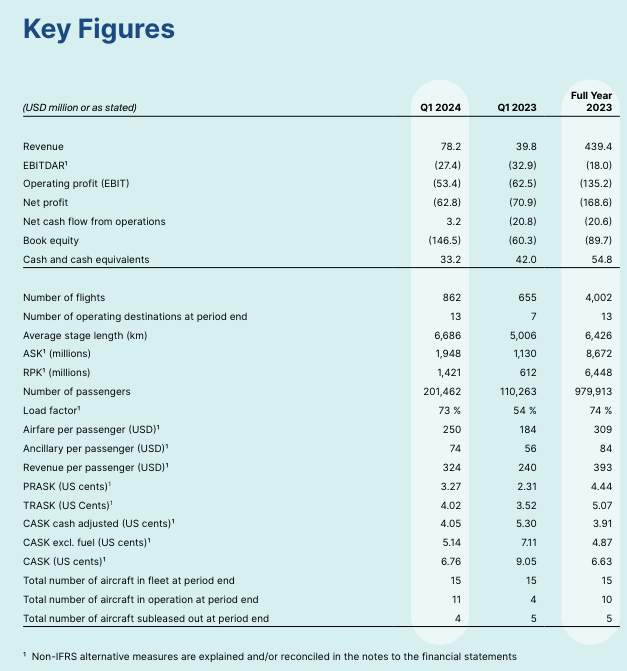
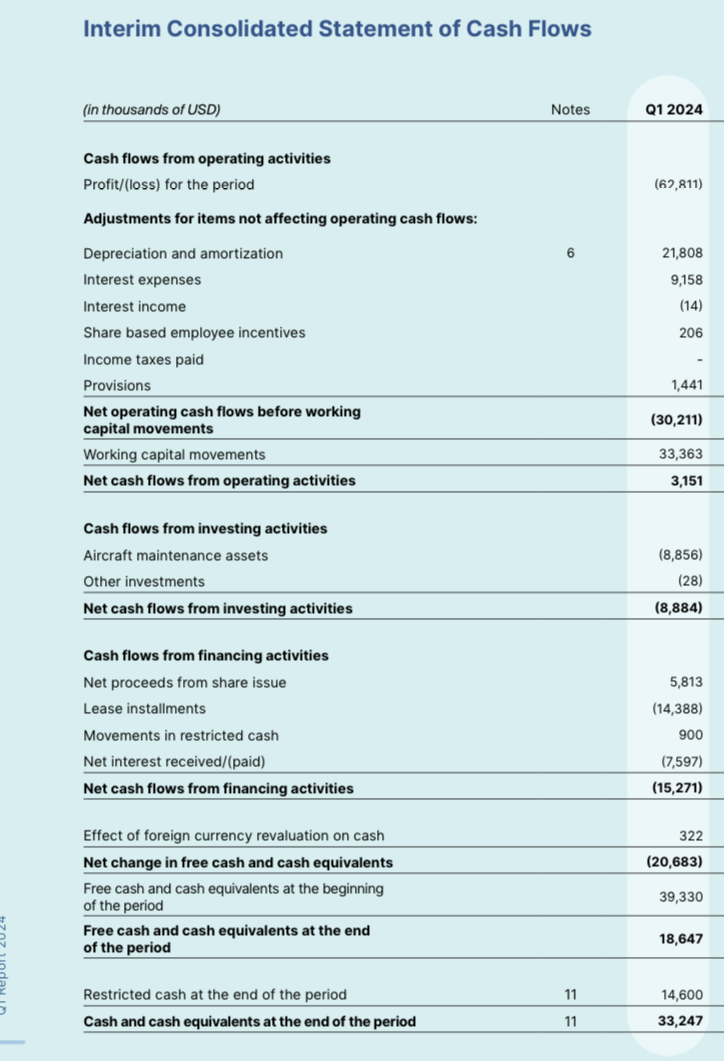
Eka, do you want to break down this income statement? A big negative at the EBITDA level (about 30% of revenue), but net cash flow from operations is slightly positive?
Currently, credit card companies hold onto the cash for a couple of months after the advance payment before releasing the funds to Norse, because if the company were to go bust, the credit card firms would be liable for refunding the money. Established operators get better terms and access to the funds more quickly. This complicates Norse’s cash management during the quiet winter season.
In my opinion, the report was as expected. It’s hard to find even small glimmers of hope in it, even if you look for them, unless you ignore the management’s overly optimistic expectations. If an airline records a loss nearly equal to its revenue, it can no longer be chalked up to seasonality, even during the weakest quarter of the year.
There was already a mention above that the company’s operating cash flow was slightly positive. The most significant factor for this was the increase in accounts payable (+$42m) to a level of over $130m, which is always a worrying sign for an airline struggling with cash flow. The net effect of advance ticket sales and credit card holdbacks on cash flow was ±0.
The usefulness of the unit revenues and expenses published by the company is slightly complicated by the revenues and expenses from aircraft out-leasing, but even so, it is clearly evident that ticket prices are very low compared to costs. When you add the low load factor to this, the bottom line on the income statement is bright red.
Regarding expenses in the cash flow statement, the significant increase in leasing costs caught my eye, as almost all aircraft have moved to fixed pricing. Comparing the revenue side to expenses, I am not at all convinced that the aircraft leased to Air Europa even cover their own costs. This was certainly the case at the start of the lease, when the rent was paid based on usage hours.
Perhaps the biggest point of suspense for the coming months is whether the company’s cash reserves will last through the summer season. At the end of March, there was $15m in unencumbered cash, in addition to a $20m injection from the main owners. In my opinion, any dreams of a profitable Q2 can be forgotten after this report, but perhaps Q3 will finally hit the mark?
The Q1 result was indeed a massive minus 62.8 million euros, and yet the full-year guidance is that Norse will be profitable. There is no way to achieve this unless Q2 is profitable, Q3 is clearly profitable, and Q4 is close to break-even. By May, management should certainly have visibility into how Q2 is going, so do you feel they are just straight-up scamming investors?
If we assume those sub-leases are at a very small premium, and we get +20% more aircraft for the summer season and higher load factors, then expenses will drop with leverage and that goal shouldn’t be a completely impossible target.
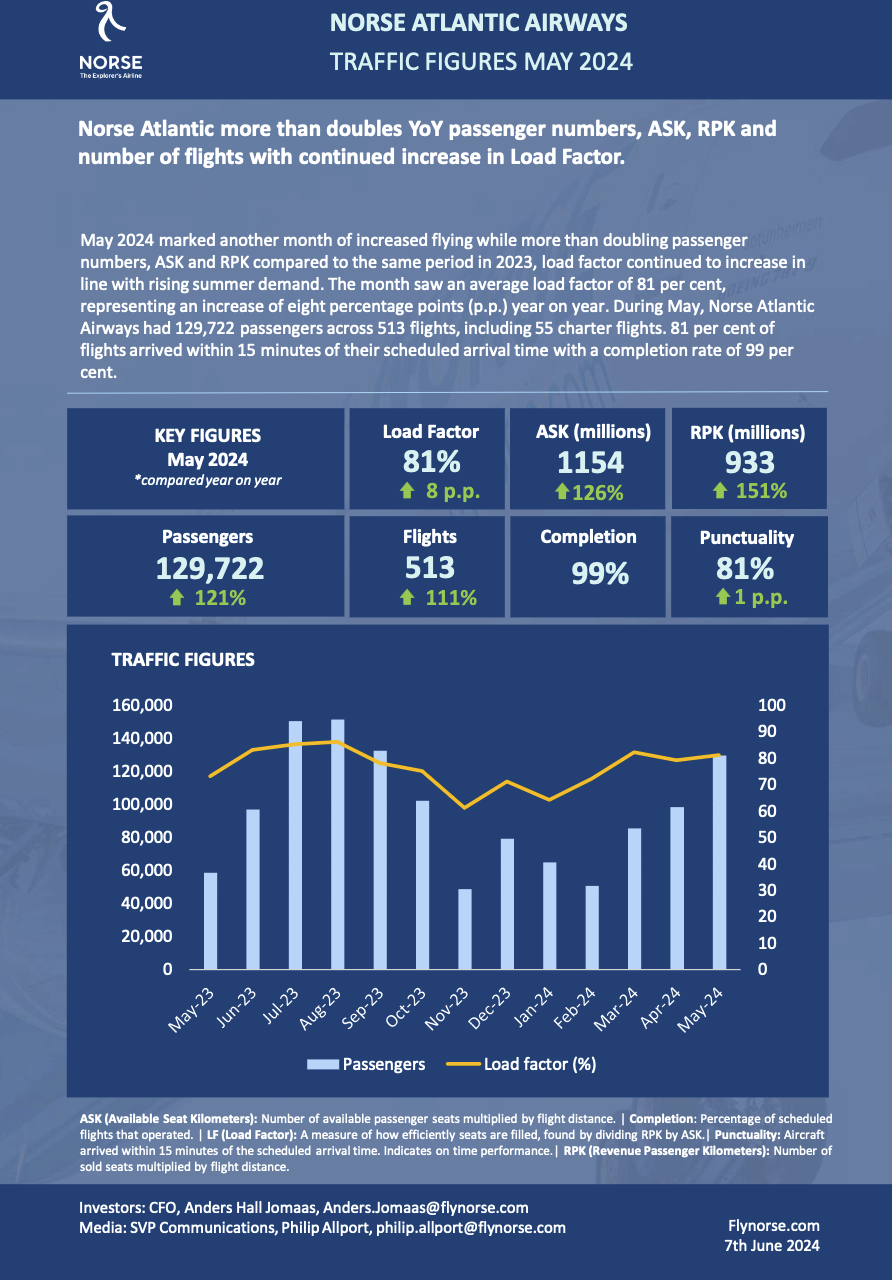
24Q2 passenger numbers currently look to be close to 23Q3 passenger numbers, which was a profitable quarter for Norse.
There were hints about 24Q4 strength in the interim report, so reaching close to a break-even result could now be realistic, as they are no longer flying the company’s actual first winter season.
According to Larsen, the scheduled flights during the winter have been performing well, with the executive seeing good sales on these routes, making Norse Atlantic optimistic about its future prospects. In addition, the charter side is off to a very good start, with the airline already selling out more charter flights during the next winter than it flew during the past winter period.
If you compare the CASK (ex-fuel) of different quarters, there is a huge scalability of costs depending on the flight volume and load factor:
Of course, if the guidance is a scam and the very drawn-out negotiations with investment bankers are just a smokescreen, then there is certainly plenty of room for the share price to drop
There is undeniably some of this going around. The closest example can be found in the Neste thread.
Margins were announced to be falling as early as the beginning of the year, yet the guidance was maintained. Investors lived in the belief that volume growth would sustain the guidance.
Now, the negative profit warning came.
Since this is also a company in trouble that needs investors, new financing rounds sound likely.
It probably wouldn’t be easy to tell investors before the summer season that we’re going to be in the red this year as well.
I don’t know how common that procedure by credit card companies is, but it sounds like they aren’t particularly confident, at least.
Negative Q2 profit warning from Norse, hints of short-term liquidity issues, etc.
The stock has been halted for an hour already; currently, it looks like it would open down about -50%. Apparently, everyone is rushing for the exit at the same time.
The story is unfolding exactly as I wrote back in May:
Today it was reported:
-Q2 below expectations due to lower-than-expected fare levels
-Q3 and H2 expected to be profitable
-Tail-heavy summer bookings curve puts pressure on August cash position while
awaiting credit card receivables being collected. Various working capital initiatives
ongoing
So, it seems the cash reserves won’t even last through the summer season, and the mean credit card companies are withholding payments. Fortunately, everything will be fine next year: