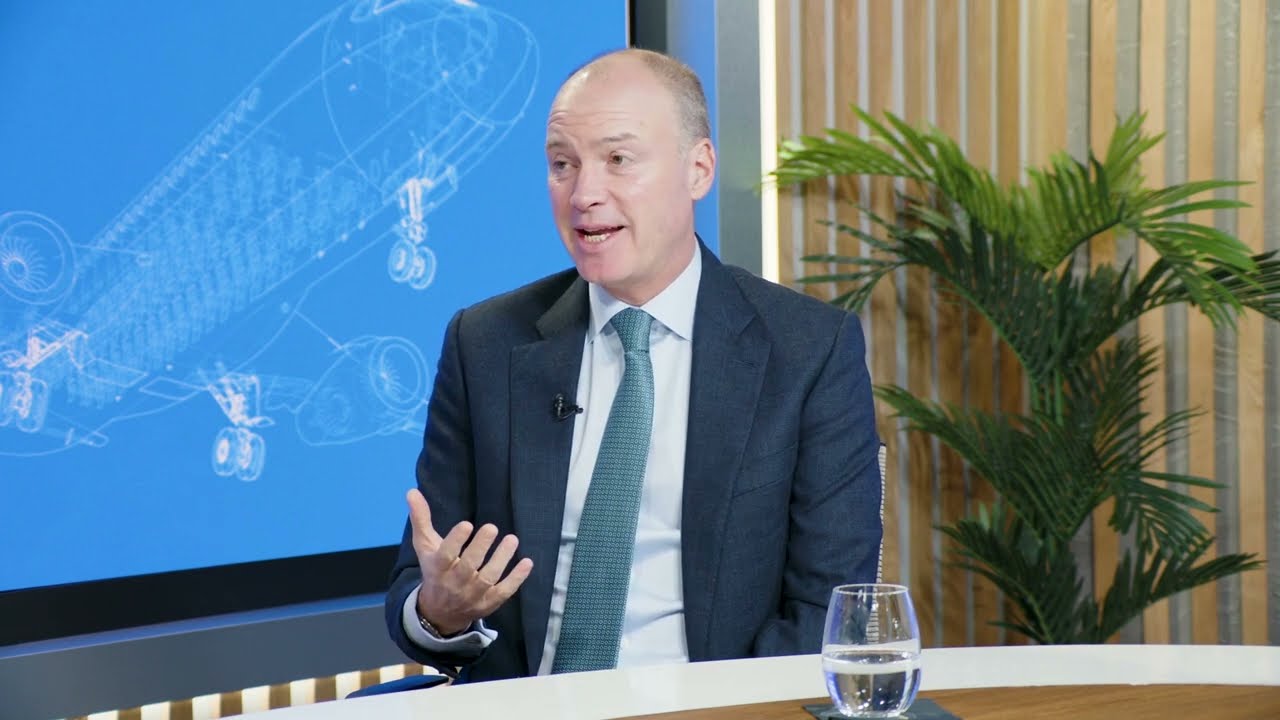
What comes to mind when talking about investing in the aviation industry? Airlines are among the first, as well as top-condition and expensive component manufacturers. But what about the company that owns the planes? This thread discusses a company that receives relatively little attention compared to its size and significance to the entire industry.
AerCap Holdings (NYSE: AER), founded in 1995 and headquartered in Ireland, is a global giant in the aircraft leasing market. It is by far the world’s largest lessor of passenger aircraft, helicopters, and engines, with customers increasingly being airlines around the world—AerCap owns a total of approximately 3,500 of the aforementioned assets.
Market Cap: 16.9 BUSD
Revenue (TTM): 7.76 BUSD
EPS (TTM): 15.18 USD
Book Value per Share (June 30, 2024): 89.5 USD
Share Price (August 4, 2024): 86.61 USD
AerCap’s business is of a fairly boring sort, but understandable to anyone familiar with the leasing business: it buys planes and engines from manufacturers (sometimes also from other parties), finances the purchases with debt and equity, and then leases them out. Lease agreements in the industry are long, with AerCap’s average agreement lasting over seven years. In addition, AerCap earns money from the maintenance of planes and engines, which is usually included in the lease agreement. However, this is a very small part of the company’s total revenue (less than 10%).
History
Next is a bunch of acronyms, for which I apologize in advance.
In the early 2000s, the leasing industry was smaller than it is today, and was dominated primarily by two players: GECAS, owned by General Electric, and ILFC, owned by AIG. AerCap—then still under its predecessor name Debis Airfinance—was a smaller competitor, but in 2014 this changed when AerCap acquired ILFC for a purchase price of 7.6 BUSD (consisting of cash and a significant stock issuance), acquiring 41 BUSD worth of assets in the deal, ILFC’s order backlog for future growth, and of course creating a credible competitor to GECAS. AIG’s sales intentions were based on organizational restructuring and the repayment of bailouts from the financial crisis, so AerCap was able to buy ILFC below its book value—an event that tends to be common in AerCap’s deal-making.
The coronavirus pandemic thoroughly disrupted the aviation industry’s plans, but AerCap certainly did not rest on its laurels. In March 2021, AerCap announced it would acquire GECAS from General Electric in a massive 30.2 BUSD deal, which made AerCap the king of the leasing market. It also opened up a new business area for AerCap, as GECAS’s helicopter business Milestone transferred to AerCap’s possession as part of the deal. Like the ILFC acquisition, this deal was also based on the seller’s intention to restructure the company, which allowed AerCap to once again buy assets at a discount. GE simultaneously became AerCap’s largest shareholder, as the consideration included 6.6 BUSD worth of AerCap shares. More on these later. In two decades, the tiny AerCap thus swallowed both of the industry’s two rulers, and now stands completely in its own majestic isolation as the number one in its field.
Business Segments
- AerCap Leasing: The core business, i.e., aircraft leasing. The largest and most important part of the company, with approx. 90 percent of revenue coming from this. The business is very globally diversified: the five largest customers account for 20 percent of the company’s fleet, and customers are not concentrated in a single continent. The APAC region is the most important market for the company, where a third of the company’s planes are leased. As I mentioned above, aircraft maintenance agreements are baked into the leasing; as I understand it, things work the same way across all business segments.
- AerCap Cargo: Same as above, but with cargo planes. Their share of AerCap’s fleet is 120 units, meaning the business is on a smaller scale compared to passenger aircraft. The largest customers are Amazon and Maersk.
- AerCap Materials: Aircraft parts repair, distribution, and sales business. AerCap has its own facilities for dismantling aircraft, which also provides spare parts for the use of over 850 customers.
- Milestone: Helicopter leasing business. The fleet size is a good 320 helicopters, and the customer base includes, among others, transportation service providers and energy companies.
- AerCap Engines: Perhaps the most interesting part of the company. Engines is a business handling aircraft engine leasing, in which AerCap has made heavy investments in recent years—the company’s CMD communicated approx. 8 BUSD in engine orders over the previous three years. Airlines need to keep planes in the air, and planes cannot be out of commission for long periods due to engine troubles. The Engines business answers this problem by offering replacement engines on a quick schedule as well as engine maintenance services. Shannon Engine Support, a joint venture half-owned by AerCap and engine manufacturer Safran, is part of this segment. In the 2023 annual report, AerCap mentions that the company generated 124 MUSD in leasing revenue.
Competitive Advantages
Aircraft leasing is not a business that enjoys deep moats and high profit margins—quite the contrary. However, AerCap gains economies of scale thanks to its large size. A broader global network, good relationships with manufacturers, financial capabilities for acquisitions, exposure to different aircraft types, and maintenance agreements guarantee an advantage over competitors. Entering the market as a new player is also not particularly easy.
Market TrendsFrom the perspective of AerCap’s investment thesis, there are a few important market trends that must be mentioned here:
- Growth of the leasing market. In recent years, an increasingly large share of new aircraft has ended up on lessors’ balance sheets rather than directly in the possession of airlines. Aircraft tie up so much capital that leasing is a better option for more and more companies.
- Demand for air travel is at its peak. People can think whatever they want about environmental issues, but flying is anything but ending. This has ensured that there is demand for the planes of AerCap and other lessors despite rent increases (between 2019-2023, a 20 percent growth in the rents of the largest aircraft group, i.e., the A321Neo, with the utilization rate approaching 100 percent). This is especially true in light of point no. 3:
- Production of new aircraft and engines is stalling badly. Boeing, Airbus, Raytheon – all major manufacturers, all signaling major production problems over the last 12 months. There are problems in both supply chains and safety aspects, as many have certainly seen in the news.
Supply is therefore nowhere near sufficient for everyone scrambling for aircraft. Example: according to AerCap’s CMD materials, new aircraft production for 2024 is set to remain at the level of 2017! Meanwhile, the CEO of AerCap’s competitor/peer company Air Lease predicted in their Q2/2024 earnings call that Boeing’s and Airbus’s production problems will continue for 3-4 years – the same line that AerCap’s management has also communicated.
Where does this lead then? Well, to positive things for those who have usable aircraft available for rent – and for sale to willing buyers.
A Masterpiece of Capital Allocation?
Every CEO’s most important task is to grow the company’s fair value per share. If you learned fractions in elementary school and capital allocation later in life, you know very well that it can be grown in two ways: grow the value (numerator) or reduce the number of shares (denominator). If I have seen one CEO during my investment career who understands this, it is AerCap’s Aengus Kelly. The image below summarizes Kelly’s mindset:
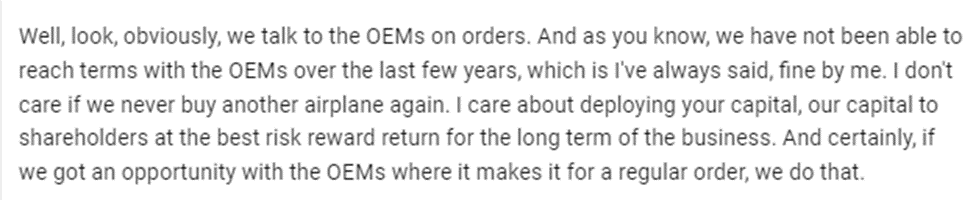
AerCap’s management has succeeded brilliantly in recent years in allocating capital in a way that benefits owners, which the share price has also thanked them for. Below are example cases:
- AerCap has sought to acquire new planes opportunistically and counter-cyclically. The GECAS acquisition after the collapse of air travel is a clear example, but also the recently published news of purchasing an order book of 37 Airbus 321Neo aircraft from budget airline Spirit Airlines, which was struggling in a liquidity crisis, demonstrates fast and efficient action.
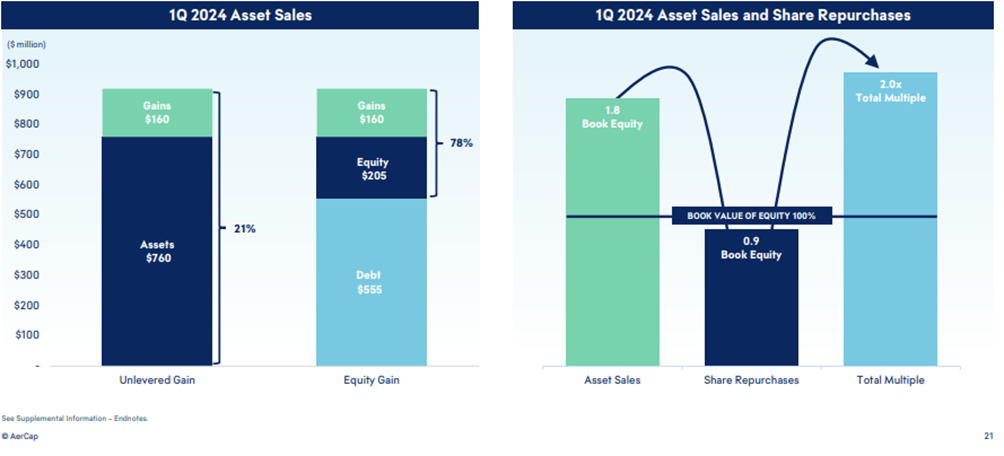
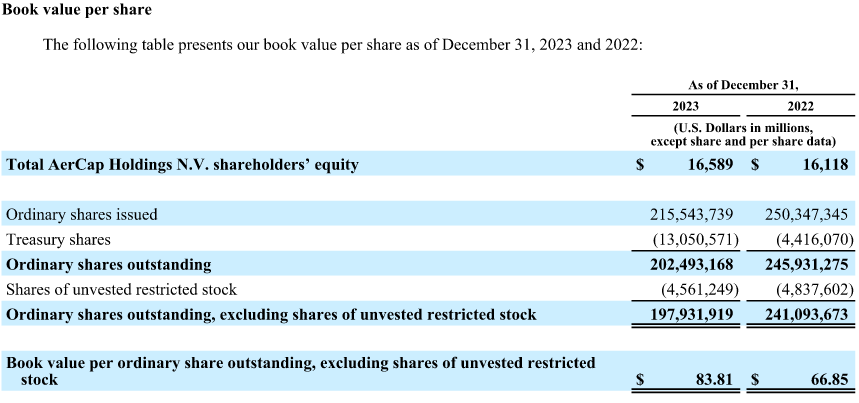
- Massive share buybacks and cancellations – in 2023 alone, when AerCap’s own stock was valued at approximately 0.8x book value, the company canceled 18 percent of its share count! Most of this was, by the way – how could it be otherwise – shares bought from GE, which AerCap acquired 36.4 million units of (approx. 15% of the total share count). First, GECAS was bought below fair value, then the shares floating in the transaction were bought back at a discount. Not bad.
- How has AerCap financed such massive buyback programs? The answer is easy: AerCap has exploited the supply and demand imbalance by selling its older fleet at high prices to airlines at approx. 15-20 percent above their book value. This is clearly above the long-term average (10%), which reflects the demand situation. The markup may sound small, but since AerCap’s fleet is largely financed by debt, the sales bring in a lot of money relative to equity. The setup is crowned by the repurchase of own shares below book value, as the chart below shows.
AerCap offers investors a treat in terms of capital allocation: whether it is organic growth, acquisitions, shrinking or growing the business, the goal is always as clear: value creation for shareholders.
AerCap’s capital allocation plan is clear. Maintaining a healthy debt level and an IG (investment grade) credit rating is the top priority, after which the focus, when opportunities arise, is on new aircraft orders and share buybacks. The company also started paying dividends as the stock’s valuation rose to the level of book value, and the company intends to drive dividend growth by reducing its share count. Helsinki stock exchange kiosks, write that down.
Management
The company’s top management is obviously experienced, and most are long-standing veterans from ILFC and GECAS before the acquisitions. As said above, the CEO is Aengus Kelly, who has worked in the industry in various roles for 25 years and owns about four percent of the company. Kelly’s style could be described as conservative, at least when it comes to conservative guidance and subsequent upgrades throughout the years. Customer service for investors, shareholder value, and buybacks are truly close to the hearts of Kelly and AerCap’s management.
Risks
The airline business involves many risks, a couple of the clearest of which have materialized in recent years in the form of COVID-19 and Russia’s war of aggression. Although AerCap has proven very capable of anticipating problems and repossessing its fleet in problem situations, it is not immune: a significant amount of AerCap’s fleet (5% of the portfolio) got stuck in Russia in the winter of 2022. Although insurance payouts compensate for the loss, and they are considered one of the sources of AerCap’s hidden value (estimated at approx. 7 USD/share in future payouts), it is good to remember that many things can go very wrong very quickly.
Interest rates are also a risk factor. Since the fleet is largely financed by debt, monitoring interest rate movements is appropriate. However, the rise in interest rates in recent years has been weathered without problems.Valuation?
At AerCap’s CMD, the company highlighted that its stock is inexpensive by the standards of both financial institutions and industrial companies.
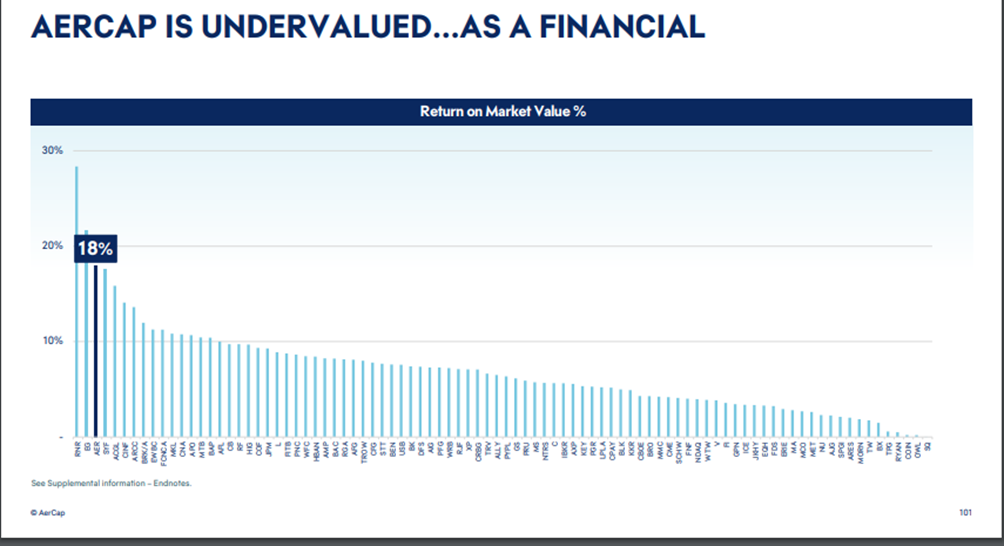
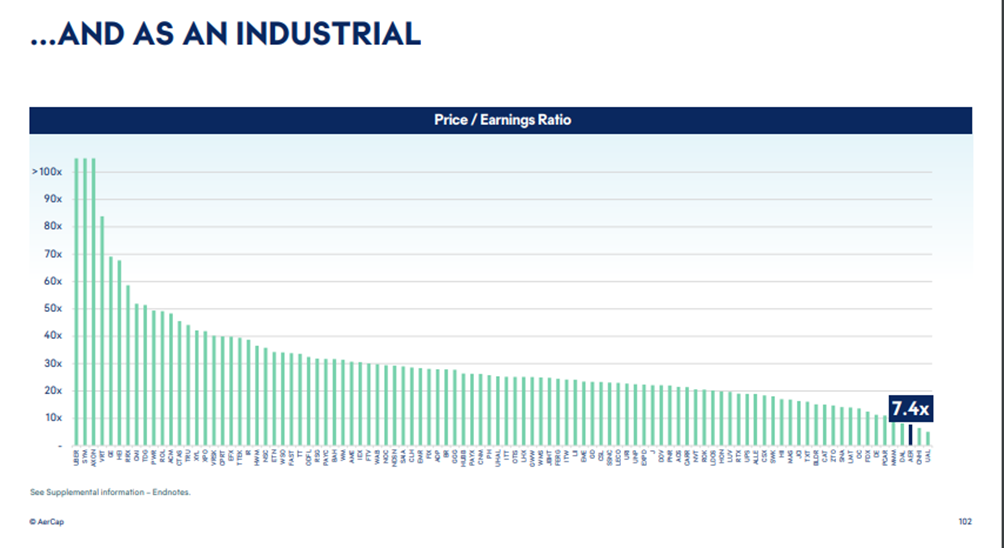
Since AerCap resembles a bank in many ways, the most sensible valuation metric is likely the P/B ratio. It has hovered around the mark of one – though it is worth remembering here that in the current demand environment, the fair value of assets is quite clearly higher than the book value. Historically, however, aircraft lessors have not been valued much above a P/B of 1 (often below it), and there isn’t necessarily a reason for that to change – the business is cyclical and generates a return on equity of just over 10%. In recent years, however, AerCap has approached the 15% threshold in a strong market – if one believes that the favorable conditions and strong execution will continue, the valuation is moderate. Speaking of valuation – AerCap’s valuation will likely be supported by the company’s tendency for share buybacks and cancellations. This is a clear advantage compared to, for example, the aforementioned competitor Air Lease, which, despite its low valuation, has not bought back its own shares.
Concluding Remarks
AerCap is a versatile aviation company that has become a key player in the industry during a time of growing demand and limited supply. It is managed exceptionally well, growing and shrinking with the shareholder’s best interest in mind. The outlook for the coming years (and perhaps even further out) is brilliant, and AerCap is exceptionally well-positioned to benefit from manufacturers’ problems and the growth of air traffic. The company is not going to skyrocket through any world-shattering innovation, but barring a crisis that collapses air travel, the company has a good chance of achieving good, predictable annual returns for a good time going forward.
(Not an investment recommendation, I own shares of AerCap.)
 ). It’s quite easy to predict that as long as Boeing’s and Airbus’s problems continue, the position will remain strong and rents can be raised.