Introduction
The forum was missing a thread on Nordic Semiconductor, or more familiarly, Nordic or NS. No worries, I’ll fix that. In my opinion, Nordic Semiconductor is a very interesting company in many ways. It combines high technology, a significant market position, and a Nordic growth story. I wonder if anyone else here on the forum has looked into the company more closely?
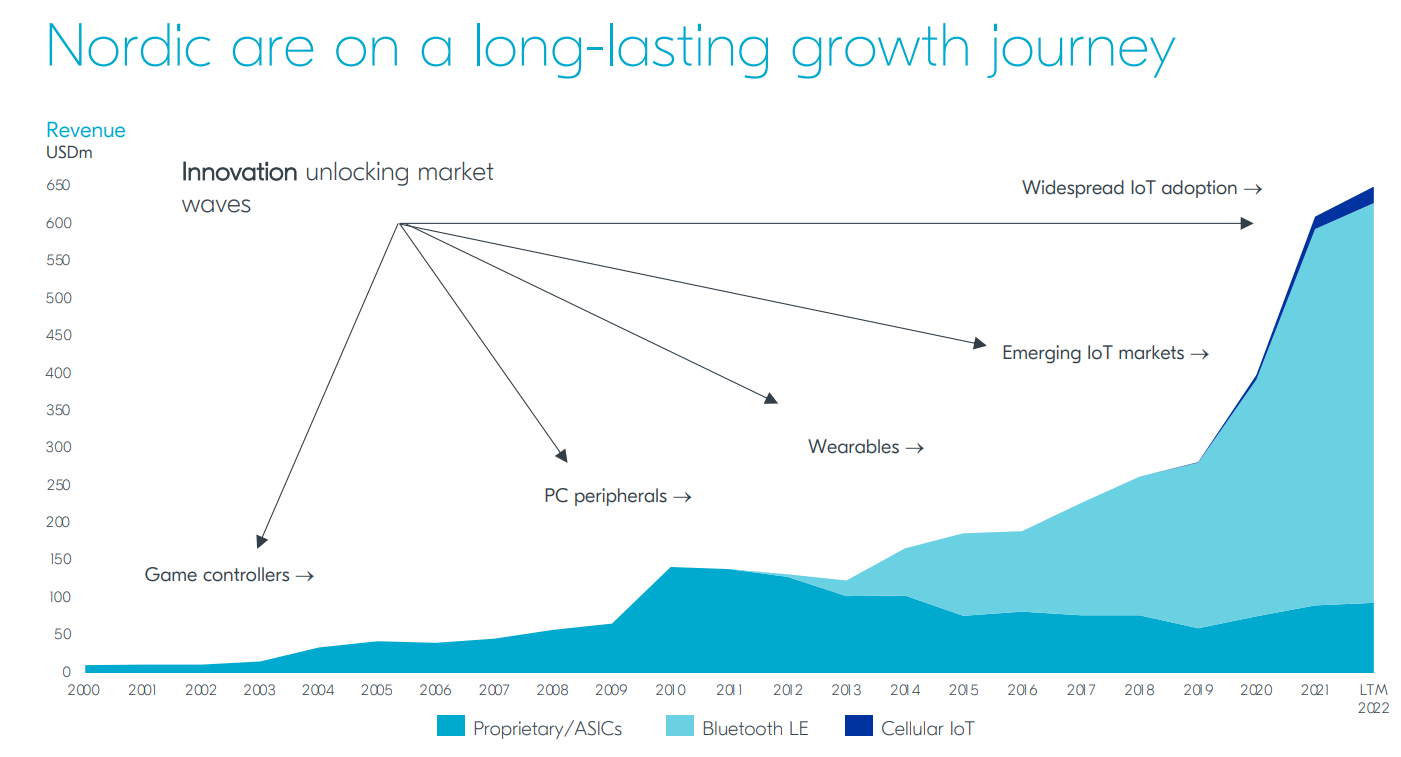
NS is one of the small-large MCU manufacturers. NS is nowhere near the largest manufacturers like NXP, TI, or ST when measured in absolute metrics. At the time of writing, NXP’s market cap is a shy 40 billion, ST’s is 24 billion, and NS’s is just over 2 billion. However, NS has an ace up its sleeve: insanely good radio IP that has been refined into a world-class Bluetooth radio and subsequently productized into the nRF51, nRF52, and nRF53 microcontrollers. This has led to a market situation where a company of NS’s size has a 42% market share of the BLE (Bluetooth Low Energy) MCU market. You don’t have to be a genius to notice that something is happening when a small player in the industry holds the lion’s share of a market that is predicted to skyrocket over the next decade.
NS Products
NS’s product portfolio is divided into 5 parts.
-
Proprietary ASICs:
Historically, custom radio solutions were NS’s mainstay about 10 years ago. Today, products in this category are a relatively small part of the entire company. Often these kinds of solutions are not public references, but as I understand it, the Logitech Unifying Receiver belongs to this category (Nordic is inside, but whether it’s a custom ASIC or a generic radio solution is debatable). This is the device used to connect a Logitech wireless mouse or keyboard to a computer via a small dongle plugged into the computer’s USB port. -
BLE:
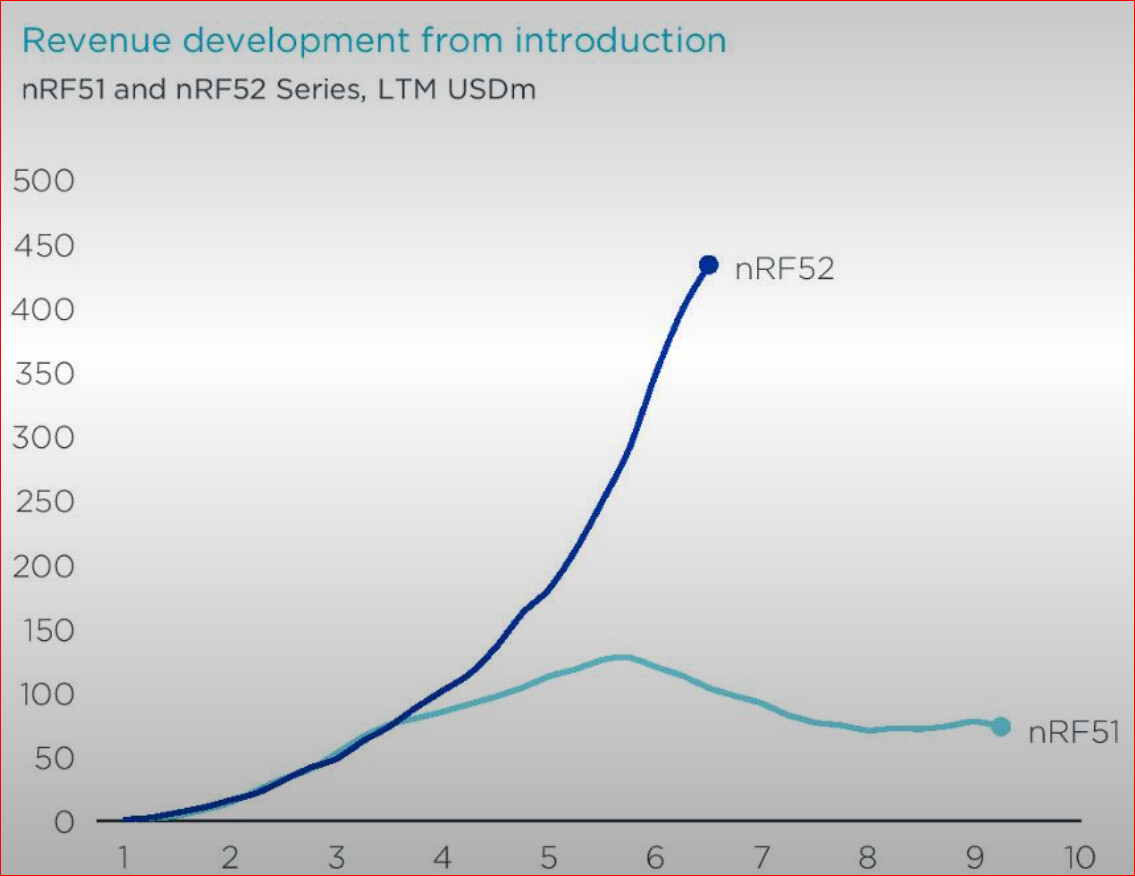
BLE is NS’s bread and butter and its most significant source of growth. Nordic’s first BLE product was the nRF51 series. The product brought NS to the attention of developers and began building trust between developers and NS. The product was significant at the time because it combined a capable microcontroller and peripherals, low power consumption, and a BLE radio into one package. The nRF51 was the first released product, and its successor, the nRF52, can be considered a more mature and improved nRF51. The nRF52 is larger, more powerful, and more energy-efficient than its predecessor. Both chips have a single ARM core on which both the radio and the application run. To function, the device requires a “softdevice,” which is a software device included as part of the binary. The SD specifically contains the radio core. Because the radio and application share the processor, it leads to interesting situations from a development perspective—especially regarding how memory and Flash are shared. Also, stepping through code line-by-line with a debugger while BT is on will crash the device sooner or later. The nRF52 is not perfect, but it’s a damn good compromise on many fronts. It is particularly well-suited for the ultra-low-power segment, as a device can operate as a BT beacon for years on a few AA batteries. The Finnish RuuviTag uses the nRF52 chip. It has a bunch of sensors and BLE. The manufacturer promises several years of operating time on a single battery (with an asterisk, of course). The newest member of the nRF series, the nRF53, is significantly different from its predecessors. The nRF53 contains separate processors for the radio and the application. The application core is also slightly more powerful than in the nRF52. The chip is still fairly new to the market, and there is no reliable data on its sales statistics yet.
I have over a year of active professional experience with the nRF52. Nowadays, the nRF52 serves as my primary platform for hobby projects. I’ll post a Git repo somewhere eventually when the project is in a state where it’s worth showing. You can then peek at what code and architecture made for the nRF52 look like.
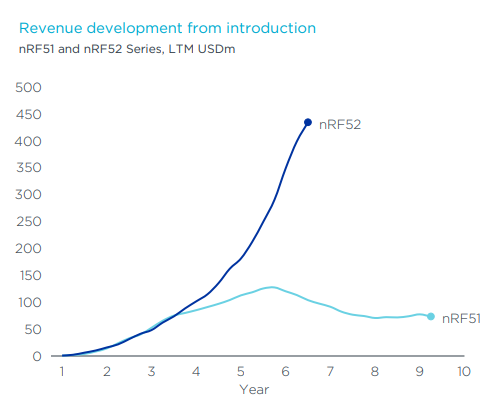
As seen from the graph, sales of the nRF51 and nRF52 have clearly developed, and the maturity brought by the nRF52 has been well received by the market.
-
Cellular IoT:
Cellular IoT is a significant growing trend for the future. NS released the nRF91 last year. The product is like the nRF53, but instead of a BLE radio, it has an LTE radio. The device achieves the same low-power characteristics as its BLE counterparts. In the future, a large part of NS’s valuation will come from cellular IoT. -
PMIC:
NS released the nPM1100 PMIC (Power Management IC) last year. This is a very capable DC-DC PMIC designed specifically to work with other NS products. The chip is designed for low currents and also handles potential battery charging and fits well into a smart USB line. NS’s goal in designing the product was to increase the “real estate” of NS components on the circuit board. The product is a so-called companion product for the previous portfolio. -
WLAN:
It’s hard to say much about WLAN as its announcement is expected during H2 this year. So, pretty soon. NS acquired an Indian design house specialized in WLAN design some time ago. This would be the first product to come out of that acquisition. I would assume NS wants to recycle old IP, so I’d estimate it’s an nRF53/nRF91 clone but with a WLAN radio. However, there is also a risk that the Indian company uses more of its own catalog, making the final product somewhat different from NS’s other products. At one point, NS identified business opportunities, and this was the most suitable angle for it.
Market Environment
NS’s market environment is interesting. In my opinion, there is no direct peer to NS. There are a few that are worth examining:
-
Espressif ESP32:
The ESP32 is a Chinese MCU family that DOES NOT use an ARM core but instead their own RISC-based processor architecture, or more recently, a RISC-V core in a few new products. From a global perspective, Chinese chips carry some risk regarding security, geopolitics, and reputation. Additionally, these chips are not very power-efficient, meaning they are not suitable for battery-powered applications such as wireless headphones. These chips can be found in all sorts of Chinese consumer electronics. For instance, Roborock robot vacuums use ESP32 chips. Roborock is a subsidiary of Xiaomi. Xiaomi is a company under state guidance. Espressif is roughly the same size as NS. Clearly a junior in the field. -
Texas Instruments
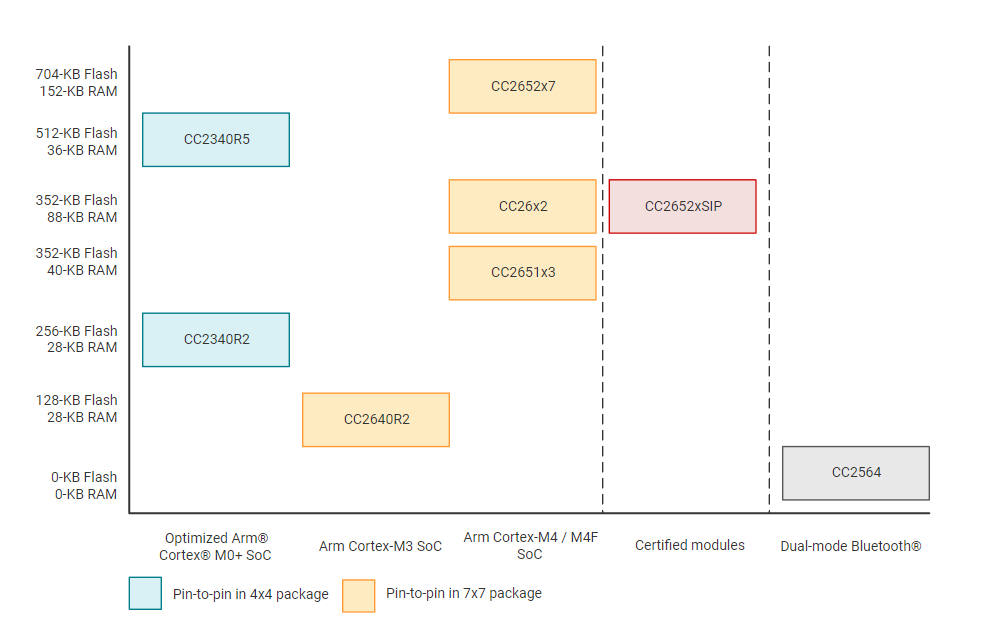
TI has a bunch of different BT radios. I don’t know much about these. I know that some model is used in the Libre 2. Additionally, TI recently released the CC12405R, which is quite close to NS’s catalog. A significant note about TI is that the house and its semiconductor portfolio are massive and broad, ranging from power transistors to processors, instrumentation amplifiers, and MILSPEC components. A true giant. It’s difficult for a large house to cover all verticals. TI is worth watching in the future. -
STMicroelectronics:
ST’s BLE product family is called STM32WB. It is a lineup consisting of a few models that are very similar to the nRF53 because the WB series processors have two cores: one application core and one radio core. It’s worth noting that ST’s BLE radio is not their own but a purchased IP block (if I recall correctly) from Infineon, which in turn bought a good part of this (if I recall correctly) from Murata. This leads to an unfortunate situation where the communication method between the application space and the radio space is very limited, making it a bit buggy, especially during development. ST is a large general-purpose MCU manufacturer, especially for industrial applications. If I were designing a circuit board implementation that didn’t require a BLE radio, I would choose an STM32 series processor 9 times out of 10. About a year ago, there were rumors that ST might acquire NS. That situation hasn’t developed further since then. -
NXP:
I can’t say much about NXP. They have some kind of BLE portfolio. They face the same challenges as ST and TI: being giants, they cannot or are unable to manage every vertical. Someone else could assist with research regarding NXP if they wish.
Other things worth noting:
-
NS is a so-called fabless company that has its chips manufactured at TSMC and uses 55ULP technology, at least in its nRF52 series. Others likely use either the same or perhaps a version a generation or two newer. This means that NS does not have direct control over its own production in special situations. This has been particularly evident during and after COVID.
-
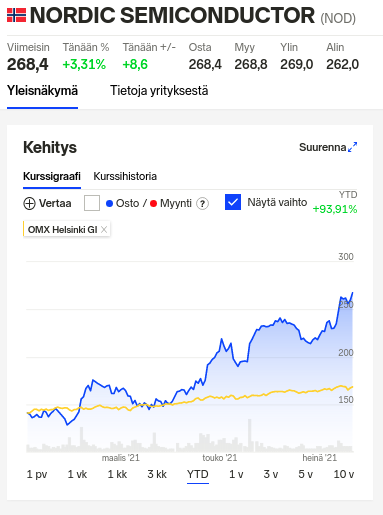
NS’s current valuation is based on a massive growth multiple and is therefore highly exposed to large swings in the share price within a changing macro environment.
-
NS’s primary markets are asset tracking, person tracking, consumer electronics, and the beacon market. The internet is full of various paid analyses on how the market is growing. Behind paywalls of several thousand euros, these are quite an expensive source of information. While working on my Master’s thesis, I tried to talk my way into getting a copy of one report. The lowest price they offered was €500. Here is an example of one: https://www.verifiedmarketresearch.com/product/bluetooth-chips-market/?utm_source=Designerwomen&utm_medium=016. If someone wants to spend money on professional literature for tax purposes, something like this is probably quite good for that

 I’m also following