This upcoming competitiveness report tomorrow is certainly much more interesting reading than Nordea’s fairly unsurprising half-year report: it went well again, as expected. CNBC also just reported on the preliminary sentiment regarding the Commission’s report: https://www.cnbc.com/2026/07/16/wall-street-us-banks-profit-boom-europe-regulation.html .
My expectation is that the report will outline measures that will effectively lower Nordea’s CET1 capital requirement by a percentage point. Otherwise, the gap to the United States will simply widen. This reduction in capital requirements, in turn, will lead to a nearly equivalent percentage increase in return on equity (ROE). To put it very simply, my assumption is that if the CET1 drops by one percent, Nordea’s share price should rise by one euro.
Kassu has written a company report on Nordea after Q2.
it doesn’t ginostele [is not tempting] expensive t kassu
Nordea’s Q2 went well, as both the loan book and assets under management continued to grow. The outlook is also good, which is why we have slightly raised our earnings forecasts for the coming years. We are adjusting our target price to 17.5 euros (previously 16.5€) in line with our earnings forecasts, but we are lowering our rating to “reduce” (previously “add”) as the share price increase has eroded the best part of the expected return.
Potential targets have already been well listed in previous messages. I assume you mentioned OmaSP tongue-in-cheek, but I’ll answer anyway No, Nordea is not going to participate in an auction for Oma Säästöpankki. The banks’ operating models are completely different, and Nordea surely doesn’t want to take on a low-quality loan book now that, under new management, the company has built a reputation as a very disciplined lender. Smaller banks are certainly interesting, but in Finland, a very high market share might become an obstacle from a competition law perspective. Thus, other Nordic countries are more natural targets.
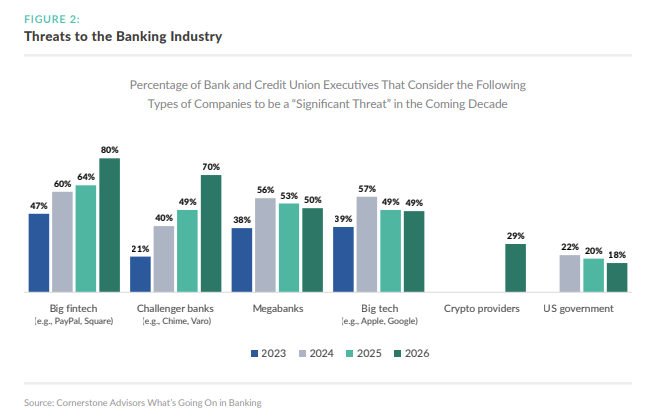
I would like to raise one more angle here that hasn’t been speculated about yet. Specifically, fintech companies have continued to challenge the traditional banking market, and in the US, smaller banks already see them as a clearly greater threat than the large mega-banks.
Fintech companies are eating away at payment service revenues in particular. For traditional banks, this poses a challenge regarding the outlook for fee and commission income, but even more importantly, various crypto initiatives (with stablecoins at the forefront) threaten to take a portion of the highly profitable deposit base outside the traditional banking sector. Banks are certainly not sitting idly by; Nordea, for instance, just joined a European banking consortium that is developing its own stablecoin. So, I wouldn’t be surprised if they are also considering acquisition targets within the fintech space right now.
This is definitely going to be interesting; I need to look into it more closely once it’s published.
Beyond just the CET1 level, we also need to look at the banks’ equity-to-assets ratios, as these define return on equity rather than the solvency calculation. For example, Nordea’s equity-to-assets ratio is only about 5%, which is very low, at least in the Finnish context. Achieving a moderately high CET1 level while maintaining a low equity-to-assets ratio is possible through Internal Ratings-Based (IRB) models. For comparison, I looked up the equity-to-assets ratios of U.S. banks, which appear to be higher than Nordea’s, despite a lower CET1 level. In light of this, European regulation does not seem particularly stringent at all. I retrieved this information quickly using Claude, so it shouldn’t be taken as absolute fact. I’ll have to return to this topic when I have more time.
Today in Denmark, there is news that Nordea and Danske Bank are practically competing for acquisition targets in the Nordic countries. Let’s see if they find anything to buy at a reasonable price. Recently, there have been many small bank mergers in Denmark, which also suggests that they do not want to end up under the wing of a larger company. Kasper’s mention of FinTech was interesting when considering potential acquisition targets. Of course, it could also happen that the shopping basket remains empty.
Does the article behind the paywall specify what kind of targets are in question? Nordea’s management has previously listed Denmark as an interesting market. There have also been rumors in the media that Nordea might be eyeing pension companies AP Pension and Velliv.
A section like this caught my eye while quickly browsing through it:
Will the simplification of prudential requirements (‘capital stack’) lead to an increase or decrease of capital held by banks?
Our objective is to strengthen the efficiency of the framework and reduce undue financial and administrative burden for banks, while retaining the overall level of resilience of the system.
To achieve these objectives, certain requirements would need to be further harmonised and their design streamlined.
In doing so, some impact on capital levels may be expected, especially in those areas where there is high discretion and heterogeneity today.
So, make of that what you will. However, it would seem that they are not, at least, embarking on any significant balance sheet reduction efforts. In general, reducing the complexity of regulation would certainly be positive from the banks’ perspective.
When will measures be proposed?
As no single measure will be sufficient on its own, the Commission will present a package of measures in the first quarter of 2027
So, it seems there aren’t any more specific actions to be found in that publication yet; let’s return to the matter in the spring
Could this be a reference to the fact that while complex IRBA models have been used to push capital requirements down, either this “gimmickry” will end and these banks’ capital requirements will increase, or (the less likely scenario) other banks’ capital requirements will also fall to lower levels?
With the disclaimer that it’s been a decade since I’ve been closely involved with Basel and capital requirements, I might be talking complete nonsense
Combining a quick human-eye scan of the announcement with an AI summary, the key takeaway was the easing of liquidity and capital requirements for cross-border groups. This would allow capital and liquidity buffers to be optimized more effectively at the group level, as subsidiaries wouldn’t need to hoard as much.
“Nordea - potentially one of Europe’s biggest beneficiaries,” the AI headlines shockingly.
Boosting ROE, putting liquidity buffers to better use, and accelerating M&A activity in the banking sector. That would be a huge deal for Nordea, but it would surely change the competitive landscape in the Nordic countries to some extent as well, wouldn’t it?
That is what Nordea has been complaining about—that there is overlapping regulation/capital requirements when operating in multiple countries.
It would sound reasonable if the overlaps were trimmed, but regulation and common sense don’t always go hand in hand. “We’ll see,” said the Nordea owner
No finalized, company-specific lists are presented. In general, Danske and Nordea, as well as other Nordic and non-Nordic players, are screening for acquisition targets. There is little belief in a large pan-Nordic bank merger, but smaller cases may come onto the market.
In particular, they are now looking for successful players in asset management. This is because it would reduce Nordea’s and Danske’s dependence on interest rate trends. Asset management is also considered interesting because it helps deepen customer relationships with the banking group and generally creates synergies.
In behind-the-scenes sounding out, the price tags for these players have inflated recently, if they are even for sale at all. There are also non-Nordic competitors who would like to get their hands on them.
Overall, it also occurred to me that in the same Nordic arena, Mandatum is probably also scouting for acquisitions with a focus on asset management, isn’t it?
I haven’t heard banks complaining about liquidity regulation, and based on Nordea’s Q2 report, for example, it is not liquidity that limits profit distribution/growth, but rather capital adequacy that would be the first hurdle.
A decrease in capital requirements for large, cross-border banks would be an interesting move, as it would improve their competitive position relative to smaller banks. Even now, economies of scale in banking are significant, even though larger players are required to hold larger capital buffers. But as mentioned, it has been possible to quite effectively compensate for this impact using internal credit risk models, and the necessary investments in areas like technology, risk management, and regulation have been constantly increasing.
Of course, it is possible to weaken these economies of scale by easing the regulatory burden for everyone, which was also mentioned on the list of measures. So, it largely depends on the details of that proposed regulatory package as to what kind of effects it will have on the competitive situation. Or if it will have any at all.
An American bank is heaping praise on Nordea’s exceptionally profitable operations. As a result, it is raising its target price for the stock.
According to Jefferies, Nordea’s return on equity is in a “superior class” in both Nordic and European bank comparisons. Based on the forecast, the return on equity could rise as high as 17 percent.
The American bank has set a target price of 20.10 euros for Nordea’s stock.
A ‘catalyst-light’ bank in terms of share price potential, but the target was still raised → €19
Analyst Gulnara Saitkulova said the firm continues to view Nordea as a high-quality pan-Nordic franchise with a solid profitability profile but sees the stock as increasingly catalyst-light.
The analyst said solid corporate lending growth, continued Swedish front-book mortgage share gains ahead of the back book, and improvements in the speed and quality of service should support earnings. Morgan Stanley believes the valuation now largely reflects these considerations.
Trading at 1.95 times 2027 estimated price-to-tangible book value and 11 times 2027 estimated price-to-earnings for an 18.5% return on tangible equity, the firm sees a more balanced risk-reward. Currently, the stock trades at a P/E of 12.95 and 1.93 times book value. Despite the downgrade, InvestingPro analysis suggests the stock remains undervalued based on Fair Value calculations, with additional insights available through 5 more InvestingPro Tips for subscribers.
Morgan Stanley said delivery ahead of plan on costs could provide a path back to Overweight.
Many industries face a upheaval in their working life in the coming decades, but this is hardly news. Rather, it is just another estimate among others.
For banks, labor is a major cost item, and it had to be significantly increased as regulation tightened. Now, artificial intelligence is bringing a change to this and cutting these costs considerably.
Bank of America raised Nordea’s target price to €19.9 (previously €16.7). Translated from Finwire’s news: “Nordea’s rating is upgraded from underperform to neutral following growth in Swedish market shares and improved prospects, although BofA believes much of the recovery is already reflected in the valuation.”
Danske Bank is the only one with a buy recommendation alongside BofA, and its target price rose to 435 DKK from 393 DKK. “The bank highlights continued market share growth, strong earnings growth, and potential revaluation.”
Deutsche Bank has raised Nordea’s target price to 20 euros (previously 19 euros), and the buy recommendation remains. Danske Bank raised its target price from 388 to 409 DKK, also maintaining its buy recommendation.
I wonder if the elevated interest rate level is starting to show in these, meaning banks’ net interest income is growing…
There is analyst coverage, and then there is coverage of analysts…
BNP Paribas (a French financial institution) has initiated coverage on Nordea (its US-listed ADR) with a buy rating (“outperform”) and a target price of $27 (approx. €23.04! - as displayed on Nordnet’s platform). This is the highest target price currently set for Nordea.

 No, Nordea is not going to participate in an auction for Oma Säästöpankki. The banks’ operating models are completely different, and Nordea surely doesn’t want to take on a low-quality loan book now that, under new management, the company has built a reputation as a very disciplined lender. Smaller banks are certainly interesting, but in Finland, a very high market share might become an obstacle from a competition law perspective. Thus, other Nordic countries are more natural targets.