Nokia as an investment (Part 4)

Nokia vs SkyDance/Paramount käsittely alkanut UKssa voi olla isoja rahoja tai pieniä puroja, vaikuttaa koko streaming palveluntarjoaja maailmaan (Netflix, disney, prime jne)

https://www.iam-media.com/article/nokia-skydance-video-streaming-global-rand-rate-trial-what-you-need-know

IAMista ei näe kuin otsikon alla AI pitkä jaarittelu

Nokia vs. Skydance: Global RAND rate trial – what you need to know

Yhteenveto

Trial underway – 20 November 2026 UK High Court

This is a significant patent-licensing case for the global video-streaming industry. It could establish a benchmark for how streaming companies pay technology patent owners for the use of video compression and encoding technology.

The central question is: how much should Paramount/Skydance and Warner Bros. Discovery pay Nokia for using its patented video-streaming technologies worldwide?

The trial began at the UK High Court on 18 November 2026 and is scheduled to run for approximately 20 days, until 11 December.

JUVE Patent

+1

1. Who is involved?

Nokia – Patent owner

Nokia developed and owns patents relating to video encoding, decoding and multimedia technologies. It wants streaming providers to pay royalties for using its patented inventions.

Paramount Skydance – Streaming provider

The company behind Paramount+, with the dispute concerning its use of Nokia’s video technology.

Warner Bros. Discovery – Streaming provider

The other major defendant, whose streaming operations include Max and other video services.

An important corporate development: Paramount has acquired Warner Bros. and renamed itself Paramount Skydance Corporation. However, the UK proceedings continue to refer to Paramount and Warner Bros. Discovery as separate parties, with separate legal teams.

JUVE Patent

+1

2. What exactly is Nokia claiming?

The dispute concerns Nokia’s Video Portfolio, including patents associated with:

  • H.264 / AVC: A widely used video compression standard.
  • H.265 / HEVC: A more advanced compression standard, enabling high-quality video with more efficient bandwidth usage.
  • Other multimedia patents: Additional patents covering video-related technologies, including non-standard-essential patents.

These technologies are used to encode, decode, compress and deliver video content efficiently.

The important distinction is that Nokia is not simply claiming that Paramount or Warner Bros. has copied a piece of software. It is seeking royalties for the use of patented technologies incorporated into the video-streaming ecosystem.

Bailii

+2

3. What does RAND mean?

RAND stands for Reasonable and Non-Discriminatory.

It is closely related to the more commonly used FRAND terminology (Fair, Reasonable and Non-Discriminatory).

In practical terms:

  • Patent owners must make licensing available on fair and reasonable terms where the relevant RAND commitment applies.
  • Licensees must pay appropriate royalties for the use of covered patents.
  • The royalty should reflect the value of the patented technology, rather than simply the commercial bargaining power of the patent owner.
  • Comparable licensing agreements and market benchmarks can be important evidence.

The court is being asked to establish a global licence rather than resolve individual country-by-country royalty disputes.

4. The biggest issue: how much money is at stake?

This is where the case becomes particularly interesting.

The two sides have very different approaches to calculating the royalty.
Party
Position
Nokia
Relies on three comparable licensing agreements to support a substantially higher valuation.
Paramount and Warner Bros.
Rely primarily on video patent-pool benchmarks to support a much lower valuation.

According to the November 2026 reporting by JUVE Patent:

  • The streaming companies’ approach indicates approximately $250,000–$300,000 for the final licence, before certain retrospective royalties and interest.
  • Nokia’s comparable-agreement approach implies a figure approximately 1,000 times higher.
  • Nokia’s overall claim is understood to be in the hundreds of millions of US dollars.

These are competing valuation positions, not a final royalty determination. The exact commercial terms of the comparable agreements are confidential.

JUVE Patent

+1

Why this difference matters

$250k–$300k

Approximate streaming companies’ proposed benchmark

~1,000×

Approximate difference between the competing valuation methodologies

The comparison is indicative, not a final court-approved rate.

5. What will the judge actually decide?

There are four particularly important questions.

A. What is a reasonable global royalty?

The judge must assess the competing licensing methodologies and determine the appropriate royalty for Nokia’s video portfolio.

B. Should royalties be calculated on indirect subscribers?

This is a particularly important issue.

Should Paramount and Warner Bros. pay royalties only for their direct subscribers, or should subscribers accessing content through third-party channel partners and distribution arrangements also count?

This could materially affect the royalty calculation.

C. Should Nokia receive retrospective royalties?

Nokia is also seeking payments relating to historical use of its technology.

The parties disagree about how far back royalties should apply, including potential claims reaching back to 2011.

D. How should the global licence be structured?

The court needs to establish licensing terms that work across different territories and streaming operations, rather than simply deciding a royalty for one country.

JUVE Patent

+1

6. What has happened before the trial?

An important development occurred in March–June 2026.

The parties agreed to a mechanism under which:

  1. Nokia would accept a single global RAND determination by the UK court.
  2. Parallel patent litigation would be withdrawn or discontinued.
  3. Paramount and Warner Bros. would make interim payments to Nokia.
  4. The court would determine the final global licence terms at trial.

In June 2026, the High Court ordered interim payments.

Importantly, the exact payment figures were redacted in the public judgment. The interim payments are not the final royalty rate, and the arrangement provides for adjustments and refunds if the final determination requires them.

Bailii

+2

7. Why should the wider industry care?

This case could have implications far beyond the two companies.
Industry participant
Potential implications
Netflix
Potential relevance to future video patent licensing negotiations
Disney+
Exposure to similar video codec licensing arguments
Amazon Prime Video
Potential implications for streaming distribution and licensing costs
Other streaming platforms
Greater clarity about how streaming patent royalties are calculated
Patent owners
Potentially important precedent for monetising video technology
Telecommunications industry
Further developments in global SEP licensing and RAND rate-setting

One particularly important aspect is that this is a major attempt to establish a global royalty for video technology used by streaming service providers, rather than the more familiar device manufacturers.

It could therefore influence negotiations between patent owners and content distributors worldwide. However, the judgment will not automatically impose a royalty on every streaming company.

JUVE Patent

+1

8. What should we watch between now and December?

  1. 18 November – 11 December 2026: Trial

    Evidence, expert testimony and arguments on royalty valuation.

  2. Patent-pool versus comparable-licence evidence

    Which valuation methodology the judge finds persuasive.

  3. Subscriber calculations

    Whether indirect subscribers and channel-partner distribution are included.

  4. Historical royalties

    Whether royalties are payable for periods before Nokia approached the streaming companies.

  5. Final judgment

    The eventual global RAND royalty and licence structure. The precise judgment date has not yet been established in the sources reviewed.

9. My assessment: the five most important takeaways

1. This is a landmark licensing dispute. It could help establish how video-streaming companies compensate patent owners for codec and multimedia technology.

2. The valuation gap is enormous. The parties’ competing approaches differ by approximately three orders of magnitude.

3. The subscriber question is commercially significant. The treatment of indirect subscribers could materially change the royalty base.

4. Historical royalties could be substantial. The period for which royalties are payable may be as important as the future royalty rate.

5. The outcome could influence future negotiations across the streaming industry. Other major streaming platforms and patent owners will be watching closely.

10. Key documents and further reading

These are useful sources if you want to follow the legal and commercial developments:

One final point worth emphasising: The trial is not about whether streaming services can use H.264 or H.265. It is about the commercial price and licensing conditions for using Nokia’s patented technology.

The most consequential outcome may be the methodology the court adopts, because that could shape negotiations throughout the global video-streaming and patent-licensing markets.

9 Likes

I got my hands on the transcript from the Morgan Stanley European Technology, Media and Telecom Conference. Summary below. A few interesting takeaways - AI-RAN collaboration with Nvidia is progressing ahead of schedule. And secondly, Wirén also practically confirmed that the 2028 “guidance” is no longer valid. Why hasn’t it been updated? Quarter after quarter, growth has been faster than before, so it would have had to be updated every single quarter!!!

Key Takeaways from the Interview

  • AI & Cloud Growth and Order Backlog: By the end of September, Nokia’s orders from AI and cloud customers stood at €5.3 billion (nearly 300% growth year-over-year). The orders were distributed quarterly as follows: Q1 €1.0B, Q2 €2.8B, and Q3 €1.5B. For next year (2027), Nokia guides IP and Optical Networks growth of 25–30%.

  • In-House Chip Production and Multiplying Capacity:

    • The new 6-inch photonic integrated circuit (PIC) fab in San Jose began 24/7 operations in late October; wafer production will start at the end of this year, reaching maximum capacity in early 2028. The facility will bring a 20–25x increase in capacity.

    • Testing and packaging capacity will increase 10-fold.

    • From Chandler, Arizona (facility acquired from NXP), the first phase will be operational in Q1 2027 and the second phase in Q1 2029.

  • New DSP Chips and Energy Efficiency: The four new DSP chips introduced at the OFC conference (which can be combined into 13 different solutions, achieving up to 70% energy savings) will enter sampling in H1 2027, with actual shipments beginning in H2 2027 and volume production from 2028 onwards.

  • AI-RAN and Nvidia Collaboration: Collaboration with Nvidia is progressing faster than expected (around 20 operators involved). The spectral efficiency improvement target is now over 20%, 50% next year, and 100% in 2028, when commercial volume shipments will begin (commercial launch at the end of next year).

  • Operating Leverage and Capital Allocation: The €200 million synergies from the Infinera transaction will be realized a year ahead of schedule. Non-core units (such as Fixed Wireless Access and Enterprise Campus Edge) have been moved into the divestment pipeline.

Special Highlight: What did Wirén say about 2028?

At the end of the interview, the moderator asked when Nokia would update the mid-term targets from last November’s Capital Markets Day (CMD) (which include the year 2028), since growth in IP and Optical Networks is already clearly exceeding them.

Wirén’s response and rationale for not updating the 2028 figures was straightforward:

"So much is happening. What we now have said that we will have this 25%, 30% growth in IP and optical next year, but full guidance for next year will come when we release our quarter four report. That is why we decided that we will not give every quarter updates on our 2028 figures either, because then you have to give that every quarter."

24 Likes

2026 will be a transition year for Nokia, marked by heavy structural transformation and front-loaded provisions—this was already stated clearly at the 2025 CMD. In 2027, revenue will accelerate as AI and cloud backlogs materialize (a 12–18 month order backlog), but gross margin will be pressured by component cost inflation, and free cash flow will still be weighed down by the yield ramp-up in San Jose, investments in Pennsylvania’s test and packaging line and Chandler Phase I (Q1/2027), alongside growing working capital. The first real harvesting phase begins in 2028, assuming the 20–25x expansion of 6" InP capacity in San Jose is fully operational and working capital starts converting into cash flow. A second, even larger wave will materialize in 2029–2030, once the Chandler plant transitions entirely to Nokia’s ownership (Q1/2029) and its additional capacity is ramped up.

Even if there is a phased slowdown in hyperscalers’ investment cycles, the technological and structural demand for Nokia’s optical products is not going anywhere—quite the contrary. There appear to be at least four key drivers here.

  1. Summary
    1. Power grid limits force decentralization (Distributed AI / DCI): Since power grids cannot endlessly accommodate >1 GW AI data centers in the same locations, compute is being distributed across different sites. These data centers are interconnected into a single cohesive entity using ultra-low latency coherent optical links (Data Center Interconnect), which is Nokia’s core competency.
    2. Copper hits physical limits (Copper Wall): As transmission speeds increase from 800G and 1.6T toward the 3.2T generation, copper cables dissipate too much power and generate excessive heat. Optical fiber and photonic integrated circuits (InP) are replacing copper over increasingly shorter reaches—even inside server racks—multiplying optical transceiver volumes exponentially.
    3. Shift in focus from training to inference and Edge AI: As AI model deployment (inference) and enterprise applications become mainstream, compute capacity along with high-speed core and access networks (IP routers and optics) will be required close to end-users worldwide, not just in a handful of centralized mega-campuses.
    4. Rapid 3–5 year networking hardware refresh cycle: Even if the construction of new data center facilities stabilizes toward the turn of the decade, the massive clusters built in 2025–2028 will hit their first major upgrade cycle in 2029–2032, replacing 400G/800G technology with 1.6T and 3.2T solutions.
13 Likes

https://www.linkedin.com/pulse/nokias-hotard-ai-escape-data-center-stephen-saunders-mbe-xw1ye/

Here is a summarized version of the main points from Justin Hotard’s interview:

According to Nokia’s Justin Hotard, the company is once again a growth company and in the midst of a major inflection point, where the next and largest AI wave is moving from data centers into the physical world.

  • Strong data-center-driven earnings turnaround: In Q3, AI and cloud sales grew by 123%, and comparable operating profit rose by 35% (€605M). Hotard sees no slowdown in data center investments; instead, demand for network connectivity remains strong, driven further by edge computing and enterprise networks.

  • AI-RAN brings artificial intelligence to the physical world: In the next wave, the mobile network transforms from a mere data pipe into a sensor that senses its environment. This lowers operator costs and unlocks new revenue streams, for example in autonomous transport, industry, and logistics.

  • Uninterrupted connectivity everywhere: Autonomous machines require completely uninterrupted connectivity, which is why Nokia is combining mobile, Wi-Fi, and satellite networks into a single dynamic whole.

  • Sovereignty stems from competitiveness: The resilience of communications networks is a matter of national security (e.g., the ICEYE partnership in Ukraine). According to Hotard, true sovereignty requires trusted partnerships and competitiveness.

“I don’t think there’s going to be a slowdown in data center,” he says.

“We are back to being a growth company,” he says, recalling his message to employees following the latest earnings announcement.

14 Likes

From this, we can draw the indirect conclusion that whenever the 2028 guidance finally drops and gets updated, it’s going to blow everyone away​:high_voltage:. Since they can’t be bothered to update it quarterly, it’ll probably happen early next year at the latest? Either way, putting it into words when the time comes will likely be a big deal, and it’ll probably turn heads one way or another regardless​:tornado:.

7 Likes

They could have officially announced that the guidance was outdated in connection with the interim report or something…

9 Likes

Ping @Tommi_Saarinen – here’s some food for thought, given that your model projects the peak of AI and cloud orders to hit this year (€6,454M), decline next year (€5,600M), and remain roughly flat after that.

When asked specifically about the order trajectory (overall trajectory over time) at the Morgan Stanley conference, Marco Wirén answered as follows:

Operator: Okay. Then another focus area is around the AI and cloud order book. You’ve said it could be volatile, but how should we expect this, the overall trajectory to evolve over time?

Marco Wirén (CFO, Nokia): Yeah, I would say that we always said that these order books, orders from hyperscalers are quite volatile, so we should not look only one quarter. If you look this year, we had EUR 1 billion in quarter one, EUR 2.8 billion in quarter two, and EUR 1.5 billion in quarter three. So you can see it’s quite jumpy. And we believe that’s going to continue as well. The reason is that these orders are quite big. So depending a little bit timing-wise, if it’s happening in this week or next week, that could be determining as well that which quarter it comes. And we believe that’s going to continue as well going forward. But definitely we see that we haven’t seen any change in the behavior, and the demand is just growing. So, so far, we’ve seen a good momentum there.

“The demand is just growing.”

Even though in your model the order backlog continues to grow due to delivery constraints, I personally strongly expect that new quarterly order intake will also continue to grow. In my view, Marco’s comment clearly implies that we have not yet seen the peak in order flow.

And in fact, when you look at the entire value chain through a technological lens, inter-data center networking (scale-across) is only just getting started, and already an increasingly larger share of hyperscalers’ CapEx is being directed there. So far, the vast majority of Nokia’s AI & Cloud orders have almost certainly come from this specific segment (along with PERHAPS a small amount from early-stage intra-data center connections).

However, the next—and in terms of volume, significantly larger—phase of AI infrastructure is still ahead: it will happen when scale-out and especially scale-up interconnects (traffic between GPU chips) transition to optics, because copper simply can no longer keep up with increasing speeds and power efficiency requirements.

Mass orders related to replacing copper inside data centers aren’t even in the order books yet, but according to analyst firms, the size of this market will be considerably larger than traditional scale-across. And Nokia has already confirmed its presence here (including its proprietary InP lasers, new DSPs, and LPO/NPO/CPO solutions).

Therefore, I argue that the highest quarterly order numbers are still ahead of us—not behind us.

18 Likes

Very true, but let’s remember that the 2028 figures were not official guidance, but rather targets set by Nokia, which they simply haven’t ended up raising as the situation evolved.

7 Likes

You could ask this same question about quite a few companies. There can be many reasons, but if this is considered a growth company, it’s fair to say that growth companies rarely buy back their own shares. Perhaps the funds are needed on the capex side, or maybe they have M&A targets in their sights.

However, Nokia’s management team loaded up quite heavily at almost two euros higher, which is a clear signal that the stock was undervalued, at least in management’s view.

7 Likes

Marco Wirén also addressed capital allocation in yesterday’s interview:

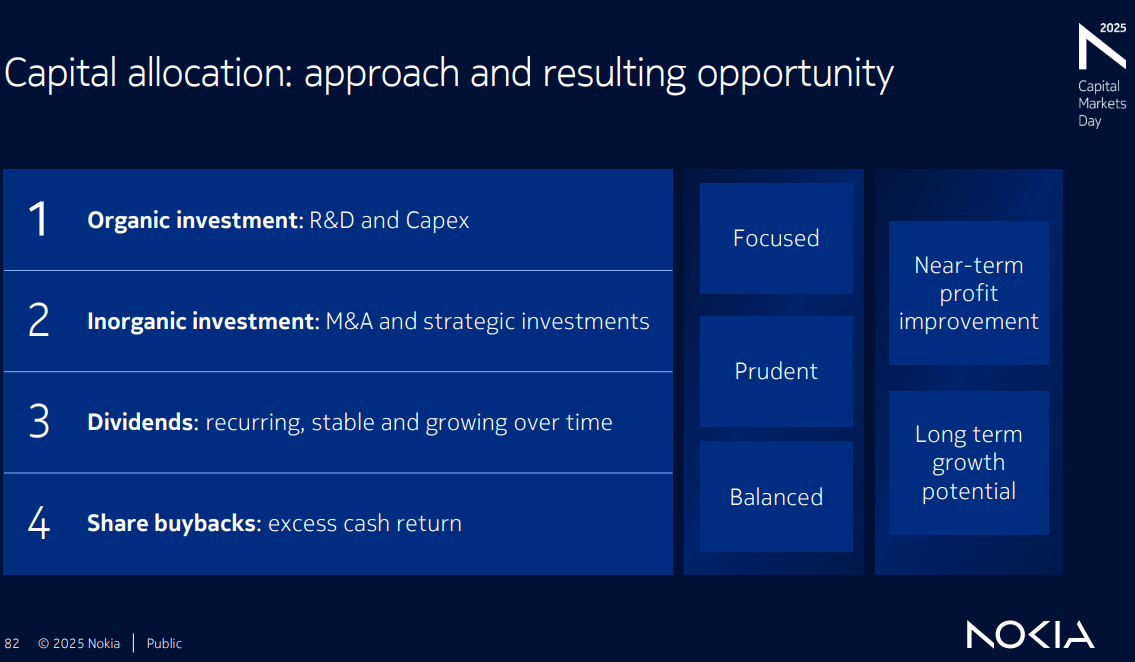
If we look at our priorities, number one is definitely investing in research and development (R&D) to ensure our competitive, cutting-edge technology stays at the forefront of the industry. Additionally, we want to make sure we capture growth across different customer segments, such as optical networks and IP networks. We have invested more this year to capitalize on growth opportunities. A good example on the wireless side is also AI-RAN (AI-based radio access network).

The second priority is reviewing mergers and acquisitions (M&A). This is more about bolt-on acquisitions. The focal areas for these acquisitions are practically strengthening our R&D or technology base, or they may involve expanding our customer base or offering – or a combination of all three. In fact, Infinera was a combination of all three: we gained a stronger product portfolio for the optical side, gained access to all hyperscalers – practically almost all US hyperscalers – and also broadened our offering.


In November 2025, at the Capital Markets Day, Nokia’s capital allocation priorities were presented, and share buybacks were the last item:

15 Likes

Nokia at Morgan Stanley European Technology, Media and Telecom Conference: AI push Transcripts Published Nov 19, 2026, 10:41 AM

The full transcript and apparently an AI-generated summary can be found on the Investing.com website.

1 Like

Marco Wiren is certainly no charismatic speaker, rather someone who just plays it safe and repeats himself. Could he be any more cautious: On the San Jose fab, he said the capacity increase is large but does not translate directly into revenue because Nokia still relies on outside suppliers for some parts of the chain… So those San Jose investments won’t impact sales because Nokia is still dependent on external suppliers… what on earth?

What Wirén said is true, even though it sounds like a cautious statement. Nokia doesn’t sell the chips it produces externally; instead, they serve as components in the company’s own products—for example, photonic integrated circuits (PICs) go into pluggable transceiver modules (pluggables). The value of the fab’s output is only realized through the end product, which may contain varying amounts of PICs, and the price of the end product does not depend solely on the number of chips.

In addition, regarding the DSPs that go into the pluggable modules, Wirén mentioned that Nokia designs them, but manufacturing is outsourced. The fab’s output only translates into revenue if the entire chain keeps pace.

7 Likes