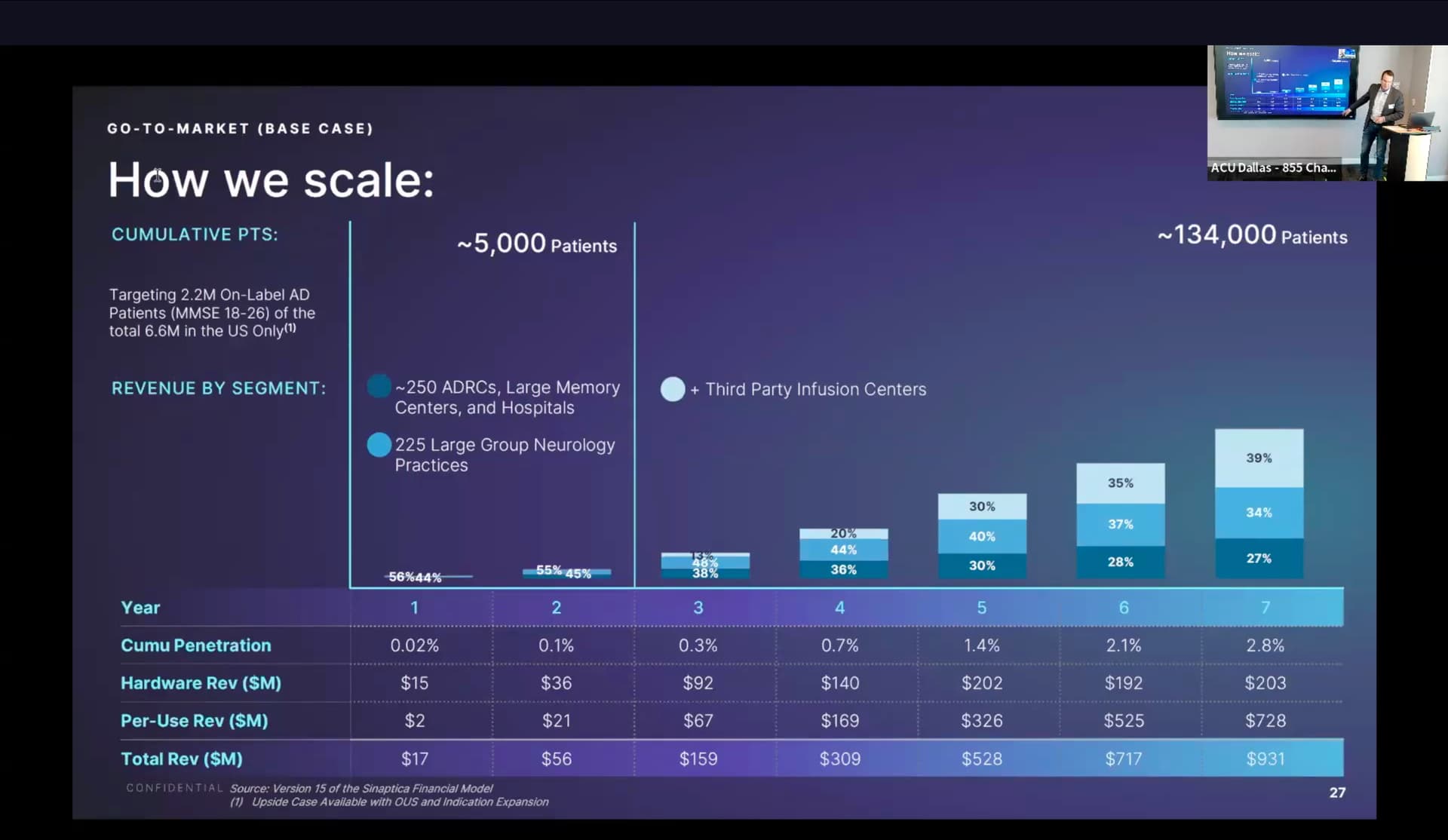
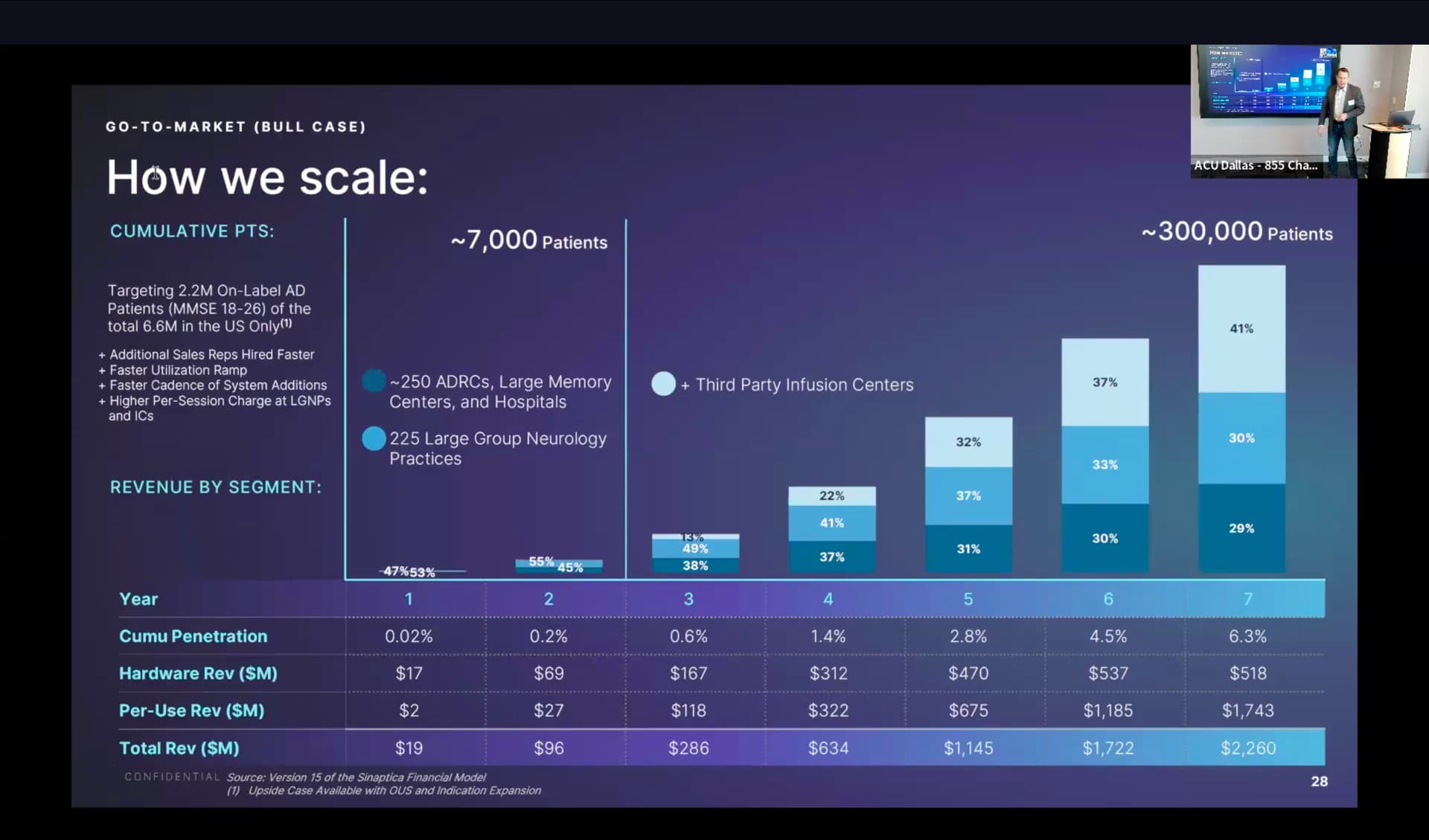
I definitely recommend watching the entire pitch, but here are a few highlights from the presentation slides:
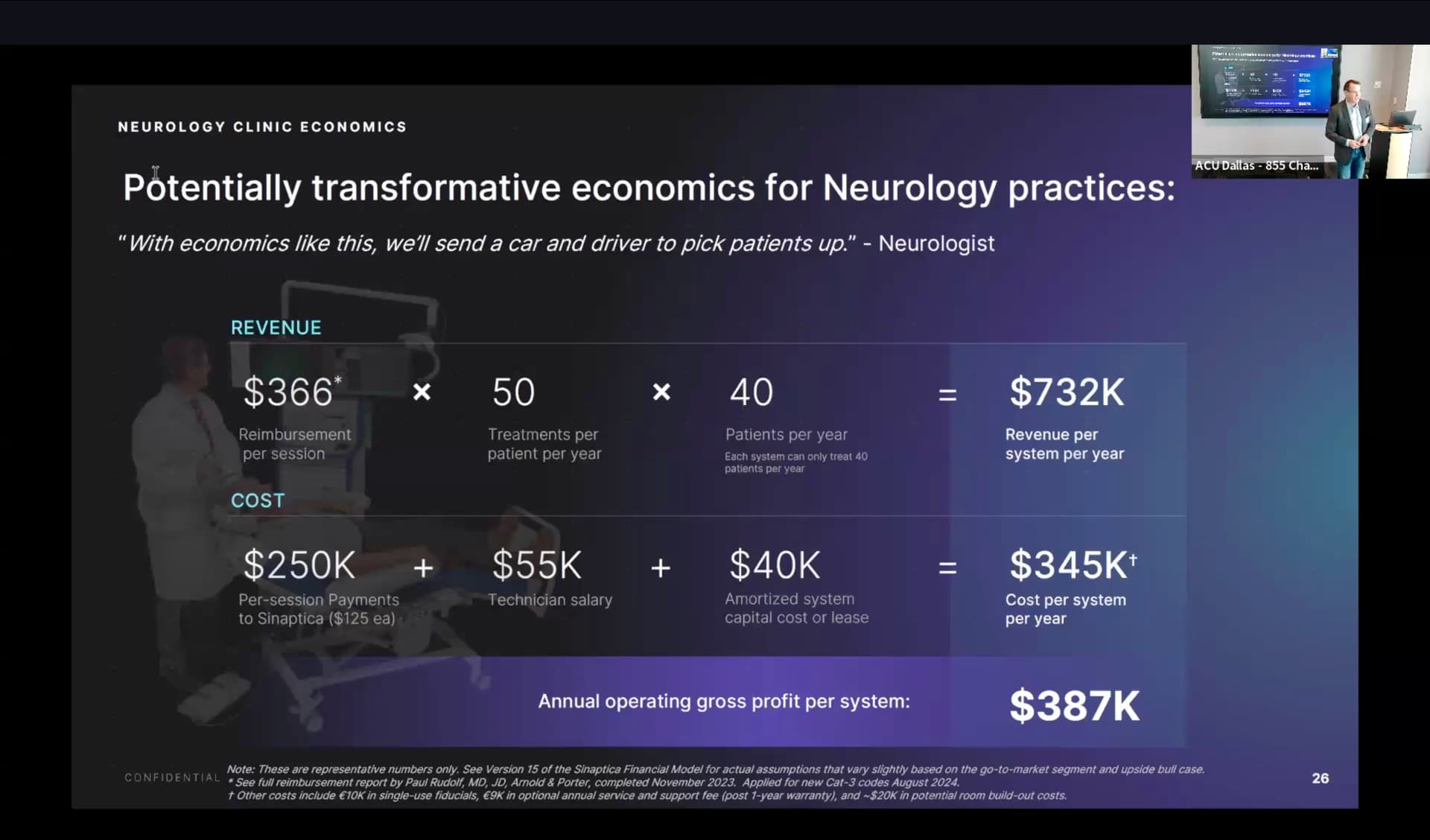
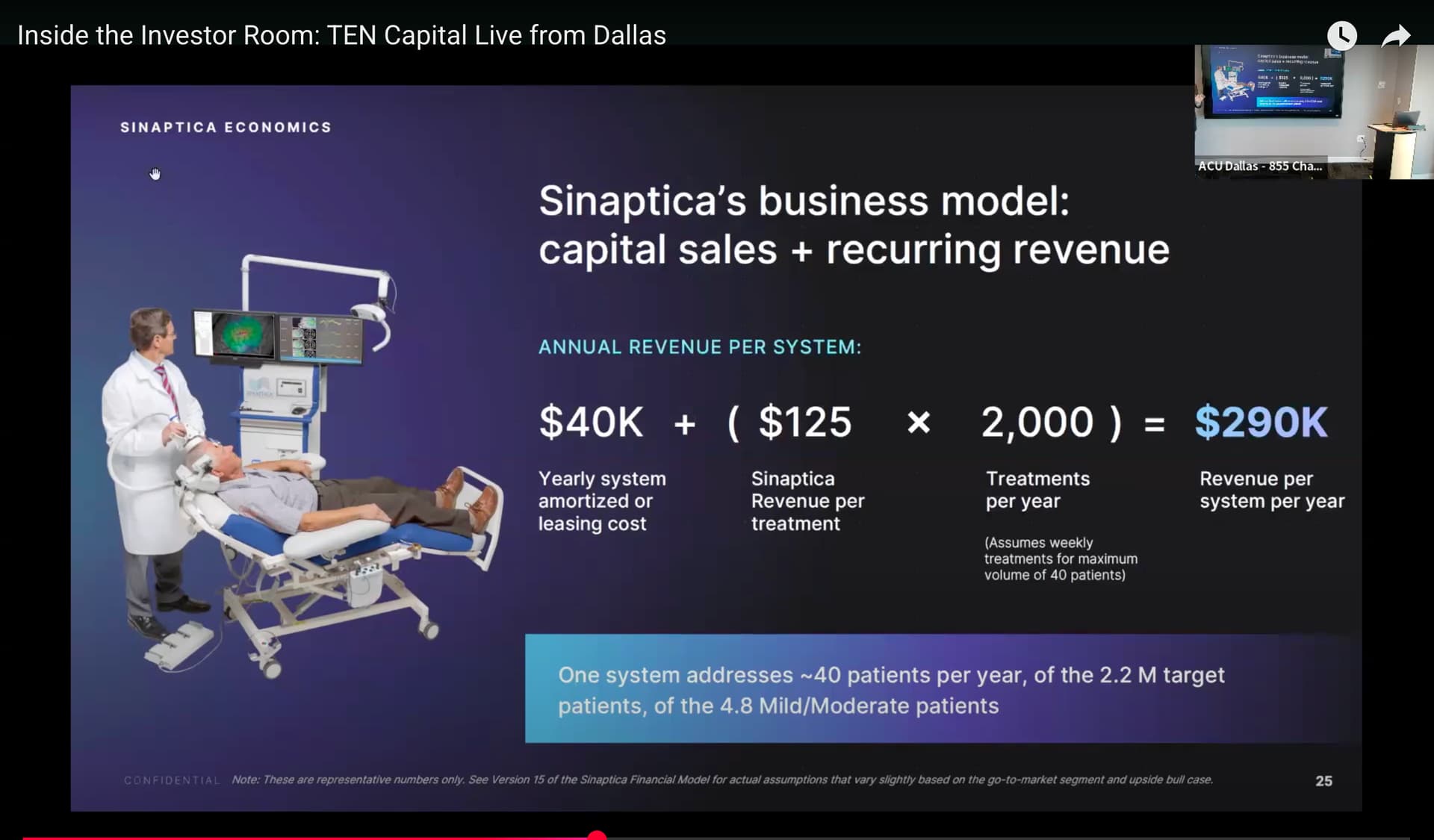
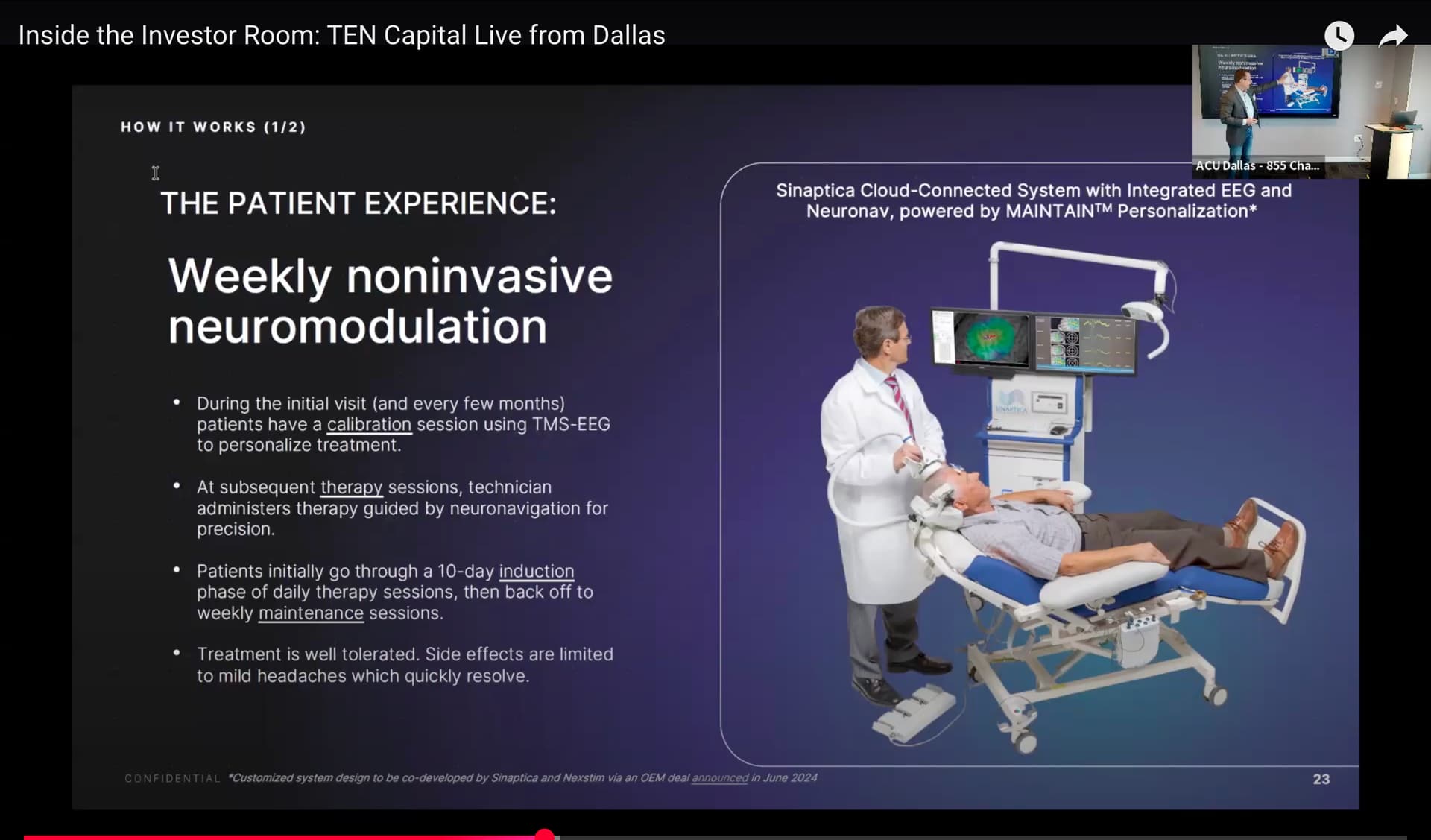
Indeed, treatment is given weekly, similar to dialysis, for the patient’s entire life, so one device can only treat a pool of approximately 40 patients, and consequently, the number of devices needed is large.
Nexstim was mentioned by name in writing in those slides and also orally during the Q&A session. Furthermore, during the staff introduction, it was stated that the R&D director would have an easy job, as they would only be customizing an already finished machine. It can therefore be stated with a high degree of certainty that the devices will indeed be ordered from Nexstim, as promised to investors.
It was mentioned on that slide that one device could treat 40 patients per year. The treatment is indeed given until death, as Alzheimer’s does not heal, but its progression can be slowed down with this treatment.
In the base case, 139,000 patients are expected to be treated during the first 7 years, and in the bull case, 307,000 patients. When a simple calculation is made from this, 3,475 devices are needed in the base case and 7,675 devices in the bull case.
A simplified calculation, of course, straightens out many complexities, as some patients will likely die along the way and will no longer need treatment. On the other hand, the utilization rate of each device will certainly not be 100%, so more devices will be needed in reality than this calculated maximum.
Base case
3,475 devices
€200,000 per device
Nexstim’s gross margin in 2024 79%
Margin per device sold €158,000
Margin from devices sold €549 million
In addition to this, disposable parts and maintenance contracts
Bull case
7,675 devices
€200,000 per device
Nexstim’s gross margin in 2024 79%
Margin per device sold €158,000
Margin from devices sold €1.2 billion
In addition to this, disposable parts and maintenance contracts
The combined value of all Nexstim shares today is €55 million.
I myself understood that a bit more modestly, that those 134K patients were over a 7-year period, and I calculated the need for machines based on the numbers. That’s why my own calculations resulted in a smaller number of machines.
Curious about nTMS-EEG? Then mark your calendars for this upcoming three-day hands-on workshop, lead by experts in the field! Even if you cannot make the trip to Italy, organizers offer a free hybrid option for the first day, including a live demonstration of nTMS-EEG!
𝗪𝗵𝗮𝘁: Multimodal EEG Workshop: Integrating EEG and Neuronavigated TMS
𝗪𝗵𝗲𝗻: September 15–17, 2025
𝗪𝗵𝗲𝗿𝗲: University of Milan, Italy (& partially online)
𝗗𝗮𝘆 𝟭 – 𝗛𝘆𝗯𝗿𝗶𝗱 (𝗙𝗿𝗲𝗲 𝗳𝗼𝗿 𝗢𝗻𝗹𝗶𝗻𝗲 𝗔𝘁𝘁𝗲𝗻𝗱𝗲𝗲𝘀!) Learn the fundamentals of nTMS, EEG signal interpretation, and clinical applications Hear about nTMS-EEG in the field of consciousness research See a live demonstration of real-time nTMS-EEG data collection
𝗗𝗮𝘆𝘀 𝟮, 𝟯 – 𝗜𝗻-𝗣𝗲𝗿𝘀𝗼𝗻 𝗢𝗻𝗹𝘆
Roll up your sleeves for hands-on sessions where you: Collect nTMS-EEG data from healthy subjects Pre-process and analyze collected nTMS-EEG data Connect with peers working in the nTMS-EEG space
Register here and make sure not to delay, as spots are limited:
Nexstim will be presented at the Finnish Shareholders’ Association’s investment evening on June 5th. Members of the Finnish Shareholders’ Association have received an invitation to attend in person, and others can watch on YouTube: https://www.youtube.com/@pk-seudunOsakesäästäjät
11th Science Factory: The TMS–EEG Workshop and Summer School is officially underway! Participants are once again gathering in the beautiful Nuuksio National Park to dive deep into the world of TMS-EEG.
Today’s highlight: A live demonstration of navigated TMS-EEG by experts from the University of Milan, showcasing the importance of reproducibility, precision, and accuracy in TMS-EEG experiments.
Missed the workshop this year? Visit our website to learn more about TMS-EEG and subscribe to our quarterly newsletter to stay updated on future TMS-EEG workshops: LinkedIn
What makes this interesting is Brainlab’s focus precisely on mapping. It gives the impression that Brainlab sells Nexstim’s system as complementary, in order to get a better picture of neuronal networks and avoid critical, healthy tissue during tumor removal, while simultaneously increasing the probability of total resection.
Total resection is reportedly the best possible treatment for brain tumors, but requires precision, better visualization, and the most optimal timing possible.
Good sales work. Happy Ascension Day to all. LinkedIn;
Only two weeks left until the Clinical TMS Society Annual Meeting in San Diego, California! We look forward to connecting with the nTMS user community and hearing about the latest research. Our team will be presenting NBS 6 at both the main conference and the PULSES workshop, demonstrating how easy it is to provide E-field navigation for individualized rTMS treatment.
If you’re attending, be sure to stop by our booth; we’d love to exchange ideas and explore how our technology can support your clinical and research needs!
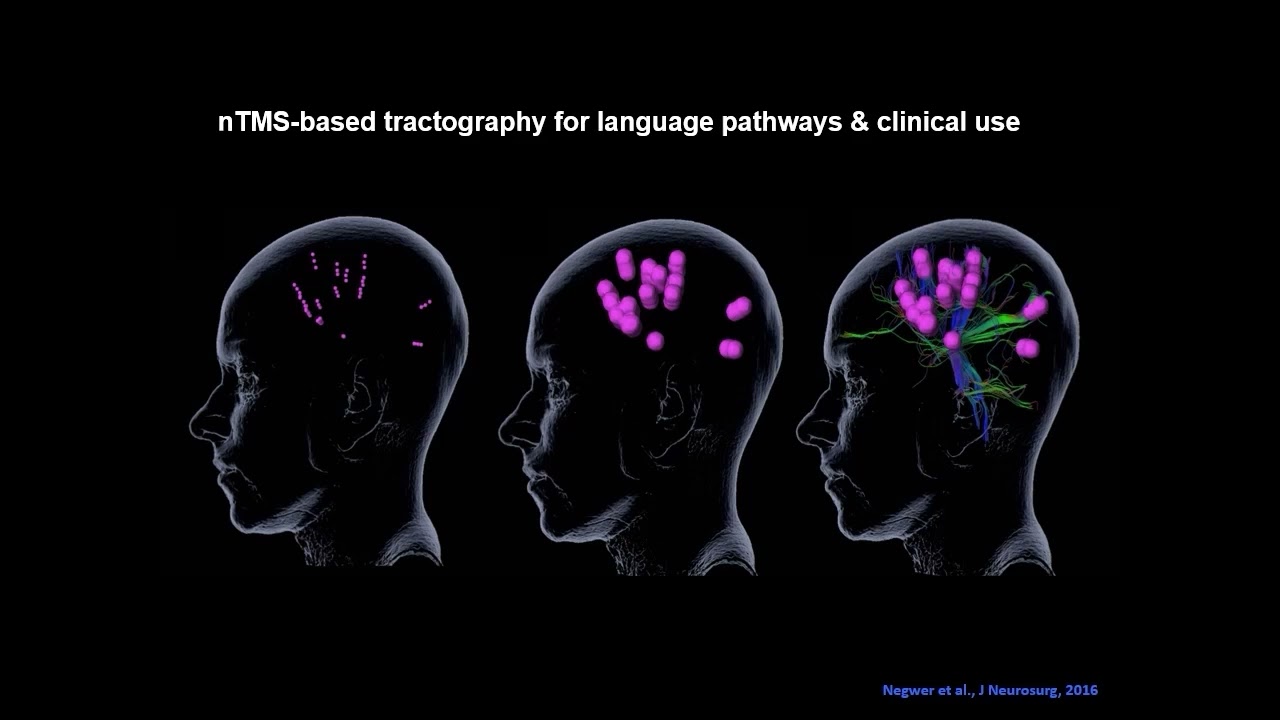
It’s great to see how tools like Nexstim nTMS, now integrated into the Brainlab cranial neurosurgery portfolio, advance functional brain mapping and support neurosurgical planning. nTMS allows for the collection of brain function-related information before surgery. It can be applied together with Brainlab Elements Fibertracking* to visualize functional pathways.
nTMS Highlights: Functional brain mapping for individualized planning Visualizes lesion-induced functional reorganization Integration with Brainlab Elements for pre-operative planning Enables function-based fiber tracking with Brainlab Elements Fibertracking*
The integration of Nexstim nTMS into Brainlab Elements brings additional tools to cranial planning workflows.
Want to see it for yourself? I’d love to hear what you think of the new site: LinkedIn
This is quite significant news for Nexstim. Recuror’s devices have been supplied by Nexstim, and now if Recuror’s service offering is scaled for use across Terveystalo, the volumes will be absolutely enormous compared to before. The number of devices simply won’t be enough.
Recuror Oy is a pioneer in neuromodulation therapies used in the treatment of depression and chronic pain (such as magnetic stimulation therapy, rTMS), the supply of which is currently scarce, and the demand for which is predicted to grow.
Recuror’s top expertise, especially in neuromodulation therapies, brings new kind of know-how to Terveystalo and opens up opportunities for the smooth implementation of this treatment method in our selected units. I warmly welcome Recuror’s top experts to be part of Terveystalo’s Fokus Mieli special unit, says Tuija Turunen, Director of Terveystalo’s Fokus Mieli special unit.
ChatGPT compiled a list of Terveystalo locations where it would be business-wise sensible for them to start offering TMS treatments immediately in the first phase. Now that the expertise and processes acquired from Recuror are being implemented across the entire chain, it makes more sense to distribute the training and processes directly to several locations. Some locations may need more than one device, as there are plenty of patients in need of treatment, and from an occupational health perspective, for example, this fast and effective treatment method is a very welcome purchase for companies.
Here is the list:
Column 1
Column 2
Column 3
#
Location
Justification
1
Terveystalo Kamppi
Helsinki’s largest private patient market, high solvency, and the device would quickly achieve high utilization.
2
Terveystalo Itäkeskus
Along the metro station, near large residential areas of East Helsinki; complements Kamppi’s capacity.
3
Terveystalo Iso Omena A-torni
Espoo’s bustling shopping center, high purchasing power, and a large occupational health client base.
4
Terveystalo Leppävaara
Important public transport hub, serves the population of northern and western Espoo.
5
Terveystalo Tikkurila
Vantaa’s administrative center, a major main railway station, and a large occupational health client base.
6
Terveystalo Tampere Rautatienkatu
Pirkanmaa’s growth center, large student and technology company dominance, over 350,000 inhabitants.
7
Terveystalo Turku Pulssi
Turku region’s population base of over 200,000 inhabitants, as well as public neuromodulation activities that private services can complement.
8
Terveystalo Oulu Linnanmaa
Northern Finland’s university and ICT center; no private TMS offering in the area.
9
Terveystalo Jyväskylä Väinönkatu
Central Finland’s student and service center, population approximately 150,000.
10
Terveystalo Kuopio
Eastern Finland’s university and hospital city, attracts patients from a wide area.
11
Terveystalo Lahti
Päijät-Häme’s provincial center along the motorway, over 120,000 inhabitants.
12
Terveystalo Lappeenranta
University city and border region center; limited TMS offering in the area.
13
Terveystalo Joensuu
North Karelia’s only large city, attracts customers from a wide area.
14
Terveystalo Vaasa
Bilingual export industry city, significant occupational health potential.
15
Terveystalo Pori Lääkäritalo
Satakunta’s largest city; private TMS treatment is missing from the province.
16
Terveystalo Seinäjoki
South Ostrobothnia’s growth center, strong industry brings occupational health patients.
17
Terveystalo Rovaniemi Revontulikeskus
Lapland’s largest city and a significant tourist destination; long distances increase the value of local offerings.
18
Terveystalo Hämeenlinna Goodman
Central location between Helsinki and Tampere; also serves the Janakkala and Riihimäki regions.
I would personally see the devices well utilized even outside this list, e.g., in Mikkeli and Kajaani, but there are already quite a few locations on this list, and enough locations to match Nexstim’s annual revenue.
 Learn the fundamentals of nTMS, EEG signal interpretation, and clinical applications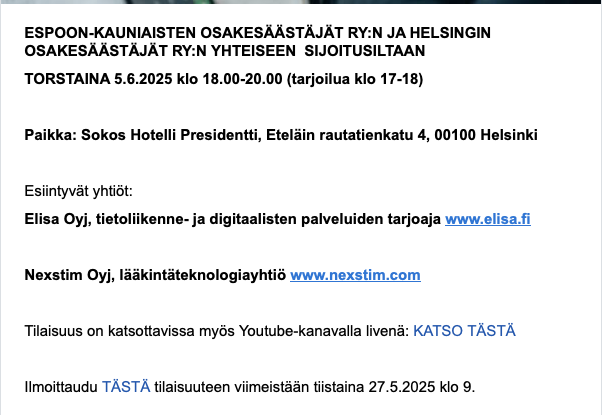
 More information about the meeting:
  nTMS Highlights:
 Functional brain mapping for individualized planning
 The integration of Nexstim nTMS into Brainlab Elements brings additional tools to cranial planning workflows.