This company is tricky to evaluate in the short term, as such a large portion of its potential depends on projects conducted with customers, about which not much can be disclosed externally yet for understandable reasons. If information were available regarding, for example, the distribution of the clinical phases of the projects’ drug substances, it would already help in assessing them. A preclinical stage candidate is much riskier than, for instance, an already approved drug whose properties are intended to be improved through nanoformulation. Currently, assessments must primarily rely only on the already published internal product kernels, which, however, underestimates the potential in the long term.
Here is that product kernel list from the presentation slides:
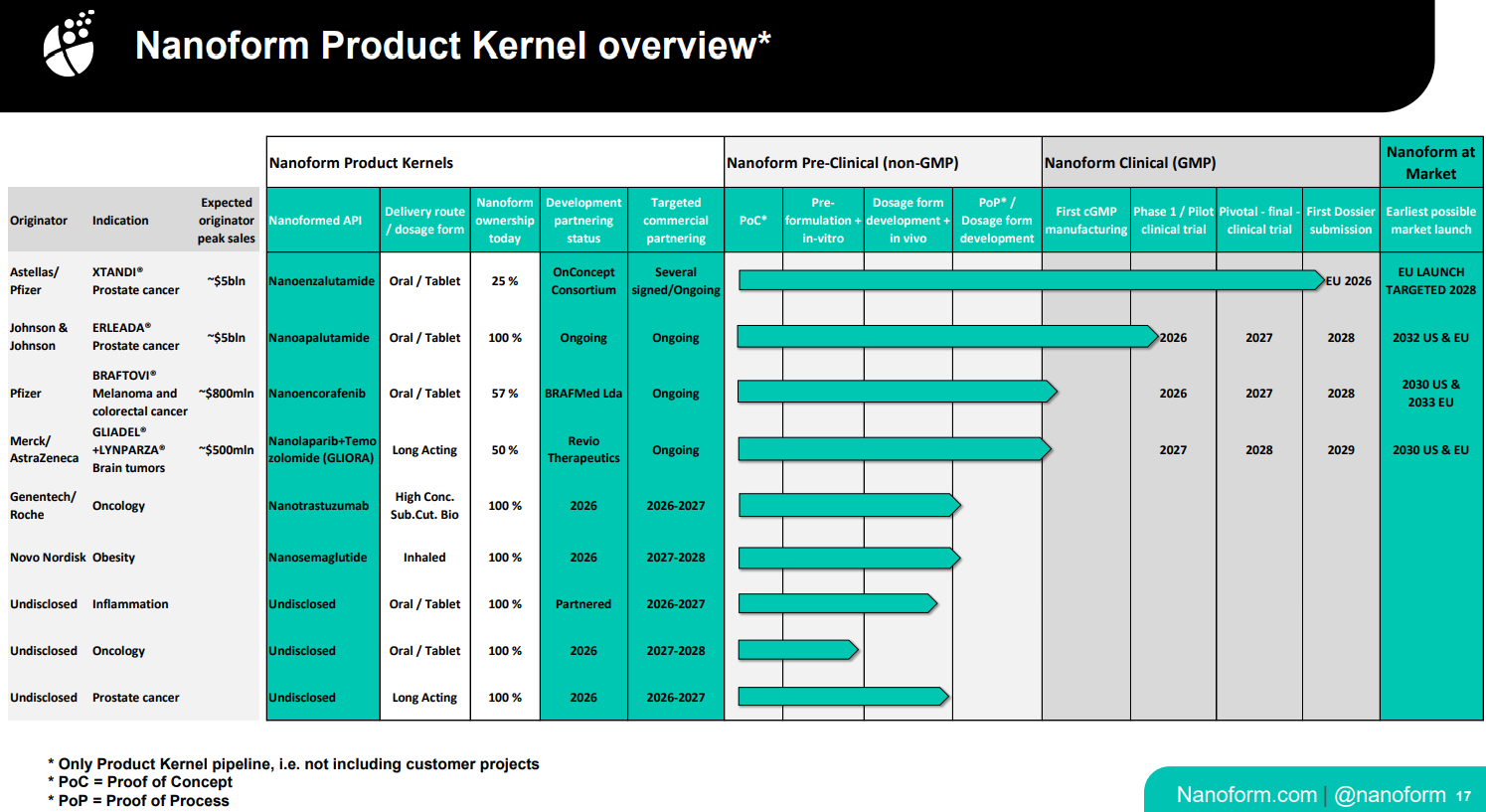
Of these, nanoenzalutamide is currently the furthest along, and its path forward is the clearest. A marketing authorization application should be submitted for this during this year, and the next milestone payments will likely be related to that. If this materializes, it could potentially turn the result positive next year, but it will likely require the regulatory authorities to accept the difference in Cmax compared to the reference drug.
Next on the list is nanoapalutamide, the first GMP batch of which was produced in December according to the press release. In that list, the partnering status is marked as ongoing. If this deal is finalized, some upfront payment could potentially be expected as early as this year, but perhaps it’s better to expect it to fall into next year. However, something that might complicate matters and slow down the deal-making is the inclusion of apalutamide on the list of discounted drugs (the Trump-era list), which would lower its sales potential.
GMP production for nanoencorafenib is also planned to start this year, and the first clinical trials for both this and nanoapalutamide are also intended to be launched this year.
Additionally, the inflammation undisclosed kernel stands out on that list, with its development partner status marked as partnered. We might hear something about this next.
In the longer term, the question of nanoformulating biological compounds is very interesting regarding the company’s potential. Here is a picture from the CMD (Capital Markets Day) slides showing the share of biological compounds in the pharmaceutical market.
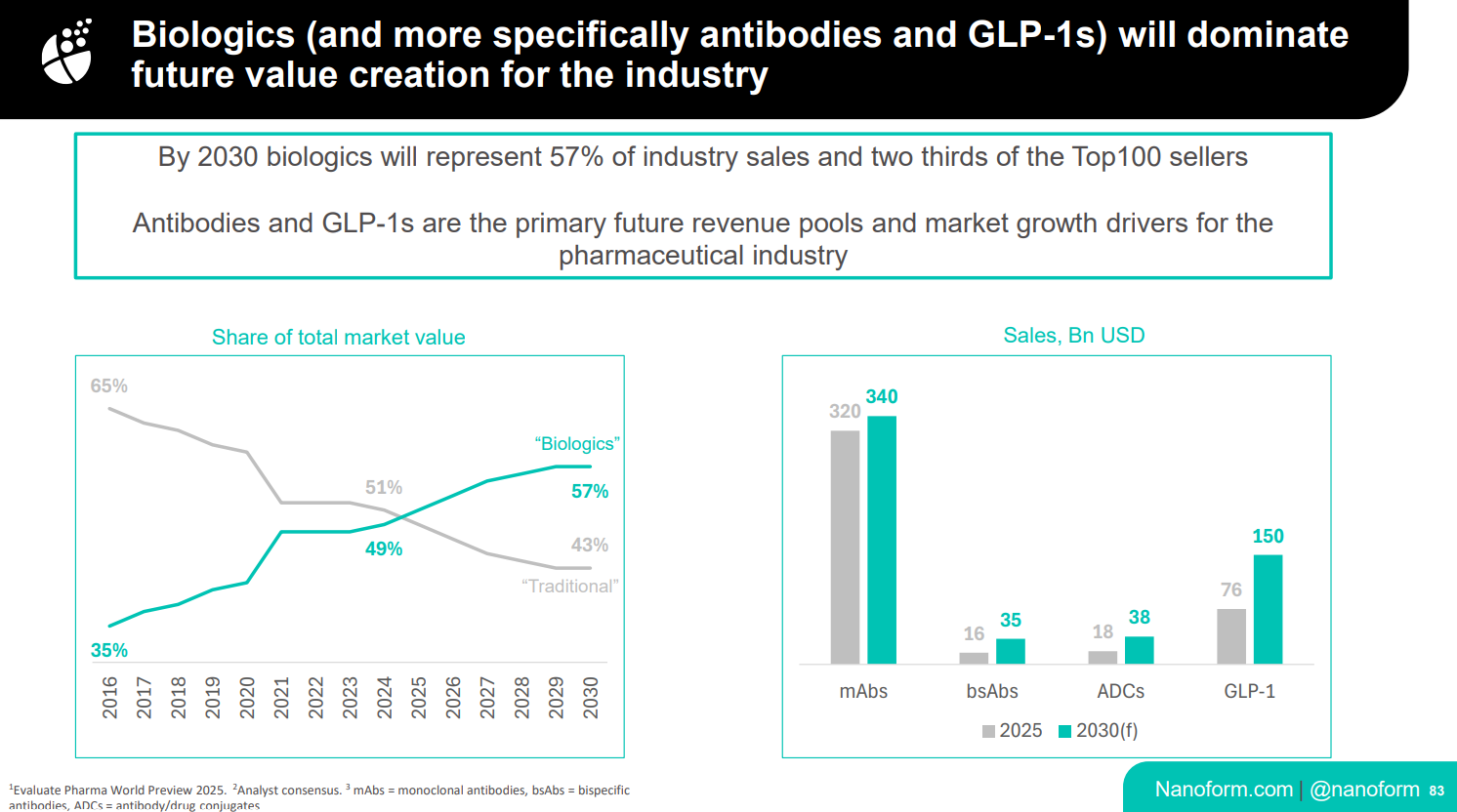
We are now moving into a situation where the market for biological compounds already accounts for a larger share than more traditional small-molecule compounds. Therefore, in my opinion, the production capacity and GMP status of the bio-line/lines are significant drivers towards the end of this strategy period. For this reason, I will perhaps pay even more attention to the progress of these biomolecules.
Regarding that previous pig study, it wasn’t just Nanoform’s trastuzumab tested in vivo, but also a nanoformulated biomolecule from a partner.
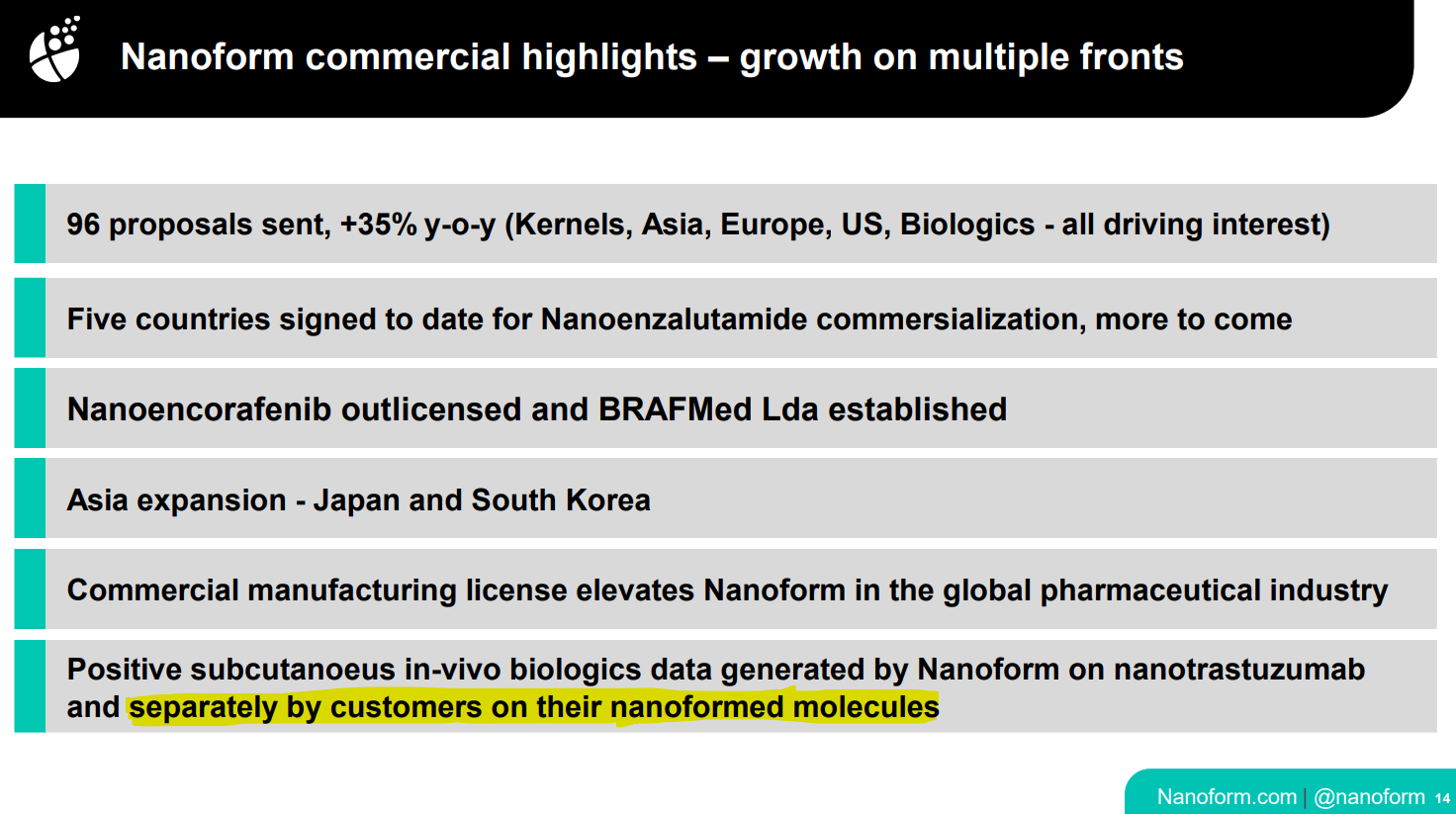
The best guess at this point is probably Takeda’s alpha-1 antitrypsin, as it has already been named elsewhere before, but it could certainly be another compound as well, such as another monoclonal antibody.
In that response, he also mentioned that the conversion of the bio-line to GMP level will be done at the partner’s expense, meaning there will be no separate costs for the company. Negotiations on this are still ongoing, however. Assuming negotiations are concluded during this year and it takes about 24 months to reach GMP status, a GMP bio-line could be operational sometime around '29.
We are now entering a phase where the initial investments have been made and cash flow should be turned positive. In my opinion, this is possible by 2027, but it will likely still depend on growing payments from partnering deals during this five-year period. Sales royalties are likely to have a relatively small impact for now, as sales of nanoenzalutamide can start in 2028 at the earliest, and even then, it will take time to reach its full potential.
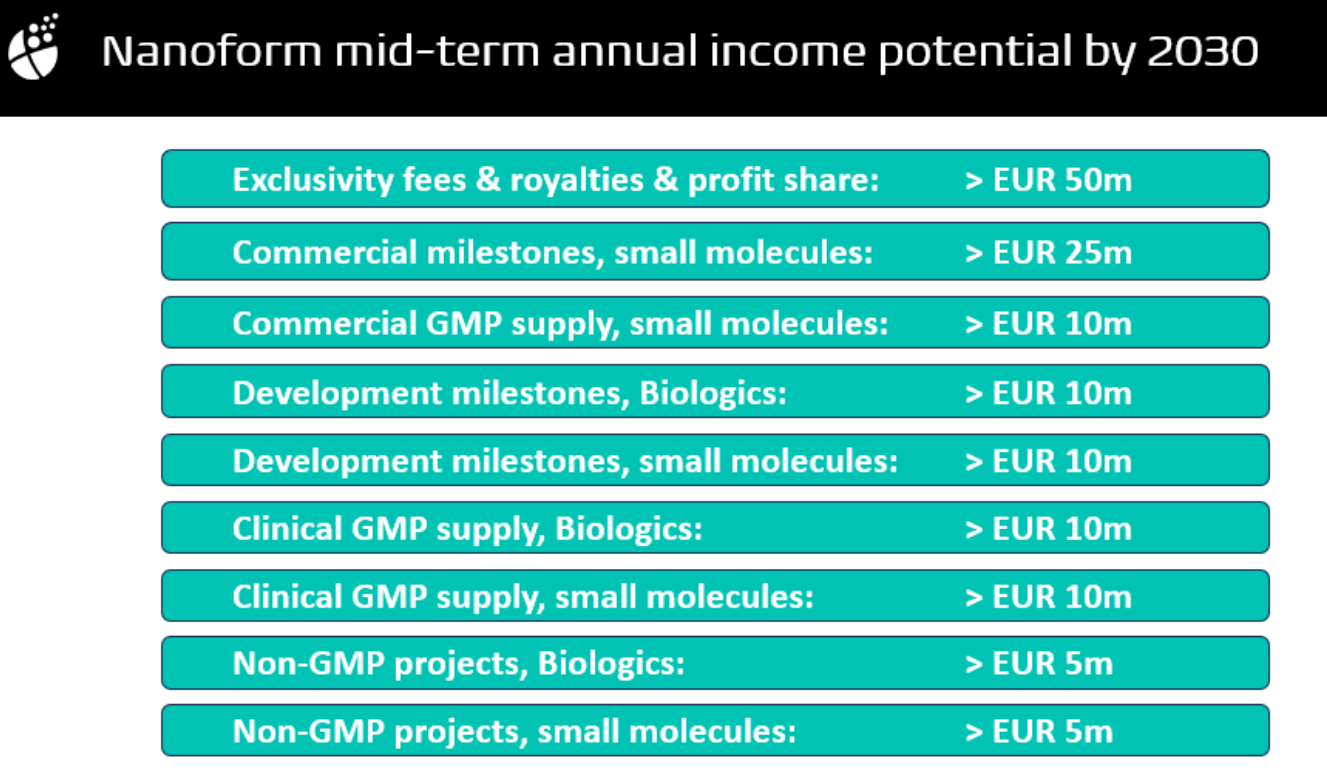
The company’s own estimates of its potential at the end of 2030 can be found toward the end of the slides. If these are realized, the situation will eventually turn around, but there’s always that eternal underlying question of whether one should listen to company CEOs.