Aiforia - Medical Image Analysis Software

Aiforia Technologies announced its intention to list on First North and raise EUR 30 million.
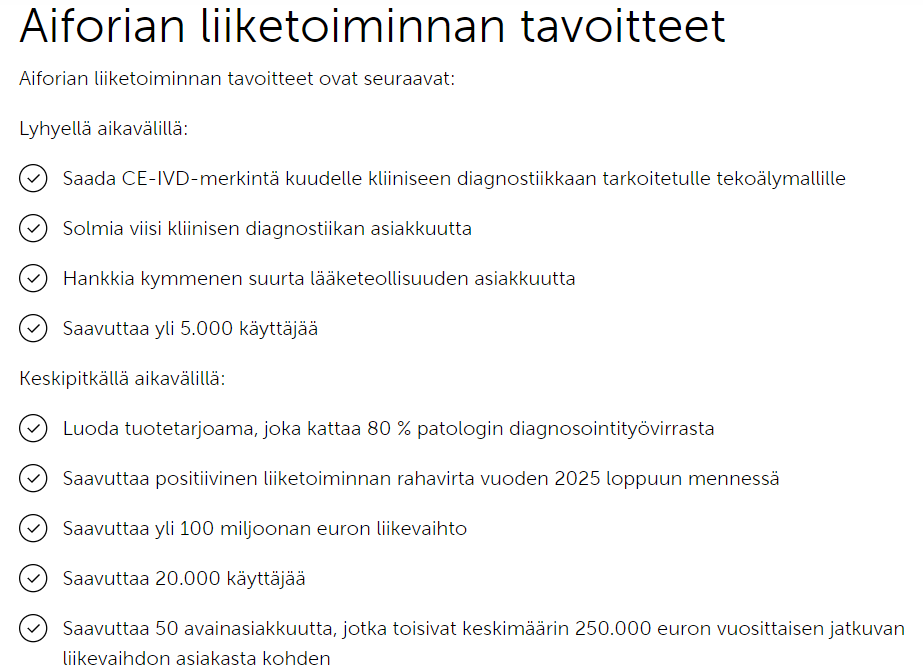
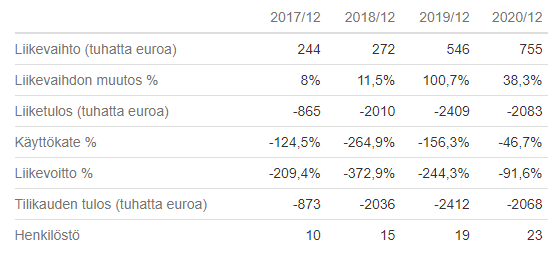
They are ambitiously targeting EUR 100 million in revenue, but so far, they seem to be operating at less than a million. They modestly omitted historical figures from the press release.

Well, this sounds interesting, but of course, the business case is another matter. So, it’s time to start dissecting it on the forum!

Aiforia aims to be a leading global player in AI-assisted tissue sample analytics. It seeks to provide AI solutions that improve the accuracy, efficiency, and repeatability of tissue sample analysis, enabling faster, better, and more personalized care for patients. The patient benefits can come through more accurate and efficient diagnostics, as well as through enhanced drug development and medical research.

The gross proceeds from the share issue are estimated to be at least approximately EUR 30 million and are intended to support Aiforia’s growth strategy through investments in sales and marketing, research and development, and other operational purposes.
https://www.finder.fi/Tukkuliike/Aiforia+Technologies+Oyj/Helsinki/yhteystiedot/2781000

22 Likes

Interesting opening, thank you for that!
The goals are clear and ambitious, and the means to achieve them are the core issue.

I’m not familiar with the industry, so I’m particularly interested in the competitive situation and potential competitive advantages. I’m sure there are experts in this field on the forum as well :+1:

It’s interesting in the sense that we rarely see these relatively early-stage “startup” type cases listed on our stock exchange, and this one is clearly still struggling in the red with big plans and promises, but the money-making part is still “coming soon.”

Added to my watchlist, but I’m a bit skeptical with this information. I need to look into it more closely.

4 Likes

Aiforia (formerly Fimmic) has been operating for quite some time, founded in 2013. The company’s scope and key personnel have changed considerably over the years.
Pros:

  • Strong team: the company and its background include experienced business professionals/entrepreneurs (Jukka Tapaninen, Kari Pitkänen), medical experts (Johan and Mikael Lundin), and domain/tech/AI specialists with a long academic background.
  • Years of work: Developing MedTech solutions is slow. Aiforia has systematically progressed in building networks, applying for certificates, etc.
  • Digital pathology is a rapidly growing application area. Aiforia’s competencies and offerings are strongest in this niche area.

Cons:

  • The focus of the offering is still a bit unclear. They sell platforms, tools, projects, solutions…
  • Revenue has grown slowly. When will it start scaling and why?
  • Several pivots behind them. Do they still need to pivot and start a completely new investment round?
  • The company is small compared to many other heavily funded startups. For example, Paige has raised $200M.
25 Likes

There are probably hundreds of AI companies in pathology and other image analytics, and Google, for example, also has its own department working on this.

Fimlab, the Hospital District of Southwest Finland, the Vaasa Hospital District, and the Central Finland Hospital District are transitioning to a digital pathology platform this autumn. Their IT partner is a company called 2M-IT, the technology provider is Philips, and the AI component for the Philips platform is apparently provided by Paige. I don’t know the situation regarding digitalization in the pathology laboratories of other hospital districts; I couldn’t find any news on the subject with a quick look.

Here is an excellent overview of AI in the interpretation of pathology tissue sections.

18 Likes

Hmm, so the question arises: “What is the moat, why is this better than the hundreds of others?”

8 Likes

My two cents, having tested Aiforia’s tool once and interviewed all HW and SW companies related to imaging at Slush a couple of years ago.

We had Aiforia’s product under test at our company for non-medical purposes, where we wanted to automatically identify things X in large images. The process worked by marking a few examples of X in the images, and then the algorithm started identifying them elsewhere in the image (semi-supervised learning). The more and more precisely you marked them, the more accurate the model’s suggestions were. Despite the enormous size of the images, both the user interface and the model training process were smooth and fast, leaving a good impression overall.

As stated above, I also believe that, depending on the need, there are other similar tools available (SuperAnnotate stuck in my mind best from Slush), and if a moat is to be dug, it will likely(?) have to come from an understanding of and specialization in pathology/tissue samples/similar fields. I understand that in the early stages, there’s a desire to try to do “a little bit of everything for everything,” but in the long run, it can be a challenging strategy.

Disclaimer: My experiences are solely with that specific tool; I am not familiar with Aiforia’s entire product/service range.

28 Likes

I’m adding to these question marks: Why is financing sought through the stock exchange? The devil on my shoulder whispers that either no other financing has been obtained, or it has been obtained on significantly worse terms than what one hopes to squeeze out from the lingering steam of a hot IPO market…

4 Likes

Regarding the medium-term targets, I was a bit puzzled by the relationship between these two goals:

  • 100 MEUR revenue
  • 12.5 MEUR recurring revenue from top 50 key accounts

I would expect a platform company, which seeks business from, for example, big pharma companies, to aim for significantly larger individual client accounts in terms of recurring revenue. According to these targets, almost 90% of the revenue would have to be scraped from one-off items and thousands of small client accounts.

2 Likes

The company page is now available here: Aiforia Technologies - osake - Inderes

A webcast for the company presentation is also available now :slight_smile: Aiforian yhtiöesittely 30.11.2021 - Inderes

5 Likes
  • The subscription period for the public offering, institutional offering, and personnel offering is expected to begin on 29.11.2021 at 10:00 AM.

  • The subscription period for the public offering and personnel offering ends on 8.12.2021 at 4:00 PM. The subscription period for the institutional offering ends on 9.12.2021 at 11:00 AM.

  • Trading in the shares is expected to begin on First North (First North) on approximately 10.12.2021.

Apparently, Moomin Characters Oy [sic!] is participating as an anchor investor, so I guess I have to subscribe too. Waiting for Karo’s analysis…

3 Likes

Preliminary price range :sweat_smile: not these, please! It’s better to just set the price at the lower end of the range, so the beginning of the stock market journey is more likely to be positive.

3 Likes
29.11.2021 at 10:00 Subscription period for the IPO begins
7.12.2021 at 16:00 Public offering may be interrupted at the earliest
8.12.2021 at 16:00 Subscription period for the public offering ends
9.12.2021 (estimated) Final results of the IPO are announced
10.12.2021 (estimated) Shares subscribed in the public offering are recorded in investors’ book-entry accounts
10.12.2021 (estimated) Trading of shares on First North Growth Market begins

https://www.nordnet.fi/fi/kampanjat/listautumisannit/aiforia/

According to the brochure, they have customers in 50 countries, 100 customers with 3000 users. Turnover in H1 2021 was approximately 400,000 euros. This means a turnover of 4000 euros per customer for a six-month period.

4 Likes

Existing owners have a 180-day lock-up period, and those participating in the personnel offering have 360 days. Right.

3 Likes

I’m thinking about Aiforia’s valuation. How can a company that in recent years has made less than a million euros in annual revenue be valued at 100-120 million euros? A valuation of 20-30x revenue would be high, but somewhat understandable. Isn’t 100-120x revenue astronomical?

6 Likes

A lot of discussion about Aiforia, but all written before yesterday’s company presentation. I got a pretty clear picture of the plans there, how about others?

2 Likes

First, I would like to hear from the company’s representative here on the Forum: how can you consider yourselves a leading company in the field??? Or is the basis for this claim that you limit the application areas of your medical tissue image analysis software so that you can make such a statement? 37+ employees!
Founded in 2013, commercialization started in 2018, entered the USA in 2019, 2020 revenue just under €1M and loss €2.7M, capital raised €28M, of which €17.5M this year (financiers are smiling about the recently implemented share issue :). MIT (USA) is currently being hyped as a newly acquired reference. Earlier in the discussion, other major players in the field were brought up; it would have been nice to hear about the company’s competitive position compared to them??
A growth company that should have a positive cash flow by 2025 and revenue around €100M, as well as 20,000 users (currently 3000 / 50 countries). Key customer-specific revenue target €250,000.
Market value €100-130M? Offering €35M? No owner exit = +

The numbers are very familiar to recent IPOs; the waiting period could be long. With neural networks, SaaS, cloud services, platform models, scalable services… it will likely be oversubscribed, and quick profits might even be made.

4 Likes

I was supposed to publish this tomorrow, but since Kempower is also starting its listing this week, I published it earlier than planned. Well, Christmas and rest are just around the corner, so below is the IPO analysis.

When thinking about recent listings with less than one million in revenue, Betolar and Spinnova come to mind.

Betolar priced itself at approximately 70 million with a long-term revenue target of one billion.

Spinnova priced itself at approximately 400 million with a long-term revenue target of one billion.

Aiforia prices itself at approximately 150 million euros with a long-term revenue target of 100 million.

These valuations are completely plucked out of thin air when considering that a billion-euro revenue company is priced so differently. At the same time, profitability differences are not that far apart, at least in dreams, as everything is a platform and SaaS nowadays.

According to studies, AI-based solutions’ revenue globally in medical fields over the next ten years is unquestionable, which means Aiforia’s hunting grounds also have many national and international competitors, and Aiforia’s differentiation, especially among clinical customers, is a big question mark.

The reason why I am passing on this offering (in addition to the absurd valuation, of course) is that I don’t think the current numbers reflect the future. With the current number of users and the price preclinical customers are paying, the targets will not be met, even if the number of clinical customers grows as targeted.

There is also currently little evidence of growth among clinical customers, on which future growth especially relies, with the exception of one customer reference. In my opinion, Aiforia could have waited another year or two to go public, because now this is just another “fingers crossed” stock on the market.

37 Likes

Thoughts on paper;

  • Management’s fundamental expertise is good; most of the management team has been with the company for several years.
  • The company has 33 employees - most are non-IT professionals. However, it is a software company; how will it have the capacity to produce AI solutions?
  • The company has been in business since 2013 - revenue 0.85 MEUR. Why hasn’t growth been more significant?
  • 3000 users, meaning revenue per user approx. 290 EUR. 100 customers - revenue per customer 8900 EUR.
  • The targeted revenue (100M) would require 340,000 users and 11,235 customers. As a curiosity, it’s worth noting that according to the source, there were 12,839 pathologists in the United States in 2017 (see Selaintasi tarkistetaan – reCAPTCHA).
  • The revenue target thus seems quite utopian… or perhaps the product is priced too low? At least it wasn’t clear to me whether the pricing is per sample (though if so, millions of samples would be needed) or license-based (this was my impression).
  • The problem, I guess, is if the product is priced high, it won’t sell under hospitals’ cost pressures? One would think, however, that a license could be significantly more expensive per user (290 EUR is low).
  • How do hospitals generally view smaller software houses? My gut feeling is that projects would focus more on broader systems - if there’s a separate software for each medical field, it would probably create quite a mess (i.e., would this scale at all)?
  • The company already has plenty of cash due to the directed issue (17.5 MEUR) carried out in the summer. Why is a new issue needed? The market cap (pre-money) of the directed issue was approx. 70 MEUR and 75 MEUR (May 14, 2021, and August 31, 2021). What has happened for the company’s value to be 150 MEUR now? Oh, if only I had invested a couple of months earlier… I would be quite happy. Of course, it’s unfortunate that the company presentation does not mention the valuation of the directed issues.
  • Competition is discussed far too little. I would assume that in the Health-AI sector, there are ERP players with more coding muscle.

Should I invest?
Well, this doesn’t cause much euphoria. I’ll pass - and wish the company success in refining and scaling its business model. I don’t understand the listing issue after the directed issue, nor the associated increase in value.

19 Likes