Exchanged at what rate?
“Views on currency exchange rate developments” could be the right forum. Would the administration take a look? My apologies to everyone for these!
1 Like
Hi @Ziibra, @jps and @vanha_Qfwfq
I moved the discussion about currencies here from the Russia’s aggression thread.
1 Like
At the rate set by the Central Bank of Russia.
So, the course does have quite a bit of practical significance, doesn’t it?
1 Like
It seems the buyer will pay a dollar/euro-based price, not in rubles, so it probably doesn’t make much difference from the buyer’s perspective.
1 Like
If that’s really the case, then there’s no problem, it doesn’t matter who exchanges the currency. But what if it’s not like that and it’s actually paid in rubles at the ruble’s exchange rate.
No, the agreements are made on a euro/dollar basis. No one in their right mind would make a ruble-based agreement because the exchange rate is determined by the state, so the actual price would be a complete lottery.
Someone just posted a link in the Fortum thread about the gas deal between China and Russia, which is also being handled in euros:
3 Likes
Last autumn, I moved almost all my free cash into foreign currencies, specifically USD, CAD, and CHF, based on the assumption that the central bank would strive to keep the dollar strong (through interest rate hikes). This, in turn, would keep import prices lower in the US, thereby somewhat curbing inflation in the US. The main idea, however, was that in difficult times, excess money always flees to the Swiss franc and the US dollar. Today, I moved some of the cash back into euros and am monitoring the situation.
As the EUR/USD (now 1.0185) parity approaches, it’s likely that the 1.000 level will be tested multiple times. In some polls, 67% are bearish on EUR/USD in the short term, which could serve as a temporary contra-indicator. Looking a month ahead, well over half believe in a slight weakening of the dollar against the euro, with EUR/USD trading around 1.040 at that time. 1.000 is also likely a significant psychological support level around which there will be some hesitation. Additionally, stocks are showing a temporary rebound, and this rebound usually goes hand in hand with a weakening dollar. The Swiss franc has already appreciated to the 0.9947 level (EUR/CHF) and was at its highest at 0.98666. The francs will likely serve as the last safe haven in my portfolio until the end of the bear market.
A rapid depreciation of the dollar would likely pose problems for the FED and US inflation, but the current situation is problematic for almost everyone else. Some countries have started raising interest rates, likely partly out of necessity, to curb inflation, but also to counter the strengthening of the dollar against their own currencies (e.g., the British, Switzerland, India, and Malaysia). US firms that export or operate widely abroad are likely suffering from the current situation, such as Microsoft. Some have already issued profit warnings related to currencies, and more are likely to follow in the coming weeks. Most larger firms, however, have hedges against currency fluctuations, which makes assessing the impact of exchange rates particularly challenging.
Some Finnish firms, on the other hand, benefit from a strong dollar. Among my own holdings, Nokia (at least in terms of revenue) and Neste are beneficiaries. Revenio seemingly avoided hedging, and if I recall correctly, may have even benefited from a strong dollar. Investing in US firms would not be particularly appealing at the moment if I had to exchange euros for dollars at the current rate and, in the worst case, suffer negative leverage if the dollar were to suddenly weaken and I also managed to pick a collapse-prone company. A strong dollar could, to some extent, temporarily curb the flow of European “new” money into the US stock market, at least for individual investors. On the other hand, it may also have supported the share prices of European export firms, and European indices like DAX, STOXX600, and even OMXs, etc., have not fallen as rapidly as one might have imagined, given the circumstances.
If forum members (or analysts working over the summer) have insights into clear currency beneficiaries (or sufferers), it would be great to get more information as earnings season approaches or, at the latest, with the reports.
9 Likes
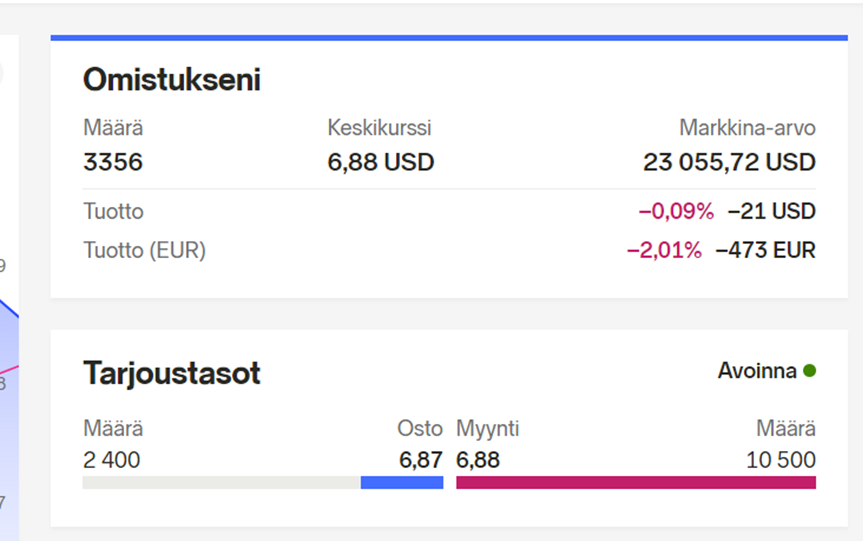
Oho, the euro has weakened sharply in a week? I’ve acquired these shares within the last couple of weeks. It went quite deep into a slump for a while, now it has risen to the same dollar value (almost) as when I acquired them. But now it’s still down 2%. Now the significance of these exchange rates in investing is becoming concrete for me. It seems it’s always the case that you only fully understand something when you experience it yourself… 

1 Like
The euro has strengthened within the last week. And that’s why the value of your dollar-denominated investment has weakened proportionally when calculated in euros.
2 Likes
Wait, a minute. So when I bought those dollar-denominated stocks about a week ago with euros, and the euro was worth less than a dollar, I had to use a couple of percent more euros for them. Ah okay, so I paid a couple of percent more for those stocks compared to today’s price, now that the euro is at parity… does that make sense?
Why is it so hard for me to grasp…  I need to stop and think about it a couple more times, from both directions, meaning from both the euro and dollar perspectives…
For me, the effects of exchange rate changes have always been as difficult to grasp as electricity; neither seems to sink in. Was it that it’s not the voltage but the amperes that kill, or maybe not? We certainly droned on about currency matters in civics class once, but I decided that it’s enough for me if there are enough numbers to the left of the decimal point when looking at a bank statement; on the right side are some decimals that don’t really matter.
1 Like
Let’s bring this thread back from the dead.
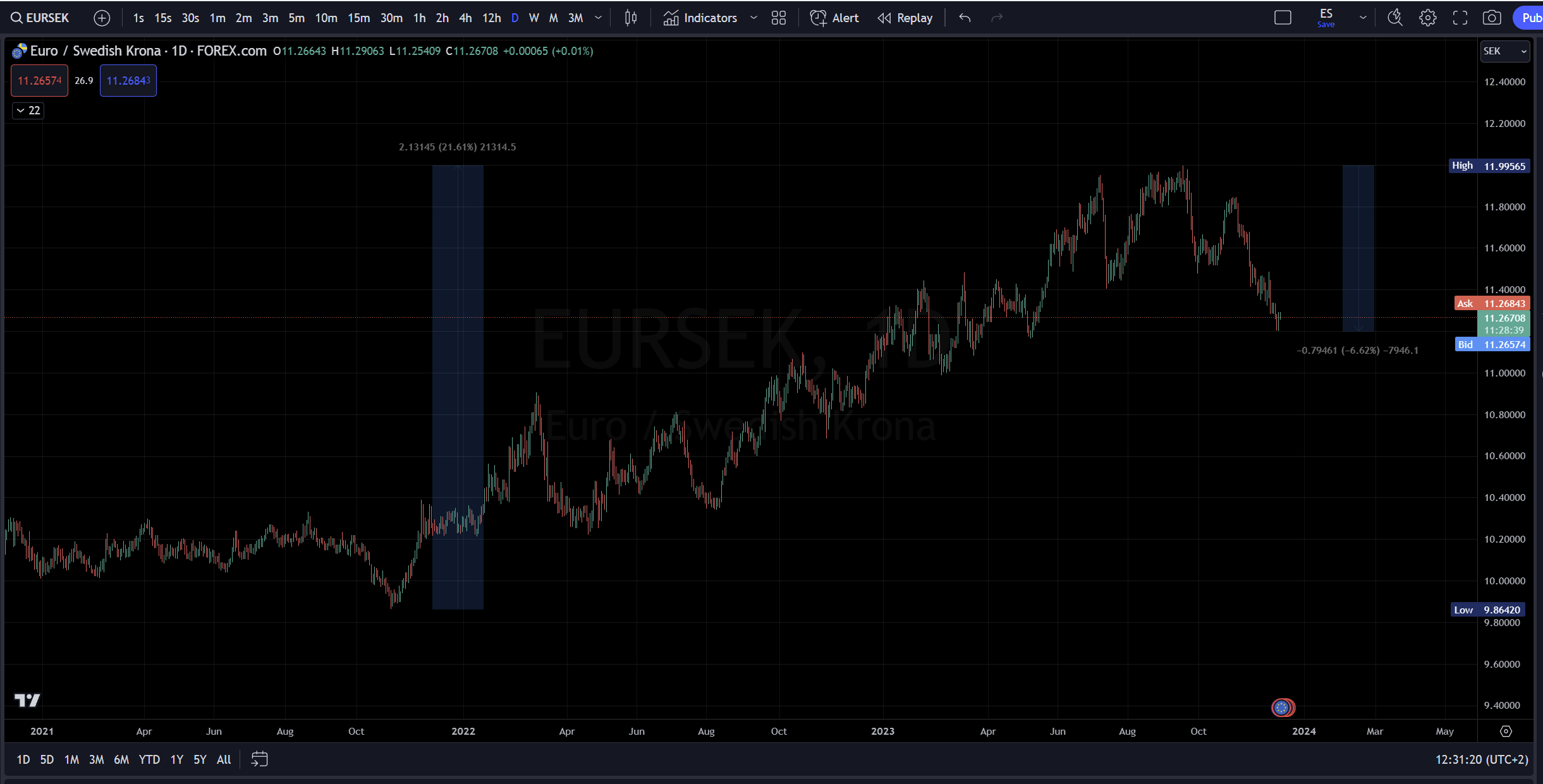
Many OMX investors surely follow currency developments at least superficially, and in particular, the Swedish Krona (SEK), which earned a reputation as a junk currency last summer, has strengthened from its lows (18 Sep 2023) against the Euro from 11.99 SEK → 11.26 SEK (EURSEK) (or (SEKEUR) 0.0833 SEK → 0.0885 SEK). The weakening of the SEK started from the 9.864 SEK level on 29 Oct 2021 and has provided negative leverage for many Finnish investors for quite a long time.
In this year’s autumn, and especially at the end of October, those invested in SEK exposures (or Sweden) have gained a nice boost to their investments (+5-6%+) in just over a month, and the long-term outlook likely remains positive, especially if the general market bottomed out at the end of October and the SEK continues its projected strengthening. People in Northern Finland, on the other hand, have gained an extra edge from their frequent trips throughout the year to Nuuskakaira in Haparanda.
My own portfolio includes Finnish companies that benefit from a strengthening krona, such as Stockmann, Talenom, and Kamux, as well as Orthex and Anora, which I picked up in October. Additionally, I took the time to skim through Inderes reports and found other potential beneficiaries like Sitowise, Oriola, HK Scan, Lassila & Tikanoja, and Fondia. There are likely other Finnish companies as well. However, the Norwegian Krone has only strengthened by a bit over two percent, so there hasn’t been much “currency leverage” from there yet.
At this rate, the effects should start showing in the Q4 results of the mentioned companies starting from early November (depending, of course, on any potential currency hedging). If anyone can think of other interesting Finnish companies (or Swedish/Norwegian ones) that benefit or suffer from the strengthening kronas (SEK and NOK), feel free to list them.
EDIT (I think this is already no. 4): Having spent a couple of hours browsing Inderes reports, I predictably found quite a number of companies that have been or are being affected by the weak kronas in one way or another. Some have also benefited from the weakened currencies.
“Expert” assessments on whether the kronas will strengthen or weaken (and on what timeline) also vary widely, meaning most are making educated guesses, just like us investors.
Here are some additional Finnish companies for the list (some self-evident) that were left out of the original post due to sheer laziness. I haven’t evaluated the magnitude of the impact for companies outside my own watchlist, and for some, the significance is ultimately small relative to the whole.
Relais, Leadesk, Telia, Solwers, Atria, Tieto, Dovre (NOK)
7 Likes