I don’t have time to comment extensively during the workday, but Claude blamed the price difference mainly on EU regulation.
Summary
Assessment of the message’s veracity
The message contains correct observations but also some exaggeration. Let’s go through it point by point.
What is accurate
Direct negotiations between companies and providers are absolutely true. Large organizations negotiate their own Enterprise Agreement prices with Microsoft and Google, and these prices are not publicly disclosed.
European prices are higher than in the US or China — this is a widely documented phenomenon. However, the reasons are multifaceted (see below). SaaS solutions typically carry a 5–15% price premium in regions with strict data protection regulations, such as those due to GDPR.
The price difference between China and Europe is particularly clear because Chinese providers like Alibaba Cloud and Tencent Cloud hold about 6% of the global market share — meaning China has strong domestic alternatives that force Western companies to compete on price in a completely different way than in Europe.
What is exaggerated
“Double-digit or triple-digit percentage Europe premium” is a strongly exaggerated claim as a universal truth. Tens of percentages are possible in certain products or negotiation contexts, but hundreds of percent do not reflect public pricing. Furthermore, in 2023, Microsoft made changes specifically to harmonize its global pricing according to the USD exchange rate, which narrowed the gaps.
What are the actual causes of pricing differences?
1. GDPR and data protection requirements
According to a study by Deloitte, SaaS companies operating in Europe typically spend 4–6% of their technical resources solely on maintaining GDPR compliance. This is a direct cost item that is passed on to prices.
2. Data localization requirements
Data localization regulations force companies like Google, Amazon, and Microsoft to build regional data centers in every country that has such laws — which significantly increases infrastructure costs.
3. Digital Services Tax (DST)
When France introduced its digital services tax, tech companies passed the costs forward, leading to higher prices for users and households. The same pattern has repeated in Spain and Italy.
4. Cumulative impact of EU regulation
According to a study by CCIA, US technology companies lose $39–97 billion annually in revenue, fines, and compliance management costs due to EU digital regulation. Part of this is reflected in pricing.
5. EU regulation acts effectively as a tariff
EU regulatory measures increase costs and operational friction for US companies, especially in cloud services, digital advertising, and app ecosystems — which functions similarly to a customs duty.
Conclusion
The core claim of the message — Europe is more expensive, and there are structural reasons for it — is true. However, the claim of “always a double- or triple-digit percentage premium” is an exaggerated generalization. Actual differences vary by product, negotiation situation, and whether it concerns consumer or enterprise pricing. Public pricing can be sourced most accurately, but details of contract negotiations are difficult to verify from the outside — a point the author of the message honestly notes as well.
There’s a lot of debate here right now regarding data centers and energy. Without having read the whole thread, my stance on data center investment is positive — I’ll have to look into the potential counter-arguments when I have more time.
My own playbook for economic growth is as follows. In terms of earnings, I understand I am in the top one percent in our country (which is honestly hard to believe), so I certainly view things from a different perspective than median wage earners:
Invest in early childhood and primary education, as Finland must extract the potential of every age cohort as efficiently as possible. More teachers, breaking path dependencies by reducing reporting burdens, and granting better disciplinary powers—for example, bringing back the option to hold students back a grade. For years, I’ve heard from teachers in my social circle that there are far too many students per teacher, the work is exhausting due to non-core reporting responsibilities and rigid processes, and teachers are toothless when dealing with problem students and difficult parents. Of course, the significant increase in S2 (Finnish as a second language) students in certain areas adds its own twist.
Hold on to innovators and star entrepreneurs more effectively. Cut taxes on labor and improve conditions for growth companies, for example, by fixing the taxation of employee stock options. Finnish taxation hits its peak at such low salary levels that the incentive to move elsewhere arises quite early in one’s career; many sharp individuals have already left or stay here only because of family ties. There isn’t much desire to join a growth company for the compensation either, when stock options are taxed in a way that makes you not even want to take them — we could look to the U.S. Incentive Stock Options (ISO) for a model. Becoming wealthy without a lottery win or crypto speculation etc. has been made quite difficult in this country, which then drives our entrepreneurial and most motivated citizens across the Gulf of Finland to our neighbors or further afield. While I’m no fan of the current government, at least they understood to provide a tax incentive for returnees and immigrants.
Make social security smart even for high earners. Fix the pension system so that one can invest at least part of their occupational/entrepreneurial pension themselves in a tax-efficient way, similar to the U.S. 401(k) style. Currently, anyone earning slightly better is mostly just annoyed to pay TyEL or YEL contributions when the ROI on the pension pot is so abysmal and social security benefits essentially cap out at relatively low salary levels.
In before someone screams “trickle-down economics” and claims I’m pushing for some U.S. Republican model. Even though I consider myself quite left-wing, it frustrates me how people in this country see red whenever making it easier to get wealthy is discussed. Yes, it’s true that motivating high-earners won’t ultimately *directly* benefit more than a small fraction of Finns, as most of us don’t have the drive or the skills to go into “hustle culture” or become corporate high-fliers. But these highly motivated types are precisely the ones who create startups and new jobs. They are the reason economic growth happens. (Absolute fact.)
A bit of a tangent, but as a resident of Turku, watching this local tram debate has been painful. Proponents of the tram justify their stance with studies and forecasts based on statistics and generally try to rationalize the decision. The opposition mostly settles for throwing out straw man arguments, whataboutisms, and tired gut-feeling arguments (along the lines of “there’s no point building anything here because all public construction projects get delayed anyway”).
Not to say that the tram proponents don’t have certain optimistic assumptions, and looking into a crystal ball always involves uncertainty, but what I don’t understand is: if the opponents can’t come up with any justifications that survive even a surface scratch (which surely could be found if they tried), why even oppose it? It’s some deep-seated contrarianism that probably lurks within every Finn.
This would be truly important. It is somewhat depressing that here, as a rule, the employer sells half of the options as soon as they vest, and in practice, if you want to cover the increased taxes (or rather the decreased net salary) resulting from them, you pretty much have to sell the rest as well. Somehow it doesn’t feel like the intention is even for people to hold onto them.
Another problem is how they are distributed to so few people, but fixing that first problem might already fix this second one as well.
The goal should therefore be that employees would generally keep at least a part for themselves and remain owners through that. And preferably in more than just growth companies.
Wasn’t this already decided in the spending limits discussion (kehysriihi)? In the future, option taxes will be paid when the subscribed shares are sold.
Oooo, thank you, I had missed this completely, but what absolutely fantastic news! Now this is the right kind of attitude, really refreshing decision-making! Now we just have to hope that it comes into effect as quickly as possible and that the implementation doesn’t get watered down along the way.
Discussion has reached an absurd level if we really have to argue over whether large-scale corporate investments in Finland are a positive or negative thing. If the price of electricity does rise, it should be compensated by building more power generation capacity. This would also create jobs, and perhaps eventually, we could afford to build fish ladders for hydroelectric plants and get the salmon running again. At the same time, we make other countries dependent on us: the need for data centers is certainly not going to decrease in the future. One only needs to look at China to see that it’s quite good to be in a position where other countries depend on you, rather than the other way around.
A program by the American CNBC about where investments in Europe’s biggest growth sector are heading. The program also visits investment sites in Finland.
We are at the very core of the reasons behind Finland’s sluggish economy:
"In Finland, companies easily blame taxation, labor markets, and regulation for the lack of growth. In reality, they should also look in the mirror. Many problems stem from corporate leaders and management styles that act as a brake on economic growth.
…caution, a quest for consensus, and targets that are set too low. These do not encourage renewal, but merely optimization. According to executives, in Finland, people are always preparing for the next bad or difficult period instead of pursuing new opportunities.”
Pretty much a nonsense “study.” And it is not at all surprising that HS highlights it (when the alternative would be questioning the world’s highest taxation and largest public sector).
I have personally worked with upper management and owners in Europe, the US, and Asia. Based on my own experience, larger Finnish companies do not differ much from international ones, other than being—contrary to the results of this “study”—probably even slightly better managed.
I am not in favor of investing pension funds into growth companies; this disrupts the financing landscape because “ownerless money” will end up competing with private capital. The best way to kill this proposal from the National Coalition Party is for the Social Democratic Party (SDP) to propose exactly the same thing in upcoming election debates. After that, the proposal will almost certainly be shot down, and rightfully so.
I fundamentally believe that the best investors are entrepreneurs who have made an exit, as they can provide the startup with valuable expertise and their own networks in addition to capital, while keeping a healthy eye on the company. I’m not saying public money is an absolute no-go, but considering discussions held elsewhere regarding interest rate swaps, for example, taxpayers and pensioners only accept profits. How then would it be explained to taxpayers and future pensioners that out of ten investments, five have been lost entirely, four yield nothing on average, and one might succeed if you get really lucky? I wish good luck to the politician who manages to sell that explanation to the Finnish public once the first investments are lost.
I basically agree, but Finland is such an egalitarian country that you won’t find former start-up entrepreneurs here who can just toss 100 million euros of funding to a company during a financing round. Even a single growth company can easily require between half a billion and a billion in funding during its growth phase. Since pension funds are the only wealthy entities in this country, without their contribution, we will inevitably remain at a “tinkering” level and companies will escape abroad in pursuit of financiers. Meanwhile, we should be able to create one new unicorn every year and a few decacorns. The alternative to Finnish pension money as the owner is American capital as the owner and moving the headquarters to Delaware.
Institutional money is usually behind successful startup investors. VC firms like Sequoia or a16z etc. select the companies and manage the investments (for large fees), but a significant portion of the capital being invested comes from various pension funds, sovereign wealth funds, university endowments, etc.
I don’t think that proposal specified that they should start making individual investments in companies. It’s more likely that the investments would be made specifically into VC funds, and Finnish funds in particular certainly need Finnish pension money so that they can grow larger.
IQM is an interesting example of how much can be achieved with long-term commitment and public funding. However, the stakes are very high and success is not guaranteed. In typical Finnish fashion, if a loss occurs, the search for the guilty and the punishment of the innocent will begin.
I really have to praise this forum member and their idea (see quote), as they changed my own mindset regarding development activities at work. Previously, I might have wondered what kind of “innovation” I could come up with this week or if this invention is big enough to tell others about. I can tell you, not many inventions were made.
Mikael’s idea is a great combination of observing the environment, helping others, and presenting an understandable solution proposal. Nothing is too small or simple. I took some lessons from this for my own work, and a few ideas have already come up!
There have been some rather restless statements and writings on this subject, but now we are starting to see some balanced ones as well:
"Environmental disadvantages associated with data centers worldwide, such as high water consumption, do not apply to Finland. In Finland, centers are not cooled with drinking water; instead, air is usually sufficient. Furthermore, the waste heat produced by many centers is utilized in district heating networks, meaning electrical energy is used twice, so to speak.
In Finland, electricity is also produced almost entirely without carbon dioxide emissions. Therefore, building centers in Finland is better for the climate than building them almost anywhere else. Waste heat recovery is a major benefit for many localities, as are the jobs and property tax revenues resulting from the centers.
But there are clear disadvantages too, especially from a nature perspective. Data center plots are large, and forests may have to be felled to make way for them. Similarly, the installation of power lines and the additional construction of wind power inevitably destroy nature.
Finland will not run out of electricity, but the concern regarding the sufficiency of electricity in all situations—including winter frosts—is still justified. It is also possible to manage that problem by setting conditions for data centers regarding their electricity procurement."
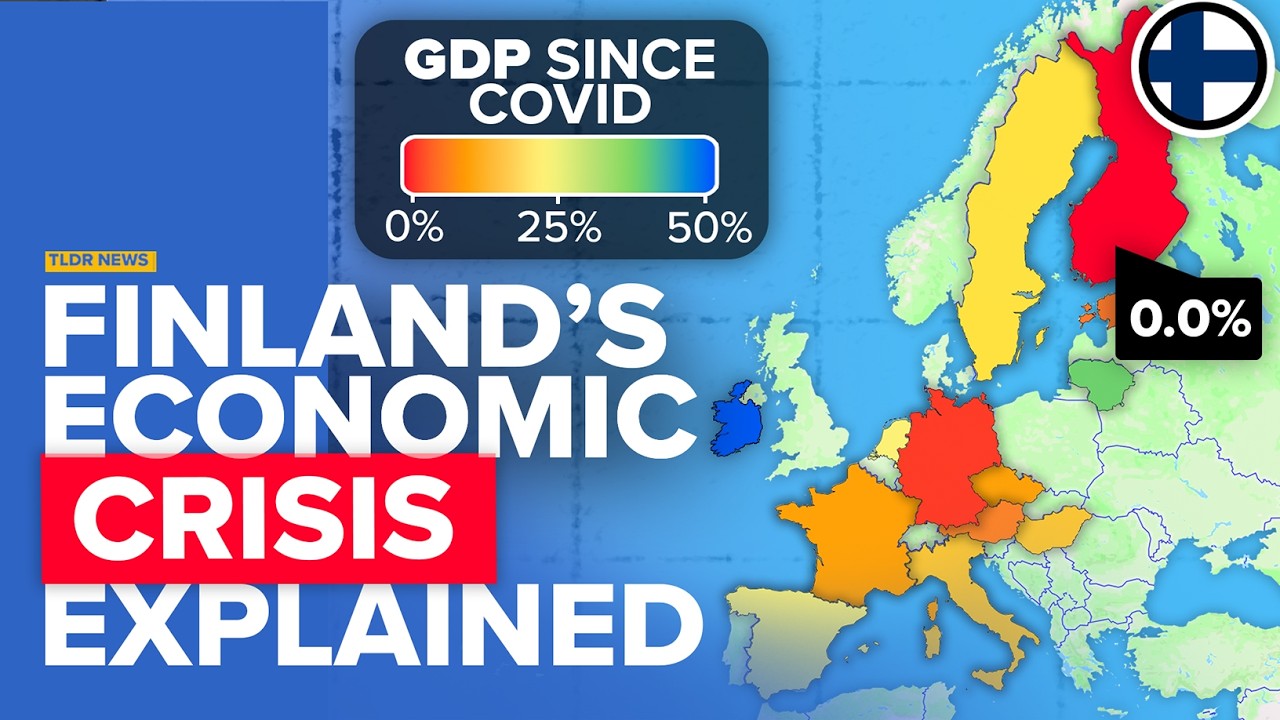
Europe’s worst economy. Unemployment, dependency ratio, national debt, GDP growth… Everything is going south. Even abroad, people are wondering how a previously successful country has been allowed to fall into this state.
And since this thread was supposed to be about suggestions for generating growth, I have a simple recipe for it. Taxation on labor and entrepreneurship, as well as pension contributions, must be lowered to a level that encourages work, and at the same time, social benefits must be cut to a level that also encourages work. Everything else is just idle tinkering.
 What is accurate
 What is exaggerated
 What are the actual causes of pricing differences?