How do you keep track of your own investment decisions and the most significant events related to your investments

Hi,

I’m a novice investor and one of those who have gained valuable information and learning from this forum!
I’ve been studying the topic for about half a year and, through experiments, have managed to make some investments, and recently also my first sales.

Here and there, the importance of documenting one’s investment decisions has popped up in discussions, and I’ve also started to realize its significance for learning. I’ve noticed this because I can’t remember all my thought processes from even 3 months ago… Now I’d like to ask experienced investors for practical tips: what things do you record and how do you record them? Do you use Excel or similar? What all do you write down? Purchase and sale date(s), reasons for buying/selling, most significant news (link to news, a couple of main bullet points, etc.?), your own reflections along the way, etc.?

Apologies if there’s already a discussion on this, but I haven’t found it. If the question is a repeat, you can delete it and direct me to an existing discussion. Thanks :slight_smile:

10 Likes

Excellent point, @Markusss. This topic definitely deserves its own thread.

I keep a journal in OneNote. Any cloud service would work, but OneNote has become my go-to tool due to my main job.

I try to keep the journal short, no stories or news. I record the date, buy/sell, and the reasons in a few words or a couple of sentences. I’ve also written my investment strategy and its revisions with dates in OneNote. Occasionally, during walks, interesting ideas come up in podcasts, and I jot them down in a few words in the journal right away. I read my journal infrequently, perhaps a couple of times a year.

7 Likes

So, all of these are in the same Excel file. I don’t read it much; the reason is more that writing things forces me to think more clearly.

I keep an investment diary where I occasionally write down feelings or views on the market situation or companies, especially if I’ve happened to read some thought-provoking news/blog/??? or delved into a company. These often help structure my thoughts and illustrate how markets truly don’t behave as one imagines, even when one has a “really strong feeling that it’s about to rise/fall.”

Whenever I buy or sell stocks, I make a note in the same diary and support the decision. Quite often, I’ve pondered a company earlier, and then, when the idea has matured, I make the actual purchase/sale, and at that point, I might just write “see reasons in the entry from 21.9.” No one else reads these writings, and sometimes there might be very thin justifications for something, and other times even a page-long “analysis.” I feel that these entries have helped my investing a lot.

Since Nordnet handles communication with the tax authorities, I don’t bother keeping very precise records of tax implications. However, when selling from my book-entry account, I always make a general note of how much profit/loss occurred, so I know approximately how much taxes I’ll have to pay the following year and can set aside a cash buffer. In addition, I always update quarterly how much the portfolio has yielded, how my net worth has developed, etc., and compare it to the OMXHPI and S&P500 indices. This isn’t very precise either, but indicative and mainly for my own pleasure, and perhaps helps motivate me. In a somewhat similar vein, I might jot down things related to cash flows or other matters in a very stream-of-consciousness style.

For the companies I follow, I also very lazily maintain their own tabs, where I compile, according to my motivation, points from earnings reports that I find interesting, links to news and good forum posts, and my own thoughts. This, in particular, is highly variable. That is, when I’m bored and have time, I might spend several hours dissecting earnings reports and scribbling notes, but most often the note is along the lines of “Pretty good earnings, no reasons to add/reduce.”

6 Likes

Twice a year, I put together a small summary (just in Word) of my portfolio, going through the most important events and adding short comments for each company, detailing what’s going on with them and where they stand. Additionally, I update my Excel sheet a couple of times a month with stock prices, bank account balances, etc., and at the end of each year, I archive such a table (so I now have the situation at the end of each year saved).

If I buy a new company for my portfolio, I create a separate document for it, where I go into more detail about the company and, most importantly, the reasons for buying it. After that, I follow the companies in those semi-annual reports.

So it’s quite a calm pace, three documents a year (+ new companies, if I happen to buy them, I don’t buy new ones every year). I’ve managed quite comfortably with these, though I’ve considered that sometimes I could do a slightly broader piece with more stream-of-consciousness and thoughts, but I haven’t had the energy.

8 Likes

I also use a very versatile Excel spreadsheet. On one page, I record all received dividends and interest, which I pivot into company- and month-specific summaries. On another page, all shares are marked by purchase batch, making it easy to see average prices, etc. I also track how much dividends that particular batch/share has yielded.

On the third page, I have listed the allocation and target allocation. I update this once a month. It’s easy to plan and review past performance if needed. The fourth page contains value development calculations. This too is updated once a month.

Finally (or actually on the front page), there’s a table where I collect all sales. The table includes purchase and sale prices, received dividends, and profit.

By the way, it’s also worth keeping an Excel for taxes. It makes planning easier when you can see how much profit/loss + dividends have accumulated so far. At the same time, you remember the deductions. Dividends automatically flow into the tax Excel from another Excel, but for now, I have to manually copy trades. Fortunately, I only have a few sales a year.

My Excel spreadsheets are quite extensive and were laborious to create, but maintenance is relatively quick. A monthly review takes about 15 minutes, and recording a trade takes a minute. You can certainly get by with a lighter version too!

I tried keeping a written diary, but it didn’t suit me. Perhaps because my investment style starts with business analysis, and that usually changes slower than fundamentals.

10 Likes

For executed trades, I record the purchase or sale date, the number of shares, and the price broken down into share price and transaction costs. If it’s a profitable sale, I also calculate how much I owe the tax authorities.

My investment style is largely quantitative value investing. I like to crunch numbers and averages from companies’ histories. However, every investment decision requires careful and comprehensive research into the company to be bought, and the ratio of research to purchase decisions is probably 10:1. Due to transaction costs, the purchase amount must be sufficiently large, and I don’t dare throw money into the stock market chasing any hype tips.

Spreadsheet programming is quite handy. It’s worth investing some time in this, because the end result is that I only need to input a few data points and the program calculates all possible key figures based on this data.

6 Likes

Thanks to everyone who shared their practices! This gave valuable tips on what style I could start building my own excel mess. I’m extremely far from an excel wizard, but through this exercise, I could study the matter a bit…

My primary focus has been to record things that

  • support the assessment of investment continuity… what to buy, what to sell, what to add, what to reduce, and when/in what situations. In other words, in addition to having some kind of plan for what will happen to existing investments in different scenarios over the coming years, there will also be better readiness to make new moves when opportunities arise.
  • help manage tax implications

The whole setup Darkroast built sounds so versatile and practical that it immediately comes to mind that it would almost be worth productizing and getting a bit more capital to invest through that :wink: I bet a lot of beginners like me would be willing to pay a suitable amount for such a ready-made tool…

2 Likes

Thanks for the compliments, but my philosophy is rather to encourage beginners to do and learn themselves! And of course, to share tips and advice. So let’s keep it a secret for now, but I’ll be happy to answer questions, of course :slight_smile:

Am I a rarity because I don’t really do much accounting? Tradingview has different lists of holdings and watchlisted items I’m considering buying. Otherwise, the stock portfolio shows what’s there, acquisition prices, profits/losses, etc. Well, in the ownership list, I might sometimes color-code, for example, sales intentions in red and additional purchase intentions in green. Otherwise, everything is mainly just stored between my ears. I do monitor the portfolio daily.

When trading, it would probably be especially good to keep some kind of diary for self-improvement. So far, I’ve only recorded the end-of-day balance when I remember, so I don’t cheat myself on the results.

4 Likes

Here’s another one who doesn’t really do bookkeeping :slight_smile: I personally get around it by being active here on the Forum and on various social media (Twitter, Shareville, etc.), and there I have to justify every (long) purchase very well.

8 Likes

Great and important opening!

Previously, for each purchase and sale, I used to write down answers to a few key questions from the perspective of so-called second-order thinking. A quote from Mäkinen’s blog 2018:

According to Howard Marks, second-order thinking in investing takes into account things like the following:

  • What are the company’s possible future scenarios?
  • Which of these scenarios do you believe will materialize?
  • What is the probability that I am right?
  • What does the mainstream of investors think about this matter?
  • How does my view differ from the majority of investors’ views?
  • How does the current price take into account the consensus future outlook compared to my own views?
  • What is the sentiment in the stock? Are investors too eager or unnecessarily pessimistic?
  • What happens to the stock price if the general view proves correct? And what is the price if I myself am right?

However, I often trade quite frequently, so this started to feel laborious.

Nowadays, for selling/reducing positions, it may be enough if the expected return falls significantly below my target of 15% p.a. In addition, for some positions, I might just shift focus from an asset with a poorer expected return to one with a better one, etc. So I no longer bother to make these entries for every move.

  • Example: this autumn’s sales of Fortum and Sampo. I believe I can find assets with better expected returns on the market after these have risen somewhat.

I have moved to a much lighter format for bookkeeping. It’s just one tab in Excel; “case analyses”. The primary purpose of my entire bookkeeping is to remind me of the qualitative characteristics of the carefully selected companies. It helps keep the company-specific (bottoms-up) approach clear in mind, regardless of what kind of news about macro or some crisis is on the KL front page.

In Excel, I describe numerically or on another scale (e.g., - - - / + + +, traffic light, or something else) a few of the most important key characteristics for each long position:

  • Previous quarter’s result, scale: traffic light red-yellow-green. For example, for a company with a yellow light, I know I need to start pondering and monitoring it more closely. I might consider selling a red one, etc., depending on the overall situation.

  • Crisis resilience (related to e.g. financial situation etc.), for example Kamux: “+++” because growth is very profitable, the financial position is good, and economic total lockdowns like the corona crisis are weathered easily.

  • ROE (long-term), for example Kamux: “25%” (in my own plan, I try to find companies > 20%, and 12% is the absolute minimum)

  • Scalability, for example Qt Group: “+++”

  • Competitive advantage, for example Talenom “+++”

  • EBIT margin (long-term), for example Smart Eye “+++” because it will eventually be a really profitable business, or numerically for Qt Group: “25-35%” because that will surely be achieved later

In addition, I describe the main points of the case in a few sentences verbally (risks, valuation, and my own position’s margin of safety to target prices, key return drivers of the case in the medium term, etc.). For this, I usually pick a few sentences from an analysis I’ve read or similar, or I write it briefly myself.

After this, there is a column where I estimate the multibagger potential or otherwise the expected return (e.g., fair value estimate and expected return in 3-5 years). Example: Smart Eye: “400-500 SEK in 2023-2024” or example Kamux: “earnings growth over 15% p.a.”. The purpose of this column is to ensure that in the long run, I am involved in a company whose expected return meets the 15% in my plan. The situation is constantly evolving, which is why this column should also be re-evaluated after each quarterly result or analyst update, etc.

Finally, there is one more column for important miscellaneous comments, usually a web link or similar.

21 Likes

@Aston_Livingstone Here’s another beginner wondering about the expected return. How do you determine the expected return? What criteria do you use to conclude that company X will likely yield 15% instead of, say, 10%? Is there a specific metric or a combination?

I have an Excel spreadsheet where each company has its own tab with all transactions. The sums from these tables are transferred to a summary table, where I update the value on the last day of each month to see the value development of my entire portfolio.

Additionally, I have a Word document where I have recorded my investment strategy. Which stocks are the cornerstones of my portfolio, generating a steady income stream as dividends. Some stocks are speculative, aiming for the best possible return :slight_smile:

@Aston_Livingstone the idea of alternative returns hadn’t occurred to me before. I invested a large position in Sampo and Fortum, thinking they would provide a good/reasonable return in the long run. In retrospect, it would have been smarter to invest in smaller companies with better return potential, and with realized profits, I could have jumped in even next year. But this is also a good lesson, which is rarely touched upon in investment discussions :slight_smile:

The three basic components of a stock’s expected return:

  • earnings growth
  • changes in valuation multiple
  • dividends

My assessment is based on whether these factors generate an expected return that meets my required return (15%). That is, some fair value estimate 2-5 years out, and then calculating the estimated return (CAGR) backwards from that. As a GARP investor, I particularly emphasize the first two, with the latter usually being less interesting or a “bonus” for me. Sometimes, a glaring short-term undervaluation is enough to spark interest, even if the case isn’t otherwise appealing. These three aspects have been covered in the Inderes investment school.

In my long-term view, I try to especially emphasize professional analysis and add my own reflections to it. Analysis isn’t always available, but I read it whenever possible… analysts give a 12-month target price, but in “long stories,” this is often a somewhat irrelevant figure for the entire investment story… (e.g., Qt’s potential in the big picture is not tied to the current target). I often try to consider numbers 2-3 years out in relation to risk, even though the endeavor is almost always very uncertain.

I’m not sure if I understood your question about alternative investments, but every week I try to consider:

  • Does the expected return for this stock still meet my required return looking 2-3 years ahead?

  • Would I buy the stock now if I didn’t already own it? (This question also applies to whether it’s worth “adding” after, for example, a price increase.)

  • What other options are available in terms of risk-return?

For Sampo at around €36 and Fortum at around €18, I estimated that the required return would no longer be met. That’s why I sold. Such sales are often not easy, especially if there aren’t immediately much better risk-return cases available.

I’m only at an average level with numbers. I try to assess the story based on gut feeling. For tech stocks, gut feeling has worked best for me so far. Luck is always needed.

I plan to change my style from GARP investing to a more defensive approach sometime when my pension pot is accumulated. At that point, stable dividends will likely be of most interest. However, now is not that time. Now, the focus is on rapidly growing capital.

23 Likes

@Ohoh, how do you determine the target price (calculation formula)?

It is worth keeping a record of your failed investments throughout your entire investing history. You should then revisit these notes at least once a year. Clearly list the loss in euros, the reasons why you bought the stock, why the investment decision failed, and why you sold. Humans have a natural tendency to try to forget their own failures, and as a result, you don’t learn from your past mistakes and end up repeating them in the coming years, losing more money.

It is enlightening to read your own notes years later; I would have otherwise completely forgotten my own mistakes from 10 years ago and the lessons learned from them. You’ll notice that you were completely certain of the company’s success at the time of purchase, yet you ended up selling your shares later after a 50% drop in price. You remind yourself that the analyst’s opinion was completely wrong at the time, the cash flow projections never materialized, and certain tips given on investment forums look like the guesswork of fools in the light of today’s knowledge. The most important thing to understand: no one knows anything for certain, even about what will happen in the next few years. Similarly, if an investment is in the green, don’t confuse luck with skill; you can make a good investment just by guessing correctly.

On the Nordnet website, I really like how dividends are now displayed visually as a bar chart. That is my best source of motivation; I go to admire it every once in a while. A dividend flow bar that grows every year is a wonderful thing to see with your own eyes. I don’t bother doing that in Excel when Nordnet generates it automatically on their website. Similarly, purchases, sales, and their profits/losses, taxes, and trading costs can be viewed most conveniently through Nordnet with just a few clicks.

On YouTube, many people showcase very complex Excel files they have built for investing. Such a tool could be useful if you have the energy to build and maintain it yourself; you can also find tips for these in video format.

3 Likes

I personally use a Google Docs document in Google Drive, where I mainly keep a journal related to investing and saving. I record my reasoning and thoughts on all my investments there and perform quarterly and annual reporting and reflection.

In addition to Docs, I use a Sheets document where I record the value of all my holdings on a monthly basis. The document includes ready-made formulas that calculate the change in value in euros and percentages compared to the previous entry.

I find this practice to be good and helpful. Writing down my reflections on my choices clearly helps me stick to my long-term investment plan. A long-term approach is, after all, the single biggest factor in my investment choices, as I still keep my investment horizon at 20+ years away.

1 Like

I forgot to mention that I make a short document (roughly always using the same template) when I research companies, and I also save those that didn’t lead to a purchase at that time. I’ve accumulated quite a few of those as well, and if I ever get interested in the same company again, I can go back to my old notes.

Lately, though, laziness has kicked in, and I’ve mostly just been updating Excel once or twice a month. I haven’t felt like making written documents; it feels like there hasn’t been anything special to write about, and I’ve just been lazy in general.

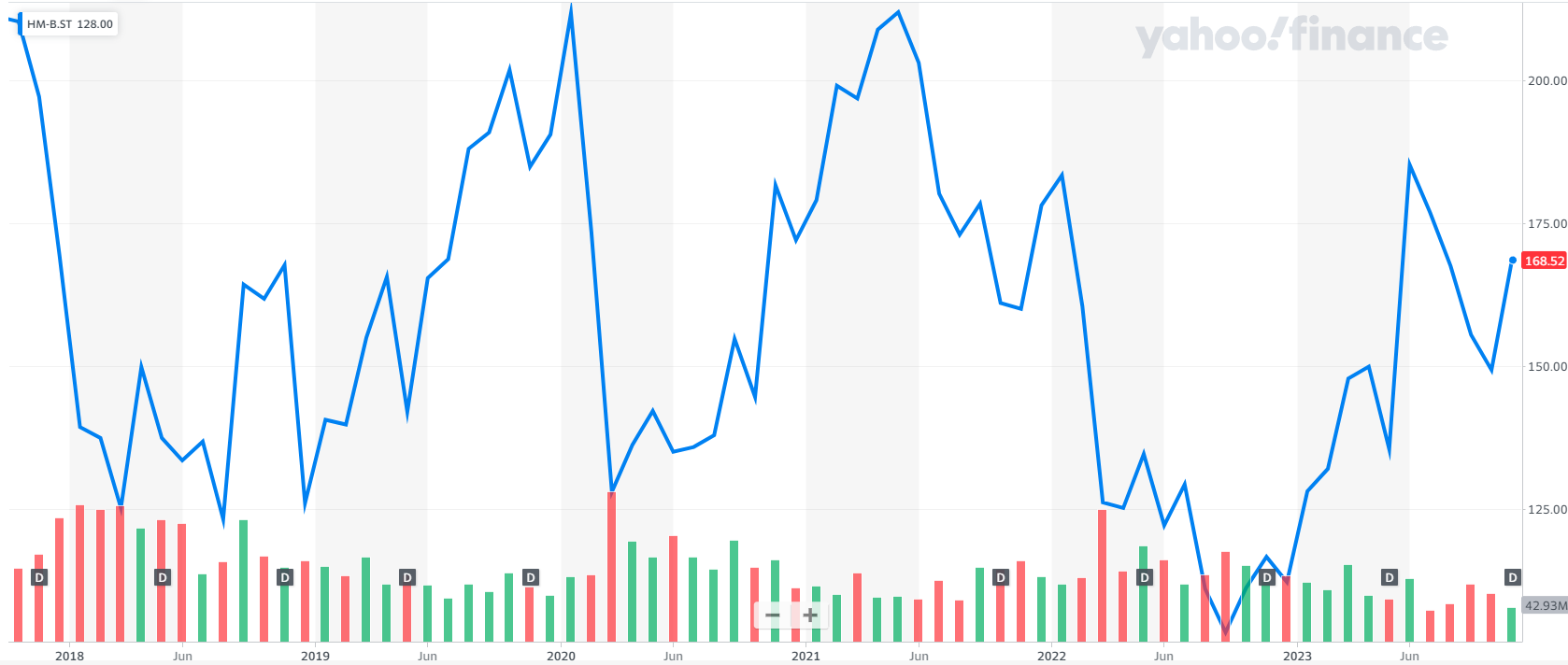
And you can also check how things would have turned out. For example, I was considering this H&M back in 2017 and fortunately skipped it after a bit of consideration. The performance has been quite weak; the stock price is now 20% lower than it was six years ago.

image

I started thinking about what it actually means for an investment to fail. For some traders, a -1% drop in price can be a crushing loss, and other investors who use stop-losses admit through their stop-loss orders that if the stock falls to that level, they must simply concede and lock in the loss. I haven’t personally practiced stop-losses because, according to my investment philosophy, a drop in the share price of a profitable company improves the investment’s expected return. I invest exclusively in profitable companies and only at a price that provides me with good compensation for bearing the risks.

I examine companies’ business histories carefully. Surviving crises unscathed says something about a company’s quality. An investment failure, therefore, would be the permanent erosion of business fundamentals. This would manifest as a sharp increase in debt or forced share issues at a poor valuation. With value investing, you can really only lose when this kind of “black swan” type of event occurs. It has certainly happened in my portfolio where a stock has collapsed -75% from its peak.

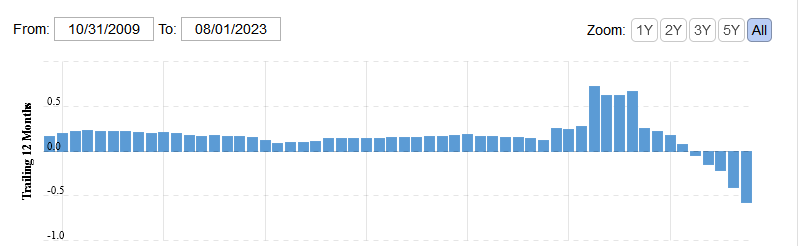
The graph below shows such a black swan-type situation. The company is the discount store chain Big Lots from the United States, and the bars represent the company’s net income in billions for the years 2009–2023.

I was very close to investing in this firm when the stock had fallen to a very attractive level relative to the company’s historical performance. The company’s business has been a total disaster following the rise in inflation. The strategy and product range failed, and all the cash was wasted on share buybacks. But it would have been difficult to see this in advance; that’s why I would call it a genuine risk. The point of discontinuity was the replacement of the entire management team at once. The fact that management says they are targeting certain returns means nothing. Management can only talk about investments as part of a stated strategy. It then becomes the investor’s task to consider whether that strategy will be viable in the future.

What makes investment decisions even more fiendish is that standing still is rarely profitable for companies. It generates good free cash flows when investments are withheld, but it makes it easy for competitors to analyze an unchanging business. When profitability weakens, you find yourself in a situation where a turnaround might be attempted through all sorts of maneuvers. That’s why a company should have a competitive advantage. A competitive advantage is sustainable only when it is based on something that does not change over time.

8 Likes