It came to mind when I watched today’s workshop video from Inderes. Which companies are cyclical and where does this cyclicality come from? How can one determine that we are at the peak of the cycle, and how is it measured?
You can only see it in retrospect.
Company cycles are dependent on macroeconomic cycles. You can consider it from the perspective of what kind of investments are made at each stage of the cycle. For example, companies are unlikely to want to invest when the economy is declining. New investments are made more widely only when the upturn has properly started and consumption is growing rapidly. At this point, the existing capacity is often already fully utilized, and more is needed. Due to this, engineering companies are late-cyclical.
Consumers, on the other hand, use, for example, dairy products practically the same amount regardless of where we are in the economic cycle.
Macroeconomic cycles are largely driven by the availability of resources. When the economy is doing poorly, there is a lot of available labor and corporate production capacity. This means that resources are cheap, which leads to an acceleration of the economy. This continues as long as resources become scarce, at which point their prices start to rise. This leads to inflation and rising interest rates. This continues until something happens and we start to decline. Due to rigidities, the economy cannot immediately adapt to the new situation, and this leads to a downturn, which eventually turns into an upturn due to abundant resources.
Certain industries also have their own industry-specific cycles, which are caused, for example, by technological development or something similar. For example, in the networking sector and for Nokia, cycles are due to the macroeconomy, and in addition, a second set of cycles is formed by the introduction of new technologies.
7 Likes
Here’s a good podcast about cycles: inderesPodi jakso 7: Miten lähestyä syklisiä yhtiöitä? - Inderes
@3235286 already summarized it well. As examples, one could say that construction companies like SRV and YIT are very cyclical (we just talked about this with Koponen regarding SRV in this video). In addition, equipment rental companies Cramo and Ramirent really fluctuate!
For engineering companies, a good indicator can be the development of order intake. At the same time, it’s good to remember that many have a very large and stable maintenance business to smooth out fluctuations in new equipment sales.
As an opposite to a cyclical company, one could consider, for example, Talenom, whose accounting services are needed even in a weak economic climate, or Revenio, whose operations are almost completely independent of macro cycles. 
Edit: Generally, the phases of the economic cycle can be anticipated, for example, by following the order intake of engineering companies, the development of construction companies, and macro indicators such as PMI (Purchasing Managers’ Index) and even GDP change, although by the time it turns, you are already late to the market.
8 Likes
Everyone recognizes and accepts cyclicality as a phenomenon. So why does the share price of a cyclical company fluctuate wildly instead of staying put? Does it make sense for Outokumpu to be at 10 euros or 2 euros? The market should want to buy Outokumpu at 2 euros at the bottom of the cycle, and by no means pay 10 euros at the peak of the cycle, if it were rational.
5 Likes
It’s the traditional alternation of greed and fear. The big players decide which way things move, at least in these highly volatile companies, and the small investor’s job is to consider whether to make the same moves, opposite moves, or stand on the sidelines with hands in pockets. In theory, it’s easy to buy when there’s blood in the streets, but in theory, it’s also easy to sleep 9 hours a night, always eat a balanced diet, and exercise an hour or two a day. However, humans are extremely imperfect beings driven by emotion, so even if it were rational to buy, for example, engineering companies when you can get them at their book value, it still feels bad for a normal person when you can get them 30% cheaper a few months later and it looks like the entire basic industry sector is going under. One’s finger might even reach for the sell button, since you can still get some pennies for your holdings. It’s much more pleasant to buy when everything is just going up and up.
6 Likes
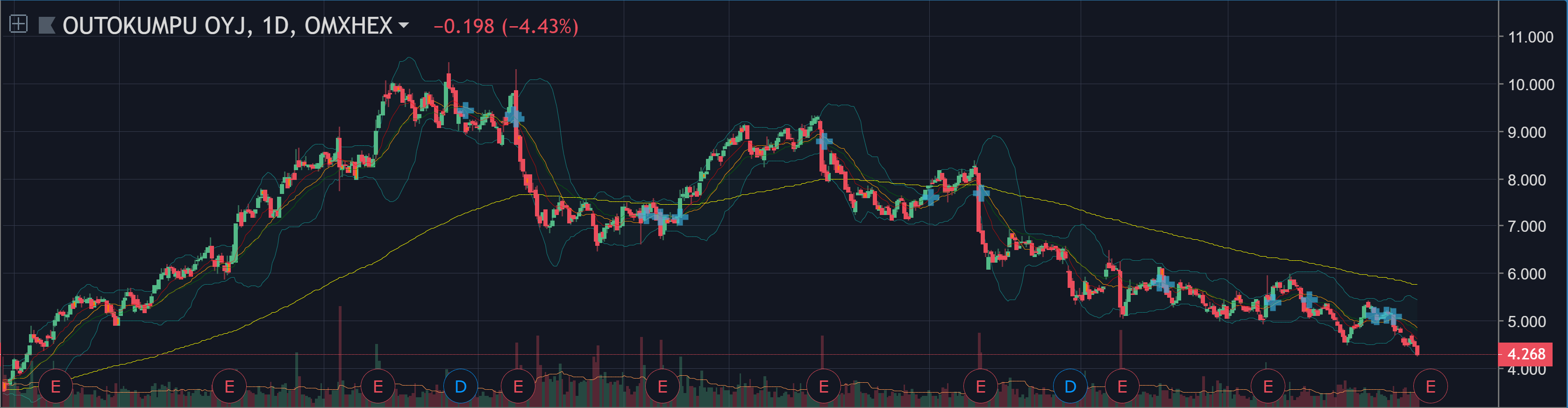
I happened to be examining Outokumpu from a TA (technical analysis) perspective. It broke the MA200 (200-period moving average) weekly level in June 2008 and hasn’t been able to get back above it since. The previous peak was on October 23, 2017, and since then, the decline has continued; the falling knife phenomenon is in full effect. There’s a lot of cycles there.
The earnings report will be published on October 26. It will be interesting to see how the CEO views the future.
- in the picture, the yellow curve is MA200 (daily level)
7 Likes
So now Outokumpu is on its way to ten, probably the last moments to jump on board…
Are there any other tips for good cyclicals at this moment..?
Outokumpu at ten wouldn’t be much more expensive than historical levels when looking at EV… Just saying…
Kannattaa vilkaista myös EV puolta.