What do you have in your portfolio?

Alright, 2025 is in the bag. For my own portfolio, this was a very successful year after a few years of sluggishness.

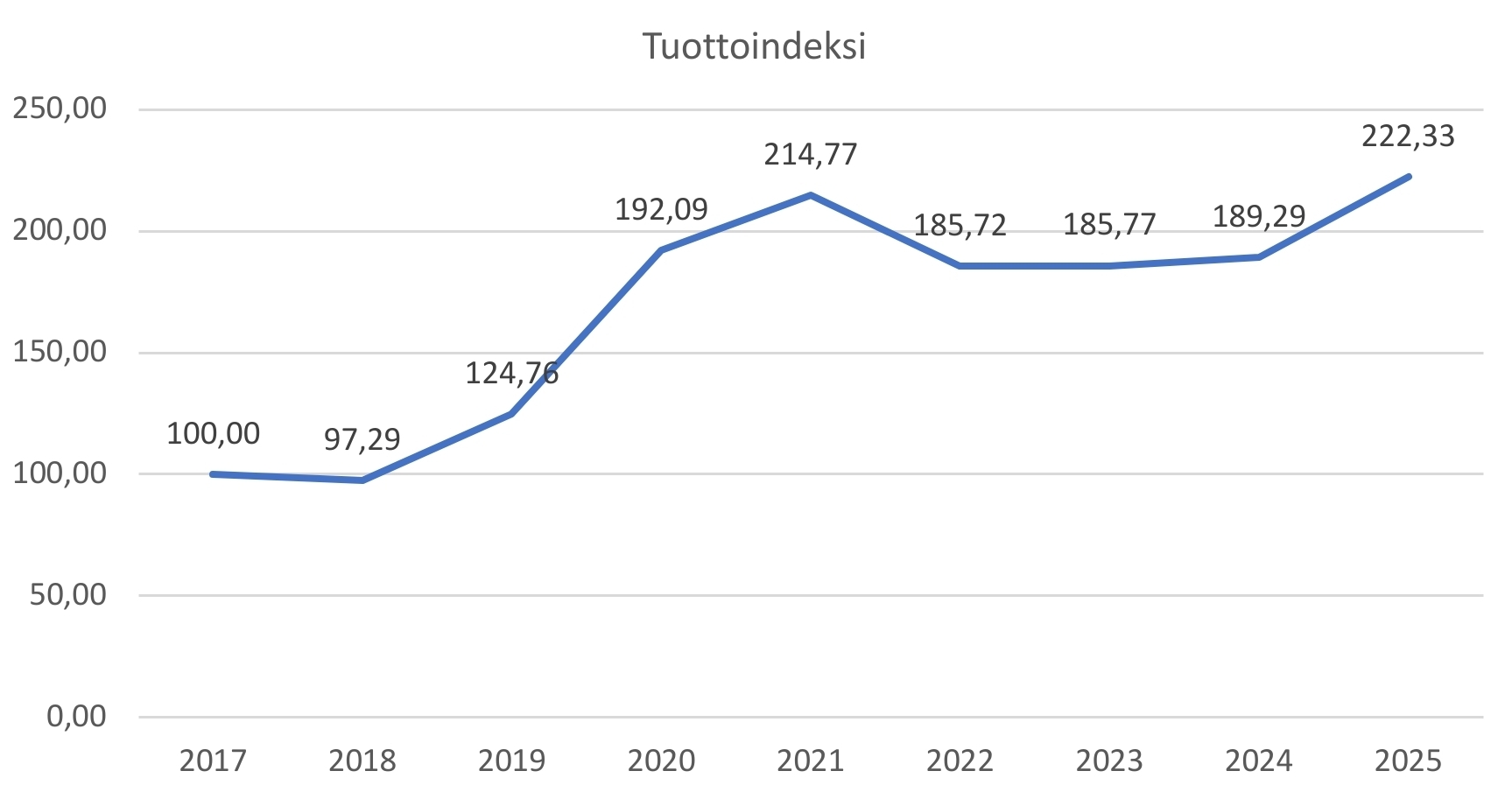
The total return for this comes to a CAGR of 9.3% for 2017–2025 and just over 17% for 2025.

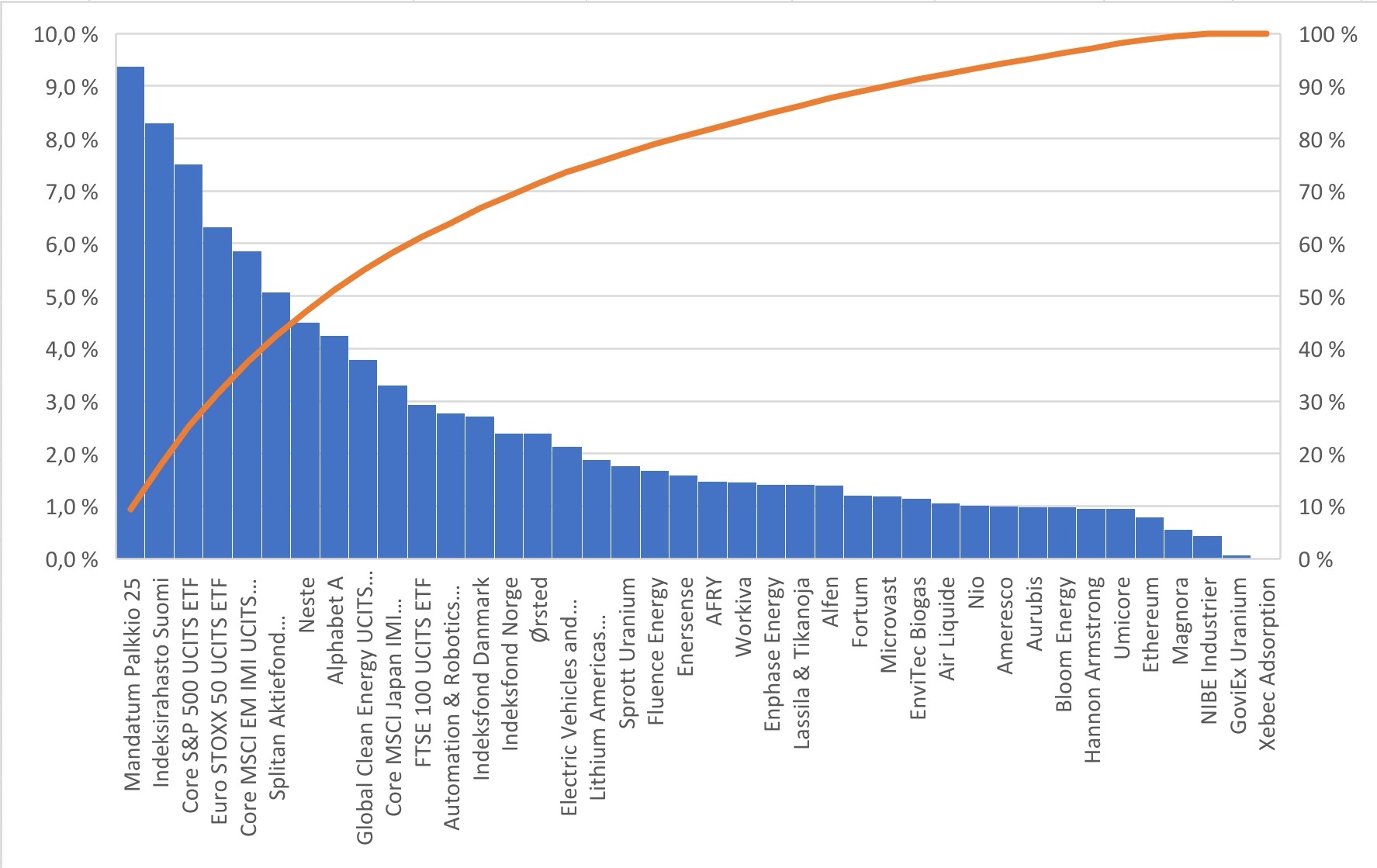
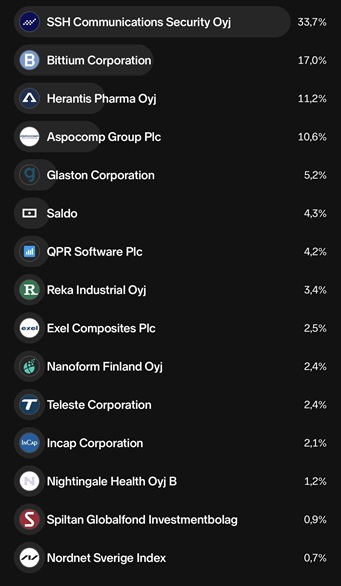
Regarding allocations, the portfolio looks like this:

The biggest moves were made in the fall, when clean energy received quite a strong tailwind from the partial impact of the AI investment cycle. At that time, about once a week, I sold a small slice of Microvast and Bloom Energy, Energy Fuels and Wärtsilä in two parts, Lithium Americas (US) entirely, and finally also a bit of Fortum. Of these, only the Finnish companies were in an equity savings account (OST), so with the realized capital gains, I also cleaned up a lot of the smaller (heavily loss-making) junk that had accumulated in the portfolio over the years.

In addition to those mentioned, the good upward year was of course complemented by the strong performance of the Finnish and European indices; on the OST (equity savings account) side, Neste’s gradual recovery and Enersense’s great rise; and on the AOT (book-entry account) side, especially Alphabet and Lithium Americas’ Argentinian cousin. The biggest losses were caused by Enphase (again) and Stem.

Including the year’s new purchases:

  • AOT: Orsted, EnviTec Biogas, Aurubis
  • OST: The already mentioned Enersense, L&T, Alfen

Let’s hope that next year will be at least nearly as good (in terms of returns) as this one! :slight_smile:

17 Likes

One year behind, I’ve done a bit of overhauling in the portfolio. I trimmed my US holdings and moved funds to an Equity Savings Account (OST); with these, I added domestic dividend payers and strengthened the defense sector. I plan to continue this into 2026.

As a highlight of my successes, I could mention being part of the US drone hype; especially Ondas Holding brought in nice profits.

The biggest loss came from selling Neste at under ten euros. Well, at least there are losses to offset.

Outperformed the OMXH25 by a fair margin, though, thanks to $ONDS.

Current portfolio setup:

9292ebc8-8491-4ed1-a572-d7dac9b61614

32 Likes

The Osinkopilkkijä blog has been running for a year, with €1,000/month invested in value stocks using mechanical screening (P/E, dividend, P/B). The portfolio has accumulated various out-of-favor companies, and for next year, the portfolio composition is very good and the return outlook is highly favorable.
You can read the blog via the link in my profile.


37 Likes

We’re starting the year with a fairly familiar-looking lineup. Last year made me realize that even with a larger number of holdings in the portfolio, you can make a good return if there’s even one gem that balances out the rest of the junk. My own mortality has become clear, and as much as I want to be that “return king” of X, the risk level I achieve with this roughly 10-15 ticker portfolio suits me much better. A wimp is a wimp!

A summary of the year 2025 and its returns from a few days ago can be found below.

But onto the portfolio content itself.

I won’t break down the holdings further here; that’s been done in many posts already. I’ll note a few things I’m monitoring in these companies. Just this sort of exercise this time.

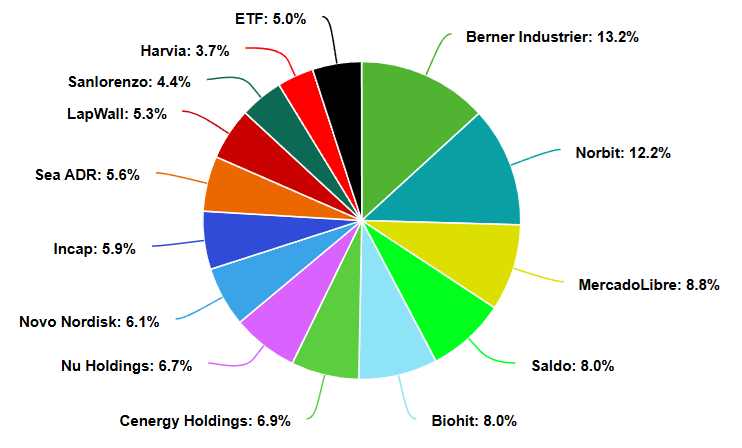
Berner Industrier (13%)

  • EBITA margin, acquisition targets, and their cost. Development of capital efficiency.

Norbit (12%)

  • EBIT margin, new medium-term targets, order book development.

MercadoLibre (9%)

  • GMV growth (gross merchandise value), loan book development on the fintech side, and ARPAC.

Biohit (8%)

  • GastroPanel sales and new distribution agreements.

Cenergy Holdings (7%)

  • Adj. EBITDA, order book development in both segments (pipes and cables).

NU Holdings (7%)

  • Customer growth, ARPAC, credit losses.

Cash (6%)

  • Constantly looking for a new target to burn my fingers as efficiently as possible.

Novo Nordisk (6%)

  • GLP-1 market share and margins. H1 launch of the oral form → reception? If the pills take off, is current capacity sufficient.

Incap (6%)

  • Organic growth and adj. EBIT margin. Customer-specific revenue development.

Sea ADR (6%)

  • Shopee’s GMV growth and Garena’s bookings. SeaMoney growth. Maintenance and development of profitability.

Lapwall (5%)

  • Order book and revenue growth. Impact of the Pyhäntä expansion. How management comments on the movement of goods and factory shifts/lines (capacity utilization).

Sanlorenzo (5%)

  • Order book development and quality, and revenue growth of new yachts.

Harvia (4%)

  • Revenue growth, especially in the US, and of course the recovery in Europe. Profitability development.

That’s all for this time!

38 Likes

A Dismal Investment Year 2025

My active portfolio rose by a mere 2.59% in 2025. That is a dismal return. Even Evli’s short-term bond fund performed better, +3%! The portfolio’s weak performance last year and in recent years (5-year return 20%) has been due to, on average, poor stock picking.

This year’s weak returns are partly explained by an imbecilic reaction to the trade war in the spring. I shouldn’t try to play the market, but rather focus on picking companies. The biggest blunder was selling Berner, but on the other hand, I succeeded in changing my mind again and buying back half of the position. The stock rose over 150% last year. Without the fumbling, the portfolio would have risen +20% since the start of the year! I am glad I learned this lesson the hard way now and not later when the capital is (hopefully) even larger.

In terms of market sentiment, my timing has been excellent in places—after all, I bought stocks during the dips of 2022–23—but I have fallen into the trap of selling winners too early, and the success of my stock picks has been too inconsistent.

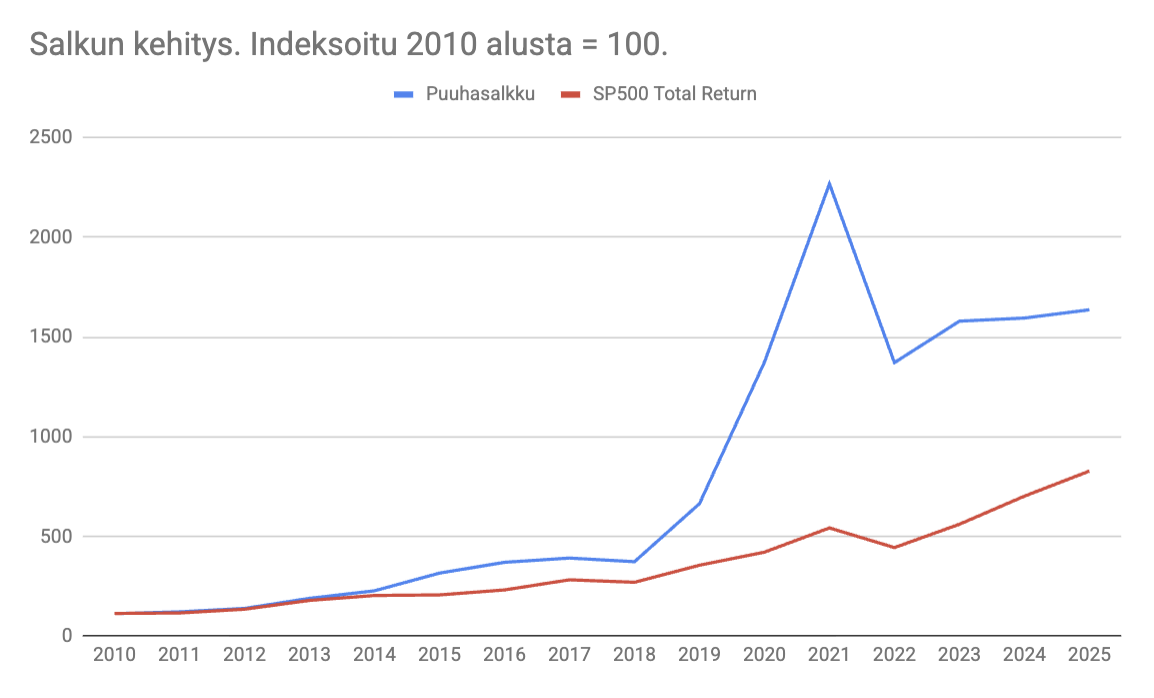
The weaker returns of recent years have now brought the portfolio’s total annual return down to 19% for the years 2010–2025, whereas the S&P 500 total return index has returned 14%.

There was also a lot of good in the past year. I spent more time on stocks, and my understanding of companies deepened across a broad front. Setbacks can thus be monetized as learning experiences. Alongside the spring blunders, I moved money into a tax-efficient equity savings account (Osakesäästötili / OST), which (presumably) will reduce the tax burden going forward.

My focus on Nordic and European small caps hasn’t been a very rewarding choice, but using that to explain the weak returns would be a mere excuse. I chose to wade through the swamp when others chose the dry path. My own choice. There are tens of thousands of companies in the world: there is no obligation to focus on just one region. Secondly, there have been brilliant opportunities in small caps as well, as Berner in my own portfolio demonstrates. That’s where you find the cloudberries! It has also hosted performance rockets like Avtech, Puuilo, and Harvia. I just need to pick winner stocks with a better hit rate and hold onto winners more firmly. Good buying opportunities in high-quality firms are rare, and even fewer firms are truly high-quality in the long run.

Every investment style has its weaker periods, and I’m not going to make major changes to anything. Instead, I have sharpened my style: look for potential long-term value creators and sit on them like a mushroom. I have also considered a new thought experiment: What if you had to HODL a stock forever? In that case, you would look at investment targets from a much more critical perspective. Purchases would become even rarer, but one would perhaps be better committed to them mentally. This thinking was inspired by an investment book I read last year, What I Learned About Investing From Darwin by Pulak Prasad—a warm reading recommendation.

In my diary entries from 2020–21, I often complained about high market valuation levels, which would inevitably eat into the returns of coming years. This has truly come to pass. Looking at my array of companies now, almost all of them look cheap. For example, looking at a simple P/E ratio with 2025 projected earnings, you can pay 11x for Aallon Group, 10x for Dominos Pizza Group, 10x for Sanlorenzo, 13x for Etteplan, 11x for Nurminen, or 20x for the highly profitable Adobe (realized figure due to a deviating fiscal year). The much-maligned Qt Group is also trading at over 22x its 2025e earnings. Relative to their earnings potential, Paradox and Remedy are inexpensive. Berner’s and Rökö’s EV/EBITA ratios hover around 20x, which is not a bad multiple for such companies.

Many of my portfolio companies are forgotten, overlooked, or insulted (like Dostoevsky’s The Insulted and Humiliated). Once the sun shines into the pile of brushwood and sentiment improves, I am optimistic about the portfolio’s return potential. In addition, the portfolio holds a lot of cash and liquid assets in the aforementioned Evli Likvidi B fund, waiting for new ideas and opportunities.

All my best investments over the years have been made in companies that were relatively cheap at the time of purchase and where investors overlooked the company’s potential to create value far into the future. With this thought, into the new year!

130 Likes

The year 2025 is over, which means it’s time to repeat the cliché and reflect on the past year.

When I look at my investment year, my feelings are twofold. In terms of returns, I have significantly lagged behind Hesuli (the Helsinki Stock Exchange). My total return for 2025 was 8.63%, which clearly underperformed the market return. Naturally, I am not satisfied with this. Like many others, I would love to showcase stellar returns here, but my strategy will likely never make that a regular occurrence.

I primarily own quite “boring” companies that should create value year after year without much drama. In the long run, however, I hope to generate steady, boring returns that beat Hesuli over a long period. On the other hand, during individual years when the market rises sharply, I don’t expect to be invited to the party.

On a positive note, I feel I have grown as an investor again this year. I’ve focused more on studying how companies can create value for their shareholders, and in the long run, I believe that is a worthwhile subject to dive into. Aside from a few stumbles, I have stuck to my investment style of trying to find good companies at a reasonable price (and who doesn’t try to do that).

Towards the end of the year, I took some distance from the market and focused more on the companies themselves. We live in a world that becomes more intense by the second. News, data, and opinions are constantly at our fingertips, and when things start happening in the market, it’s easy—at least for me—to get the feeling that “I have to do something.” This sense of constant optimization hasn’t done my portfolio any favors in the past. That’s why I eventually pulled the handbrake and decided to go in a completely different direction. I came to the conclusion that I should only look at my portfolio once a week, preferably on the weekend when the exchange is closed. Of course, if I see during the week that a portfolio company or something on my watchlist has dropped -10%, I won’t forbid myself from buying. This is a hobby, not a law. However, I sometimes find myself taking investing too seriously, which is why I try to avoid staring at my own portfolio. Tracking gains and losses specifically makes me feel uneasy—so why would I inflict that feeling on myself? Watchlists that don’t include my actual portfolio have been a good alternative for me lately.

My investment style hasn’t changed during the year, but I want to emphasize predictability and boredom even more in my large positions. In smaller positions, I can take on more risk and thus increase the portfolio’s optionality, where a small position could potentially grow large if my analysis hits the mark. If I’m wrong, the damage is limited.

I thought I’d focus for a change on discussing the companies where price development didn’t go as I expected during the past year.

Revenio 8.5% position

Revenio was my biggest miss of the year. I expected earnings growth this year, but revenue still isn’t growing fast enough to cover increased costs. Additionally, the company has faced headwinds from the dollar, which has weakened the bottom line. Return on capital figures have naturally weakened in tandem since NOPAT isn’t growing, meaning a sort of creeping mediocrity threatens the company. Relative to that, my position is quite large. Am I worried? Partially. I believe part of the reason has been the market and that the company has drifted into a kind of limbo. The market for private acquisition targets has been expensive, which has resulted in the next growth leap not being made by buying the “missing piece” of the company. The competitive advantage has likely not weakened, but if the underlying market is soft, the company has settled for distributing cash in the form of dividends instead of pursuing growth. That is, of course, the only right solution for the owner when the expected return on an acquisition is insufficient, but I would hope my portfolio companies could grow NOPAT year after year, and apparently, the underlying market hasn’t allowed for this in recent years.

Copart 3.4% position

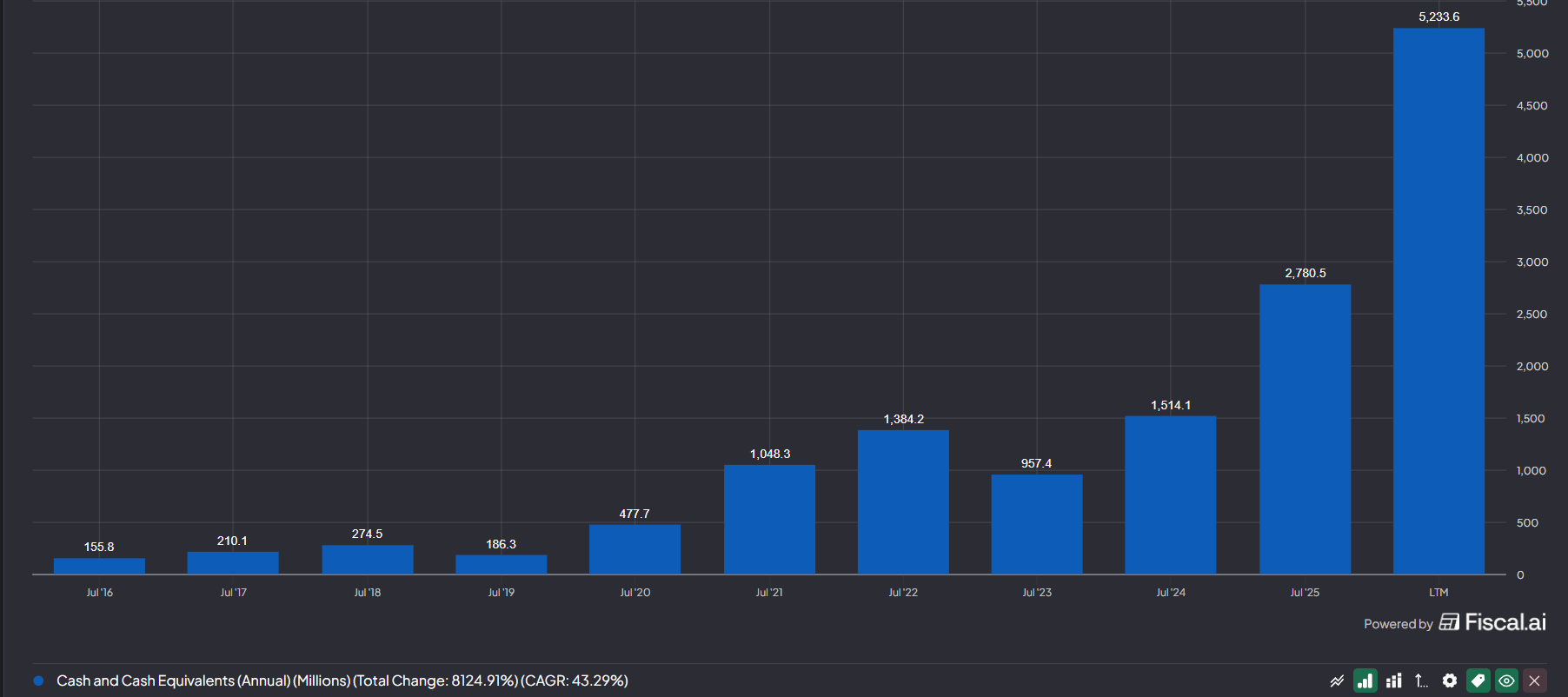
When you pay high multiples for quality and the market starts to doubt the investment thesis, the result is often ugly. Copart’s 12-month return is -32%. EV/EBIT multiples have nearly halved from the 2024 peaks. There are several reasons for this. The market has questioned the company’s market position as competitor IAA’s position has strengthened, at least momentarily. The company’s domestic market has proven difficult as the number of uninsured vehicles has grown. Investors are also keeping an eye on the company’s significant cash position.
image

Copart has previously successfully allocated capital to land and bought back its own shares opportunistically. To top it all off, Copart is on the “wrong side” of the AI trend. Am I worried? Not really; I still believe this is mostly a temporary situation where investors are questioning whether the company is as good as before due to external factors; additionally, multiples have normalized. Copart is known for not allocating capital just because the market wants them to, but rather waiting persistently until attractive options are available. I will continue to hold, but I don’t expect a quick change in multiples or for growth to take off wildly. Therefore, I’m not adding more until I see a clear change in the trend. I’m sitting in a hole, but I’m not going to keep digging.

Hemnet 1.1% position

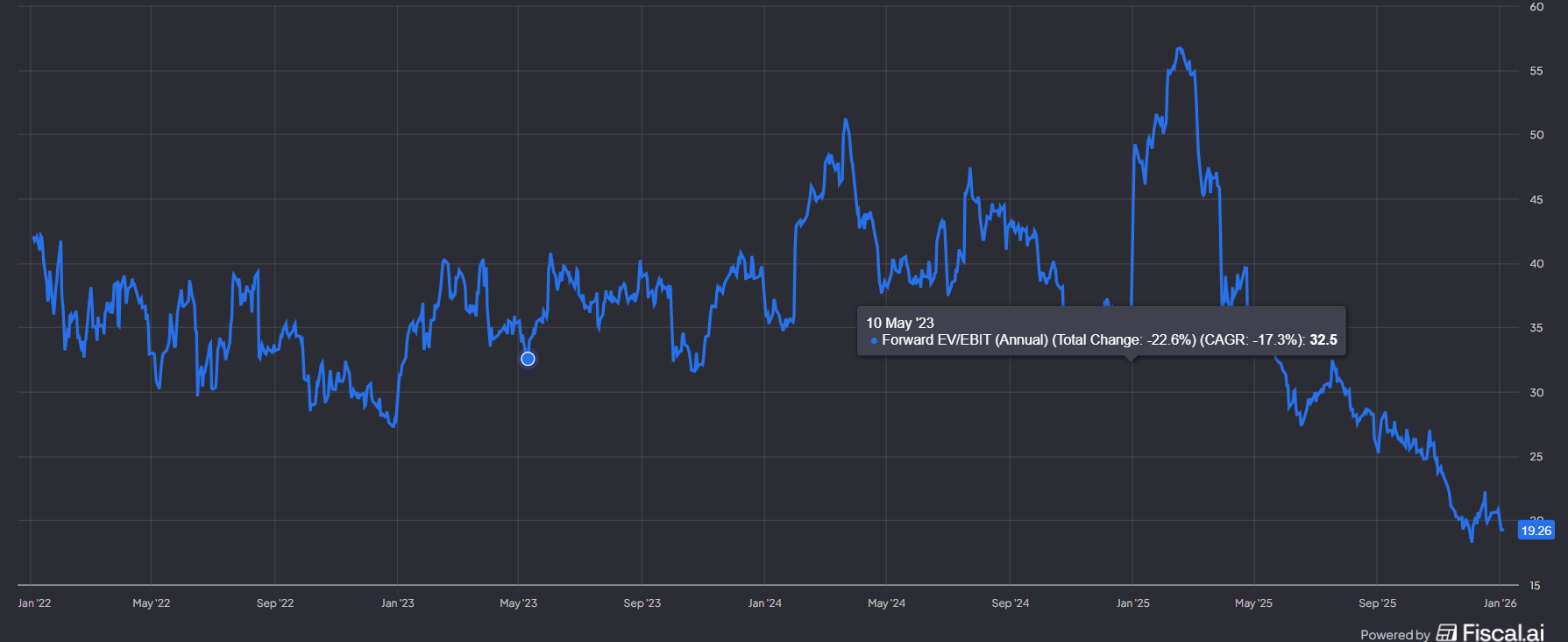
Hemnet’s share price drop has been staggering. The 12-month price performance is -55%. The company is still a new position for me, so fortunately I haven’t been catching falling knives the whole way down. The company is Sweden’s largest portal for home buyers and sellers. Aggressive pricing has become a headwind for the company, and the less user-friendly but cheaper competitor Booli has taken market share. Hemnet’s multiples were sky-high and the company was a darling of investors until the market started doubting the sustainability of the pricing and thus future growth. Forward-looking EV/EBIT has collapsed as strong growth is expected to slow down.
image

It should also be noted that the real estate market in Sweden has been challenging, which has complicated the market. However, Hemnet has already made changes and experimented with different pricing styles that can lower the seller’s risk when choosing a more expensive advertising package. Hemnet’s trump card has been that it attracts the most eyes. This way, selling prices have also been better, meaning the price charged to the listing party has been tied to the value brought by the platform. I am, of course, a little worried, but I don’t know the company well enough yet to have a strong opinion on its future. Therefore, the position remains small and I am monitoring the situation.
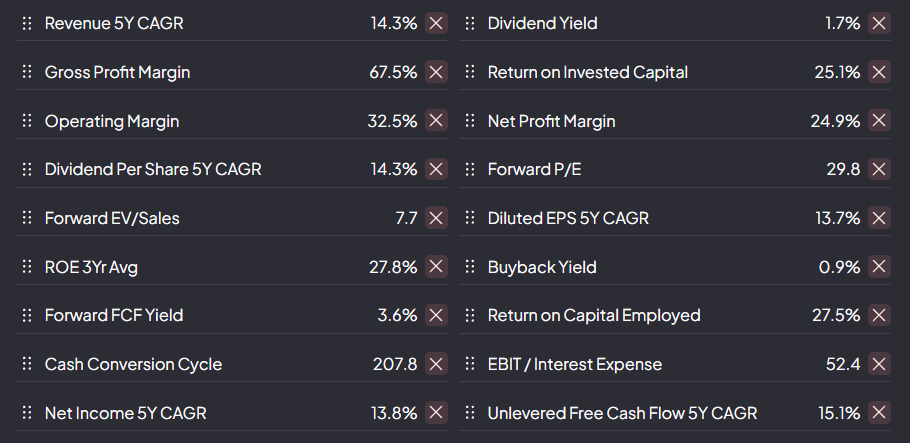
image

image

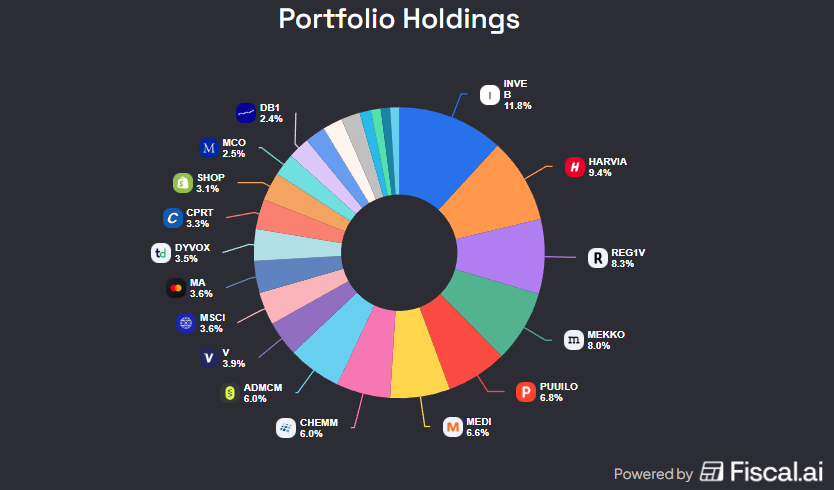
There have been no dramatic changes in the portfolio. During the last quarter, I have continued to add to several companies. The largest additions have gone to Deutsche Börse and Medistim. As new positions, I have bought the aforementioned Hemnet, Carasent, and Toast. Of these, Toast is still under evaluation; this might have been one of the year’s mistaken purchases. The more I’ve thought about the nature of the business, the more I’ve come to the conclusion that the company may not necessarily meet the criteria I hope for in a portfolio company. I sold Nordea, which was quite a significant position in the portfolio. It’s hard for me to justify the company’s valuation level anymore. Furthermore, banks have the downside that every now and then somewhere in the world, some bank gets into trouble, and then the whole industry suffers. Therefore, I felt now was a good time to exit while the music was still playing. European banks have had their best period in decades.

I don’t have a new recipe for success for 2026. If the same trends continue in the market as last year, I will likely lag behind the index again this year. I have about six companies on my watchlist that I would be ready to buy if the price is right. Monitoring and chasing these will surely be the main theme of the year.Finally, I would like to highlight my favorite book and podcast discovery from last year. The book is easily What I Learned About Investing from Darwin. It has been praised many times here on the forum, and I can only agree. It is an excellent and timeless book that can be read multiple times. An honorable mention naturally goes to McKinsey’s Valuation, which I am still in the middle of.

As for a podcast, I would highlight The Art of Quality, which I believe is still a fairly underrated pod. It is primarily investment-themed, but quality is explored from multiple dimensions with the help of guests from various fields. Truly interesting listening.

A very happy New Year to everyone! :slightly_smiling_face:

54 Likes

An update on the portfolio’s contents. I’ve been trading far too much, but I’ve managed to reduce the number of holdings, and my New Year’s resolution is to trade less and focus on putting money into current holdings, especially funds (excluding high-expense funds, which I’m primarily selling).

I started more active stock investing almost exactly a year ago, and in this time, I’ve had quite decent returns (calculating the exact figure is difficult because the data is spread across different brokers, but about 10–15%), but I’ve also learned that I’m far too impulsive and stress over the movements of individual stocks too much, so I’ve calibrated the portfolio with my weaknesses in mind. This was heavily influenced by the Intellego fiasco, from which I managed to get out unscathed. Not buying the April dip also stings, but we had just had a baby, so I’m trying to be kind to myself.

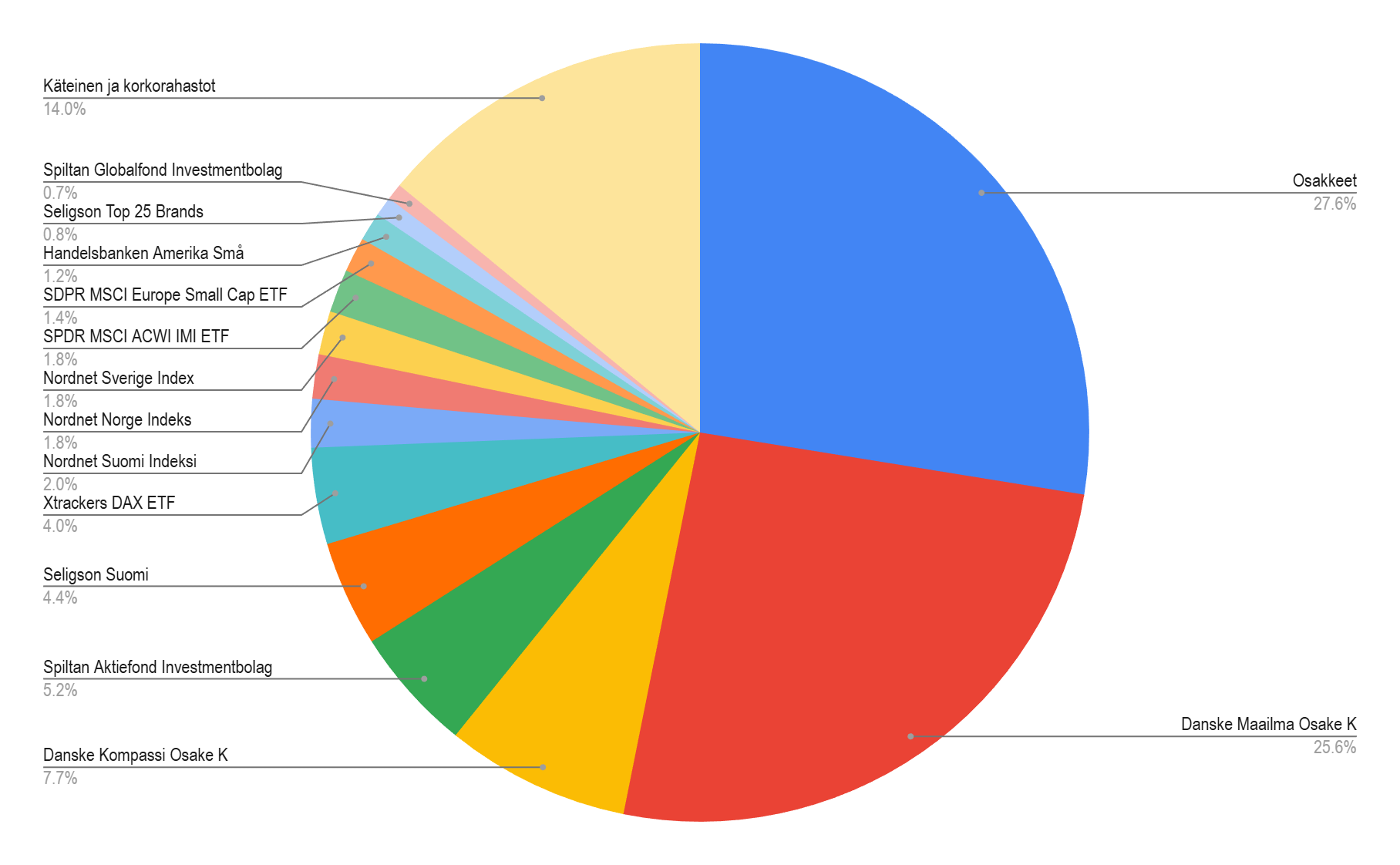
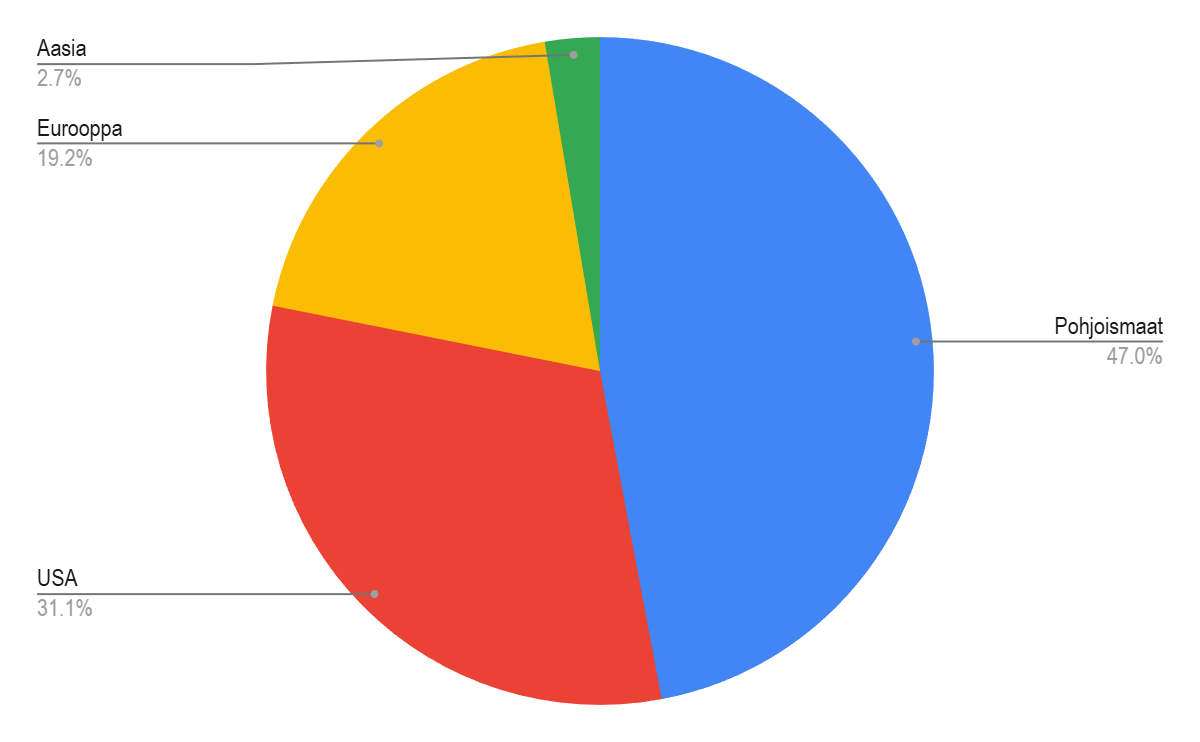
On geography. My portfolio’s US weight was estimated at around 50 percent a year ago. Now it has decreased significantly; a year ago, I took the view that the US is expensive and Finland is cheap. Now the US is even more expensive and Finland isn’t as cheap anymore, but loading up on Finnish stocks in early 2025 has clearly been my biggest success. In principle, however, new money goes into the ACWI IMI ETF, which increases the portfolio’s US weight.

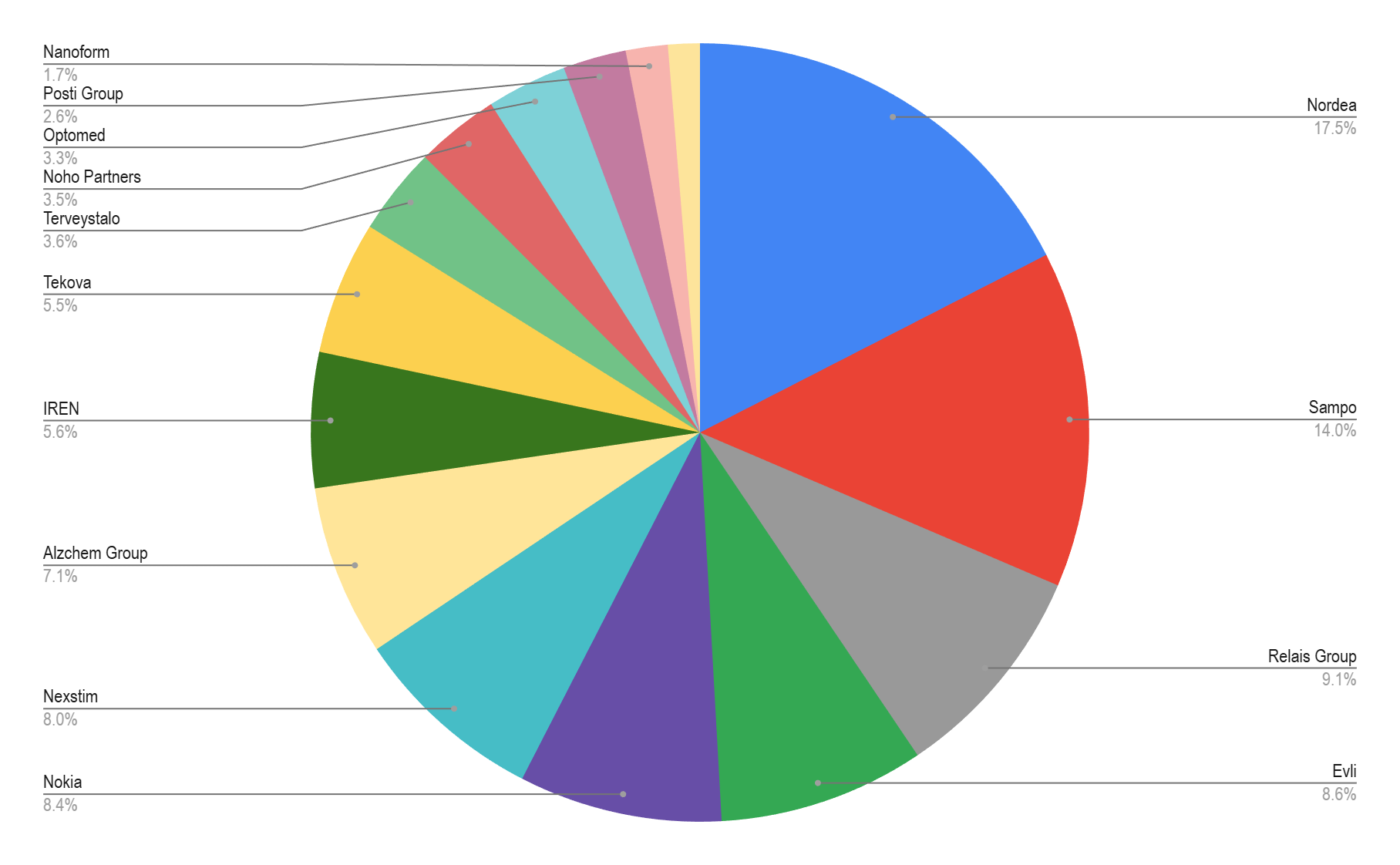
In the “Nordics” classification, the majority are Finnish-listed companies and Finnish funds, but on the other hand, Nordea, Sampo, Relais, and even Noho are primarily Nordic companies, so I don’t think the classification is misleading at all.

I would be most interested in those famous American value stocks as new positions.

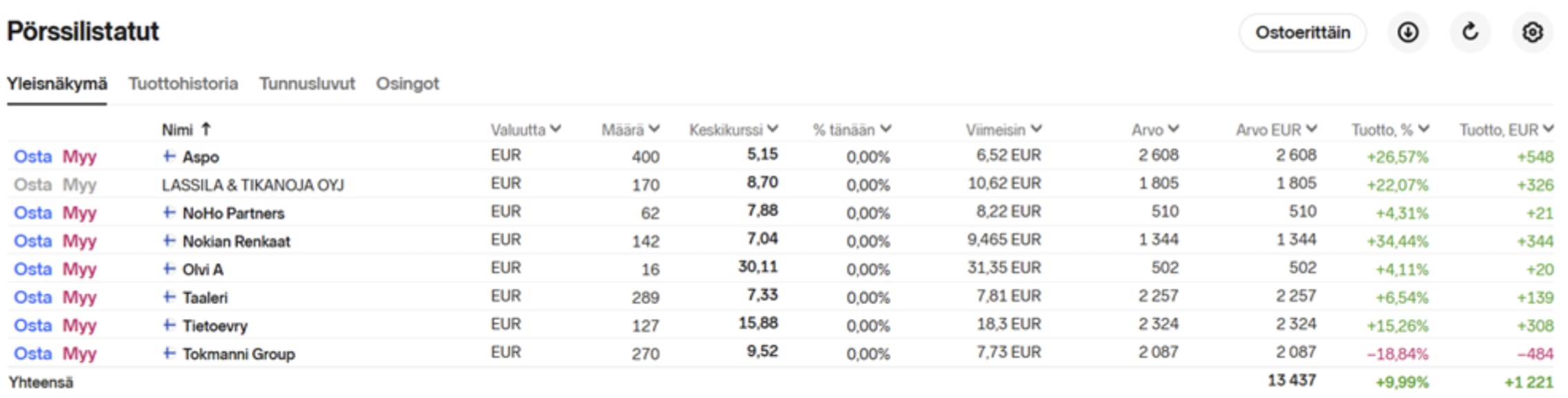
Direct stock investments:


(disclaimer: Nokia shares as well as some of the Nordea and Sampo shares were received as an advance inheritance)

Total portfolio:

Geographical distribution of the entire portfolio (excl. cash and bond funds):

32 Likes

Let’s also post the agrarian capitalist’s portfolio overview here.

Distribution of total investment assets
-Equity funds/ETFs: 29%
-Shares in jointly owned forests: 57%
-Land leased for agricultural production: 14%

On the stock front, the largest single company in the Equity fund/ETF portfolio is NVIDIA with a 3% share. Investments are mainly in the USA (45%), Europe (45%), India (4%), and Japan (3%). Only about 1–2% in Finland at the moment.

When including assets other than the Equity fund/ETF portfolio, NVIDIA’s share is about 1%. So the diversification is quite high, but market returns are enough for me in the long run.

Somewhat surprisingly, the best investment over the last 5 years has been the jointly owned forest. The price of raw timber has risen so drastically due to Russia’s military actions that the return has been double-digit for the last 5 years (including logging income and the change in the value of the standing timber capital).

25 Likes

Let’s put the first post in this thread… I guess?

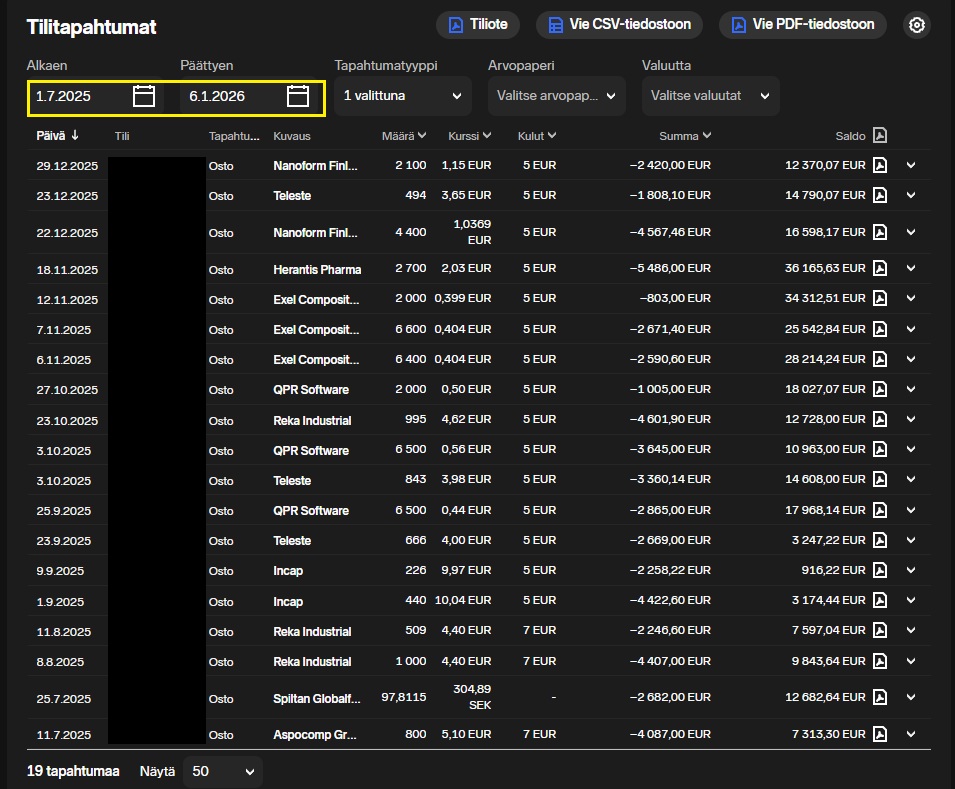
After my portfolio languished for 3½ years and then 2025/H2 was excellent relative to its low base, strangely enough, I started increasing my positions again as wealth grew rapidly; so here are the late-year purchases of a bullish retail investor who has rediscovered their confidence. I haven’t sold any of these. :backhand_index_pointing_down:

Salkkuhankinnat 2025-H2

13 Likes

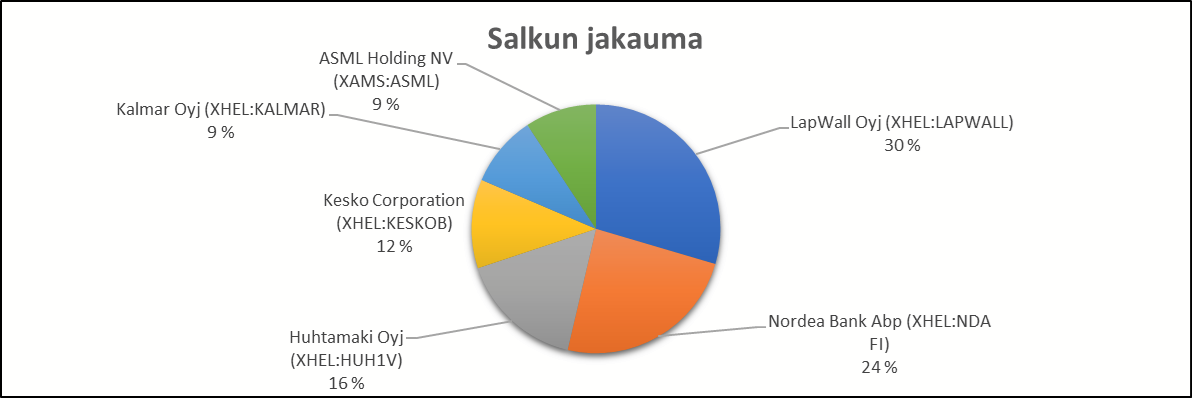
Time once again to take a look back at the past market year 2025. In my post from last year ( https://forum.inderes.com/t/mita-sinulla-on-salkussa/1246/3974 ), the return to the stock market I opened up about has now been going on for over 2.5 years. At the end of the last review, I stated: I’m entering 2025 with this portfolio with interest - I still have enough hope that returns can still be made on the Helsinki Stock Exchange in the future. On the other hand, the intention is also to gradually continue diversifying into other markets, mainly in the form of a world index, because “never stop the madness and soon we’ll go at it again”. Now that the year has ended, it can be said that it was good to live in hope, and the madness didn’t stop this time either :smiley:

I must be humbly satisfied with the portfolio’s returns so far, when the benchmark is our dear friend Hesuli (Helsinki Stock Exchange), where most of my portfolio’s stocks reside. For 2025, my portfolio’s returns even lost slightly to the index (30.34% vs. 33.95%), but the lead pulled at the end of 2024 remained in the portfolio’s favor.

kuva

The biggest situations of 2025 were, of course, caused by Trump’s tariff mess. As the situation began to escalate, I made my decision and sold about half of the portfolio as a precaution. Some of the stocks were sold at a small loss, and in hindsight, for some stocks (like Nordea), it would have been better to just sit on my hands, because I ended up buying them back later at a slightly higher price.

On the other hand, market uncertainty and a large cash weight gave me the opportunity to jump on stocks I had been watching from the sidelines for a long time, but which had previously felt too expensive. Those stocks were ASML, Kalmar, and Huhtamäki - ASML came into the portfolio as a completely new line, and I returned Kalmar to holding after having sold the previous ones last year. Those turned out to be my best picks of the year. Huhtamäki’s share price development, on the other hand, was a bit of a disappointment so far. With cash burning a hole in my pocket, I amateurishly started buying it too early, and as it happened, the knife just kept falling lower. However, it doesn’t change my view of the company’s solid performance, so let’s wait and see.

Overall, I am quite satisfied with the current composition of the portfolio - in my opinion, all the companies in the portfolio are such that stable returns can be expected from them in the future. The weight of Lapwall and Nordea is quite large, but I have tried to balance the portfolio’s content roughly according to how I see their potential return/risk potential. I see Lapwall as still being in the starting blocks due to the deep freeze in the construction market, but the company’s own performance is convincing in every way. Nordea, on the other hand, has been chugging along with such nice returns in terms of both dividends and share price increase that it’s a pleasure to keep it in the portfolio in the future as well. I already took some profits on ASML, but I plan to keep some for the long term - it’s such an interesting, unique, and important European company. Kesko, on the other hand, can stay in the portfolio just as a rock-solid basic performer.

kuva

In last year’s concluding remark, I stated I would increase diversification into world markets - well, in the wake of the tariff crisis, even those few ETF and fund holdings had to go, and I haven’t returned to them since. So for now, we’re going with quite little diversification, whether it was a risky move or not.

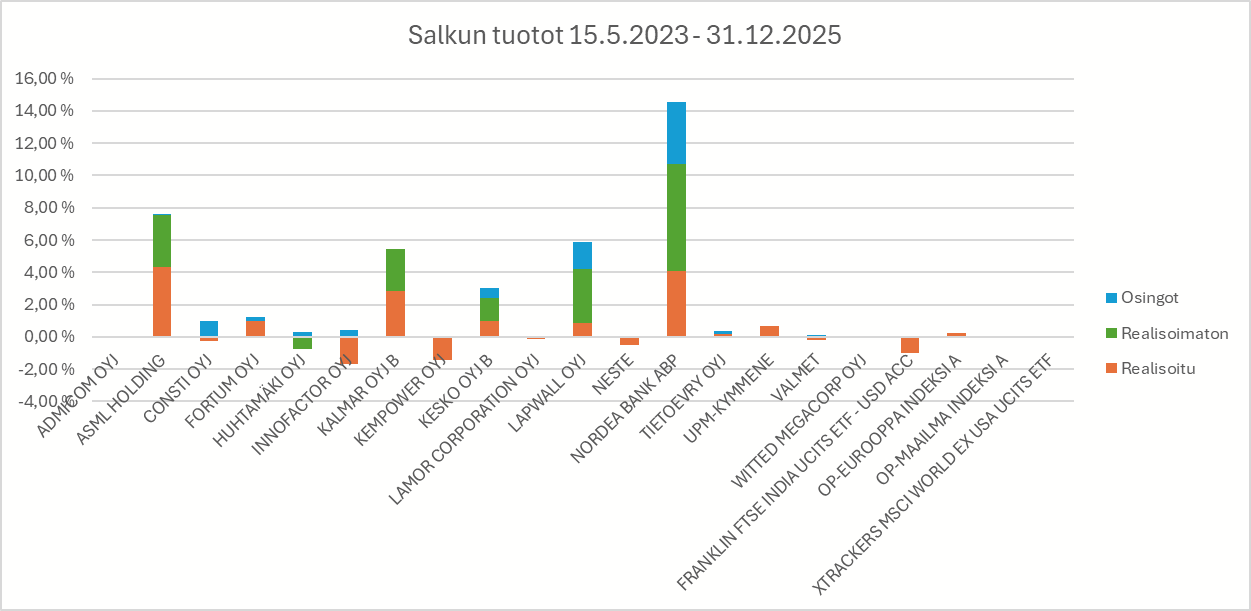
Finally, a summary of all the stocks that have been in the portfolio over the entire 2.5 years, and their contribution relative to the portfolio value at the end of 2025. The brightest star has rightfully been Nordea, but ASML wedges itself into a surprising second place. Kalmar’s performance also deserves a special mention.

kuva

Let’s hope the trend that started in 2025 continues in the same direction in 2026!

28 Likes

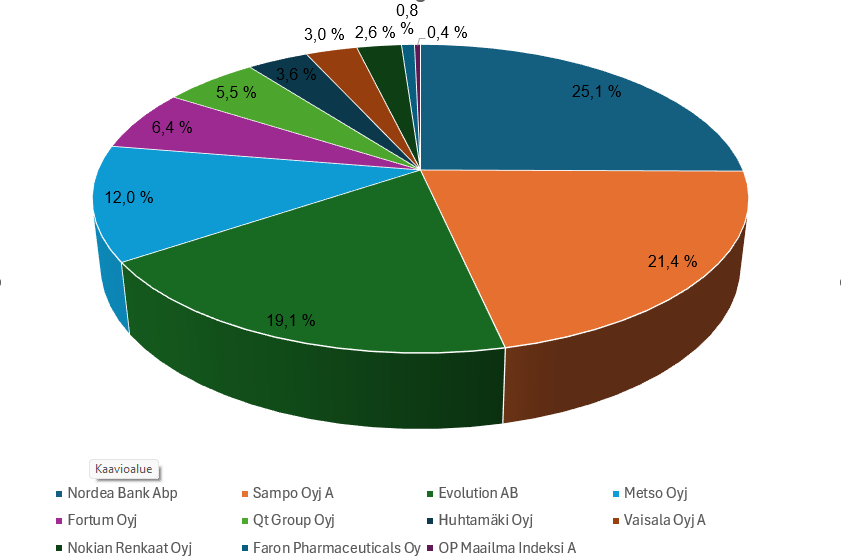
Well, it’s been a bit over two and a half years since the last portfolio update, so it’s a good time to put the current situation out there. The portfolio has shifted a bit since then, but among the largest holdings back then, Sampo and Evo are still included with almost the same weight. Nordea has overtaken these to become the largest holding. Among other stocks, Metso and Qt Group have also remained.

During 2025, I made 9 buys and one sell, so no extra tinkering. The portfolio was supplemented with shares of Evo and Nordea, and new acquisitions were Faron and Huhtamäki. I haven’t owned the latter before. Additionally, I made a decision at the end of the year to start making monthly investments into OP’s World (Maailma) index. I probably should have started earlier, since I’ve been buying the same for the kids for a while now.

Of the stocks currently in the portfolio, Fortum, Vaisala, and Nokian Tyres (Nokian Renkaat) were acquired during 2024.

In addition to the holdings shown in the graph, a fairly large pile of a forum “favorite” from a few years ago, Voxtur, has been left to gather dust in my Nordnet book-entry account (AOT). Hopefully, I’ll be able to utilize the tax deductions from that pile at some point.

I’ve been able to make additions a bit slowly lately, as there have been other things I’ve had to put my money into. Hopefully, that monthly fund saving will start to show on the bottom line at some point.

Edit. And if I calculate a bit more precisely, three and a half years have actually passed since the last update in June 2022… :grimacing:

28 Likes


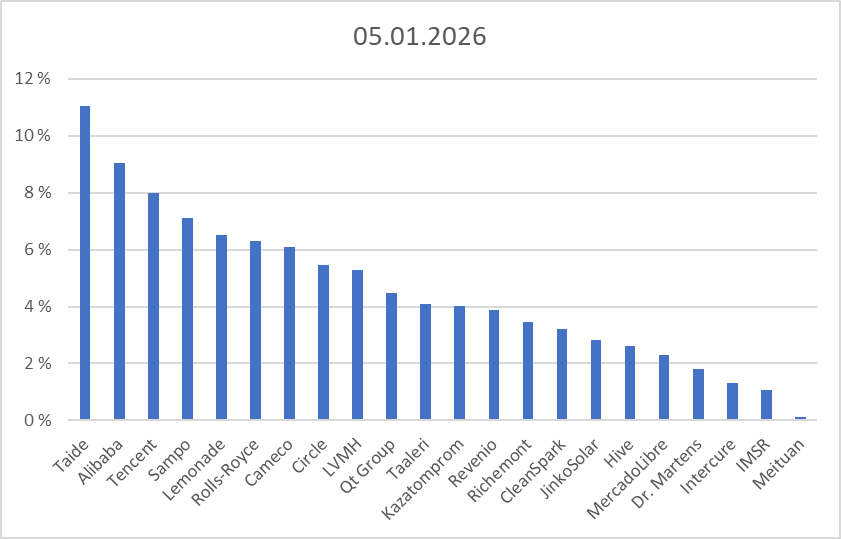
Purchases: Mara, Circle, IMSR
Additions: QT, Taaleri
Reductions: Lemonade, Cameco, Rolls-Royce, Kazatomprom
Sales: Fortum, Block

Crypto exposure and new openings
The year 2025 is behind us, and a few new names have been added to the portfolio. The portfolio now includes a third bitcoin miner, Mara Holdings. Interest in crypto has grown, and I wanted bitcoin exposure in the portfolio. Mara has massive bitcoin reserves in addition to their computers. As a bonus, the company produces district heating in Hamina. Utilizing waste heat from crypto mining is an extremely fascinating component, and I believe it increases the value of crypto miners, especially considering that electric boilers are being installed for district heating production in Finland.

Mara has been very volatile, as have CleanSpark and Hive. All miners rose sharply in October, but unfortunately, I didn’t manage to take any profits. Of these investments, only CleanSpark has remained clearly in the green.

I also swapped Block for Circle Group. Although I’m still interested in Block, I saw greater potential in Circle after such a long period of stagnation. Block might still return to the portfolio later. Circle offers stablecoins, and I ended up trying their USDC coin instead of Tether. To a beginner’s ear, USDC sounds better as a name than USDT (USDC = USD coin). This is a very subjective opinion, but perhaps there’s something to it. At the same time, I also see that stablecoins have huge long-term potential, especially if they succeed in challenging traditional credit cards.

Energy sector moves and SMR hype

I reduced Cameco and Kazatomprom and added Terrestrial Energy (IMSR), which develops molten salt reactors. There is massive hype around SMRs. IMSR fell from a peak of $27 all the way down to $6, now rising back to $11. My investment thesis is based on the agreement between Terrestrial Energy and Westinghouse to develop fuel for molten salt reactors. I am not completely convinced by their reactor, but I want exposure to the SMR boom and a new kind of fuel manufacturing in the nuclear power sector.

Mistakes

Generally, the uranium stocks in the portfolio have performed very favorably, as have Rolls-Royce and Lemonade. However, now I am trying not to touch those tickers. I have more or less sold off my initial investment amounts and am now just waiting for returns.

I also sold Fortum entirely out of the portfolio. I made the sale purely based on emotion, mistakenly. I wanted to buy QT Group after the big dip in May, and unfortunately, the stock has fallen even further since then. Well, the intention was to increase QT anyway, and I have wanted to get rid of Fortum for a long time after the Uniper mess. I also bought IMSR at around $13, and it was scary to look at the portfolio as its value just kept dropping. After these mistakes, I have followed the portfolio very little. But in the end, the portfolio performed very well in 2025, with a return of about +25%. Now at the beginning of the year, the crypto miners and IMSR have come back fast, YTD +10%. I intend to keep an eye on crypto treasury firms (especially those based on Solana) as well as Mara if good buying opportunities arise.

Future

I reduced my workload for 2026 and moved to a four-day work week. One extra day off doesn’t significantly change my financial situation but reduces stress and gives me valuable personal time. In the future, I aim to follow the portfolio more closely and focus on well-being, exercise, and oil painting.

Art acquisitions

As my latest acquisition, I bought a drypoint print by Edvard Munch of a Norwegian landscape. Visually, the work isn’t the most striking, but I’m drawn to the way Munch created perspective with a road extending into infinity. I am still interested in Rafael Wardi and hope to find a good deal on his oil paintings soon.

42 Likes

image

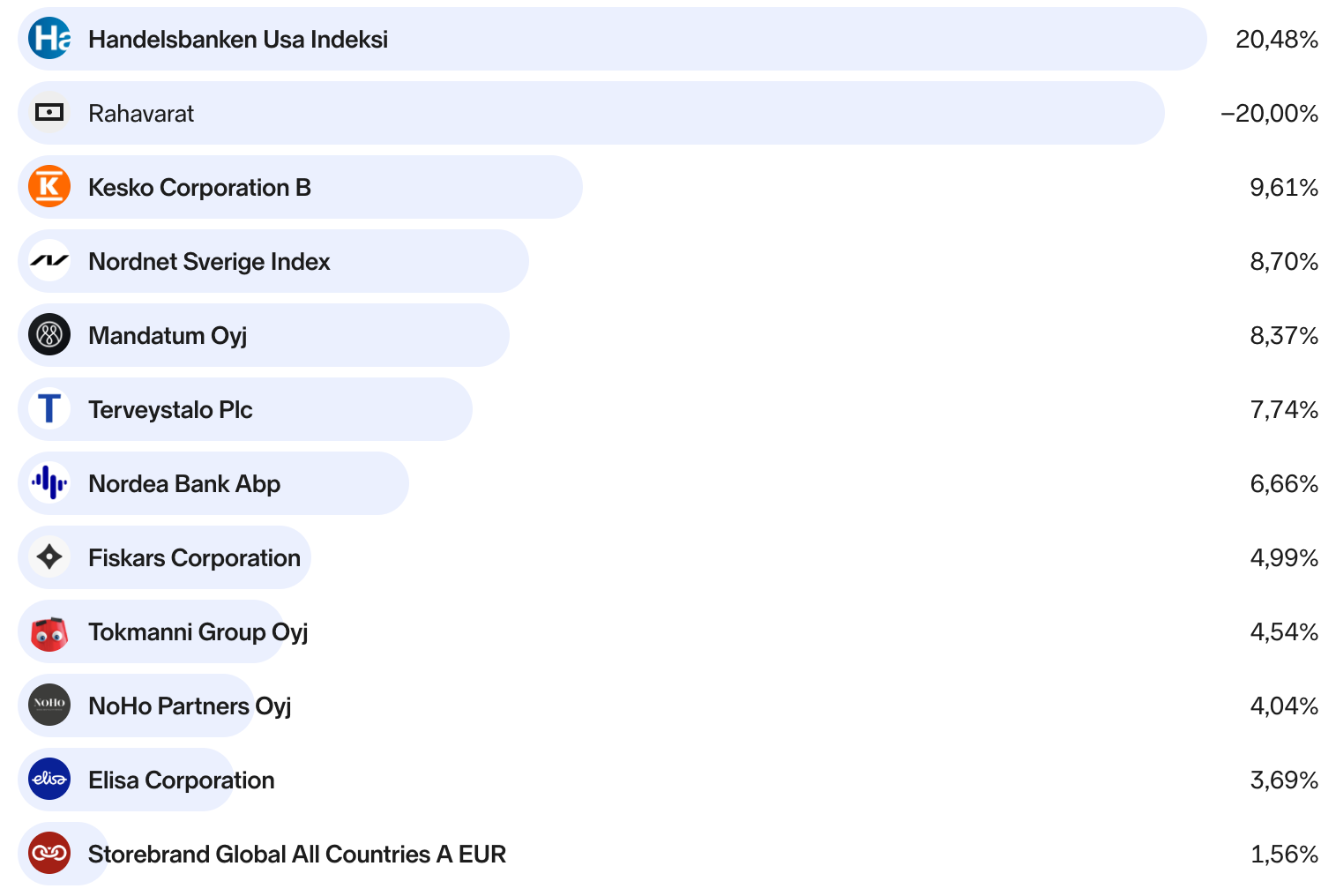
Starting the year with this portfolio. Nordea has been in my portfolio since I was a young boy. Fiskars was added solely because it is my home region.

35 Likes

Portfolio composition (total portfolios)

Also celebrating a bit as the portfolio crossed a milestone after just under 6 years of investing.:chart_increasing:

74 Likes

I’ll open up this little pouch (pussukka) here for everyone to take a look at. Not that it’ll stir up any big emotions, but here it is anyway. Total pot is just under €12,000.

Name —————————– Return ———— Share of portfolio

OP-Finland index +31 % 16 %

I’ve also gotten my share of the Helsinki (Hesuli) returns.

OP-Nordics index +12 14

What can I say? Things are going well.

OP-Europe index +12 13

Things are going well here too.

Kempower -6 8

I held, I didn’t sell. Through wind and storm. At its worst, it was nearly 50% in the red, now it’s almost at break-even. At the craziest times, it was 50% of the whole bag (reppu). My faith isn’t running out, it’s not even wavering.

Kongsberg +18 8

I like it. I expect the rise to continue because of the restless state of the world.

Fodelia -7 8

In investment speak, an eternal crawler (ikimörnijä). It’ll come around; I wouldn’t have bought it if I didn’t believe in it.

Saab +81% 8

I’ve sold with handsome profits and bought back. Successful buys and sells. For once.

Nordea +26 5

An everyman’s stock. Great performance.

Assa Abloy +29 5

The market leader doesn’t disappoint. Great return. It’ll probably keep performing in the future too. I have no doubts.

OP-Asia index +9 5

My newest index. €50/month, just like the others.

Poste Italiane +13 5

The odd bird in the portfolio. Italian post. Good return, good dividends, diversification. That’s why.

Faron -11 4

I lost faith a long time ago. But maybe the miracle will happen this year.

Springvest -20 1

Newest purchase. I just had to, because of Donut… I don’t dare risk more than that.

Herantis +9 0.2

I decided last autumn to put all my dividends into this and will continue to do so. You have to start somewhere. I’m sure it’ll be half a percent by spring.

So there it is. €200/month goes into indices in total. Small additions of tens or a few hundreds into direct holdings, so the same pace continues. Very few sells. This spring, however, I’ll have to let go of something to pay for a vacation.

A good vibe for my taste. Not a single megalomaniacal success story or rocket. But no total crashes either. Last year nothing much happened, except towards the end when the ones that had crashed started to recover and the defense sector continued its rise. Diversification is improving. Just under half in indices, the goal is still to get it over half. Big market leaders and smaller lottery tickets (lottolappu). Finland, Sweden, Norway, Italy. America would be nice, but I actually sold everything off for principled reasons last spring because of that one nutcase.

Oh yeah, the whole portfolio is up 15% right now. I don’t know how to calculate what it really is, considering I’ve sold some things at a profit and then used that to buy something else.

Not a hero’s story, and it doesn’t need to be. The main thing is having some dough (hillo) stashed away and even producing a little something.

If you have questions, comments, etc., head over to the coffee room, thanks.

56 Likes

Since I am mentally an exhibitionist (thank God the small size of my junk prevents me from acting on it), let’s virtually open the trench coat and tip the fedora on such a shitty market day (portfolio <2% in the red, following Friday’s >4%). There’s no sense in my portfolio, and none in me either, except for memories of a shred of sense… I’ve never worked as a security guard, due to my small size. :flushed_face: Apologies for my language, and I’ll take a seat on the bench if the thread calls for it. After all, I was the center for the benching line in my youth. :ice_hockey:

20 Likes

Over the weekend, I had time to reflect on my own strategy and its development. I’ve been contemplating the idea of dividing my portfolios’ lifecycles into a yet-to-be-defined number of stages. These stages correspond to the amount of leverage used in the portfolio.

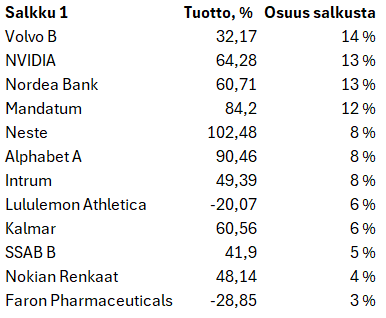
Having fretted over Portfolio 1 for about 30 months under the current strategy, it is starting to reach a relatively stable position between the still-unnamed stages 1 and 2. The intention is to let the portfolio live its own life; there are no active plans to grow the portfolio’s value through further equity injections or debt. If development remains favorable, the portfolio would progress to the second stage of its lifecycle, where leverage would be increased from 100k to 200k. This is waiting for equity to grow to a level where implementing the change would be sensible. On the other hand, the loan-to-value ratio has also dropped to a moderate level, and I currently see significant hedging measures as distant. My biggest hopes for capital appreciation at this point are placed on the Volvo and Intrum axis. Faron, of course, is haunting the background, pondering its own direction. The acquisitions of Faron and Lululemon were timed around the same period. I guess I must have skipped breakfast that morning.

image

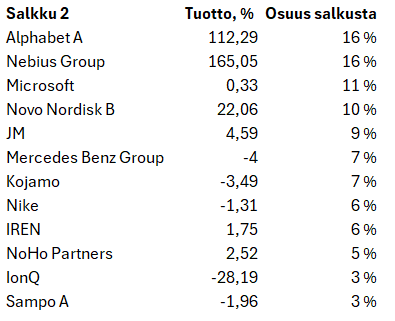
Portfolio 2 is naturally newer and currently under construction. In terms of euro value, it is about half the size of Portfolio 1, and its lifecycle stage in my process is stage number 1. The completion rate of the portfolio construction is about 50%, meaning the goal is to get it to a similar stable state where Portfolio 1 currently resides. I have applied to double the current leverage, and if the recent market antics don’t completely collapse values, I believe I will achieve this—if not during this application round, then within a few months.

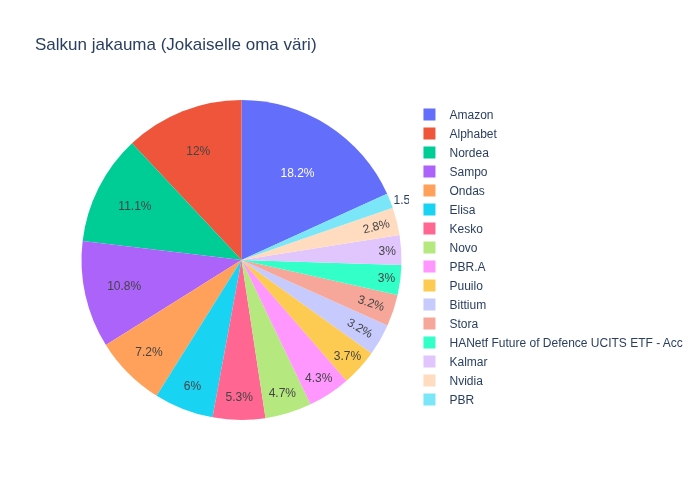
When I started building this portfolio, the intention was to over-diversify and include more potential “growth rockets.” Initially, I also tried swing trading, but fortunately, I’ve now had the courage to stop that. As the return % shows, the portfolio’s success rests on significantly narrower shoulders, and on the other hand, the rather impressive “bodybuilding” of those shoulders is giving them an excessive weighting alongside the biceps and triceps. At the moment, however, there are no acute thoughts of selling; company analyses are currently underway in case I get more “play money” into the portfolio. As the latest acquisition for the portfolio, I put my accumulated OP bonuses, which had turned into cash, into Sampo. Apparently, if you don’t know what to buy, you should buy Sampo. The idea, however, is to put occasionally accumulating cash funds into Sampo and raise its weight to around the middle of the portfolio as a so-called support and cash flow stock.

Alphabet is found in both portfolios and is therefore my largest holding. According to my strategy, the maximum weighting for a single stock per portfolio is 20%, but greed might win out if, for example, Nebius starts closing in on a trillion-dollar market cap. Since I play with high leverage, over-diversification is the way to manage risk. Of course, actively following dozens of tickers doesn’t work very well, so the portfolio should ideally consist of high-quality companies at a respectable price, intended for an “eternal hold.” This seems to be a pleasant and suitable way for me to pick stocks anyway. Additionally, I keep relatively moderate bets on these more “impatient” companies. When building this portfolio, a core idea was also to increase geographical diversification. Finnish companies have only been included in recent months.

image

26 Likes

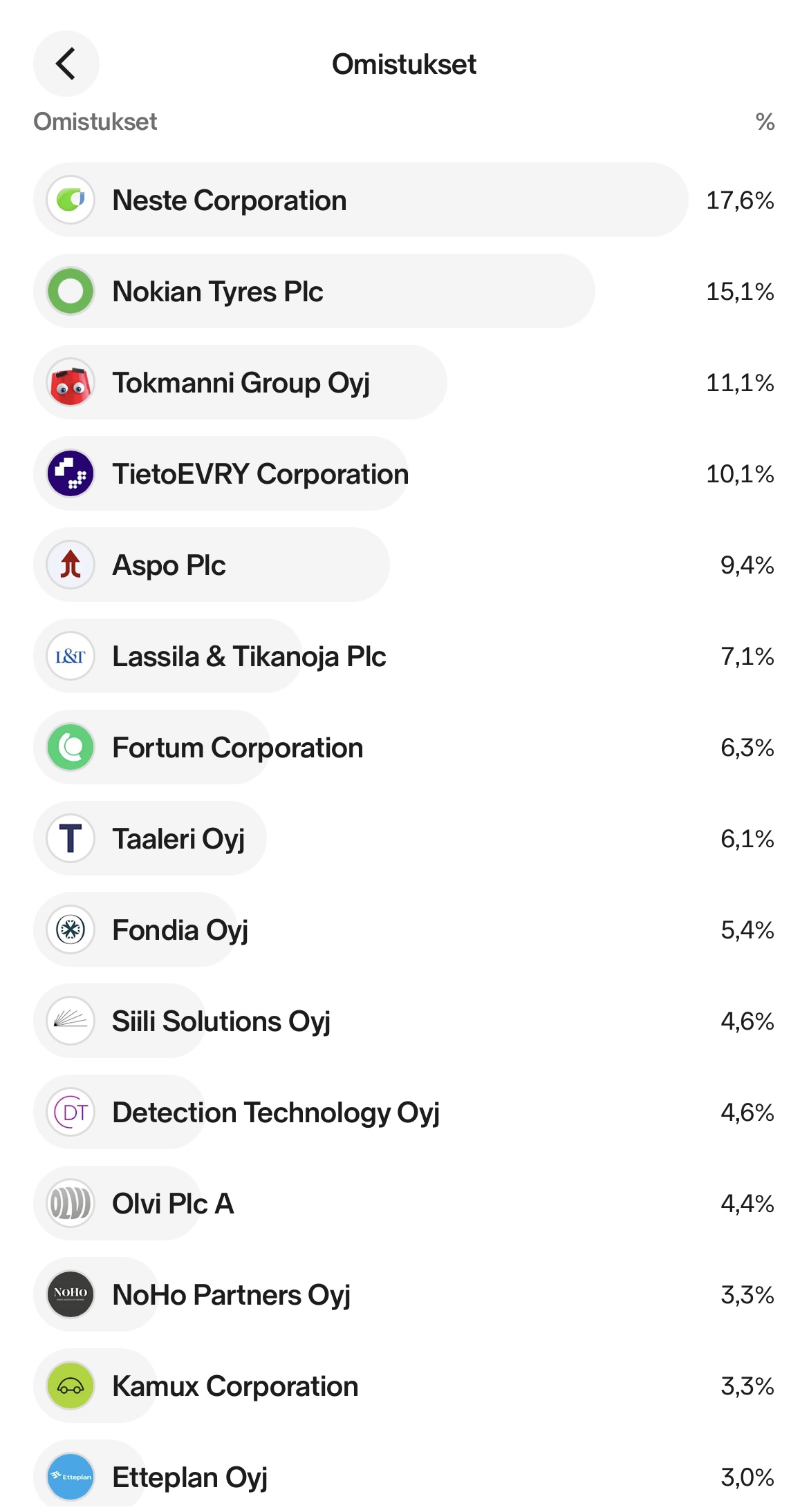
Let’s do another semi-annual portfolio review. I was supposed to do this at the turn of the year, but major irritation over the discontinuation of Nordea Investor and the increased difficulty of making a summary killed the motivation.

Compared to six months ago, Puuilo and Volvo B have left the portfolio.

Regarding Puuilo, I reached my own return targets and managed to sell near the 2025 peak.

Volvo B left the portfolio perhaps a bit hastily, but still clearly in the green in early autumn 2025.

The weight of Cash has averaged 10% of the portfolio, though it is currently only around 2%.

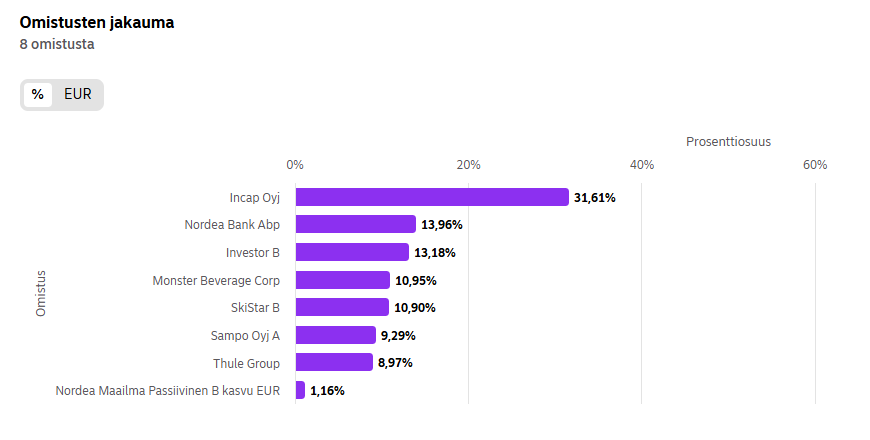
The weight of Incap in the portfolio has grown disproportionately large, but my own expectations for it remain very high. I intend to potentially trim the position if it rises to around €12 and leave a position of a few thousand shares after that. Currently, average prices are just under €9.50.

I haven’t added to Nordea in a long time; according to preliminary plans, I’m not doing anything with it unless something significant happens.

Small additions have been made to Investor along the way; the position is currently up ~55%. This is intended to stay in the portfolio for a long time, and I’ll add more if I can’t think of anything else.

Monster was originally bought as a joke, but over the years, the company has grown into a quite significant investment. The average price here is around $40, so it’s up ~100%. I’ve mainly been considering the sustainability of the growth, but it seems to keep chugging along year after year. This is perhaps closest to my heart and difficult to let go of, even if it would make sense based on the numbers.

SkiStar initially entered the portfolio with the minimum amount required for shareholder discounts, but after some quick research, it showed potential and the position grew. I’ve set a target exit price of 190-200 SEK, at which point the entire position will be sold.

Sampo has long been a company where I haven’t done anything with the position, and I don’t really even follow the company. This is also in a separate book-entry account (AO-tili) that was once pledged as additional collateral for some renovation loan. No plans for this unless there’s an acute need for cash.

Thule was also in the portfolio in the last semi-annual review but was completely sold after that when my target price was met. It returned to the portfolio this week following the price drops and will be sold again if my target price of 275-300 SEK is realized.

Currently, the portfolio doesn’t yield particularly impressive dividends; the goal is mainly capital appreciation. The dividends for 2026 will likely be less than half of previous levels.

I also became a fund investor at the end of the year when I realized I had a so-called “emergency fund” account that hadn’t been touched for three years. I set up a monthly savings plan from there, so the money might get a slightly better return than the 0.5% interest on the account.

28 Likes

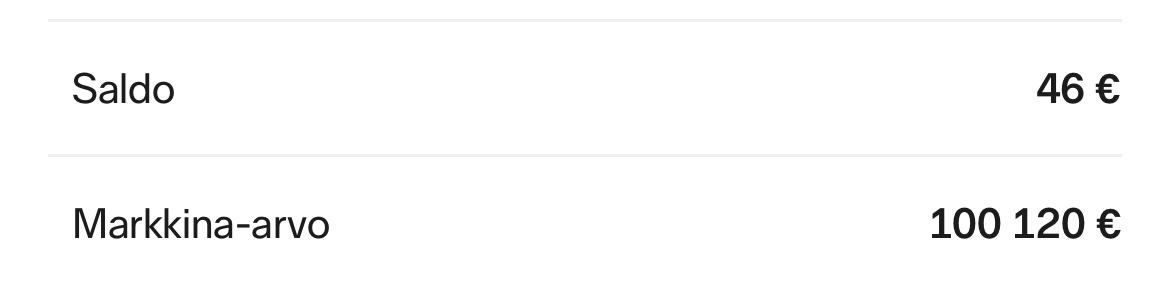
What do I have in my portfolio? Lots of “boring” index funds, but in addition to that, there is also a fairly significant slice of stocks. I am still a bull (bullero), as the term popularized by @Sauli_Vilen goes, regarding REITs. Real estate is by far the worst-performing sector of the S&P 500 index from 2022–2025. I believe in a bounce-back. I predict double-digit gains for REITs in 2027–2029 (not an investment recommendation).

Table of Contents

  1. Introduction

  2. Funds 59,673.87 € (30,972.47 €)

  3. Apartments 22,000 € (26,500 €)

  4. Stocks 15,683 € (6,686 €)

  5. Buffers 5,185.71 € (9,297.82 €)

  6. Cryptocurrencies 44.17 € (94.89 €)

  7. Total net wealth 102,586.75 € (107,922.28 €)

21 Likes

Posting my own portfolio, which I definitely can’t recommend to anyone, but here we’re going all-in on Kempower. :smiley: The rest of the portfolio is leverage.

Been involved since the IPO and sold everything at suitable intervals when the valuation started to get nerve-wracking.

Rarely in a lifetime do you come across a megatrend where a market leader is available at a low price. Of course, the valuation is high again now, but the market will grow so drastically over the coming decades that this time I’ll likely do nothing but add to the position. The next sales will be considered once I’m retired.

Additionally, small positions in suitable companies that can be flipped after holding for a week or a month.

8 Likes