My clear eternity-hold seems to be Vaisala. I bought it in 2016 and it’s probably the only stock I don’t really even follow anymore, because my trust in the company is strong. If I had to put one of my stocks in a safe for ten years, it would be this one.
Inderes, which has now entered my portfolio, is also there for a long hold, though under active monitoring as a more dynamic company (I’m also looking for opportunities to add more).
Qt and Revenio have risen so sharply (1000-2000%) that I don’t feel like selling for tax reasons, although currently in my portfolio they are just making returns on returns, I’ve already taken out my initial investment. Revenio, at least, would be in my long-term portfolio anyway; Qt needs to be monitored more closely in the coming years regarding its performance and competition.
Interesting discussion starter. I’m only at the beginning of my journey with direct stock investments, as I only actively started saving through stocks in late last year, even though my first direct stock purchases were in 2013.
Now that I’m putting most of my investment assets into direct stocks instead of funds, I feel it’s important to primarily find strong growth companies, which currently make up the majority of my portfolio. In addition, I want to have 2-3 “cornerstones” and/or market leaders in my portfolio that will stay there year after year, regardless of economic cycles. One such company is Microsoft, another is Puuilo, and for the third, I’ve been considering either Nordea, Sampo, or some “traditional” industrial company that is, however, making a significant turnaround in its business and also pays dividends. Such a wild card could be, for example, UPM or Wärtsilä.
Plain and simple. Currently distributing capital to shareholders through share buybacks and upcoming dividends. Once the excess capital is trimmed, it will continue to grow its basic (insurance) dividend and grind steadily.
Here are the shares bought for the book-entry account, initially for long-term holding. Time will tell how long they ultimately end up being held, and if it would have been better to just stick with funds.
Is the logic here that you expect prices to fall lower so you don’t have to pay as much in taxes?
If you expect growth to continue, then you’ll have to pay even more in taxes.
Of course, if you never sell, then I guess it doesn’t matter what the price is.
Holdings like that, for tax reasons, are justifiable because they allow you to invest with a calculated tax liability, meaning money that you would have to pay in taxes if you divested from the stock. By continuing to hold, you can keep the tax debt “generating returns” in the form of capital appreciation and dividends.
Furthermore, if you wait for the acquisition cost presumption (hankintameno-olettama) to improve at the 10-year anniversary of acquiring the shares, you can reduce that tax liability.
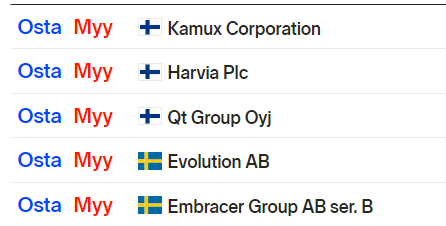
And so as not to go too off-topic, my long-term hold is Embracer.
I’ve chosen the Swedish company Investor AB as my long-term holding. I trust that the Wallenbergs can allocate capital more efficiently than I could. Investor’s portfolio includes some of the highest-quality companies on the Stockholm Stock Exchange, as well as several unlisted ones that would otherwise be inaccessible. Some holdings, such as Atlas Copco and SEB, have been in Investor’s portfolio since the company’s founding in 1916. Over a 20-year period, the annual return has been approximately 15%, which easily beats most indices. Of this, dividends and capital appreciation each account for about half. In the last 10 years, however, capital appreciation has played a larger role in the total return. I use the Ibindex.se service to keep an eye on when there might be a suitable NAV (Net Asset Value) discount, but otherwise, I won’t worry too much about timing my purchases. I plan to gradually add to this in my portfolio and hold it for a long time.
No, it’s not. I’m happy to pay my taxes Because you only pay taxes on profits, and because I’m a welfare state fan However, I don’t want to knowingly increase my tax slice. For those two, the acquisition cost presumption (hankintameno-olettama) will kick in within a reasonable time, so there’s no point in unnecessarily fiddling with it before then. Additionally, both are performing nicely, and I see no fundamental reason to sell.
The shopping list is long, but I haven’t been able to buy everything at current prices. There would easily be over a dozen stocks to hold if I could just get them into my portfolio. Of those in the portfolio, at least these are on hold:
-Sampo
-Fortum
-Capman
-Algonquin
-Abbvie
-WPCarey
-Gentex
-Essex Property Trust
This is an extremely good question! It makes you think about things from a slightly different, and better, perspective. In the long run, business quality stands out as the most important factor, valuation less so, and short-term noise not at all.
But a lot can happen in 5-10 years.
I’ve only been investing for just over 12 years, but my longest continuous holding period is probably Revenio since 2013 (although I don’t own those shares anymore as I used to make the mistake of selling a good company “when it’s a bit expensive,” especially before. Of my current stocks, those acquired in 2016 are the oldest).
Currently, some of the most exciting 10-year cases in my portfolio include Qt, Remedy, or indeed Revenio.
Often, good companies are also easy to “pitch” simply:
Qt = The bottleneck solver for graphical user interface programmers.
Remedy = Tremendous expertise in a growing gaming market where the content creator’s position only improves.
Revenio = Revenio.
But how much have these companies changed in ten years? And what will they look like in ten years from now?
Qt was a forgotten part of Nokia, if I recall correctly, back then. Even three years ago, it was a risky stock because it was still unclear whether it was positioned correctly for the future.
The same with Remedy. Ten years ago, the company had just released Alan Wake and was a small studio making one game at a time. A couple of years ago, the transition to a multi-project model was still underway, and its functionality was unproven.
Ten years ago, Revenio was still a confusing rubber boat LED house, which happened to contain the most lucrative intraocular pressure meter business on the Helsinki Stock Exchange.
It’s hard to say where these three will be in ten years. Hopefully, bigger and stronger than ever before. But they could also have changed completely in another direction. Perhaps their investment profile will change so that I no longer like owning them years from now? One can’t know. Perhaps competition, internal challenges, or some other factor has brought them to the brink of crisis? One can’t know.
One could assume, and I will assume now, that all will do well for a long time, but as noted, their last ten years have also been a time of significant change. There’s no reason to assume that major changes won’t also happen within the next 10 years.
Currently, it looks like I have the following on hold:
Fortum (OST) (desire to add more, but most of my money is tied up in Tecnotree )
An energy company, what all can Fortum achieve in the future on this front? Bought in 2021 @22.87
Sampo (AOT) (desire to add more, but money is tied up in Harvia )
Everyone probably knows Sampo, a future insurance “crawler” seasoned with dividends. Bought in 2021 @38.88
A Toronto venture company called Thunderbird Entertainment. It has only been in my portfolio for 1.5 years.
Thunderbird is a content producer and distributor for streaming services and television companies. Their clients include Netflix, Disney+, etc. Most of the content is produced as a contract service for subscribers, but the share of their own IP is also growing. An example of this is Last Kids On Earth on Netflix.
The merchandising business has recently been launched.
Frank Giustra, who founded Lionsgate Entertainment, sits on the company’s board of directors. Insiders own 35% of the shares, and the CEO has been “grown” within the company.
Elisa has been mentioned a couple of times as an inherited stock, but here I am, the original holder of the HPY cooperative certificate. I recall buying the maximum amount I could back in the late 90s, and that currently translates to about a €15k investment. In the 90s, that cooperative certificate was “just a piece of paper,” and the maximum additional sum one could invest was quite modest. So, it essentially came “almost out of nowhere,” although someone good with numbers could easily prove that wrong by calculating compound interest, accounting for inflation, etc., but in any case, my impression is that my investment was only a small part of a monthly salary.
I originally acquired it as a dividend stock to cover phone bills, and it has served that purpose reasonably well, except for a few poorer years. I might consider selling it sometime next decade if my pension isn’t enough for a reasonable standard of living.
I agree, good question and it forced me to think. My portfolio allocation now:
Harvia
24%
Index Funds
17%
Cash
10%
Kamux
8%
QT
7%
Tecnotree
7%
Oroco
6%
Sampo
6%
Voxtur
5%
Solteq
4%
Modulight
4%
Deep South
1%
Inderes
0%
Basically, the portfolio is now such that I’m not looking for new companies, and the intention is to hold these stocks for years, growing the positions (with the exception of Oroco and DSM, which are just waiting for a big payout). Of course, we’ll react if the story changes, as mentioned above.
But in the spirit of the question in the title, I tried to think about where I would invest if I had to cut down on the number of companies. Somehow I have a hunch that Harvia, Sampo, Tecnotree, and Modulight (and the Inderes support share ) will be in my portfolio for the longest time. Especially Sampo’s share in the portfolio is intended to grow. I believe there are still growth drivers for Harvia’s growth and I hope that at some point it will start paying dividends too. From Tecnotree and Modulight, I, in turn, hope for “new moon cubs” that are at the beginning of their journey.


 Because you only pay taxes on profits, and because I’m a welfare state fan
  However, I don’t want to knowingly increase my tax slice. For those two, the acquisition cost presumption (hankintameno-olettama) will kick in within a reasonable time, so there’s no point in unnecessarily fiddling with it before then. Additionally, both are performing nicely, and I see no fundamental reason to sell.
 )
)